Nuraghe Arrubiu: Inside Sardinia's Largest Nuragic Fortress
Rising from the basalt plateau near Orroli, Nuraghe Arrubiu is the most complex nuragic monument in Sardinia: 21 towers, a central keep that once stood 25–30 metres tall, and walls still stained reddish-orange by ancient lichens. It is the kind of place that makes the sheer ambition of Bronze Age Sardinia impossible to ignore.
Quick Facts
- Location
- Località Su Pranu, 09061 Orroli (SU), Sardinia
- Getting There
- By car only — signposted off the SP10 between Escalaplano and Orroli; parking at the visitor centre, then ~300 m on foot to the nuraghe
- Time Needed
- 1.5–2.5 hours
- Cost
- Ticket office on site; verify current prices with the site directly or via Sardegna Turismo
- Best for
- Archaeology enthusiasts, history travellers, photographers, families with older children
- Official website
- www.sardegnaturismo.it/en/explore/nuraghe-arrubiu
What Is Nuraghe Arrubiu?
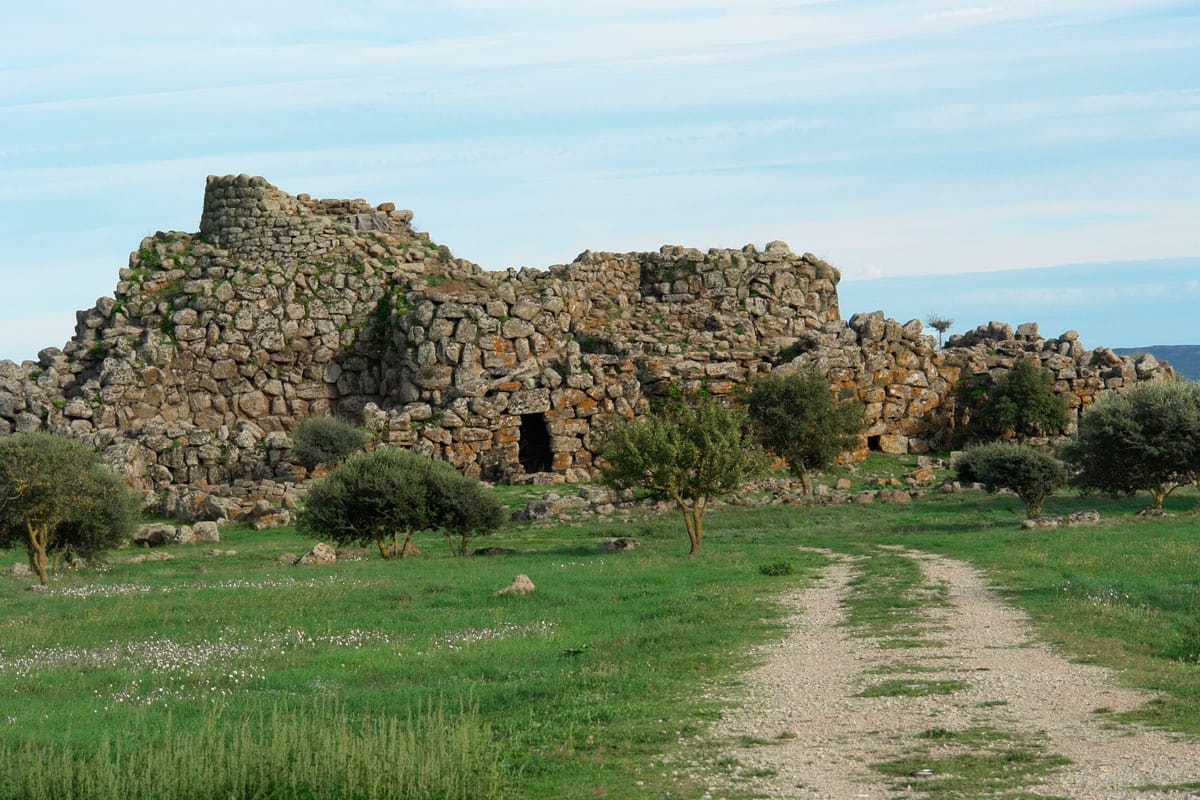
Nuraghe Arrubiu is the largest and most structurally complex nuragic monument on the island of Sardinia. Built around the 15th century BC during the Bronze Age, this fortress-sanctuary covers roughly 3,000 square metres and incorporates 21 towers connected by thick curtain walls. The central tower, still standing at approximately 15 metres today, originally rose to an estimated 25–30 metres: a height that would have made it one of the tallest man-made structures in Bronze Age Europe.
The name comes straight from the Sardinian language: "arrubiu" means red, a reference to the vivid orange-red lichens that colonise the grey basalt blocks and give the walls their distinctive, almost rust-coloured hue. On overcast days or in the slanted light of late afternoon, that colour deepens to something close to terracotta, and the contrast against the pale plateau grass around it is striking.
Nuraghe Arrubiu sits in the territory of Orroli, in the inland province of South Sardinia, a part of the island that most beach-focused itineraries skip entirely. That makes it an ideal addition to any exploration of the Barbagia and Nuoro highlands — a landscape defined by basalt plateaux, cork oak forests, and a density of prehistoric sites found almost nowhere else in the Mediterranean.
💡 Local tip
Opening hours are reported as approximately 09:30–18:30 daily, but closing time may shift to dusk in summer. Call ahead or check the Sardegna Turismo portal before driving out, since the site is remote and there are no alternatives nearby if you find it closed.
The Architecture: What You Are Actually Looking At
Most visitors arrive expecting a single stone tower on a hill. Nuraghe Arrubiu is something considerably more ambitious. The complex follows a "pentalobed" plan: a central keep surrounded by five secondary towers, all linked by walls to form a fortified courtyard. Beyond that inner ring, a second outer enclosure adds further towers, creating a layered defensive system that archaeologists believe served both military and ceremonial purposes.
The basalt blocks used in construction were quarried from the same plateau the nuraghe stands on. They were shaped and stacked without mortar using a corbelling technique that distributes weight inward, allowing the builders to construct corbelled vaulted chambers inside the towers. Walking into one of these chambers for the first time, with the walls narrowing overhead in concentric rings of stone and the only light filtering from the entrance passage, produces a particular kind of quiet that is hard to explain.
The main tower contains multiple floors connected by internal staircases carved into the wall thickness. The tread on those stairs is worn smooth from foot traffic spanning millennia, and the stone walls are cool to the touch even in midsummer. Some sections of the outer enclosure have collapsed, but enough survives to give a clear sense of the original footprint. Signage at the site explains the phasing of construction, which took place over several centuries rather than all at once.
For broader context on the Nuragic civilisation that produced this monument, the guide to Sardinia's nuragic sites covers the major complexes across the island and how they compare to one another.
Tickets & tours
Hand-picked options from our booking partner. Prices are indicative; availability and final rates are confirmed when you complete your booking.
Tour of the Nuraghe of Barumini and Casa Zapata from Cagliari
From 101 €Instant confirmationFree cancellationVineyard Guided Tour and 7 Wine Tasting in Palau
From 84 €Instant confirmationFree cancellationFull-Day Sailboat Tour in La Maddalena Archipelago from Cannigione
From 112 €Instant confirmationFree cancellationHiking excursion to the Devil's Saddle
From 35 €Instant confirmationFree cancellation
The Visit: How It Unfolds in Practice
After parking at the visitor centre, a flat 300-metre path leads through low scrubland to the monument. The path is straightforward for most visitors but unpaved and uneven in places, so closed-toe shoes with grip are a practical requirement rather than a suggestion. The nuraghe itself appears gradually as you approach, the reddish towers rising above the scrub before you round the last bend.
Guided tours are available from the visitor centre and are worth considering. The on-site guides tend to know which chambers can still be entered safely, where to look for ancient grindstones or pottery fragments in situ, and how the spatial logic of the complex relates to the landscape around it. Without a guide, some of the interior sections can be confusing to interpret, especially the outer enclosure where several towers are in varying states of preservation.
The interior passages are narrow in places and require ducking through low lintels. If you have moderate concerns about confined spaces, it is worth knowing this before committing to the full interior tour. None of the spaces are fully enclosed — there are always openings to outside — but the lower chambers do feel enclosed. Children over roughly 7 or 8 tend to find this exciting rather than uncomfortable; younger children and those with claustrophobia should factor it in.
⚠️ What to skip
The stone steps inside the towers are slippery when wet. Even in summer, morning moisture or recent rain leaves the interior surfaces hazardous. Avoid sandals or smooth-soled footwear.
Time of Day and Seasonal Considerations
The site faces mostly open sky with limited shade outside the tower interiors. In July and August, midday visits between roughly 11:00 and 15:00 are uncomfortable, with temperatures on the exposed basalt plateau regularly exceeding 35°C. Morning visits, ideally arriving at or shortly after 09:30, offer the best combination of soft light, cooler temperatures, and smaller crowds.
Late afternoon, especially in September and October, produces the most photogenic conditions. The low sun hits the lichened basalt at a raking angle that intensifies the orange-red colouring and throws the corbelled stonework into sharp relief. At that time of year the crowds have thinned from summer peaks, and the surrounding plateau takes on a dry golden colour that makes the whole landscape feel older somehow.
Spring visits, particularly in May, offer wildflowers across the plateau and cooler walking conditions. The site is not heavily visited outside the July–August peak, so shoulder-season visitors often have long stretches of the complex essentially to themselves. For a broader look at what Sardinia offers in spring, the Sardinia in May guide gives useful context on conditions across the island at that time.
ℹ️ Good to know
Nuraghe Arrubiu is an inland site at moderate elevation. Summer thunderstorms can roll in quickly over the Sarcidano plateau. If clouds build in the afternoon, note that the stone surfaces become very slippery. Keep an eye on the weather.
Historical and Cultural Significance
The Nuragic civilisation that built Nuraghe Arrubiu flourished in Sardinia from roughly 1800 BC to around 500 BC, leaving behind more than 7,000 nuragic towers scattered across the island. No other place on earth has anything quite like them. The civilisation had no known written language, which means what we understand about how these structures were used comes almost entirely from archaeology: food preparation areas, storage, ritual deposits, and evidence of metalworking have all been identified at Nuraghe Arrubiu.
The scale of Arrubiu relative to other nuraghi is significant. While single-tower nuraghi are common across Sardinia, pentalobed complexes of this size are rare, and none matches Arrubiu in overall footprint. This suggests it served as a regional centre of some kind, whether political, religious, or economic, for the surrounding plateau communities. The site continued to be occupied or used into the Bronze Age Final and Iron Age periods, and evidence of later activity into Roman times has also been found.
Nuraghe Arrubiu is often discussed alongside Su Nuraxi di Barumini (the only Sardinian nuraghe on the UNESCO World Heritage List) and Nuraghe Santu Antine in the Sassari province. The three sites together give a sense of how nuragic architecture varied by region and period.
Getting There and Practical Logistics
Nuraghe Arrubiu is not accessible by public transport. A car is required, and this is non-negotiable. The site sits on the Sarcidano plateau southeast of the Lago del Flumendosa reservoir, about 70 kilometres north of Cagliari by road. The drive from Cagliari takes around 1 hour 15 minutes under normal conditions, following the SS554 and then SP10 through Escalaplano and Orroli. Signage on the SP10 directs you to the site and its parking area.
From Nuoro, the drive is roughly 90 kilometres southwest via the SS128, passing through Isili. The road quality on the final approach is adequate but narrow in places, and large motorhomes may find the last section awkward. There are no petrol stations immediately adjacent to the site, so fill the tank in Orroli or Escalaplano before heading out.
If you are planning a multi-site archaeology day from the south of the island, Nuraghe Arrubiu pairs logistically with the nearby sacred well of Santa Cristina to the west, or with the remarkable stone giants at Monte Prama as part of a longer circuit. See the day trips from Cagliari guide for route ideas.
There is no café or restaurant at the visitor centre itself. Bring water, especially in summer — the plateau is exposed and the walk back from the nuraghe in full sun is dehydrating. Orroli village, a few kilometres away, has small alimentari and bars where you can pick up supplies before the visit.
Photography at Nuraghe Arrubiu
The lichen colouring on the basalt is the main visual element that distinguishes Arrubiu from other nuraghi photographically. Overcast light brings out the orange tones most evenly, while direct midday sun bleaches the colour and creates harsh shadow patterns inside the towers. A polarising filter, if you shoot with a DSLR or mirrorless camera, cuts the occasional glare from the pale stone sections and deepens the sky against the tower profiles.
Interior shots require a wide-angle lens and patience with low light: there is no artificial lighting inside the chambers, and exposure times long enough to capture the corbelled ceiling detail usually mean using a tripod or bracing against the walls. The narrowness of some passages makes a tripod impractical in those spots; pushing ISO and using a fast prime lens is a more realistic approach. The contrast between the dim interior stone and the bright opening of the entrance passage is one of the more technically demanding shots to balance at the site.
Insider Tips
- Book a guided tour if available, even if you generally prefer to self-guide nuragic sites. The on-site guides at Arrubiu know which interior chambers are currently accessible and where the most legible archaeological features are — this information is not always on the signage.
- The basalt plateau surrounding the nuraghe is itself worth a slow walk before or after the main visit. The surface is dotted with smaller nuragic features, and the wide views across the Sarcidano uplands give a strong sense of why this location was chosen for such a large structure.
- Bring a small torch or phone light. Even on bright days, some of the lower interior passages are dark, and trying to navigate them without a light source means missing significant details in the stonework.
- Carry more water than you think you need. The path from the car park looks short on paper, but between the walk out, the time inside, and the walk back in summer heat, a 500 ml bottle is not enough for most adults.
- If you visit in autumn, check whether the site offers extended dusk hours. The late afternoon light in September and October transforms the lichen colouring in a way that midday visits simply cannot replicate.
Who Is Nuraghe Arrubiu For?
- Archaeology and ancient history travellers who want to go beyond the UNESCO-listed sites to something less crowded and equally impressive
- Photographers seeking dramatic texture and colour in a prehistoric setting, particularly in the softer light of shoulder-season mornings or late afternoons
- Families with children aged 8 and above who are comfortable with uneven stone surfaces and low interior passages
- Road trippers crossing the Sarcidano plateau as part of a broader Sardinian inland itinerary
- Visitors with a serious interest in Bronze Age Europe looking for a monument that matches Su Nuraxi di Barumini in scale but draws far fewer visitors
Nearby Attractions
Other things to see while in Barbagia & Nuoro:
- Giara di Gesturi
Rising to around 550 metres above central Sardinia, the Giara di Gesturi is a 45-square-kilometre basalt plateau formed by Oligocene volcanic activity. Cork oak forests, seasonal wetlands, and an extraordinary population of small wild horses make it one of the most ecologically singular landscapes on the island.
- Gola di Su Gorropu
Gola di Su Gorropu is a karst canyon in Sardinia's Supramonte massif with walls rising over 500 metres and passages as narrow as 4 metres across. It's a serious hiking destination that rewards physical effort with one of the most dramatic landscapes in the Mediterranean.
- Monte Ortobene
Reaching a maximum elevation of 955 metres above sea level near the inland city of Nuoro, Monte Ortobene is a forested mountain with panoramic views across central Sardinia, a landmark bronze statue of Cristo Redentore, and walking paths through fragrant Mediterranean scrubland. Access is free, the road reaches the summit, and the atmosphere is unlike anything on the coast.
- Murales di Orgosolo
Orgosolo, a small hill town in the Barbagia region of central Sardinia, has covered its streets in around 150 murals since the late 1960s. Free to visit at any hour, the Murales di Orgosolo form one of the most politically charged and visually striking open-air art experiences in Italy.