North Gate (Beimen): Taipei's Last Intact Qing-Dynasty Gate
Standing at a major crossroads in central Taipei, the North Gate (Beimen) is the only surviving city gate preserved in its original Qing-dynasty form. Free to visit at any hour for exterior viewing, it rewards travelers who look past the traffic to appreciate 140 years of history embedded in stone and fired brick.
Quick Facts
- Location
- Sec. 1, Zhongxiao West Road, Zhongzheng District, Taipei
- Getting There
- Beimen Station (Green Line) or Taipei Main Station (5-min walk)
- Time Needed
- 20–40 minutes
- Cost
- Free
- Best for
- History lovers, architecture fans, photographers
- Official website
- english.culture.gov.taipei/cp.aspx?n=03B1EE29FEAE245E
What Is the North Gate?
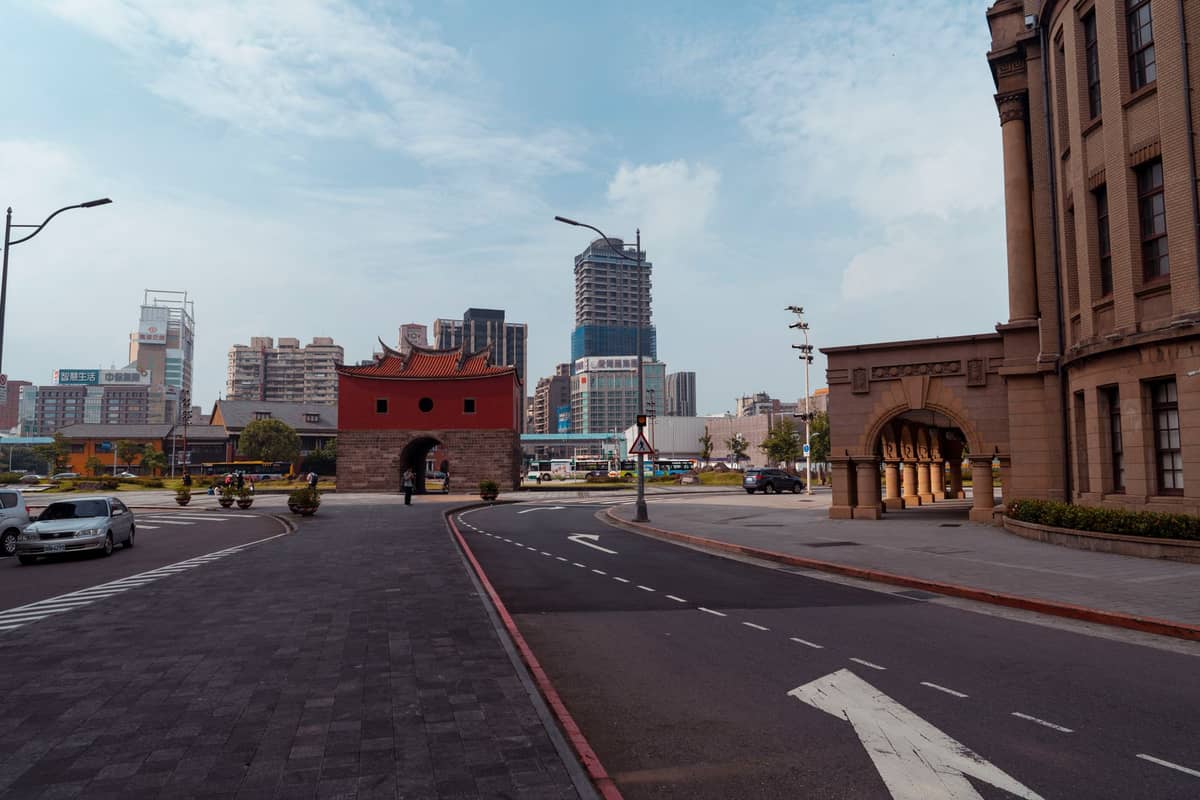
The North Gate, formally known in Chinese as 承恩門 (Cheng'en Gate), is a Class 1 historical monument and one of five historical city gates from Taipei's original Qing-dynasty city wall, of which four still stand today. Completed in 1884 under the supervision of Liu Mingchuan, Taiwan's first provincial governor, it sits at the intersection of Zhongxiao West Road, Bo'ai Road, Yanping North Road, and Zhonghua Road in Zhongzheng District. Among the remaining gates, it holds a distinction that makes it genuinely irreplaceable: it is the only one that still preserves its original Qing-dynasty architectural appearance. What you see is exactly what was built nearly 140 years ago.
The other surviving gates — East Gate, South Gate, and Little South Gate — were all renovated during the 1960s and given rooflines in a northern Chinese palace style that was never part of their original design. The North Gate escaped that fate, partly through neglect and partly through advocacy, retaining its original southern Fujian architectural character: a barrel-vaulted stone passage, thick rammed-earth and brick walls, and a squat, functional roofline that speaks to practical defense rather than ceremonial grandeur.
ℹ️ Good to know
The gate's interior is not open to visitors. The experience is entirely exterior: walking around the base, reading the interpretive panels, and studying the structure from different angles.
The Architecture Up Close
Approach the gate on foot and the first thing you notice is the material contrast. The lower walls are constructed from gray granite blocks quarried locally, while the upper sections use a darker, iron-rich fired brick. The arch of the gate passage is wide enough to have accommodated ox carts, and the stonework around it is finished with a precision that reflects Qing-era craftsmanship rather than the rougher work typical of frontier construction. Look for the deliberate gaps in the parapet at the top: these are crenellations, designed for defensive firing positions.
The roof sits lower than it appears in most photographs. It follows a traditional Minnan (southern Fujian) style, with upturned eaves and decorative ridge tiles, but it is comparatively modest in scale. This is a working military gate, not a ceremonial one, and the architecture communicates that clearly. The green-glazed tiles on the roof have aged to a muted, mossy tone that reads differently depending on the light.
Interpretive signage in English and Chinese is installed around the plaza, explaining the gate's construction history and its near-demolition in the 1960s when the elevated Zhonghua Road expressway was built directly overhead. That expressway was eventually demolished in 2016, and the surrounding public space was redesigned to give the gate the open sightlines it has today. The difference in photographs taken before and after 2016 is striking: what was once a monument half-hidden beneath concrete overpass columns is now the visual anchor of a pedestrian-friendly plaza.
How the Visit Changes by Time of Day
Early morning, roughly between 7 and 9 AM, is the most photogenic window. The low-angle eastern light catches the texture of the granite and brick, and the surrounding streets are quiet enough that you can compose a shot without construction vehicles or double-decker tour buses entering the frame. A small number of commuters pass through the adjacent pedestrian zone on their way to Taipei Main Station, but the gate plaza itself is rarely crowded at this hour.
Midday brings more foot traffic and harsher overhead light that flattens the stonework detail. The surrounding intersection is one of the busier road junctions in central Taipei, and the ambient noise of traffic is a constant presence regardless of hour. If you are sensitive to street noise, this matters: the gate is not a quiet contemplative space in the way that a garden or temple courtyard might be. It is a monument in the middle of a city, and the city asserts itself.
After dark, the gate is illuminated by ground-level floodlighting that emphasizes the arch and the textured wall surfaces in a way daylight does not. The surrounding area sees foot traffic from people heading to and from Taipei Main Station, and the lit gate against a dark sky makes for a dramatically different set of photographs than daytime shots. Night visits are entirely reasonable given that the plaza is open and well-lit.
💡 Local tip
For photography: arrive within the first hour after sunrise or in the 30 minutes before and after sunset. These windows offer directional light that reveals the stonework's texture. A polarizing filter helps reduce glare from the granite on bright days.
Historical Context: The Wall That Almost Vanished
When Liu Mingchuan oversaw the construction of Taipei's city wall in the 1880s, the plan included five gates: East Gate, West Gate, South Gate, Little South Gate, and North Gate. The wall itself was built from local stone and brick, enclosing what was then a rapidly developing administrative center. Construction finished in 1884, making Taipei's fortified city one of the later examples of traditional Chinese walled-city planning in Taiwan.
Under Japanese colonial rule from 1895, the walls were systematically demolished to accommodate modern urban planning. Most of the perimeter walls were torn down in the early twentieth century to make way for roads and new construction. The gates themselves survived longer, but their fate became uncertain as Taipei expanded after 1945. The renovation decisions of the 1960s, which altered the other three gates, were part of a broader political effort by the Republic of China government to visually emphasize mainland Chinese cultural heritage. The North Gate, then less prominent and partially obscured by the soon-to-be-built expressway, was left alone — and that neglect turned out to be its preservation.
The 2016 demolition of the Zhonghua Road elevated expressway was a turning point not just for the gate but for how Taipei thought about its urban heritage. The project revealed and restored the gate's original spatial relationship to the surrounding streets, and the redesign of the plaza drew on archival research to create a historically grounded public space. Today the North Gate is one of the most legible examples of Taipei's Qing-era past.
For broader context on Taipei's historic architecture and cultural sites, the Taipei temples guide covers the religious buildings that share the same historical period as the wall's construction.
Getting There and Navigating the Area
The most direct MRT option is Beimen Station on the Songshan-Xindian (Green) Line. From Exit 1 or Exit 3, the gate is visible within about two minutes of walking. If you are arriving from Taipei Main Station, use the southern exits and walk west along Zhongxiao West Road for approximately five minutes. The gate appears on the left side of the road, identifiable from a distance by its roofline and the open plaza around it.
The immediate area around the gate connects naturally with several other sites worth combining into a half-day itinerary. Dadaocheng, Taipei's best-preserved Qing-era commercial district, is a 15-minute walk north along Yanping North Road. The Presidential Office Building and its surrounding colonial-era civic architecture are roughly 10 minutes on foot to the south.
The neighborhood around the gate is part of a broader cluster of historical attractions in Zhongzheng and the adjacent Wanhua area. Longshan Temple in Wanhua, about 20 minutes away by MRT, represents another major layer of Taipei's pre-colonial and colonial history and pairs well with a visit to Beimen.
If you are building a full day around Taipei's historical core, the Taipei walking tours guide includes itineraries that incorporate Beimen alongside nearby heritage sites.
Who This Attraction Suits — and Who Might Skip It
Travelers with a genuine interest in pre-20th-century Taiwanese history, Qing-dynasty architecture, or urban heritage will find the North Gate rewarding. The interpretive panels are informative, the structure is genuinely significant, and understanding what it represents within Taipei's larger historical narrative adds meaningful depth to any visit to the city.
The gate is also a practical photography subject. It photographs well under multiple lighting conditions, is surrounded by enough open space to allow decent compositions, and is free and quick enough to justify a short detour.
On the other hand, travelers expecting an immersive or atmospheric heritage experience may find the location underwhelming. The gate sits at a busy urban intersection surrounded by roads, commercial buildings, and the infrastructure of a major transit hub. There is no garden, no surrounding wall section to walk along, no interior to enter. The experience is essentially: arrive, observe, read the panels, photograph, and move on. For travelers who need a place to feel engaging or scenic on its own terms, the gate will likely disappoint unless it is combined with other nearby destinations.
For a fuller picture of Taipei's historical layers, consider pairing the North Gate visit with the National Taiwan Museum in the same district, which holds archaeological and cultural artifacts that give context to the Qing-era city the gate once protected.
⚠️ What to skip
The gate sits on a busy multi-lane intersection. Be attentive when crossing streets to reach the plaza, and check pedestrian crossing signals carefully. The surrounding traffic pattern can be disorienting for first-time visitors.
Insider Tips
- Stand at the northeast corner of the plaza to see the gate framed against the Taipei Main Station building in the background — this juxtaposition of Qing-era stone and contemporary architecture in a single frame is one of the more striking compositions available.
- The interpretive panels installed around the plaza include archival photographs showing the gate partially buried under the elevated expressway. Comparing those images to what you see in front of you is one of the more visceral ways to understand the 2016 restoration project.
- If you visit in the late afternoon in autumn or winter, the sun drops toward the west and illuminates the gate's front face directly. October through February offers the best directional light for this angle.
- Combine the visit with a short walk north to Dihua Street in Dadaocheng — roughly 15 minutes on foot — to see Qing-era commercial architecture still in active use, which adds a lived-in dimension to what the North Gate represents in isolation.
- The gate is a practical orientation landmark. Because it sits at a major transit junction between Taipei Main Station, Beimen MRT, and several bus routes, returning here after exploring the surrounding area is straightforward without needing to consult a map.
Who Is North Gate (Beimen) For?
- History and heritage travelers building an itinerary around Taipei's pre-colonial and colonial past
- Photographers looking for a structurally distinctive subject that works in both daylight and night lighting
- Architecture enthusiasts interested in traditional southern Fujian building techniques and their contrast with later Chinese palace-style renovations
- First-time visitors to Taipei who want a quick but grounding historical reference point near Taipei Main Station
- Anyone combining a half-day walk through Zhongzheng and Dadaocheng who needs a logical starting or ending point
Nearby Attractions
Other things to see while in Zhongzheng District:
- 228 Peace Memorial Park
228 Peace Memorial Park is one of Taipei's oldest and most significant public spaces, blending formal gardens with a powerful memorial to Taiwan's defining political tragedy. Free to enter and open around the clock, it rewards visitors who come prepared to read the landscape carefully.
- Chiang Kai-shek Memorial Hall
Standing 70 metres tall at the heart of Zhongzheng District, the National Chiang Kai-shek Memorial Hall is one of Taipei's most recognizable structures. Free to enter and open daily from 9:00 AM to 6:00 PM (with the surrounding park open 5:00 AM–midnight), it draws history seekers, architecture admirers, and locals who use the surrounding park as their morning exercise ground.
- Huashan 1914 Creative Park
A former Japanese-era winery turned open-air cultural campus, Huashan 1914 Creative Park draws a steady stream of Taipei's artists, designers, film lovers, and weekend wanderers. Admission to the grounds is free, but the real pull is what fills the space: independent exhibitions, pop-up markets, live performances, and some of the most interesting cafes in central Taipei.
- Liberty Square
Liberty Square is one of the largest public plazas in Taiwan, anchoring the Chiang Kai-shek Memorial Hall complex in central Taipei. Free to enter at any hour, it draws joggers at dawn, school groups by mid-morning, and photographers chasing the golden-hour glow on its white marble archway by evening. This guide covers what to see, when to go, and what most visitors overlook.