National Taiwan Museum: A Century of Natural History in Taipei's Most Beautiful Building
The National Taiwan Museum is Taiwan's oldest public museum, housed in a striking Baroque-style stone building completed in 1915 during the Japanese colonial period. Located in Zhongzheng District steps from Taipei Main Station, it covers Taiwan's natural history, geology, indigenous cultures, and ecology — all for NT$30 entry. A single ticket also covers the Land Bank Exhibition Hall across the street, where a full dinosaur skeleton greets visitors at the door.
Quick Facts
- Location
- No. 2, Xiangyang Rd., Zhongzheng District, Taipei
- Getting There
- NTU Hospital Station (Red Line, Exit 4) or Taipei Main Station (8–10-min walk)
- Time Needed
- 1.5 to 2.5 hours (both venues)
- Cost
- NT$30 full price; NT$15 concessions; free under 6 and seniors 65+ on weekdays (with valid ID)
- Best for
- History enthusiasts, families with children, architecture lovers, budget travelers
- Official website
- www.ntm.gov.tw/en
What the National Taiwan Museum Actually Is
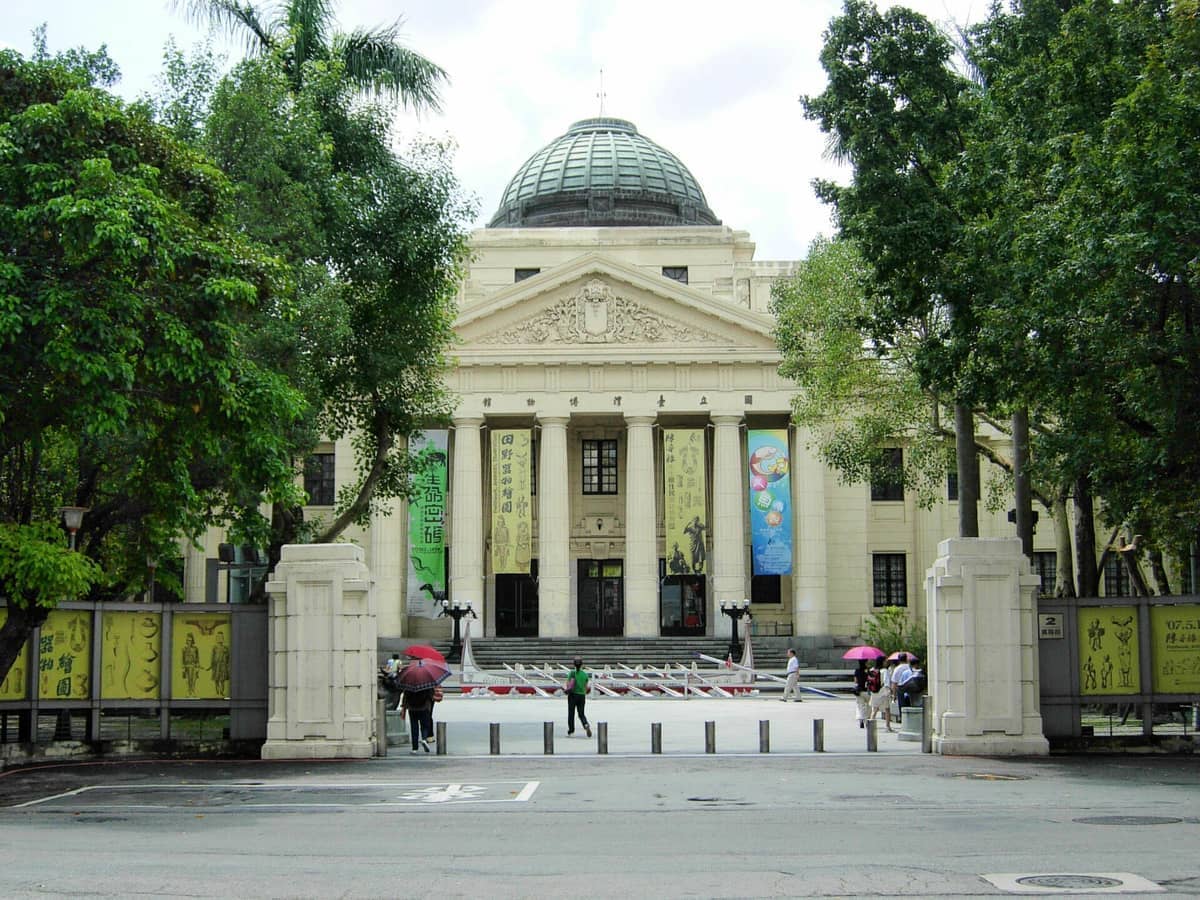
The National Taiwan Museum (國立臺灣博物館) holds a specific distinction that no other institution in Taiwan can claim: it is the oldest museum on the island. The building you see today, a Neoclassical stone structure with a colonnaded facade and a green dome, was completed in 1915 under the Japanese colonial government. Its predecessor, the Taiwan Governor-General's Museum, opened in 1908, which means the institution itself has been collecting and displaying for well over a century.
The museum's focus is natural history, ecology, geology, and the indigenous peoples of Taiwan. This is not a fine art museum and not a history museum in the conventional sense. The collections lean scientific: mineral specimens, preserved fauna, geological maps, ethnographic objects from Taiwan's 16 officially recognized indigenous groups, and rotating special exhibitions that often tie Taiwan's biodiversity to broader regional themes. If you come expecting paintings or historical artifacts from Chinese dynasties, you'll be in the wrong place. If you come to understand the island itself — its mountains, its creatures, its pre-colonial peoples — this museum repays the visit.
ℹ️ Good to know
One ticket (NT$30 full price) covers both the Main Building and the Taiwan Land Bank Exhibition Hall, located directly across Xiangyang Road. Don't skip the Land Bank: it houses the dinosaur and whale skeleton exhibits in a converted Japanese-era bank building that is architecturally interesting in its own right.
The Building: Architecture That Earns Attention
The Main Building is a designated national historic site of Taiwan, and it looks the part. The exterior is faced in granite and reinforced concrete, with a Doric colonnade running across the front elevation and a central dome that rises above the entrance hall. The design reflects the colonial government's ambition to project permanence and institutional authority, borrowing from the European museum architecture of the period.
Inside, the entrance hall feels deliberately monumental. The dome overhead, the marble floors, and the wide interior staircase create a space that slows visitors down. The proportions are generous compared to most museums built in this era in Asia. Morning light enters from the upper windows around the dome and falls across the central hall in a way that shifts noticeably over the course of the day. Arriving around 9:30 when the museum opens at 09:30 means catching this light at its most direct, before tour groups and school classes begin filling the galleries.
The building's age shows in places — some display cases have the slightly dated look of mid-20th-century museum design — but this is part of the character rather than a flaw. The NTM has made deliberate choices to balance preservation of the historic fabric with modern exhibition standards, and the result is a space that feels genuinely old in a way that few institutions in Taipei can match.
The Collections: What You'll Actually See
The permanent galleries are organized across several floors. The natural history collection covers Taiwan's geology and mineral wealth with particular depth, reflecting the island's complex tectonic position at the junction of the Philippine Sea Plate and the Eurasian Plate. The specimens range from everyday quartz formations to rarer minerals extracted from Taiwan's mountain zones. The labels are in both Chinese and English, though some of the older display cases use English translations that are functional rather than polished.
The indigenous peoples galleries are arguably the most significant section of the permanent collection. Taiwan has multiple officially recognized indigenous groups, collectively referred to as Austronesian peoples, and the museum holds ethnographic objects including ceremonial textiles, tools, agricultural implements, and ornamentation from multiple groups. The presentation is respectful and informative, though visitors with deeper interest in this subject may want to complement the visit with research beyond what the display text covers.
Special exhibitions rotate throughout the year and tend to be well-curated compared to the modest entry price. The museum also manages the Nanmen Park Exhibition Hall nearby, which focuses on Taiwan's industrial and agricultural history during the Japanese period. For a fuller picture of Taipei's museum landscape, the Taipei museums guide covers how the NTM fits alongside institutions like the National Palace Museum and the Museum of Contemporary Art.
The Land Bank Exhibition Hall: Cross the Street
The Taiwan Land Bank Exhibition Hall sits directly across Xiangyang Road from the Main Building at No. 25, Xiangyang Rd. It was built in 1933 as a branch of the Nippon Kangyo Bank, another Japanese-era structure, and the conversion into a museum space has preserved the original banking hall layout. The ceilings are high, the columns thick, and the overall atmosphere is noticeably different from the main museum — more industrial, less formal.
The Land Bank is where the dinosaur skeletons are displayed, and for families with children, this is often the highlight of the combined visit. A mounted sauropod skeleton dominates the central hall. There are also whale specimens, prehistoric fauna, and geological timeline displays. The space feels more energetic than the Main Building, partly because the exhibits are more visually dramatic and partly because children respond loudly to life-size prehistoric animals. If you're visiting with young kids, start here and let them burn through their excitement before moving to the more detailed exhibitions across the road.
Planning Your Visit: Timing, Access, and Logistics
The museum is open Tuesday through Sunday, 09:30 to 17:00, with the ticket booth closing at 16:30. It is closed on Mondays, Chinese New Year's Eve, and Chinese New Year's Day. Arriving at opening time on a weekday gives you the best chance of having the entrance hall and the early galleries to yourself. Weekend mornings see a consistent stream of families and school groups, and by 11:00 the main halls can feel crowded enough to affect the experience of the architectural spaces.
Getting here is straightforward. NTU Hospital Station on the MRT Red Line (Exit 4) puts you within about a four-minute walk of the front entrance along Xiangyang Road. Taipei Main Station is also walkable, roughly 8–10 minutes on foot. The museum sits on the western edge of 228 Peace Memorial Park, so combining both in a single visit is a natural choice.
The surrounding area in Zhongzheng District is dense with cultural institutions. The 228 Peace Memorial Park borders the museum grounds, and the Chiang Kai-shek Memorial Hall is within reasonable walking distance to the south. A half-day itinerary covering all three is entirely feasible.
💡 Local tip
The NTM grounds themselves are worth a few minutes before you enter. The forecourt is framed by mature trees, and the scale of the building reads differently from street level than from inside. Photographers get cleaner shots of the facade in the morning before the light swings behind the dome.
Accessibility: the museum offers free admission for visitors with disabilities and one accompanying person, with valid ID. Modern ramp and elevator access has been added to the historic building, though some areas may present constraints due to the preserved heritage structure. The Main Building entrance involves steps; check with staff at arrival for the most accessible route through the building.
Is It Worth Your Time? An Honest Assessment
At NT$30, the price makes the decision simple — the cost is so low that the calculus shifts entirely to whether the content interests you. For travelers curious about Taiwan's natural environment, its geological complexity, or its indigenous peoples, the museum offers a focused introduction that is hard to replicate elsewhere at this quality level. For those primarily interested in art, imperial Chinese history, or contemporary culture, the NTM is a lower priority compared to other Taipei institutions.
The museum does not try to be everything. It is not spectacular in the way that newer, larger institutions are spectacular. The displays in some sections feel dated. But the building itself has a gravitas that few structures in Taipei possess, and the combination of architecture, natural history, and indigenous cultures gives the visit a coherence that more scattered collections lack.
Travelers on tight schedules who are already planning to visit the area for the Taipei Botanical Garden or the Liberty Square complex should factor in 90 minutes for the NTM. It holds up well as part of a larger Zhongzheng half-day without dominating the itinerary.
⚠️ What to skip
Who should skip: Travelers with very limited time in Taipei who have not yet seen the major sites may find better return on their hours elsewhere. The NTM rewards curiosity about Taiwan's natural and indigenous heritage specifically — it is not a general-purpose introduction to Taiwanese history or culture.
Insider Tips
- A single NT$30 ticket (NT$15 concessions) covers both the Main Building and the Land Bank Exhibition Hall across the road. Collect your sticker or stamp at whichever venue you enter first and present it at the second.
- The forecourt of the Main Building is publicly accessible even on Mondays when the museum is closed. The exterior architecture, the steps, and the surrounding parkland can still be experienced on closure days.
- Weekday mornings between 09:30 and 11:00 are consistently the quietest window. School groups tend to arrive mid-morning and fill the dinosaur hall at the Land Bank particularly quickly.
- The museum shop near the Main Building entrance stocks Taiwan-specific natural history publications and illustrated books on indigenous cultures — considerably more specific and harder to find than typical tourist gift items.
- Combine the visit with a walk through the adjacent 228 Peace Memorial Park, which is directly east of the museum. The park's mature trees, ponds, and quiet paths make for a natural decompression after museum time, and the entry is free.
Who Is National Taiwan Museum For?
- Travelers curious about Taiwan's geology, biodiversity, and indigenous cultures
- Families with children who want the dinosaur skeletons at the Land Bank Exhibition Hall
- Architecture enthusiasts drawn to Japanese colonial Baroque buildings
- Budget travelers: NT$30 for two linked venues is among the best value in Taipei
- Anyone combining a half-day Zhongzheng itinerary with 228 Park or the Botanical Garden
Nearby Attractions
Other things to see while in Zhongzheng District:
- 228 Peace Memorial Park
228 Peace Memorial Park is one of Taipei's oldest and most significant public spaces, blending formal gardens with a powerful memorial to Taiwan's defining political tragedy. Free to enter and open around the clock, it rewards visitors who come prepared to read the landscape carefully.
- Chiang Kai-shek Memorial Hall
Standing 70 metres tall at the heart of Zhongzheng District, the National Chiang Kai-shek Memorial Hall is one of Taipei's most recognizable structures. Free to enter and open daily from 9:00 AM to 6:00 PM (with the surrounding park open 5:00 AM–midnight), it draws history seekers, architecture admirers, and locals who use the surrounding park as their morning exercise ground.
- Huashan 1914 Creative Park
A former Japanese-era winery turned open-air cultural campus, Huashan 1914 Creative Park draws a steady stream of Taipei's artists, designers, film lovers, and weekend wanderers. Admission to the grounds is free, but the real pull is what fills the space: independent exhibitions, pop-up markets, live performances, and some of the most interesting cafes in central Taipei.
- Liberty Square
Liberty Square is one of the largest public plazas in Taiwan, anchoring the Chiang Kai-shek Memorial Hall complex in central Taipei. Free to enter at any hour, it draws joggers at dawn, school groups by mid-morning, and photographers chasing the golden-hour glow on its white marble archway by evening. This guide covers what to see, when to go, and what most visitors overlook.