Taipei Botanical Garden: A Living Museum of Plants in the Heart of the City
Taipei Botanical Garden is a free, 8.2-hectare green retreat in Zhongzheng District, Taipei Botanical Garden is a free, 8.2-hectare green retreat in Zhongzheng District, home to over 1,500 plant species and one of Taipei's most serene lotus ponds. Managed by the Taiwan Forestry Research Institute, it balances serious botanical research with genuine public accessibility — making it a rewarding stop for nature lovers, families, and anyone needing a break from the city's pace. and one of Taipei's most serene lotus ponds. Managed by the Taiwan Forestry Research Institute, it balances serious botanical research with genuine public accessibility — making it a rewarding stop for nature lovers, families, and anyone needing a break from the city's pace.
Quick Facts
- Location
- No. 53, Nanhai Road, Zhongzheng District, Taipei City
- Getting There
- Xiaonanmen Station (Green Line, G11), Exit 3 — about 5–10 min walk
- Time Needed
- 1–2 hours for the grounds; add 30–45 min for indoor exhibitions
- Cost
- Free admission to the garden grounds
- Best for
- Nature walks, lotus pond photography, families, morning routines
- Official website
- tpbg.tfri.gov.tw
What Taipei Botanical Garden Actually Is
Taipei Botanical Garden (臺北植物園) is a free public garden in Zhongzheng District spanning roughly 8.2 hectares, managed by the Taiwan Forestry Research Institute. It holds over 1,500 plant species organized into themed zones covering tropical trees, ferns, aquatic plants, palms, and economic crops. The garden is not a manicured showpiece in the European tradition. It is a working botanical research site that also happens to be one of the most pleasant places to walk in central Taipei.
The grounds are open daily from 06:00 to 20:00. The indoor cultural and exhibition facilities operate on shorter hours, typically Tuesday through Sunday from 09:00 to 16:30, and are closed on Mondays and during Chinese New Year. Confirm current indoor hours at the official site before visiting if that is your primary reason for coming.
💡 Local tip
Early mornings between 06:30 and 08:00 are worth the effort. The lotus pond catches low angled light, the paths are nearly empty, and you share the garden mainly with elderly locals doing tai chi and joggers. The atmosphere at this hour is completely different from midday.
The Lotus Pond: The Garden's Centerpiece
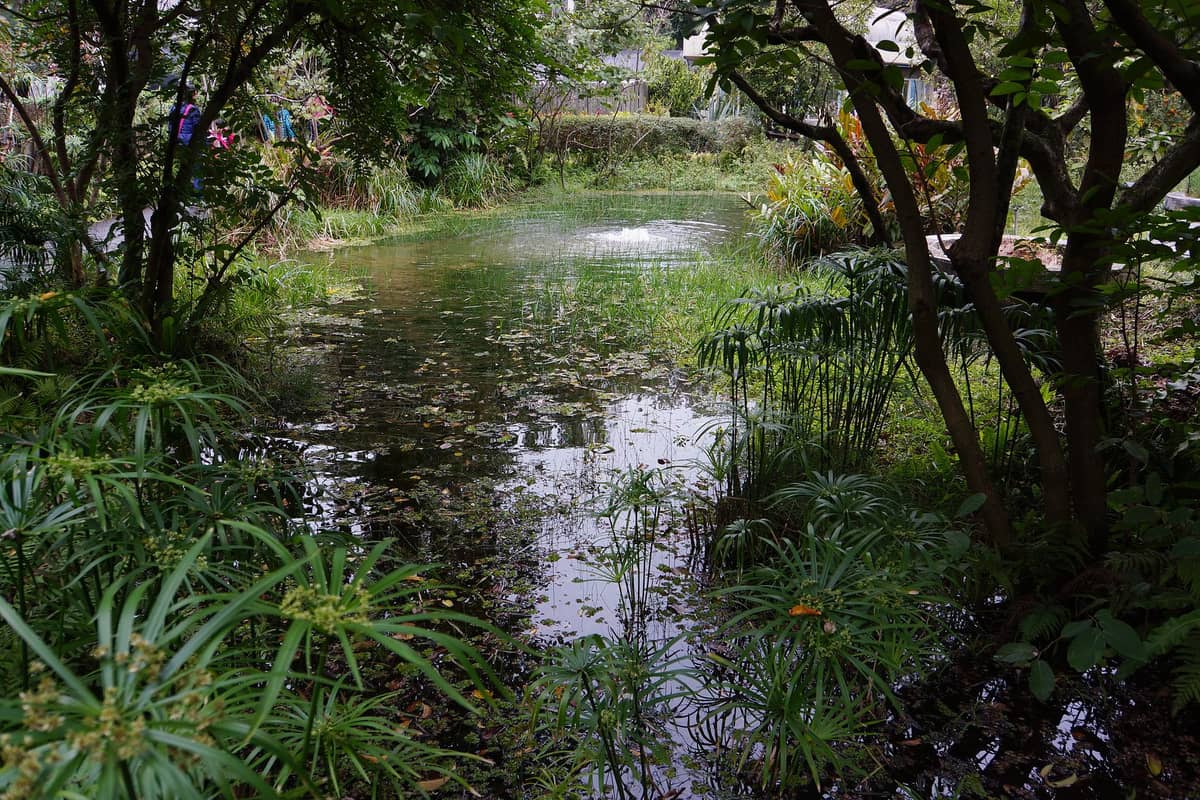
The lotus pond dominates the garden's emotional center. In summer, typically June through August, the surface becomes densely packed with large pink and white lotus flowers rising above broad green pads. The flowers open in the morning and begin closing by midday, which makes the first hour after the garden opens the best window for photography. By 10:00, many flowers have already started to close and the light becomes harsher.
Even outside the flowering season, the pond holds its own. The pads remain through much of the year, and the surrounding wooden walkways let you get close to the water without trampling the edge planting. Dragonflies are common from late spring onward. On cooler mornings in autumn and winter, a light mist sometimes sits on the water before burning off — the kind of scene that draws local watercolor painters on weekends.
The lotus spectacle is one of the more genuinely impressive things you can see in Taipei for free. That said, the peak period is limited. If you are visiting between October and April, the pond will be quieter and less photogenic. It is still a pleasant place to sit, just set your expectations accordingly.
Navigating the Garden Zones
The garden is organized into thematic sections that a first-time visitor will not immediately recognize as distinct — there are no dramatic gates or signboards separating them. What you notice first is the canopy. Many of the trees are large and old, and even in Taipei's humid summers they create a real microclimate. The air under the mature fig trees and rain trees drops noticeably in temperature compared to the streets outside. The ground is mostly paved or compacted gravel, and the flat terrain makes the whole garden easy to walk without effort.
The fern section is a quiet highlight that most visitors walk past without registering. It occupies a shaded corner where humidity stays high, and the variety of fern forms — tree ferns, climbing ferns, tiny ground-cover species — gives the area a prehistoric quality. The palm collection sits in a more open section near the southern edge, with species from Southeast Asia and the Pacific that do not appear elsewhere in the city.
The garden also sits near a cluster of museums on Nanhai Road, including the National History Museum and the National Taiwan Science Education Center. If you are building a half-day around this part of Zhongzheng, combining the garden with a visit to the National Taiwan Museum — a short walk away — makes for a coherent and unhurried morning.
Historical and Cultural Context
The Taipei Botanical Garden's origins trace back to the Japanese colonial period. It was established in the The Taipei Botanical Garden's origins trace back to the Japanese colonial period. It was established in 1921 as part of the colonial government's systematic effort to catalog and cultivate the plant diversity of Taiwan and its territories — a function that placed it alongside similar botanical gardens built across the Japanese Empire. The Taiwan Forestry Research Institute took over management after 1945 and has run the site ever since, maintaining its dual identity as a scientific research facility and a public green space. as part of the colonial government's systematic effort to catalog and cultivate the plant diversity of Taiwan and its territories — a function that placed it alongside similar botanical gardens built across the Japanese Empire. The Taiwan Forestry Research Institute took over management after 1945 and has run the site ever since, maintaining its dual identity as a scientific research facility and a public green space.
That history gives the garden a slightly different feel from municipal parks built purely for recreation. The plant labeling is systematic rather than decorative, and the layout reflects categorization logic rather than aesthetic landscape design. For visitors with any interest in tropical botany or Taiwan's ecological diversity, the depth of the collection rewards a slow walk with attention paid to the label stakes.
The surrounding Zhongzheng District is Taipei's administrative and cultural core. The garden sits a short walk from the Chiang Kai-shek Memorial Hall and its adjacent Liberty Square, which together form one of the city's most significant public spaces. Combining both areas into a single morning gives you a useful contrast: the grand civic formality of the square versus the quieter, slower scale of the garden.
Practical Walkthrough: Getting There and Getting Around
The most straightforward approach is via Xiaonanmen Station on the MRT Green Line (G11). Use Exit 3 and walk south for about five to ten minutes along Zhonghua Road or Yanping South Road before turning toward Nanhai Road. The route is flat and simple. Taipei's city bus network also serves the area from multiple directions if you are coming from a different neighborhood. along Zhonghua Road or Yanping South Road before turning toward Nanhai Road. The route is flat and simple. Taipei's city bus network also serves the area from multiple directions if you are coming from a different neighborhood.
The garden's main entrance is on Nanhai Road. There is no ticket booth, no turnstile, and no admission process. You walk in. The paths do not form a strict circuit, so it is easy to wander without a plan. A rough loop around the perimeter plus the lotus pond area takes about 45 minutes at a comfortable pace. Spending 90 minutes or more is easy if you stop often.
⚠️ What to skip
Taipei summers are hot and humid. The garden offers real shade, but the open sections around the lotus pond have little cover during midday. Bring water, wear light clothing, and consider visiting before 09:00 or after 17:00 from June through September.
The terrain is flat and the main paths are paved, making the garden generally accessible for those with mobility considerations. However, the garden's official sources do not detail wheelchair-accessible entrances, adapted restrooms, or audio guides — contact the garden directly if these specifics matter for your visit.
For photography, a small telephoto lens is useful for the lotus flowers without having to lean over the walkway railings. The indoor facilities, open Tuesday to Sunday, include historical botanical displays that are worth 20 to 30 minutes. For a broader look at Taipei's green spaces, the city's parks range considerably in character — from the intensely social Da'an Forest Park to more remote mountain walks covered in the Taipei hiking guide.
Who Should Recalibrate Their Expectations
The Taipei Botanical Garden rewards visitors who go slowly. If you are looking for dramatic scenery, a themed visitor experience, or a landmark photo for a single shot and then move on, this is not the best use of your time. The garden is not Kew Gardens. It does not have a greenhouse centrepiece or sweeping views. Its appeal is cumulative: the texture of old bark, the smell of damp earth after rain, the sound of tree frogs in the evening.
Travelers on very tight city itineraries might reasonably skip this in favor of higher-density attractions nearby. But if you have a full day in Zhongzheng District and want to understand the area at a slower pace, the garden earns its place. The 3-day Taipei itinerary places this garden well as a morning opener before moving to the surrounding museum cluster.
Insider Tips
- Visit the lotus pond between 06:30 and 08:30 during June, July, and August. The flowers are fully open, the light is soft, and foot traffic is minimal. By 09:30, tour groups begin arriving and the midday heat starts building.
- The fern section in the garden's shaded northeastern corner is almost always empty and provides a genuine temperature drop on hot days. Most visitors stick to the lotus pond area and leave without finding it.
- The indoor exhibition rooms are small but contain colonial-era botanical illustrations and pressed plant specimens that put the living collection in historical context. They are worth 20 minutes if they are open during your visit.
- Evening visits between 18:00 and 20:00 in summer are underrated. The light goes golden, the temperature drops several degrees, and the garden takes on a different quality. Local families with children are common at this hour.
- Bring insect repellent if you are sensitive to mosquitoes. The shaded, humid sections of the garden can have active mosquitoes, particularly after rain or in the early morning.
Who Is Taipei Botanical Garden For?
- Nature lovers and photographers, especially during the June to August lotus flowering season
- Families with children looking for a free, low-stress outdoor activity in central Taipei
- Travelers building a half-day around the Zhongzheng museum cluster on Nanhai Road
- Slow-travel visitors who want a genuine break from urban density without leaving the city center
- Early risers wanting a quiet morning walk before most of Taipei wakes up
Nearby Attractions
Other things to see while in Zhongzheng District:
- 228 Peace Memorial Park
228 Peace Memorial Park is one of Taipei's oldest and most significant public spaces, blending formal gardens with a powerful memorial to Taiwan's defining political tragedy. Free to enter and open around the clock, it rewards visitors who come prepared to read the landscape carefully.
- Chiang Kai-shek Memorial Hall
Standing 70 metres tall at the heart of Zhongzheng District, the National Chiang Kai-shek Memorial Hall is one of Taipei's most recognizable structures. Free to enter and open daily from 9:00 AM to 6:00 PM (with the surrounding park open 5:00 AM–midnight), it draws history seekers, architecture admirers, and locals who use the surrounding park as their morning exercise ground.
- Huashan 1914 Creative Park
A former Japanese-era winery turned open-air cultural campus, Huashan 1914 Creative Park draws a steady stream of Taipei's artists, designers, film lovers, and weekend wanderers. Admission to the grounds is free, but the real pull is what fills the space: independent exhibitions, pop-up markets, live performances, and some of the most interesting cafes in central Taipei.
- Liberty Square
Liberty Square is one of the largest public plazas in Taiwan, anchoring the Chiang Kai-shek Memorial Hall complex in central Taipei. Free to enter at any hour, it draws joggers at dawn, school groups by mid-morning, and photographers chasing the golden-hour glow on its white marble archway by evening. This guide covers what to see, when to go, and what most visitors overlook.