Liberty Square, Taipei: The Complete Visitor Guide
Liberty Square is one of the largest public plazas in Taiwan, anchoring the Chiang Kai-shek Memorial Hall complex in central Taipei. Free to enter at any hour, it draws joggers at dawn, school groups by mid-morning, and photographers chasing the golden-hour glow on its white marble archway by evening. This guide covers what to see, when to go, and what most visitors overlook.
Quick Facts
- Location
- No. 21, Zhongshan South Road, Zhongzheng District, Taipei City 100, Taiwan
- Getting There
- Chiang Kai-shek Memorial Hall Station (Green/Red Line), Exit 5
- Time Needed
- 1–2 hours for the plaza; add 1 hour if visiting the memorial hall interior
- Cost
- Free (outdoor plaza and memorial hall admission). Ticketed events at National Theater and Concert Hall vary.
- Best for
- History, architecture, photography, open-air walks, the changing-of-the-guard ceremony
- Official website
- www.cksmh.gov.tw/en/cp.aspx?n=6329
What Liberty Square Actually Is
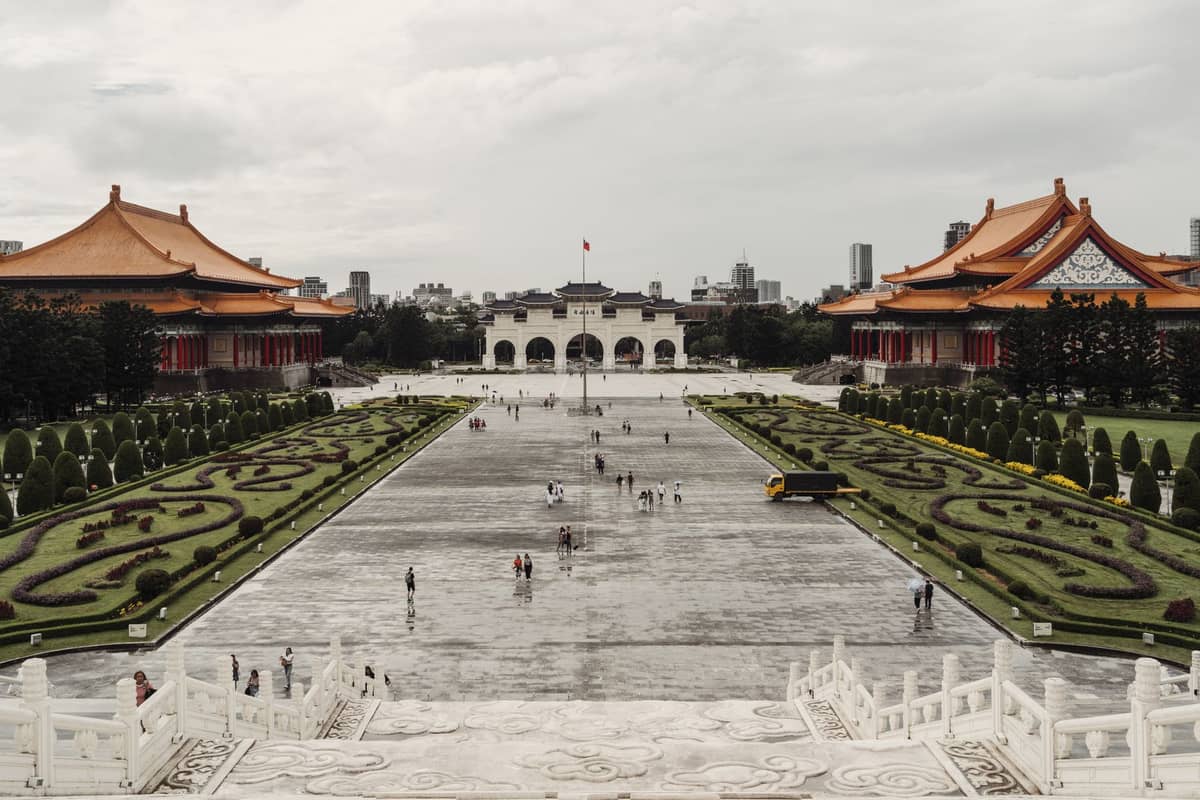
Liberty Square (自由廣場) is a public plaza of over 240,000 square meters in Taipei's Zhongzheng District, forming the ceremonial forecourt of the National Chiang Kai-shek Memorial Hall complex. That number is worth pausing on: over 240,000 square meters of open paved ground, flanked by two of Taiwan's most prestigious performing arts venues and bounded at the north end by a white marble memorial hall that rises 70 meters above the plaza floor.
The complex was built in the late 1970s following the death of Chiang Kai-shek and opened in 1980. For decades, the towering archway at the south entrance bore the inscription 'Dà Zhōng Zhì Zhèng' (大中至正), a Confucian phrase roughly meaning 'impartiality and righteousness.' In 2007, as part of a broader reorientation toward Taiwan's democratic identity, the inscription was changed to 'Liberty Square' (自由廣場). It remains one of the most visually striking and politically layered public spaces in the Chinese-speaking world.
ℹ️ Good to know
The outdoor plaza is open 24 hours, year-round, with no entry fee or turnstile. The Chiang Kai-shek Memorial Hall building (including the statue hall and museum exhibits) is generally open 09:00–18:00, also free of charge, but closes on certain public holidays and maintenance days.
Arriving and First Impressions
Most visitors arrive via Exit 5 of Chiang Kai-shek Memorial Hall MRT Station, which deposits you at the southwest corner of the square, directly in front of the National Theater. The first thing you notice is scale. The archway ahead, framing the memorial hall at the far end, is genuinely monumental, and the white-tiled plaza stretches wide enough that the hall looks almost modest from this vantage point. It takes a solid three to four minutes of walking to close the distance.
The twin buildings flanking the plaza, the National Concert Hall to the north and the National Theater to the south, are built in a palatial Chinese palace style with green-glazed tile roofs curving upward at the corners. Their ground-floor colonnades provide shade and the occasional arts-related exhibition free to the public. Both buildings seat over 1,500 people and host performances most evenings; checking what's on before your visit is worthwhile.
The surrounding Zhongzheng District is dense with government buildings, national museums, and transit links. For context on how the square fits into the wider neighbourhood, the Zhongzheng District guide covers adjacent sites including the Presidential Office Building and Taipei's main railway hub.
The Memorial Hall: Architecture, Interior, and the Changing of the Guard
The Chiang Kai-shek Memorial Hall sits on an octagonal platform reached by 89 steps, a number said to correspond to Chiang's age at death. The building's white exterior is deliberate: white marble against the blue-tile roof is an intentional inversion of the red and yellow palette of Beijing's Forbidden City, signalling a distinct identity. Up close, the scale becomes more apparent. Each of the four bronze doors weighs about 7.5 tonnes.
Inside the entrance hall, a 6.3-metre bronze statue of Chiang Kai-shek remains on display. The changing-of-the-guard ceremony now takes place outdoors on Democracy Boulevard, on the hour between 09:00 and 17:00, and takes around 15 minutes. It is cancelled in rain.
Below the main hall, two floors of free museum exhibits cover Chiang Kai-shek's life, the history of the Republic of China government, and rotating cultural exhibitions. The exhibits are bilingual in Chinese and English. Even visitors with limited interest in mid-20th century Chinese and Taiwanese history may find value in the archival photographs and historical artefacts on display.
💡 Local tip
For the changing of the guard, arrive at least five minutes before the hour and wait on Democracy Boulevard in front of the hall. The crowd assembles fast, and the ceremony is cancelled if it is raining.
How the Square Changes Through the Day
Early mornings, particularly before 08:00, are when Liberty Square reveals a different personality entirely. The stone cools overnight, and the air at this hour carries the faint green smell of the surrounding trees and nearby gardens. Retirees practice tai chi and fan dancing in clusters near the trees at the plaza's edges. Joggers complete circuits around the perimeter. The marble shines pale under the low eastern light, and the memorial hall is reflected in the dew on the tiles. If you want Liberty Square without the crowds, this is your window.
By mid-morning, tour groups begin arriving, often coordinating photo lines at the base of the hall steps. School trips from across Taiwan use the square for civics education and guided history walks. The plaza itself is exposed with minimal shade across the central stretch, so by 11:00 in summer the heat index on the open marble can be punishing. Taiwanese summers regularly push above 35°C with high humidity; carry water and consider a hat.
Late afternoon from around 16:00 to 18:00 is the most photogenic window. The sun angles from the west, lighting the memorial hall facade directly and casting long shadows across the plaza tiles. The warm tone against the white marble and blue roof makes this the reliable choice for architectural photography. After 17:00 the interior closes, but the outdoor plaza stays open and attendance typically thins, leaving the square quieter than any point since morning.
After dark, the memorial hall and archway are illuminated by floodlights. The effect is dramatic from a distance: the white structure glows cleanly against the night sky, framed by the archway. The plaza is used for evening events, outdoor concerts, and occasional public gatherings. It is safe and reasonably well-lit, though the central area grows quiet on ordinary weeknights.
⚠️ What to skip
Taipei summers (June to September) bring intense heat and afternoon thunderstorms. The central plaza has almost no shade. If you are visiting between June and September, plan to arrive before 09:00 or after 16:00 to avoid peak heat and sun exposure.
The Square's Political and Cultural Significance
Liberty Square occupies a particular position in Taiwanese public life that goes beyond tourism. The space has been the staging ground for major political events, student movements, and public demonstrations across the decades, most notably during the 1990 Wild Lily student movement that pushed for democratic reform. The 2007 renaming of the archway was itself contentious, opposed by some who saw it as a political act and supported by others as an acknowledgement of Taiwan's democratic transition. This layered history gives the space a weight that simple sightseeing doesn't fully capture. It helps to read even a brief account of modern Taiwanese history before visiting. The Chiang Kai-shek Memorial Hall article covers the historical context in more depth.
The broader Zhongzheng District places Liberty Square within walking distance of several other historically significant sites. The 228 Peace Memorial Park, which commemorates the 228 Incident of 1947 and its victims, is roughly a 15-minute walk to the northwest. The two sites together offer a more complete picture of modern Taiwanese history than either does alone.
Getting There and Getting Around
The most direct route is Taipei Metro to Chiang Kai-shek Memorial Hall Station (served by the Green Line and Red Line). Exit 5 places you at the southwest entrance near the National Theater. Exit 1 brings you to the southeast side. The walk from exit to the memorial hall entrance is approximately 400 metres across open plaza.
The square is close enough to several central Taipei landmarks to incorporate into a half-day walk. The North Gate (Beimen) is about 1.5 km north, and Longshan Temple in Wanhua is approximately 1.5 km to the southwest, walkable in about 20 minutes. For a structured half-day route through this part of the city, the Taipei walking tours guide maps out several options.
The plaza itself is fully accessible. Wide, level paved surfaces cover the entire public area. MRT exits include ramp access, and the memorial hall interior has elevators. There are no steps or barriers at the plaza level.
Photography at Liberty Square
The archway framing the memorial hall is the classic composition, most commonly shot from midway across the plaza with a wide-angle or standard lens. The symmetry is clean and the proportions work in both portrait and landscape orientation. For a cleaner shot without crowds in the foreground, early morning weekdays are the most reliable. On weekends, the foreground is almost always occupied.
The 89 steps leading up to the memorial hall entrance create a strong leading line when shot from below and to one side. The honour guards in their white dress uniforms photograph well against the dark bronze doors. A telephoto lens from the plaza floor captures the stillness and detail of the guard stance in a way a standard lens cannot from the same distance.
Drone operation over Liberty Square requires advance permission and is subject to Taiwan's Civil Aeronautics Administration regulations. Do not fly without prior authorisation; enforcement is active in central Taipei.
Who Might Not Find This Worthwhile
Visitors with no interest in political history, civic architecture, or ceremonial spaces may find Liberty Square less compelling than Taipei's more sensory attractions. It is not a market, a food destination, or a natural landscape. On a hot, hazy summer afternoon with tour groups massing at the steps, it can feel like an obligation rather than a pleasure. Travellers prioritising food, temples, or natural scenery should consider other itinerary anchors first and treat this as an addition rather than a centrepiece.
If you are drawn to Taipei's temple culture, Longshan Temple offers a more immersive and sensory experience. If you want open green space, Daan Forest Park is quieter and shadier. For broader context on Taipei's civic and cultural sites, the Taipei museums guide covers the full range of options in the city.
Insider Tips
- The changing-of-the-guard ceremony is held every hour on the hour from 09:00 to 17:00 outdoors on Democracy Boulevard in front of the memorial hall. It takes around 15 minutes and is cancelled in rain. The last ceremony of the day, at 17:00, is often the least crowded.
- The colonnaded walkways beneath the National Theater and National Concert Hall are almost always in shade and often host small free exhibitions. They are a useful retreat from midday heat and frequently overlooked by visitors focused on the memorial hall.
- Taipei's cherry blossom season (typically late February to mid-March) brings significant crowds to Liberty Square, as cherry trees on the grounds bloom during this period. The blossom is real, but so are the crowds. Weekday mornings during the peak week are the only reliable way to avoid them.
- The memorial hall museum basement contains detailed exhibits on the Republic of China's history, including material rarely covered in standard English-language travel coverage of Taipei. Allow at least 45 minutes if you plan to read the panels.
- Street food vendors and convenience stores are found near all MRT exits, but there are no food or drink vendors within the plaza itself. Bring water, particularly between May and October.
Who Is Liberty Square For?
- Travellers interested in modern Taiwanese and Chinese political history
- Architecture and symmetry photography, especially at golden hour
- Early-morning walkers and joggers looking for open, flat ground in central Taipei
- Visitors wanting a free, accessible half-day itinerary anchor in Zhongzheng District
- Anyone attending a performance at the National Theater or National Concert Hall
Nearby Attractions
Other things to see while in Zhongzheng District:
- 228 Peace Memorial Park
228 Peace Memorial Park is one of Taipei's oldest and most significant public spaces, blending formal gardens with a powerful memorial to Taiwan's defining political tragedy. Free to enter and open around the clock, it rewards visitors who come prepared to read the landscape carefully.
- Chiang Kai-shek Memorial Hall
Standing 70 metres tall at the heart of Zhongzheng District, the National Chiang Kai-shek Memorial Hall is one of Taipei's most recognizable structures. Free to enter and open daily from 9:00 AM to 6:00 PM (with the surrounding park open 5:00 AM–midnight), it draws history seekers, architecture admirers, and locals who use the surrounding park as their morning exercise ground.
- Huashan 1914 Creative Park
A former Japanese-era winery turned open-air cultural campus, Huashan 1914 Creative Park draws a steady stream of Taipei's artists, designers, film lovers, and weekend wanderers. Admission to the grounds is free, but the real pull is what fills the space: independent exhibitions, pop-up markets, live performances, and some of the most interesting cafes in central Taipei.
- National Taiwan Museum
The National Taiwan Museum is Taiwan's oldest public museum, housed in a striking Baroque-style stone building completed in 1915 during the Japanese colonial period. Located in Zhongzheng District steps from Taipei Main Station, it covers Taiwan's natural history, geology, indigenous cultures, and ecology — all for NT$30 entry. A single ticket also covers the Land Bank Exhibition Hall across the street, where a full dinosaur skeleton greets visitors at the door.