228 Peace Memorial Park: History, Green Space, and Memory in Central Taipei
228 Peace Memorial Park is one of Taipei's oldest and most significant public spaces, blending formal gardens with a powerful memorial to Taiwan's defining political tragedy. Free to enter and open around the clock, it rewards visitors who come prepared to read the landscape carefully.
Quick Facts
- Location
- No. 3, Ketagalan Boulevard, Zhongzheng District, Taipei
- Getting There
- NTU Hospital Station (Red Line, MRT) — 3-min walk; Taipei Main Station — about 10-min walk
- Time Needed
- 45 minutes to 2 hours depending on whether you enter the memorial museum
- Cost
- Free (park); separate fee may apply for the 228 Memorial Museum inside
- Best for
- History-focused travelers, quiet morning walks, Taiwanese cultural context
- Official website
- parks.gov.taipei/parks/en/en_parks.php?pmsid=374
What Is 228 Peace Memorial Park?
228 Peace Memorial Park sits at the heart of Zhongzheng District, directly across Ketagalan Boulevard from the Presidential Office Building. Covering 76,180 square meters, it is one of the oldest parks in Taiwan, originally laid out in 1908 during the Japanese colonial administration. For decades it was known simply as Taipei New Park. Its current name reflects a profound reckoning with history: the park was renamed in 1996 to commemorate the February 28 Incident of 1947, a government crackdown on civilian protesters that killed an estimated thousands of Taiwanese and marked the beginning of nearly four decades of martial law.
The name does real work. Arriving here without knowing the history means missing roughly half of what the park communicates. The central memorial monument, the quiet reflecting pool nearby, and the museum housed in a former Japanese-era broadcasting station are not decorative. They represent Taiwan's ongoing effort to acknowledge a trauma that was officially suppressed for most of the 20th century.
ℹ️ Good to know
The park is open 24 hours and free to enter. The 228 Memorial Museum inside is free to enter (as of 28 February 2025) and has its own opening hours — verify current details at the official site before visiting.
The Physical Space: What You Actually See
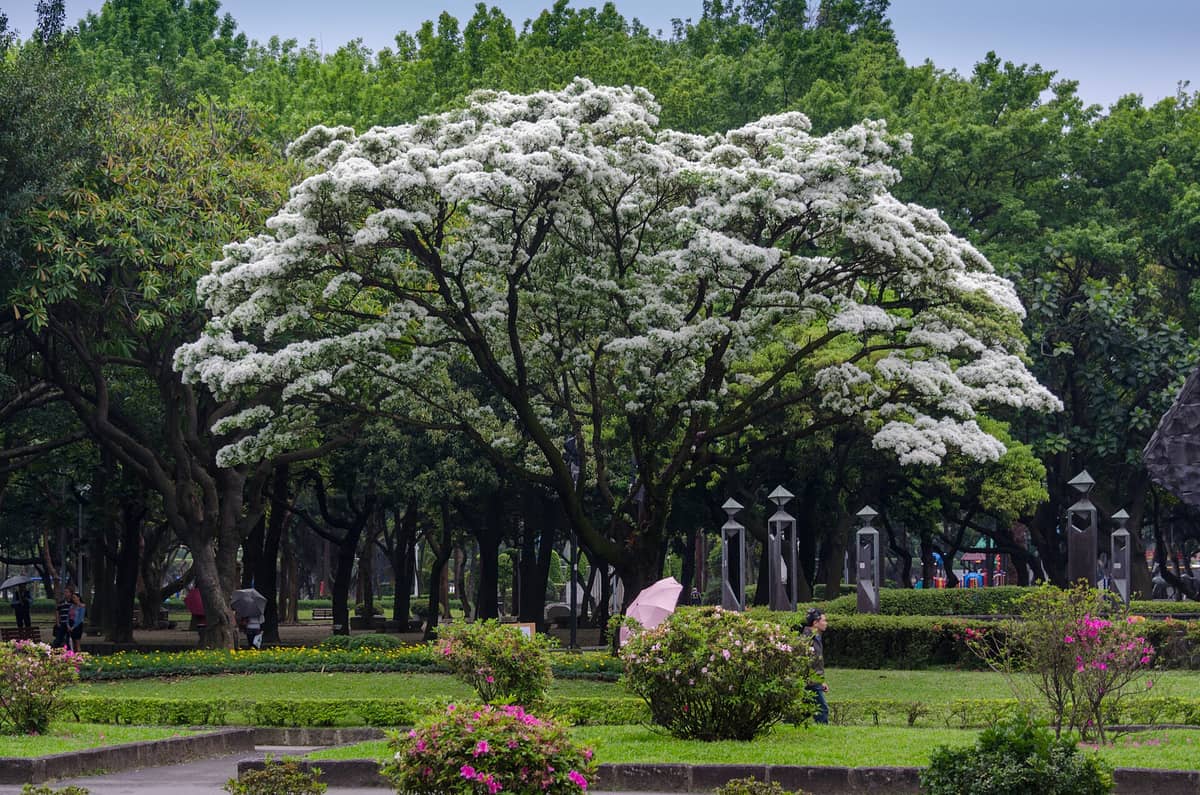
The park's layout reflects its layered colonial and post-colonial history. Wide paved paths wind through mature tropical trees, some of them original plantings from the Japanese period. Banyan roots spread across the ground in that recognizable strangling sprawl, and on humid mornings the canopy catches low light in a way that makes the space feel considerably older than the city around it.
Several architectural pieces punctuate the greenery. The most prominent is the 228 Memorial Monument itself, a white abstract structure rising from a pool near the center of the park. The inscription and surrounding plaques are in Mandarin Chinese but the visual language is clear: this is a place of public mourning that has been shaped into something calm. Near the southern end of the park stands a traditional-style pavilion complex with a hexagonal pond and stone bridges, the kind of landscaping common in Japanese-era Taiwanese parks. Several architectural pieces punctuate the greenery. The most prominent is the 228 Memorial Monument itself, a white abstract structure rising from a pool near the center of the park. The inscription and surrounding plaques are in Mandarin Chinese but the visual language is clear: this is a place of public mourning that has been shaped into something calm. Near the southern end of the park stands a traditional-style pavilion complex with a hexagonal pond and stone bridges, the kind of landscaping common in Japanese-era Taiwanese parks. There is also a radio station building from 1930, now the location of the 228 Memorial Museum, that served as the point from which protesters broadcast messages to the population in February 1947.
Benches, shaded paths, and small exercise areas fill the rest of the grounds. Taipei residents use this park with genuine regularity, especially the sections away from the monument. You will find older residents practicing tai chi in the early morning, office workers eating lunch near the pond, and school groups moving through the museum wing during weekdays.
How the Park Changes Through the Day
Early morning, roughly 6:00 to 8:30, is the park at its most local. The air is cooler, the light filters through the canopy at a low angle, and the population is almost entirely Taipei residents rather than tourists. Tai chi groups occupy several of the open paved areas. The smell of fresh soil and the sound of birds are noticeable before the traffic on Ketagalan Boulevard builds.
Midday shifts the character significantly. Tourists arrive from the nearby Presidential Office Building and Chiang Kai-shek Memorial Hall area, the heat becomes oppressive from May through September, and the shaded sections fill with people seeking respite. If you visit in summer, the sun exposure on the central monument plaza is intense and the humidity is punishing. Bring water, wear light clothing, and set aside any idea of lingering on the exposed sections for long.
Late afternoon and evening are another viable window. The temperature drops after 5:00 pm in shoulder seasons, the light goes golden across the old buildings, and the park takes on a more contemplative atmosphere. Because the grounds are open 24 hours, some visitors walk through after dinner when the illuminated monument takes on a different, more formal weight.
💡 Local tip
The best photography of the memorial monument happens in the hour after sunrise, when the light is soft and the crowds are thin. The reflecting pool in the foreground gives a clean compositional frame.
The Historical Context You Need Before You Arrive
On February 28, 1947, agents of the Nationalist government (KMT) arrested a widow selling untaxed cigarettes in Taipei, firing on the crowd that gathered in protest and killing a bystander. The incident triggered island-wide uprisings against the mainland Chinese administration that had taken control of Taiwan from Japan in 1945. The KMT government's response was a military crackdown that killed thousands of Taiwanese civilians, intellectuals, and community leaders. The precise death toll remains disputed and is the subject of ongoing historical research.
For nearly four decades under martial law, which lasted from 1949 to 1987, public discussion of the 228 Incident was effectively banned in Taiwan. The park was renamed, and the first official government apology was issued by President Lee Teng-hui in 1995. The 228 Memorial Museum opened in the former Taipei Broadcasting Station in 1997. This timeline matters: the park and its institutions are products of Taiwan's democratization, not colonial-era memorials. They represent a living, contested public memory, not a settled historical fact. This timeline matters: the park and its institutions are products of Taiwan's democratization, not colonial-era memorials. They represent a living, contested public memory, not a settled historical fact.
Understanding this context transforms the park from pleasant green space into something considerably more charged. For deeper historical orientation, the Liberty Square and Chiang Kai-shek Memorial Hall complex nearby adds another layer to Taipei's complicated relationship with the authoritarian period — though the political framing there is very different.
Getting There and Practical Logistics
The most convenient MRT access is NTU Hospital Station on the Red (Tamsui-Xinyi) Line, which puts you a three-minute walk from the park's eastern entrance. Taipei Main Station is roughly ten minutes on foot through the government district and works well if you are already in that area.
The park has multiple entrances from surrounding streets. The Ketagalan Boulevard side faces the Presidential Office Building and is the most formal approach, with the monument visible from the gate. Side entrances from Gongyuan Road and Huaining Street are less ceremonial and deposit you into the greener sections more directly.
The surrounding area is dense with significant sites. The National Taiwan Museum sits just north of the park on Xiangyang Road and is worth combining into the same visit. The Presidential Office Building is visible from the park's northern boundary. If you have half a day in Zhongzheng, these three sites form a coherent loop.
⚠️ What to skip
Ketagalan Boulevard is occasionally closed to traffic for political demonstrations and national events, which can make the approach from the north chaotic. This is especially common around February 28 each year.
The 228 Memorial Museum: Worth Your Time?
The museum occupies the 1930 Taipei Broadcasting Station building, a compact, well-preserved Japanese colonial structure with a distinctive red-brick and plaster exterior. The interior has been renovated to house permanent and rotating exhibitions on the 228 Incident, its causes, the crackdown, and the long suppression of public memory that followed.
The exhibitions use photographs, survivor testimonies, documents, and artifacts. The presentation is thorough and not triumphalist — it acknowledges the difficulty of establishing precise facts for events that were officially denied for decades. English-language panels are available throughout, though the depth of explanation in English is sometimes shallower than the Mandarin sections. Plan 45 minutes to an hour for a serious visit.
This museum is not suited to visitors looking for light cultural tourism. The subject matter is heavy, the emotional register is appropriate to a tragedy, and some of the survivor accounts are graphic. It is, however, one of the most honest and rigorously presented historical museums in Taipei, and for anyone trying to understand modern Taiwan it provides irreplaceable context.
Visitors with a broader interest in Taipei's museum landscape can find orientation in our Taipei museums guide, which covers the range from colonial history to contemporary art across the city.
Who Should Consider Skipping This
If you are visiting Taipei primarily for food, shopping, or outdoor recreation, 228 Peace Memorial Park is a pleasant but not essential stop. The greenery is attractive, but Taipei has larger and arguably more relaxing parks for a pure leisure visit.
Travelers with young children may find the museum difficult to navigate both emotionally and practically. For family-oriented outdoor time in central Taipei, Daan Forest Park offers more open space and activity areas without the memorial weight.
Visitors on a very tight schedule who have not done background reading may find the park underwhelming without context. The physical space alone does not explain itself. Come prepared or allocate time for the museum, or both.
Insider Tips
- The radio broadcast building (now the museum) is more interesting from the outside than many visitors realize. Walk around the full perimeter before going in — the building's proportions and original signage are best appreciated from the southeast corner.
- February 28 each year sees official commemorations at the park with significant crowds and occasional road closures. If your visit coincides with this date, arrive early or expect limited access to the monument area.
- The pond area in the southeast section of the park is quieter than the central monument plaza and has the best canopy cover for a midday rest. Most tourists circulate around the monument and miss it entirely.
- Combine the park with the National Taiwan Museum (a short walk north) on the same visit. The museum's natural history and colonial-era exhibits add a longer chronological arc to what the 228 memorial addresses.
- The park's trees include several large ficus and rain trees that are worth examining closely. Some of the banyans have root systems that have been growing since the Japanese colonial period, and the scale becomes apparent when you stand next to them.
Who Is 228 Peace Memorial Park For?
- History-focused travelers seeking context for modern Taiwan's democracy and political identity
- Architecture enthusiasts interested in Japanese colonial civic design
- Morning walkers who want a quieter green space in the heart of the government district
- Visitors building a half-day itinerary around Zhongzheng's civic and cultural corridor
- Photographers working on urban documentary or long-exposure water reflection shots
Nearby Attractions
Other things to see while in Zhongzheng District:
- Chiang Kai-shek Memorial Hall
Standing 70 metres tall at the heart of Zhongzheng District, the National Chiang Kai-shek Memorial Hall is one of Taipei's most recognizable structures. Free to enter and open daily from 9:00 AM to 6:00 PM (with the surrounding park open 5:00 AM–midnight), it draws history seekers, architecture admirers, and locals who use the surrounding park as their morning exercise ground.
- Huashan 1914 Creative Park
A former Japanese-era winery turned open-air cultural campus, Huashan 1914 Creative Park draws a steady stream of Taipei's artists, designers, film lovers, and weekend wanderers. Admission to the grounds is free, but the real pull is what fills the space: independent exhibitions, pop-up markets, live performances, and some of the most interesting cafes in central Taipei.
- Liberty Square
Liberty Square is one of the largest public plazas in Taiwan, anchoring the Chiang Kai-shek Memorial Hall complex in central Taipei. Free to enter at any hour, it draws joggers at dawn, school groups by mid-morning, and photographers chasing the golden-hour glow on its white marble archway by evening. This guide covers what to see, when to go, and what most visitors overlook.
- National Taiwan Museum
The National Taiwan Museum is Taiwan's oldest public museum, housed in a striking Baroque-style stone building completed in 1915 during the Japanese colonial period. Located in Zhongzheng District steps from Taipei Main Station, it covers Taiwan's natural history, geology, indigenous cultures, and ecology — all for NT$30 entry. A single ticket also covers the Land Bank Exhibition Hall across the street, where a full dinosaur skeleton greets visitors at the door.