Presidential Office Building: Taipei's Grandest Colonial Landmark
The Presidential Office Building (總統府) is Taipei's most architecturally imposing government landmark, a red-brick Baroque structure completed during the Japanese colonial era and still the working seat of Taiwan's presidency. Visits are currently temporarily suspended for remodeling, though check the official website before planning a visit.
Quick Facts
- Location
- No. 122, Sec. 1, Chongqing South Road, Zhongzheng District, Taipei
- Getting There
- NTU Hospital Station (Tamsui–Xinyi Line) or Ximen Station (Songshan–Xindian Line), approx. 10-min walk
- Time Needed
- 1–1.5 hours
- Cost
- Free admission; valid photo ID or passport required
- Best for
- History enthusiasts, architecture lovers, first-time visitors to Taipei
- Official website
- english.president.gov.tw
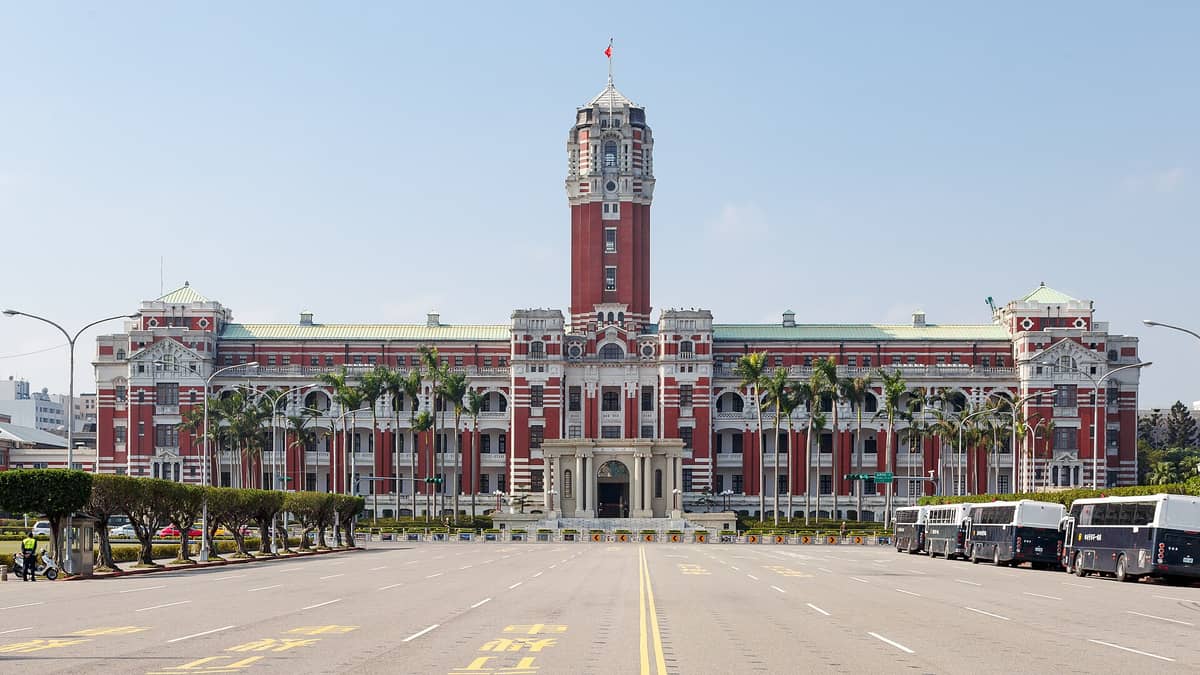
What the Presidential Office Building Actually Is
The Presidential Office Building, known in Chinese as 總統府 and officially the Office of the President, Republic of China (Taiwan), is simultaneously a working government headquarters and a public heritage site. The current president of Taiwan conducts official business here, which makes it unusual among major civic landmarks: this is not a preserved relic but an active seat of power that opens its doors to ordinary visitors on weekday mornings when tours are operating.
The building occupies a full city block in central Zhongzheng District, fronted by Ketagalan Boulevard and The building occupies a full city block in central Zhongzheng District, fronted by Ketagalan Boulevard and near Baoqing Road, Boai Road, and Guiyang Street. Its scale is immediately apparent from the street. The red-brick facade, layered horizontal banding, and 60-meter central tower give it an authority that makes neighboring buildings feel incidental. Its scale is immediately apparent from the street. The red-brick facade, layered horizontal banding, and 60-meter central tower give it an authority that makes neighboring buildings feel incidental.
⚠️ What to skip
As of May 20, 2024, all regular public tours have been temporarily suspended for remodeling. The suspension has no confirmed end date. Check the official website at english.president.gov.tw before planning a visit, as conditions may have changed. The suspension has no confirmed end date. Check the official website at english.president.gov.tw before planning a visit, as conditions may have changed.
Architecture and Historical Context
The building was constructed during Taiwan's Japanese colonial period and The building was constructed during Taiwan's Japanese colonial period and completed in 1919 as the Governor-General's Office. Its design reflects the Western Baroque vocabulary that Japanese colonial architects deployed across Taiwan for institutions meant to project imperial permanence: thick masonry, symmetrical facades, arched windows, and a dominant central tower visible from the length of Ketagalan Boulevard.
After 1945, when the Republic of China government took control of Taiwan, the building was repurposed as the presidential office and has remained so ever since. It was designated a national historic site in 1998, giving it formal heritage protection while it continues to function as a government building. That combination of preserved architecture and active use makes it one of the more interesting colonial-era structures in East Asia.
The surrounding area amplifies the building's significance. Ketagalan Boulevard, which runs directly in front, is Taipei's primary ceremonial avenue and the site of major public demonstrations and national gatherings. The Chiang Kai-shek Memorial Hall and its surrounding Liberty Square are roughly 10 minutes on foot to the southeast, making this entire corridor the symbolic heart of Taiwan's political identity. Walking between these two sites gives a compressed but coherent sense of how modern Taiwan's civic landscape was shaped.
The Visitor Experience: What You See Inside
When tours are running, visitors enter through Gate No. 3, located at the northwest corner of the complex at the intersection of Baoqing Road and Bo'ai Road. Security here is real: expect bag checks and ID verification. Every visitor must present a valid photo ID or passport. When tours are running, visitors enter through Gate No. 3, located at the northwest corner of the complex at the intersection of Baoqing Road and Bo'ai Road. Security here is real: expect bag checks and ID verification. Every visitor must present a valid photo ID or passport. Visitors without identification will be turned away.
Inside, the ground floor holds an exhibition space covering Taiwan's political history and the evolution of the Republic of China government. The displays are bilingual in Chinese and English and cover the period from Japanese colonial rule through the post-war decades. The quality is uneven in places, with some sections being genuinely informative about institutional history and others functioning as straightforward political biography. Visitors with a background in Taiwan's history will find more to engage with than those approaching it cold.
The ceremonial halls and corridors are the architectural highlight. High ceilings, formal colonnades, and period woodwork are well-preserved, and the sense of scale inside matches the exterior. Photography is generally permitted in public areas, though restrictions apply in certain sections. Guided tours in English are available on specific days, so confirm the schedule when checking tour availability.
💡 Local tip
Tours run Monday through Friday, 09:00–12:00 (last entry 11:30), and are closed on weekends and public holidays unless a special open-house day is announced. Note that regular open house tours are currently suspended for remodeling. Arrive before 10:30 to avoid the modest midmorning group tour clusters.
The Building at Different Times of Day
From the outside, the building reads differently depending on light and hour. Early morning, before 09:00, Ketagalan Boulevard is quiet enough that you can stand directly in front of the main gate and photograph the facade without tour groups or passing buses in the frame. The red brick takes on warmer tones in morning light, and the central tower is unobstructed from the boulevard.
By mid-morning, school groups and tour buses begin arriving. The visitor entrance on the northwest corner sees regular foot traffic, and the surrounding pavements carry the ordinary business of government workers and delivery vehicles. There is nothing cinematic about the mid-morning scene, but it underscores that this is a real working institution rather than a museum set piece.
In the evening, the floodlit facade is worth a short detour if you are walking between Ximen and the Zhongzheng government district. The tower is lit against the night sky, and the boulevard in front is calm enough for a clear view. You cannot enter after hours, but the exterior at night is one of the better architectural photographs available in central Taipei without climbing anything.
Getting There and Practical Logistics
The two most practical MRT options are NTU Hospital Station on the Tamsui–Xinyi Line and Ximen Station on the Songshan–Xindian Line, each about a 10-minute walk. From Taipei Main Station, the walk takes roughly 15 minutes along Zhongshan South Road or through the underpass network. There is no dedicated parking on-site; group tour buses can drop off and pick up but not park, so private car access is impractical during visit hours. From Taipei Main Station, the walk takes roughly 15 minutes along Zhongshan South Road or through the underpass network. There is no dedicated parking on-site; group tour buses can drop off and pick up but not park, so private car access is impractical during visit hours.
If you are planning a broader half-day in Zhongzheng, the Presidential Office Building pairs naturally with the 228 Peace Memorial Park just to the east, the National Taiwan Museum a few minutes beyond that, and the Chiang Kai-shek Memorial Hall complex to the south. The entire circuit is walkable and covers several important layers of Taiwan's 20th-century history within about two hours on foot.
ℹ️ Good to know
Dress code: Smart casual is appropriate. Taipei's broader dress norms are relaxed, but entering a working government building in beachwear or torn clothing may draw comments from security staff.
Photography Tips and Practical Notes
The best exterior shot is from the center of Ketagalan Boulevard, looking directly north toward the main facade and tower. A wide-angle lens captures the full building plus the flagpoles and ceremonial gate. Avoid shooting from directly across the street on the south side, where parked vehicles and median plantings interrupt the sightline. On overcast days, the red brick photographs more evenly than in harsh midday sun, which blows out the lighter architectural trim.
Inside, interiors are lit with a mixture of natural and artificial light. A camera that handles moderate low light without flash is useful, as flash photography is restricted in some exhibition areas. The central hall and corridors near the main staircase offer the most architecturally interesting compositions.
If architectural photography in Taipei is a priority, note that the North Gate (Beimen) in the same district is one of the best-preserved Baroque-style gates from the Qing dynasty era and can be combined with a visit here in a single morning.
Honest Assessment: Is It Worth Your Time?
For visitors with a genuine interest in Taiwan's political history or colonial-era architecture, the Presidential Office Building is worth scheduling specifically. The access it provides to a functioning presidential compound is unusual globally, and the building's architecture is the finest example of Japanese colonial civic design in Taipei.
For travelers on a tight itinerary focused on food, markets, or nature, the time cost is harder to justify. The interior exhibitions, while informative, are not as polished or immersive as those at the National Palace Museum or the 228 Peace Memorial. The exterior can be seen in 10 minutes without entering, and that alone may satisfy most casual curiosity.
Who should skip it: travelers who find institutional history dry, anyone who cannot produce a valid photo ID, visitors arriving on weekends without a special open-house day scheduled, and anyone during the current remodeling suspension. For everyone else, particularly those interested in what Taiwan's democratic institutions look like from the inside, this is one of the more accessible and unexpectedly interesting civic experiences in central Taipei.
For broader context on planning your time in this part of the city, the Taipei 3-day itinerary places the Zhongzheng government district within a logical sequence that avoids unnecessary backtracking.
Insider Tips
- The main facade is fully visible from Ketagalan Boulevard without entering the compound. If the tour suspension is still in effect, the exterior visit and boulevard walk take about 20 minutes and are still worth doing as part of a Zhongzheng walking loop.
- Special open-house days, typically held around national holidays, allow weekend visits with extended hours and sometimes include areas not accessible on regular weekdays. Check the official site (english.president.gov.tw/Page/127) for announcements several weeks in advance.
- English-language guided tours are available on select weekday mornings when tours are running. Confirm the English tour schedule when booking, as it is not offered every day.
- The exterior ceremonial presence outside the main gate can be observed from the boulevard without entering the compound at all.
- Combine with the 228 Peace Memorial Park next door: the park's museum provides detailed historical context that makes the Presidential Office exhibits more meaningful if visited afterward rather than before.
Who Is Presidential Office Building For?
- History enthusiasts interested in Taiwan's colonial period and democratic transition
- Architecture-focused travelers drawn to Japanese-era civic buildings
- First-time visitors to Taipei wanting to understand the city's political geography
- Travelers building a half-day Zhongzheng walking circuit
- Those interested in accessible civic institutions that allow genuine public access
Nearby Attractions
Other things to see while in Zhongzheng District:
- 228 Peace Memorial Park
228 Peace Memorial Park is one of Taipei's oldest and most significant public spaces, blending formal gardens with a powerful memorial to Taiwan's defining political tragedy. Free to enter and open around the clock, it rewards visitors who come prepared to read the landscape carefully.
- Chiang Kai-shek Memorial Hall
Standing 70 metres tall at the heart of Zhongzheng District, the National Chiang Kai-shek Memorial Hall is one of Taipei's most recognizable structures. Free to enter and open daily from 9:00 AM to 6:00 PM (with the surrounding park open 5:00 AM–midnight), it draws history seekers, architecture admirers, and locals who use the surrounding park as their morning exercise ground.
- Huashan 1914 Creative Park
A former Japanese-era winery turned open-air cultural campus, Huashan 1914 Creative Park draws a steady stream of Taipei's artists, designers, film lovers, and weekend wanderers. Admission to the grounds is free, but the real pull is what fills the space: independent exhibitions, pop-up markets, live performances, and some of the most interesting cafes in central Taipei.
- Liberty Square
Liberty Square is one of the largest public plazas in Taiwan, anchoring the Chiang Kai-shek Memorial Hall complex in central Taipei. Free to enter at any hour, it draws joggers at dawn, school groups by mid-morning, and photographers chasing the golden-hour glow on its white marble archway by evening. This guide covers what to see, when to go, and what most visitors overlook.