Niujie Mosque: Beijing's Oldest Place of Islamic Worship
Founded during the Liao dynasty in 996 AD, Niujie Mosque is the oldest mosque in Beijing, covering approximately 10,000 square metres in the Xicheng District. With its rare fusion of Chinese palace architecture and Islamic spatial principles, it offers one of the most architecturally distinctive religious experiences in the Chinese capital.
Quick Facts
- Location
- No. 88 Niujie Zhonglu, Xicheng District, Beijing
- Getting There
- Subway Line 7, Guang'anmennei Station (Exit C2), then walk south along Niujie Street. Bus routes 10, 48, 88, and 717 also stop at Niu Jie Li Bai Si (Niujie Mosque) stop.
- Time Needed
- 45 minutes to 1.5 hours
- Cost
- Approx. CNY 5 (Chinese visitors), CNY 10 (international visitors); free for Muslims. Verify before visiting as prices may have changed since 2021.
- Best for
- History enthusiasts, architecture lovers, travelers interested in Islamic culture in China
What Is Niujie Mosque?
Niujie Mosque, officially known in Chinese as 牛街礼拜寺 (Niújiē Lǐbàisì), is Beijing's oldest mosque and one of the most historically significant Islamic sites in northern China. Founded in 996 AD during the Liao dynasty, it predates the Forbidden City by more than four centuries. The compound covers approximately 10,000 square metres and sits at the heart of Niujie Street, a neighborhood that has served as the center of Beijing's Hui Muslim community for over a millennium.
This is not a museum, and it should not be visited as one. The mosque is an active place of worship with five daily prayer sessions. Non-Muslim visitors are welcome during designated visiting hours, but entering as a quiet, respectful observer is the only appropriate approach. The atmosphere is noticeably different from Beijing's imperial landmarks: calmer, more intimate, with the faint scent of incense and the sound of recitation occasionally drifting through the courtyards.
ℹ️ Good to know
Opening hours published online are inconsistent: some sources list 08:00–17:00, others 07:00–18:00. Hours may also be restricted around Friday noon prayers. Verify locally before visiting, and arrive early or mid-morning on weekdays for the most relaxed experience.
The Architecture: Chinese Form, Islamic Soul
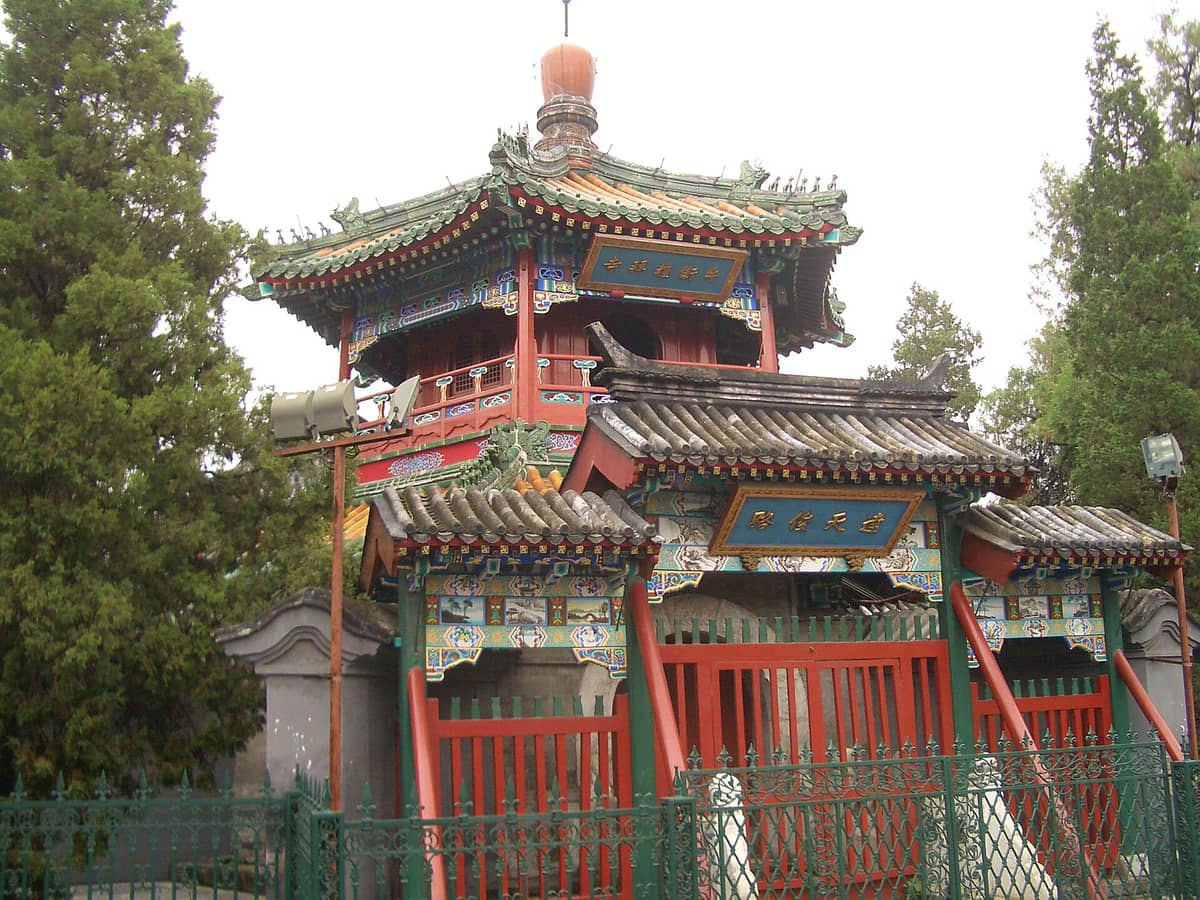
The single most compelling reason to visit Niujie Mosque is its architecture. At first glance, the compound resembles a traditional Chinese temple complex: upturned roof eaves glazed in green tile, red timber columns, and carved stone archways that echo the style of imperial Beijing. Look more carefully and the Islamic identity asserts itself clearly. Quranic calligraphy in Arabic replaces the Chinese characters you would find at a Buddhist or Taoist site. Geometric arabesque patterns are carved into panels alongside recognizably Chinese cloud and dragon motifs. The prayer hall opens toward Mecca rather than following the south-facing orientation of most Chinese ceremonial buildings.
This synthesis was not accidental. Hui Muslim architects working within the Chinese building tradition adapted its forms to serve Islamic requirements across centuries of reconstruction and expansion, with major work carried out during the Song, Ming, and Qing dynasties. The result is a spatial language unique to Chinese Islamic architecture, and Niujie is one of its finest surviving examples. Travelers with an interest in how religions adapted to local building cultures will find the compound genuinely instructive.
The compound is laid out along an east-west axis rather than the north-south axis typical of Chinese palace architecture, orienting the prayer hall toward Mecca. Several structures are particularly worth examining: the Moon-Watching Tower (望月楼), a timber pavilion used to observe the new moon for Islamic calendar purposes, and the stele pavilions that hold inscribed tablets recording the mosque's history in both Arabic and Chinese. If you are interested in exploring more of Beijing's layered religious history, the nearby Fayuan Temple in Xicheng offers a contrasting Buddhist experience just a short walk away.
Tickets & tours
Hand-picked options from our booking partner. Prices are indicative; availability and final rates are confirmed when you complete your booking.
Small group tour of Tian'anmen Square and the Forbidden City
From 43 €Instant confirmationFree cancellationBeijing Summer Palace Entrance Ticket
From 7 €Instant confirmationFree cancellationMutianyu Great Wall and Summer Palace small-group tour from Beijing
From 171 €Instant confirmationFree cancellationPrivate Guided Tour to Temple of Heaven, Panda House and Summer Palace
From 67 €Instant confirmationFree cancellation
The Surrounding Neighborhood: Niujie Street
Niujie Street itself rewards a slow walk before or after your visit to the mosque. The street is lined with halal restaurants, bakeries selling sesame-crusted breads and lamb-filled pastries, and small shops catering to Beijing's Hui community. The food here is genuine rather than tourist-oriented: lamb skewers and niurobing (beef flatbread) sold from counters that open early and close when the day's supply runs out. Arriving hungry is a reasonable strategy.
The Xicheng District context is important. This is not the heavily renovated, tourist-facing version of old Beijing you encounter around Nanluoguxiang or Qianmen. Niujie is a working neighborhood where the mosque and its community coexist with ordinary residential and commercial life. That authenticity is precisely what makes it worthwhile, but it also means the area is not designed for tourism: signage is almost entirely in Chinese, and English is rarely spoken outside the mosque itself.
How the Visit Changes by Time of Day
Mornings on weekdays are the most tranquil time to visit. The courtyards are quiet, the light is soft on the green-glazed rooftiles, and you can move through the compound without feeling pressed. Elderly worshippers sometimes sit in the shaded areas near the prayer hall before and after the morning prayer, and the atmosphere is more conducive to observation and reflection than at busier periods.
Friday midday is a different experience entirely. The Friday noon prayer (Jumu'ah) draws the largest congregation of the week, and the streets around the mosque fill with worshippers arriving on foot and by bicycle. The atmosphere is communal and significant, but visiting non-Muslims should be aware that access may be restricted during this period and that the area immediately around the mosque becomes very crowded. If your interest is architectural and historical rather than observational, Friday midday is the one time to avoid.
Afternoons tend to see a modest uptick in individual visitors and small tour groups, though the mosque never reaches the crowd levels of Beijing's major imperial sites. Late afternoon light falls well on the front gate and the Moon-Watching Tower, making it a reasonable time for photographs if the morning is not possible.
💡 Local tip
Photography is generally permitted in the outer courtyards and of the exterior architecture. Do not photograph worshippers without clear permission, and do not attempt to photograph the interior of the prayer hall during prayers. When in doubt, ask a staff member at the entrance.
Practical Information for Visitors
Getting There
Take Beijing Subway Line 7 to Guang'anmennei Station and use Exit C2. Walk east along Guang'anmennei Street, then turn south onto Niujie Street. The mosque entrance is at No. 18 Niujie Street; the walk from the subway exit is around ten minutes. Bus routes 10, 48, 88, and 717 serve a stop named Niujie Mosque directly. Taxis and DiDi are straightforward; show the driver the Chinese name 牛街礼拜寺 or the address 西城区牛街18号.
Admission and Entry
Published admission prices are CNY 5 for Chinese visitors and CNY 10 for international visitors. Muslims enter free. These figures should be reconfirmed before your visit, as pricing may have changed. Purchase tickets at the entrance gate.
Dress and Conduct
Dress modestly. Shorts, sleeveless tops, and clothing considered revealing are inappropriate. Women are not required to cover their heads, but doing so is respectful. Remove shoes before entering the prayer hall if you are permitted access. Speak quietly throughout the compound. The mosque is a functioning religious space, not a heritage monument, and conduct should reflect that distinction.
Accessibility
No verified information about wheelchair access, step-free entrances, or accessible toilet facilities was available at time of writing. The compound's traditional architecture typically involves raised thresholds and uneven stone pathways. Contact the mosque directly or the Xicheng District cultural tourism office before visiting if mobility access is a requirement.
Historical Context: A Thousand Years of Islam in Beijing
The founding of Niujie Mosque in 996 AD corresponds to a period when the Liao dynasty controlled the area now known as Beijing, then called Nanjing or Yanjing. Arab and Persian traders had been present in northern China along Silk Road networks for centuries, and the Hui Muslim community that formed around Niujie Street developed into one of the most durable ethnic and religious communities in the city's history.
The mosque underwent significant reconstruction and expansion during the Ming dynasty (1368–1644) and again under the Qing emperor Kangxi in the late seventeenth century, adding the architectural elements most visible today. Understanding this building's history adds considerably to a visit to Xicheng District as a whole, where the physical layers of Beijing's pre-modern history are more legible than in heavily modernized areas of the city. For a broader view of how religion shaped Beijing's urban landscape, the best temples in Beijing guide provides useful comparative context.
It is worth noting that Islamic practice and Muslim community life in China exist within a complex political and regulatory context. The mosque functions as an active religious institution and a designated cultural relic under Chinese heritage law. Visitors should approach the site with awareness that it carries significance both as architecture and as a living community space.
Is It Worth the Visit?
Niujie Mosque is worth your time if you are genuinely curious about architectural hybridity, the deep history of Islam in China, or the texture of Beijing neighborhoods beyond the imperial core. It is not a spectacular visual experience in the way that the Temple of Heaven or the Forbidden City are. The compound is relatively modest in scale, and the green-and-red palette, while distinctive, does not produce the overwhelming grandeur of Beijing's most photographed sites.
What it offers instead is specificity and quiet. On a well-planned day, it pairs naturally with the White Cloud Temple to the west or with a walk through the nearby hutong streets of Xicheng. Travelers following a focused Beijing imperial history itinerary may find the mosque a useful counterpoint: a reminder that the city's history contains many stories beyond the dynastic Chinese narrative centered on the imperial axis.
⚠️ What to skip
Visitors who are not interested in religious architecture or community history may find the site underwhelming. There are no English audio guides, English-language exhibits are minimal, and the experience depends largely on your own preparedness. Arriving with some background knowledge of Chinese Islamic history will substantially enrich the visit.
Insider Tips
- The entrance gate on Niujie Street is easy to walk past if you are not looking for it. The frontage is relatively narrow; look for the green-roofed gatehouse set back slightly from the street with Arabic calligraphy above the arch.
- The Moon-Watching Tower (望月楼) at the rear of the compound is the most photogenic single structure. Position yourself in the western courtyard in the morning for the best light angle and a cleaner background.
- The halal bakeries and lamb restaurants on Niujie Street open early and are at their best before noon. Order niurobing (牛肉饼), a pan-fried beef flatbread, from any counter showing a queue of local customers. Price and quality tend to be more reliable where locals congregate.
- The stele pavilions inside the compound contain inscribed tablets in Arabic and Chinese dating back centuries. Taking time to examine these closely, even without being able to read them, gives a clearer sense of the site's documentary and historical significance than most other elements of the compound.
- If you are visiting on a non-Friday weekday and arrive around 09:00, you are likely to have significant stretches of the compound to yourself. The low admission price and low crowd levels make this one of the more underrated quiet spots in central Beijing.
Who Is Niujie Mosque For?
- Travelers interested in the history of Islam and Muslim communities in China
- Architecture enthusiasts drawn to cross-cultural building traditions
- Visitors seeking authentic neighborhood experiences away from major tourist circuits
- Photographers looking for distinctive architectural subjects with minimal crowds
- History-focused visitors building a broader picture of Beijing beyond its imperial landmarks
Nearby Attractions
Other things to see while in Xicheng District:
- Beihai Park
Beihai Park is one of Beijing's oldest and best-preserved imperial gardens, covering roughly 69 hectares with more than half the area given over to a large lake. Dating back over a thousand years, it offers a rare mix of imperial architecture, Buddhist monuments, and open green space within walking distance of the Forbidden City.
- Beijing Planetarium
Beijing Planetarium (北京天文馆) is located in Xicheng District near Beijing Zoo. It runs dome theater shows, 3D and 4D screenings, and permanent science exhibitions across two buildings. Here's what a visit actually looks like.
- Beijing Zoo
Beijing Zoo is one of China's oldest and largest zoological parks, covering over 80 hectares in Xicheng District. Home to the city's most accessible giant panda viewing experience, it draws millions of visitors each year. This guide covers what to expect, when to go, and how to make the most of your time there.
- Capital Museum
The Capital Museum (首都博物馆) in Xicheng District is Beijing's premier civic museum, tracing the city's history across three millennia. Admission is free, the permanent galleries are genuinely impressive, and it rarely gets as crowded as the Forbidden City — making it one of the smartest stops in central Beijing.