White Cloud Temple (Baiyun Guan): Beijing's Living Daoist Heart
White Cloud Temple, known in Chinese as Baiyun Guan, is Beijing's most important Daoist temple complex and one of the oldest active religious sites in northern China. Founded in 741 CE, it spans 60,000 square metres of courtyards, pavilions, and shrines that remain in daily liturgical use. Entry costs just ¥10, making it one of the most rewarding and undervisited stops in Xicheng District.
Quick Facts
- Location
- No. 7 Baiyunguan Street, Xicheng District, Beijing
- Getting There
- Muxidi Station (Line 1, southeast Exit C1), approx. 1.6 km walk; or bus routes 26, 45, 80, 319, 717, 特5, 特6 to Baiyun Guan stop
- Time Needed
- 1.5 to 2.5 hours
- Cost
- ¥10 per person (verify locally before visiting)
- Best for
- Daoist history, quiet contemplation, traditional architecture, photography
What Is White Cloud Temple?
White Cloud Temple, or Baiyun Guan (白云观), is the principal Daoist temple in Beijing and one of the three ancestral courts of the Quanzhen school of Daoism, one of the two main traditions of the religion in China. It is not a monument frozen in amber for tourists. Resident monks live here, rituals are performed daily, and the incense in the main halls has never really stopped burning. That continuity, stretching back in some form to 741 CE, is what separates this place from many of Beijing's more celebrated attractions.
The original structure on this site was called Tianchang Temple, established during the Tang dynasty reign of Emperor Xuanzong. It was renamed and substantially rebuilt under the Jin dynasty in the 12th century, and again expanded during the Yuan, Ming, and Qing dynasties. Today's complex covers approximately 60,000 square metres in total area, with buildings occupying around 10,000 square metres, arranged along a central north-south axis with quieter side courtyards branching off on either side.
💡 Local tip
Opening hours are 08:30–16:30 year-round according to the Beijing municipal listing. Admission typically ends before closing. Confirm times locally before visiting, as hours can shift around major festivals.
The Experience: Moving Through the Complex
You enter through the Pailou, a painted ceremonial archway on Baiyunguan Street, and immediately the temperature of the surrounding city seems to drop slightly, not from air conditioning but from the density of old timber, stone, and cypress trees blocking the traffic noise. The entrance gate complex is decorated in the dark reds and greens typical of imperial-era temple architecture, and the stonework around the threshold shows the kind of wear that comes from centuries of foot traffic.
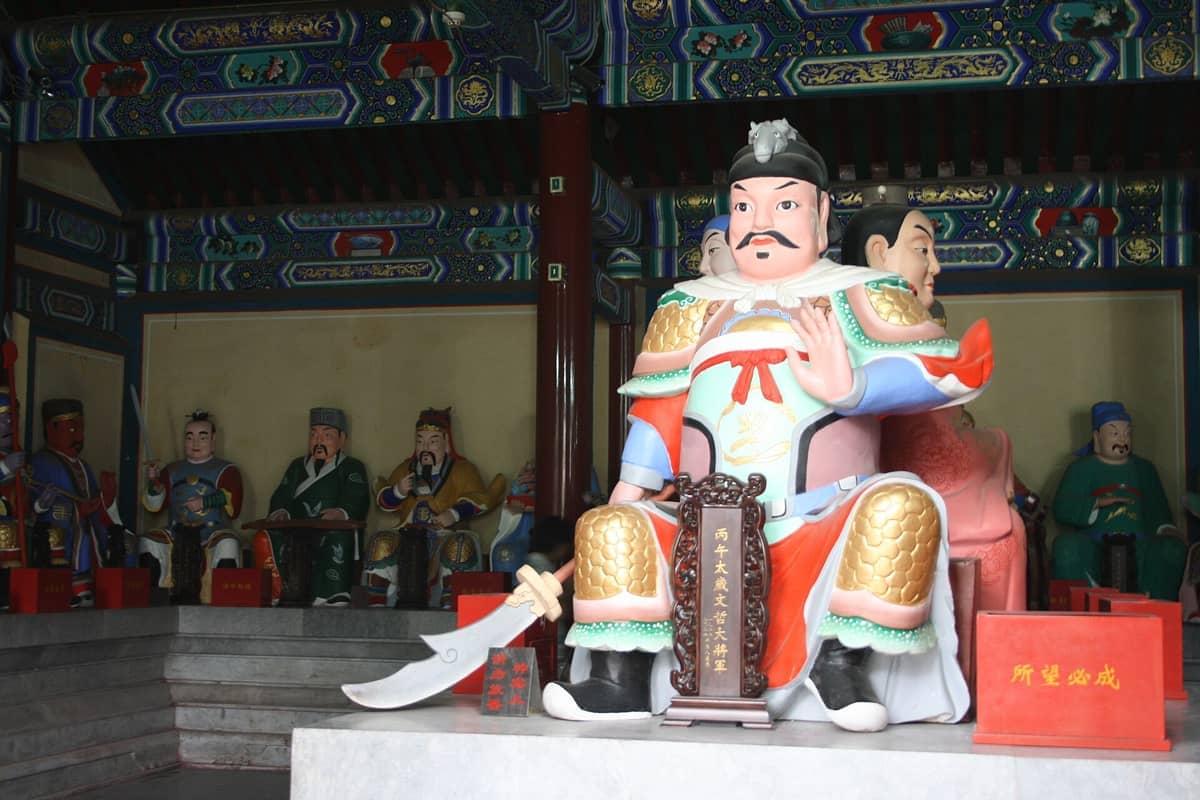
The central axis takes you through a sequence of halls dedicated to different Daoist deities and immortals. The Hall of the Jade Emperor, the Hall of the Four Heavenly Kings, and the Sanqing Hall (dedicated to the Three Pure Ones, the highest Daoist deities) form the ceremonial core. In each hall, the air is thick with incense smoke and the low resonance of chanting if monks are in service. The statuary is painted in vivid reds, golds, and blues, some of it recently restored, some noticeably worn around the edges where devotees have touched or kneeled for generations.
The side courtyards reward slower exploration. There are shrines to specific deities associated with wealth, longevity, and childbirth, each drawing a different cross-section of Beijing residents who have come with a specific purpose in mind. You might find an elderly woman praying quietly in a corner shrine, or a small group of younger visitors lighting incense sticks at a courtyard burner, filling the space with fragrant smoke that drifts across stone paving worn smooth over centuries.
Tickets & tours
Hand-picked options from our booking partner. Prices are indicative; availability and final rates are confirmed when you complete your booking.
Small group tour of Tian'anmen Square and the Forbidden City
From 43 €Instant confirmationFree cancellationBeijing Summer Palace Entrance Ticket
From 7 €Instant confirmationFree cancellationMutianyu Great Wall and Summer Palace small-group tour from Beijing
From 171 €Instant confirmationFree cancellationPrivate Guided Tour to Temple of Heaven, Panda House and Summer Palace
From 67 €Instant confirmationFree cancellation
How the Temple Changes Through the Day
Early morning, roughly between 08:30 and 10:00, is when the temple belongs to its regulars. Local devotees arrive before the tourist day gets going, and the monks may be conducting morning rituals in the main halls. The light at this hour filters through the cypress canopy in long, angled shafts, and the incense smoke hangs low in the cool air. If you can arrive at opening time, particularly on a weekday, the atmosphere is closer to what this place has been for most of its 1,300 years.
By mid-morning the tour groups begin to arrive, particularly on weekends and during national holidays. The main courtyards can become crowded, but the side halls remain quieter. Midday is the least atmospheric time: the light is flat, the crowds are at their peak, and the monks have typically finished their morning routines. Late afternoon, especially in the hour before closing, sees the crowd thin and the light return to something interesting. Shadows lengthen across the tiled rooflines, and the temple assumes a more contemplative quality.
ℹ️ Good to know
The Chinese New Year temple fair held at Baiyun Guan is one of the oldest in Beijing, drawing enormous crowds in late January or early February. If you visit then, the atmosphere is extraordinary but the temple is packed. Expect queues, noise, and a very different kind of energy from a regular visit.
Architectural and Cultural Significance
The complex follows the classic Chinese axial planning principle, where the most sacred spaces are positioned deepest inside the compound, requiring the visitor to pass through layers of ceremonial gateways and courtyards before reaching them. This spatial logic is deliberate: the gradual transition from street to shrine mirrors the Daoist concept of moving from the mundane world toward the sacred.
The rooflines throughout the complex use yellow and green glazed tiles, a colour combination permitted for significant religious institutions during the imperial period. Look carefully at the ridge decorations: the ceramic figures placed along the roof edges are not merely ornamental but carry apotropaic significance in traditional Chinese religious architecture, each figure assigned a specific protective role.
Baiyun Guan is the national centre for the China Daoist Association, which makes it institutionally significant beyond its role as a local place of worship. For visitors with a broader interest in Beijing's religious heritage, it pairs naturally with the Lama Temple in Dongcheng, which offers a contrasting introduction to Tibetan Buddhism and similarly retains genuine religious function alongside its status as a visitor attraction. Together the two sites give a much richer picture of how different religious traditions have coexisted in imperial and contemporary Beijing.
Practical Walkthrough: What to Expect on Arrival
From Muxidi Station on Metro Line 1, exit via the southeast C1 exit and walk approximately 1.6 kilometres south along Baiyunguan Street. The walk takes around 20 minutes on a flat, straightforward route. Alternatively, bus routes 26, 45, 80, 319, 717, 特5, and 特6 stop at Baiyun Guan.
Tickets are purchased at the gate and cost ¥10 per person. There is no online advance booking system for general admission. Once inside, there is no strict route to follow: the complex is navigable by following the central axis and then looping through the side courtyards at your own pace. Allow at least 90 minutes to see the main halls without feeling rushed; two to two and a half hours allows proper exploration of the quieter peripheral areas and the small museum section within the complex.
Dress modestly. Shorts and sleeveless tops are not prohibited by a posted rule, but this is an active religious site and conservative dress is respectful and appropriate. Comfortable flat shoes are practical: the courtyard surfaces are uneven stone and brick in places. Photography is generally permitted in the courtyards and exterior areas; some interior halls may have restrictions that are posted or indicated by staff, so check before raising a camera.
⚠️ What to skip
Accessibility information is not reliably documented for this site. The complex contains multiple thresholds, steps between courtyards, and uneven stone paving. Visitors with mobility concerns should contact the temple directly at 010-63443666 before visiting to ask about access routes.
Honest Assessment: Who This Is For, and Who Might Struggle
At ¥10, Baiyun Guan is one of the most underpriced experiences in central Beijing. For anyone with an interest in Chinese religion, classical architecture, or simply in finding a place that feels genuinely rooted in the city's history rather than curated for visitors, this temple delivers. The scale is human, the admission is minimal, and the crowds are manageable on most weekdays.
That said, visitors who prefer highly contextualised, English-language experiences may find Baiyun Guan challenging. There is limited English signage throughout the complex, so coming with some background knowledge of Daoist practice or iconography makes the visit considerably richer. The guide section of our best temples in Beijing overview covers several sites with more extensive English interpretation, if that is a priority.
The temple is not the right destination for visitors primarily seeking grand spectacle. It lacks the sweeping scale of the Temple of Heaven or the imperial drama of the Forbidden City. Its value is more subtle: the accumulated atmosphere of centuries of continuous use, the smell of sandalwood incense on cold stone, the sound of monks at prayer in a hall where the shutters have remained open for a thousand years in various forms. That is either exactly what you are looking for, or it is not.
Families with young children can visit, but there is little specifically designed to engage children. If you are travelling with kids, the nearby Beihai Park in Xicheng combines open space and visual interest in a more child-friendly format. For visitors building a wider itinerary across the district, our Xicheng District guide outlines how to combine Baiyun Guan with nearby sites efficiently.
Photography at Baiyun Guan
The temple offers strong photographic material: layered rooflines against grey Beijing skies, incense smoke caught in morning light, close detail on painted wooden beams and ceramic ridge figures. Early morning visits in autumn, when mist sometimes lingers in the courtyards and the cypress trees are at their most atmospheric, produce particularly strong results. The pailou entrance arch frames well with a wide lens. Inside the halls, light levels are low; a camera that handles available light is more useful than flash, which is disruptive and may not be permitted.
If temple and traditional architecture photography is a central part of your Beijing trip, the broader Beijing photography guide covers timing, equipment considerations, and the sites across the city that repay the most careful attention.
Insider Tips
- The small stone monkey figure embedded in one of the bridge balustrades near the entrance is a well-known local tradition: rubbing it is said to bring good luck. Watch where Chinese visitors pause on the bridge and you will find it.
- Weekday mornings between 08:30 and 09:30 are when you are most likely to encounter monks conducting rituals in the main halls. This is not a performance for visitors; it is the actual daily practice of the temple, and witnessing it is one of the more quietly affecting experiences Baiyun Guan offers.
- The temple's annual Lunar New Year fair runs from the first to the nineteenth day of the first lunar month and is one of Beijing's oldest surviving temple fair traditions. The atmosphere is extraordinary, but so are the crowds. Arrive by 09:00 if you visit during this period.
- The bookshop inside the complex sells Daoist texts, printed prayer cards, and a small selection of incense and religious items. Prices are fixed and considerably lower than the souvenir market outside the gate.
- If you are combining this visit with other Xicheng sites, the walk from Baiyun Guan north toward Houhai and Shichahai takes roughly 30 to 40 minutes on foot through a mix of residential streets and older lanes, a more interesting route than the main roads.
Who Is White Cloud Temple (Baiyun Guan) For?
- Travellers interested in Chinese religious history and Daoist culture
- Architecture enthusiasts drawn to layered imperial-era temple complexes
- Photographers looking for genuine atmosphere and strong compositional material in morning light
- Visitors who want a meaningful experience without major crowds or high admission costs
- Anyone building a comprehensive Xicheng day itinerary that includes Houhai, Beihai, and the district's quieter heritage sites
Nearby Attractions
Other things to see while in Xicheng District:
- Beihai Park
Beihai Park is one of Beijing's oldest and best-preserved imperial gardens, covering roughly 69 hectares with more than half the area given over to a large lake. Dating back over a thousand years, it offers a rare mix of imperial architecture, Buddhist monuments, and open green space within walking distance of the Forbidden City.
- Beijing Planetarium
Beijing Planetarium (北京天文馆) is located in Xicheng District near Beijing Zoo. It runs dome theater shows, 3D and 4D screenings, and permanent science exhibitions across two buildings. Here's what a visit actually looks like.
- Beijing Zoo
Beijing Zoo is one of China's oldest and largest zoological parks, covering over 80 hectares in Xicheng District. Home to the city's most accessible giant panda viewing experience, it draws millions of visitors each year. This guide covers what to expect, when to go, and how to make the most of your time there.
- Capital Museum
The Capital Museum (首都博物馆) in Xicheng District is Beijing's premier civic museum, tracing the city's history across three millennia. Admission is free, the permanent galleries are genuinely impressive, and it rarely gets as crowded as the Forbidden City — making it one of the smartest stops in central Beijing.