National Library of Latvia (Castle of Light): Riga's Landmark on the Daugava
The National Library of Latvia, known as the Castle of Light or Gaismas pils, is one of the most architecturally ambitious buildings in the Baltic states. Opened in 2014 on the left bank of the Daugava River, it offers a rare combination of cultural institution, architectural spectacle, and sweeping views of Old Town Riga.
Quick Facts
- Location
- Mūkusalas iela 3, Riga LV-1423 — left bank of the Daugava, opposite Old Town
- Getting There
- Walkable from Old Town via Akmens Bridge (about 10–15 min on foot); city bus and tram routes serve the area nearby
- Time Needed
- 45 minutes to 2 hours depending on how deeply you explore
- Cost
- Free to enter the public areas; verify current hours and any event fees at the official website
- Best for
- Architecture enthusiasts, culture-curious travelers, and anyone who wants the best view of Old Town's skyline
- Official website
- lnb.gov.lv/en
What Is the Castle of Light?
The National Library of Latvia, officially named Latvijas Nacionālā bibliotēka, is the country's central public and research library. It was founded on 29 August 1919, in the first years of Latvian independence, but operated in various temporary premises for nearly a century. The current building, universally known as the Castle of Light or Gaismas pils, opened on 29 August 2014 and represents the culmination of a decades-long national project. It holds about six million items including rare manuscripts, historical maps, and one of the most complete archives of Latvian printed culture anywhere in the world.
The Castle of Light name is not marketing language. It draws on a Latvian folk legend about a castle that sank into the earth and would one day rise again, filled with light, when Latvia regained its freedom. Building a permanent home for the national library on the west bank of the Daugava was seen, explicitly, as the fulfillment of that story. That context matters when you're standing inside: this is not just a library, it's a piece of national mythology made from concrete and glass.
💡 Local tip
Verify opening hours directly on the official website (lnb.gov.lv/en/) before visiting. Hours differ for public spaces, reading rooms, and special exhibitions, and they change seasonally.
The Architecture: What Gunārs Birkerts Actually Built
The building was designed by Latvian-American architect Gunārs Birkerts, who developed the original concept in the 1980s while Latvia was still under Soviet occupation. Birkerts spent decades refining the design before construction finally began. He died in 2017, having lived to see the completed building.
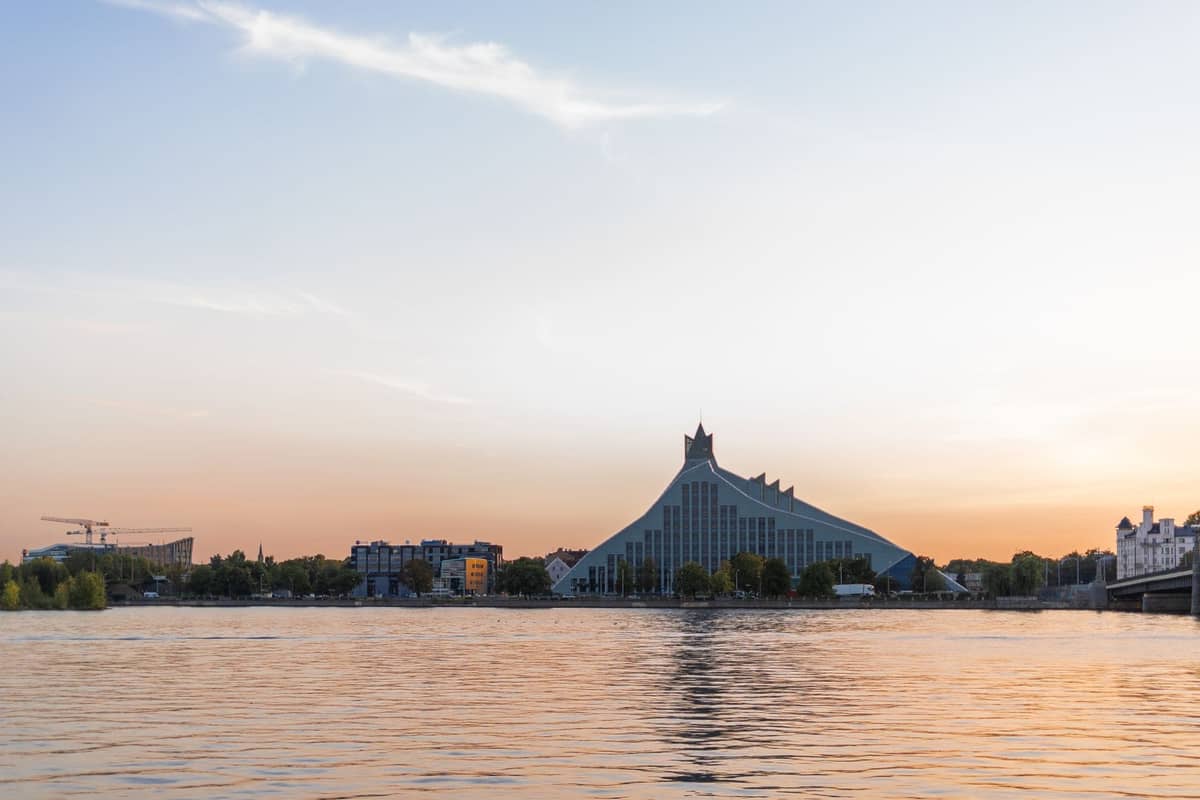
Viewed from the Akmens Bridge or from Old Town's embankment, the Castle of Light reads as a crystalline wedge rising from the riverbank, its angled glass facade reflecting the sky and the water in shifting panels of light and grey. The form is deliberately non-rectilinear: Birkerts described it as a hill of books, and from certain angles the stepped, sloping profile suggests a geological feature more than a conventional public building. It sits in striking contrast to the red-brick and spire-heavy silhouette of Old Town directly across the river.
Inside, the central atrium is the spatial centrepiece. A dramatic cascade of reading terraces and open stacks rises through multiple floors, all flooded with natural light from the glass facade. The structural logic is exposed rather than hidden: you can see how the building holds itself up. For anyone interested in 20th and 21st century library architecture, this is a serious example.
Tickets & tours
Hand-picked options from our booking partner. Prices are indicative; availability and final rates are confirmed when you complete your booking.
Canal boat sightseeing tour in Riga
From 13 €Instant confirmationArt and culture walking tour of Riga with a local
From 66 €Instant confirmationFree cancellationSelf-guided discovery walk in Riga - the essential old town and its secrets
From 30 €Instant confirmationFree cancellationExclusive private guided tour of Riga's architecture with a local
From 175 €Instant confirmationFree cancellation
How the Visit Actually Feels
Approaching from Old Town, you cross the Daugava on the Akmens Bridge, and the building grows in scale as you descend toward the left bank. The entrance plaza is open and exposed to the river wind, which on cooler days means the glass doors offer real relief. The ground floor is genuinely public: there are reading areas, a café, exhibition spaces, and information desks. You do not need to show identification or hold a library card to walk in and explore the public floors.
The most rewarding part of the visit is looking up. From the atrium floor, the tower of stacked reading galleries above you conveys the scale of the collection in a way that flat numbers cannot. The building holds around 1,000 readers at capacity, and on a busy weekday afternoon the stacks hum with focused activity: students at long wooden tables, researchers requesting items from staff, the occasional quiet click of a laptop. It smells, satisfyingly, like paper and climate-controlled air.
On the upper floors, the glass facade frames a panoramic view across the Daugava toward the spires of Old Town Riga. The view is unhurried and free of crowds. This is arguably the best ground-level panoramic perspective on the Old Town skyline available anywhere in the city, and almost no tourist itineraries mention it.
ℹ️ Good to know
The library also offers a virtual tour on its official website if you want to preview the interior layout before visiting — useful for planning how long to spend on each floor.
Best Time to Visit and How It Changes
Midweek mornings are the quietest. Students and researchers arrive in waves around 10am, and the building fills gradually through the early afternoon. Weekend afternoons bring a different crowd: families, architecture tourists, and people who have walked across the bridge simply to see the exterior. Either works, but if you want to move freely through the floors without interruption, Tuesday or Wednesday mornings are reliable.
Seasonally, the Castle of Light is most dramatic in late autumn and winter, when low Baltic light hits the angled glass facade at a shallow angle and the interior glows from the outside like an illuminated lantern. In summer, the terrace and plaza areas near the river are pleasant before the day heats up. Rain does not significantly affect the visit since almost everything of interest is indoors, making this a genuinely useful option on grey Riga days.
If you are planning several days in Riga, the library fits naturally into a broader cultural itinerary. Consider pairing it with the Latvian National Museum of Art and the Museum of the Occupation of Latvia for a full day of Latvian cultural history.
Getting There and Practical Logistics
The library is at Mūkusalas iela 3, on the left bank of the Daugava. From Old Town, the straightforward route is on foot across the Akmens Bridge, which connects the Old Town embankment directly to the library's side of the river. The walk from the bridge to the entrance takes about five minutes. Several city bus routes also serve the area; check the Riga public transport network for current stops and routes nearest to Mūkusalas iela.
If you are using public transport more broadly, the getting around Riga guide covers the tram, trolleybus, and bus network in detail, including how to buy and validate tickets.
The building is modern and purpose-built, with level access at the main entrance and lifts serving all public floors. If you have specific accessibility requirements, contact the library in advance via the official website to confirm current arrangements.
Is the Castle of Light Worth the Detour?
The honest answer depends on what you are looking for. As a working public institution, the library is not an entertainment destination: there are no theatrical exhibits on the ground floor, no audio guides narrating dramatic moments in Latvian history. What it offers instead is a serious architectural experience, a free and uncrowded view of Old Town from across the water, and a genuine sense of what post-independence Latvia chose to build when it finally had the chance to build something permanent.
Travelers who find modern civic architecture uninteresting, or who are on a tight schedule focused entirely on the medieval Old Town, can reasonably skip this. But for anyone who reads cities through their buildings, or who wants to understand Latvia as a contemporary country rather than just a collection of historic facades, the Castle of Light is one of the more revealing stops in Riga.
It also makes practical sense to include on a free Riga itinerary, given that entry to the public areas costs nothing.
Photography Tips
The exterior is best photographed from the Akmens Bridge or from the Old Town embankment directly opposite. From that distance, you can capture the full diagonal profile of the building against the sky and frame it alongside the river. Early morning light on the glass facade is particularly clean, before haze or cloud cover flattens the reflections.
Inside, the atrium looking upward at the stacked galleries is the standard interior shot, but the more interesting photograph is often the reverse: standing on an upper floor and looking down through the glass facade toward the Daugava and Old Town. A wide-angle lens or the standard wide setting on a phone camera handles the interior scale well. Flash photography is not appropriate in active reading areas.
⚠️ What to skip
This is an active library, not a museum. Keep noise low in reading areas, avoid blocking access to stacks, and follow any posted signs about photography restrictions in specific sections.
Insider Tips
- The view of Old Town from the upper floors of the Castle of Light is one of the best in Riga, and almost no one mentions it. Take the lift to the higher public floors and look east across the Daugava.
- The building is dramatically lit from within after dark, visible from the Akmens Bridge and the Old Town embankment. If you are walking back from the left bank in the evening, stop on the bridge for the full effect.
- The library hosts temporary exhibitions, lectures, and cultural events throughout the year, many of them free. Check the events calendar on the official website before your visit to see if anything coincides with your trip.
- On rainy days when outdoor sightseeing loses its appeal, the library's public reading areas are warm, quiet, and free. The café near the entrance is a practical option for a break without queues.
- The building's folk-legend origin is worth reading before you visit. Knowing the story of the sunken castle makes the architectural choices feel intentional rather than arbitrary, and it adds weight to what might otherwise read as a stylish but generic civic building.
Who Is National Library of Latvia (Castle of Light) For?
- Architecture and design enthusiasts who want to see one of the most significant post-Soviet public buildings in the Baltics
- Travelers on a budget who want a culturally meaningful stop without an entry fee
- Photographers looking for the best skyline view of Old Town Riga from across the Daugava
- Visitors with an interest in Latvian history and national identity beyond the medieval streetscape
- Anyone caught in bad weather who wants an indoor cultural option close to Old Town
Nearby Attractions
Other things to see while in City Centre (Centrs):
- Bastejkalns Park & City Canal
Bastejkalns Park, also known as Bastion Hill Park, wraps around the edge of Riga's Old Town along the historic City Canal. Formed on the site of demolished 19th-century fortifications, it offers terraced lawns, stone cascades, canal-side paths, and a rare pocket of calm within easy walking distance of the Freedom Monument and the Art Nouveau district.
- Esplanade Park
Stretching across 8.75 hectares in the heart of Riga, the Esplanāde is the city's most centrally located public park. Framed by grand streets and a cluster of significant landmarks, it offers a quiet, unhurried counterpoint to Old Town's crowds — and it's completely free.
- Freedom Monument
The Freedom Monument is the symbolic heart of Riga, a 42.7-metre granite and travertine column that has stood at the intersection of the Old Town and the main boulevard since 1935. Entry is free, access is around the clock, and the hourly changing of the guard adds a living ritual to what might otherwise be a static landmark.
- KGB Building (Corner House)
At the corner of Brīvības iela and Stabu iela stands a building that once made Riga's residents cross to the other side of the street. The Corner House served as the KGB's Latvian headquarters from 1940 to 1991, housing interrogation rooms, cells, and a bureaucracy of fear. Today it functions as a museum that documents Soviet occupation with unflinching honesty.