Nakupenda Sandbank: Zanzibar's Tide-Dependent Strip of White Sand
Nakupenda Sandbank is a small, low-lying strip of white coral sand that emerges from the Indian Ocean about 4 km off Stone Town's west coast. Accessible only by boat and only at low tide, it offers calm turquoise water, soft sand, and a strong sense of being genuinely away from the island. The name means 'I love you' in Swahili.
Quick Facts
- Location
- Indian Ocean, Indian Ocean, a few kilometres west of Stone Town, Zanzibar (Unguja), Zanzibar (Unguja)
- Getting There
- Boat from Stone Town waterfront or Shangani Beach; Boat from Stone Town waterfront or Shangani Beach; roughly 20–30 minutes each way
- Time Needed
- Allow a few hours; combined tours can take 5–6 hours, and tide timing limits your time on the sand
- Cost
- Tour prices vary by operator and inclusions; Tour prices vary by operator and inclusions; confirm whether any marine-conservation fee applies to your itinerary
- Best for
- Snorkeling, honeymooners, swimmers, photographers, Stone Town day-trippers
What Nakupenda Sandbank Actually Is
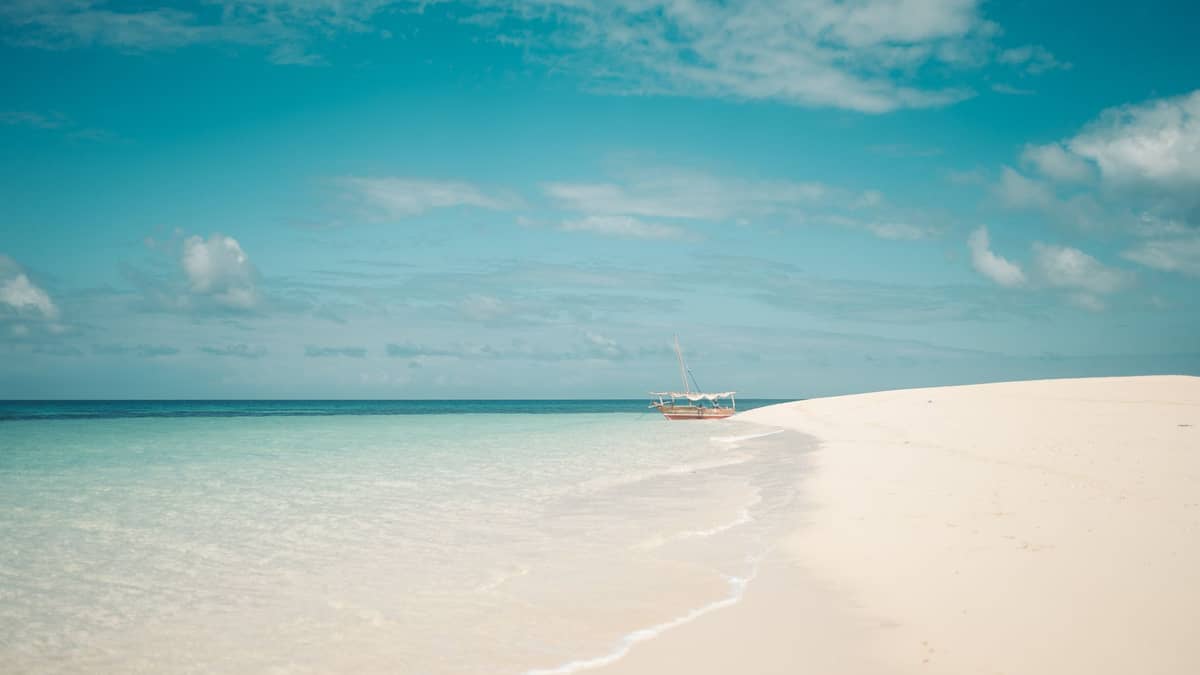
Nakupenda Sandbank is not a permanent island. It is a narrow, elongated bar of white coral sand that sits just above sea level in the channels west of Stone Town. At high tide, most of it disappears. At low tide, it becomes one of the more photogenic natural features in the archipelago: a sliver of bright sand surrounded by shallow turquoise water, with the Stone Town skyline faintly visible on the horizon.
The name 'Nakupenda' is Swahili for 'I love you,' and it is sometimes listed as Nakupenda Beach in tour listings, though 'beach' is a loose term for what is essentially a shifting sandbar. The sand itself is fine and pale, made of crushed coral, and the water in the surrounding shallows is typically warm and calm, sheltered from the stronger Indian Ocean swells.
⚠️ What to skip
Tide timing is everything here. If you arrive at or near high tide, there may be very little or no dry sand to stand on. Always ask your tour operator to confirm the low-tide window before booking a specific departure time.
Getting There: Boats, Departure Points, and What to Expect
There is no public transport to Nakupenda. Access is entirely by boat, with departures typically arranged through tour operators based in Stone Town. Most boats leave from the Stone Town waterfront or from Shangani Beach, the narrow strip of sand on the southwest edge of the old city. The crossing takes roughly 20–30 minutes in calm conditions, though dhow trips run by traditional wooden vessels can take longer depending on the wind.
Nearly all visits are sold as day trips, sometimes combined with a stop at Prison Island, which lies in the same channel to the northwest. Combined trips can stretch to five or six hours, which is a reasonable use of a day if you want to cover both in one outing.
Speedboat trips are faster and more predictable on timing. Dhow sailboat excursions are slower and more atmospheric, but they are also more dependent on wind conditions and can make precise tidal scheduling harder. If the tide window matters to you, a speedboat is the safer bet.
💡 Local tip
Book through an established Stone Town operator rather than accepting last-minute offers at the waterfront. Ask specifically what the price includes: transport, snorkeling gear, food, and any marine-area fees are not always bundled together.
Tickets & tours
Live prices and dates from our booking partner. If you book, we may earn a commission at no extra cost to you.
Zanzibar catamaran and snorkelling tour to Mnemba Marine Park
From 114 €Instant confirmationFree cancellationNyerere National Park two-day safari with two game drives
From 866 €Instant confirmationFree cancellationSerengeti National Park private three-day safari from Zanzibar
From 2.144 €Instant confirmationFree cancellationZanzibar north coast sunset dhow cruise
From 42 €Instant confirmationFree cancellation
The Experience on the Sandbank: Hour by Hour
Arrival at Nakupenda feels abrupt and a little surreal. One moment you are on a boat surrounded by open water; the next you are stepping onto a bright, exposed spit of sand with no trees, no shade structures, and nothing around you but ocean. On a clear morning, the light is sharp and the water reads as several distinct shades of blue and green depending on depth.
The sandbank is small. You can walk its length in a few minutes. What people do here is essentially swim, snorkel in the surrounding shallows, take photographs, and sit in the water where it is ankle-deep. The lack of shade is the most significant practical issue: the equatorial sun at midday is intense, and there are no natural windbreaks or umbrellas unless your operator brings them. Sunscreen, a hat, and a rash guard are not optional.
Morning trips, arriving around low tide, tend to offer the most sand area and the calmest surface conditions. By early afternoon the tide is usually rising, the sand area contracts, and some operators begin calling passengers back to the boat. The window of comfortable time on the sandbank is often two hours or less, which is worth factoring into your expectations.
💡 Local tip
Bring reef-safe sunscreen. Conventional sunscreen chemicals are harmful to coral, and the reefs around the sandbank are part of a broader marine ecosystem. Many operators now request or require reef-safe products.
Snorkeling and Marine Life
The shallows immediately around the sandbank can offer snorkeling, though the quality varies with conditions and season. The water near the sand itself is often stirred up and visibility can be limited in the immediate vicinity. Better snorkeling tends to be found slightly farther out, where the seabed transitions from sand to scattered reef structures.
Zanzibar's waters around the west coast are not the island's most celebrated dive or snorkel sites. If serious reef snorkeling is your primary goal, locations like Mnemba Atoll off the northeast coast offer significantly richer marine biodiversity. Nakupenda is better understood as a sandbank experience that includes snorkeling, rather than a snorkeling destination that happens to have a sandbank.
That said, on calm days with good visibility, it is possible to spot reef fish, sea urchins, and occasional starfish in the shallows. Gear is usually provided by operators, but check the condition of the masks and fins before you leave the shore, as rental quality varies.
Seasonal Considerations and Weather
Zanzibar's climate is tropical monsoon, and conditions at Nakupenda shift significantly with the seasons. The dry season from June through October brings steadier winds and generally calmer seas, making boat crossings more comfortable and visibility in the water more reliable. These months also align with Zanzibar's peak travel period, so trips fill up quickly and prices can reflect higher demand.
The long rains (roughly April to May) and short rains (November) can make boat trips rougher and less predictable. Some operators suspend sandbank trips during heavy weather. The months of December through March, while popular with European visitors escaping winter, can bring humid conditions and occasional afternoon squalls, though mornings are often clear and boat trips still operate regularly.
ℹ️ Good to know
The Indian Ocean tide cycle means the sandbank may be fully submerged on some days regardless of season. Check the local tide table for your travel dates and confirm low-tide timing with your operator at least a day in advance.
Who This Is For, and Who Should Skip It
Nakupenda works best as one component of a broader Stone Town day rather than as a standalone destination requiring significant planning. It is well suited to travelers who want a pure tropical-water experience close to the city, honeymooners looking for the kind of setting that photographs as dramatically as it feels, and families with children who swim confidently and can handle the boat crossing.
Travelers with mobility limitations should be aware that getting on and off the boat and wading through shallow water onto the sandbank involves uneven footing on sand and requires physical stability. The experience may not be accessible for everyone without prior arrangement. Similarly, travelers hoping for the lush, shaded beauty of the east coast beaches such as Paje Beach or Nungwi Beach will find Nakupenda stark by comparison: there is no shade, no fringing vegetation, and no infrastructure on the sandbank itself.
If you have limited time in Zanzibar and must choose between a sandbank trip and a full beach day, consider your priorities honestly. The sandbank is genuinely striking, but the experience is short, tide-dependent, and can feel rushed when the window is narrow. If you have three or more days on the island, it fits naturally into a Stone Town day. If you have only one full day, a beach may offer more relaxed value.
Practical Notes: Photography, What to Bring, and Booking
Photography conditions on the sandbank are excellent in the early morning when the light is soft and the water is glassy. By mid-morning the sun is high and harsh, which creates strong reflections on the water and flattens the color gradients that make sandbank photographs compelling. A polarizing filter, if you shoot with a camera that accepts one, makes a significant difference to water color.
Waterproof bags or dry bags are worth bringing, both for protecting your phone or camera on the boat and for the wade through shallow water to reach the sand. Most operators will not take responsibility for water-damaged electronics. Bring more water than you think you need: the heat on an exposed sandbank with no shade is deceptive, and dehydration sets in faster than it does on a shaded beach.
For context on how Nakupenda fits into a broader Stone Town itinerary, the Stone Town walking guide covers the old city's key sites, most of which can be seen in the same day as a sandbank trip if you plan your morning departure around the tide window.
Insider Tips
- Check the tide table before you book, not after. The Zanzibar tide cycle is roughly 12 hours, and the low-tide window shifts daily. An operator who refuses to confirm the tide schedule for your chosen day is a red flag.
- If you are combining Nakupenda with a Prison Island stop on the same trip, go to Prison Island first, especially if you want to see the giant Aldabra tortoises when they are most active in the morning shade. The sandbank works better as the midday or early-afternoon stop.
- Bring a small waterproof pouch for your phone rather than trusting dry storage on the boat. The wade from the boat to the sand, even in calm conditions, can involve knee-deep water if the tide is partially in.
- Morning departures on weekdays are noticeably less crowded than weekend or afternoon trips, which tend to attract larger tour group boats. Arriving at the sandbank before 9:30am gives you a significantly different experience.
- Negotiate snorkeling gear condition at the waterfront before departure, not once you are already on the water. Masks with broken seals or fins that do not fit are common with budget operators and very difficult to resolve mid-trip.
Who Is Nakupenda Sandbank For?
- Honeymooners and couples wanting a dramatic, isolated setting close to Stone Town
- Swimmers and snorkelers looking for calm, warm, shallow water
- Photographers chasing pale sand and turquoise water in a single frame
- Families with older children who are comfortable on small boats
- Stone Town visitors who want a half-day water excursion without traveling to the north or east coast
Nearby Attractions
Combine your visit with:
- Bwejuu Beach
Bwejuu Beach sits on Unguja's southeast coast, about 50 km from Stone Town, and delivers something increasingly rare on Zanzibar: a long stretch of sand without the resort crowds. The water is calm, the village is small, and the pace is slow. It suits travelers who want a beach day that feels like an escape rather than a performance.
- Cheetah's Rock Wildlife Sanctuary
Cheetah's Rock Wildlife Sanctuary is a small, guided wildlife experience on Unguja where visitors walk alongside rescued cheetahs, interact with servals, and meet a rotating cast of African species in semi-natural enclosures. It is expensive, deliberately exclusive, and unlike anything else on the island.
- Chumbe Island Coral Park
Chumbe Island Coral Park sits off Zanzibar's southwest coast and protects one of the Indian Ocean's most intact coral reef ecosystems. Reaching it requires advance planning, a boat transfer, and a genuine interest in marine conservation — but for the right traveler, nothing on the island compares.
- Kidichi Spice Farm & Persian Baths
A few kilometers inland from Zanzibar's northern coast road, the Kidichi Persian Baths preserve a rare piece of Omani sultanate architecture, complete with decorative plasterwork and domed ceilings. Paired with a working spice farm, this site offers a quieter, more considered alternative to the busier spice tours closer to Stone Town.
Planning a trip? Discover personalized activities with the Nomado app.