MAK – Museum of Applied Arts Vienna: What to Know Before You Go
Housed in a monumental Ringstrasse building on Stubenring, the MAK (Museum für angewandte Kunst) is one of Europe's foremost applied arts museums. With over 900,000 objects spanning furniture, textiles, glass, ceramics, metalwork, and design across five centuries, it rewards careful visitors far more than a casual walk-through.
Quick Facts
- Location
- Stubenring 5, 1010 Vienna (Innere Stadt)
- Getting There
- U3 Stubentor; Tram 2 Stubentor; Bus 3A / 74A Stubentor
- Time Needed
- 2–3 hours for highlights; half a day for the full collection
- Cost
- €19 on-site / €18 online (regular); free for under-19s
- Best for
- Design and craft enthusiasts, architecture lovers, Wiener Werkstätte fans
- Official website
- www.mak.at
What the MAK Actually Is (And Why It Matters)
The MAK – Museum of Applied Arts (Museum für angewandte Kunst) is not Vienna's most photographed institution, but it may be its most intellectually serious one. Founded in 1863 as the k.k. Österreichisches Museum für Kunst und Industrie under Emperor Franz Joseph I, it was conceived at a moment when Europe's industrial nations were rethinking the relationship between manufacturing and beauty. The idea was direct: train craftspeople and designers by exposing them to the finest historical objects. Over 160 years later, that founding tension between utility and artistry still drives the collection.
The museum moved to its current Ringstrasse address at Stubenring 5 in 1871, placing it among the grand institutional buildings that define Vienna's 19th-century urban ambition. Today its collection runs to over 900,000 objects and printed works, covering roughly five centuries of European and Asian applied arts. That number sounds overwhelming, and in a way it is. The curators respond by rotating and thematically rehanging rooms, so repeat visits genuinely differ.
If you are already exploring Vienna's Ringstrasse, the MAK sits at its eastern end, close to the canal. It pairs naturally with a walk along the boulevard and makes a logical stop on any serious Vienna architecture itinerary.
The Building: Ringstrasse Authority on the Outside, Surprise Within
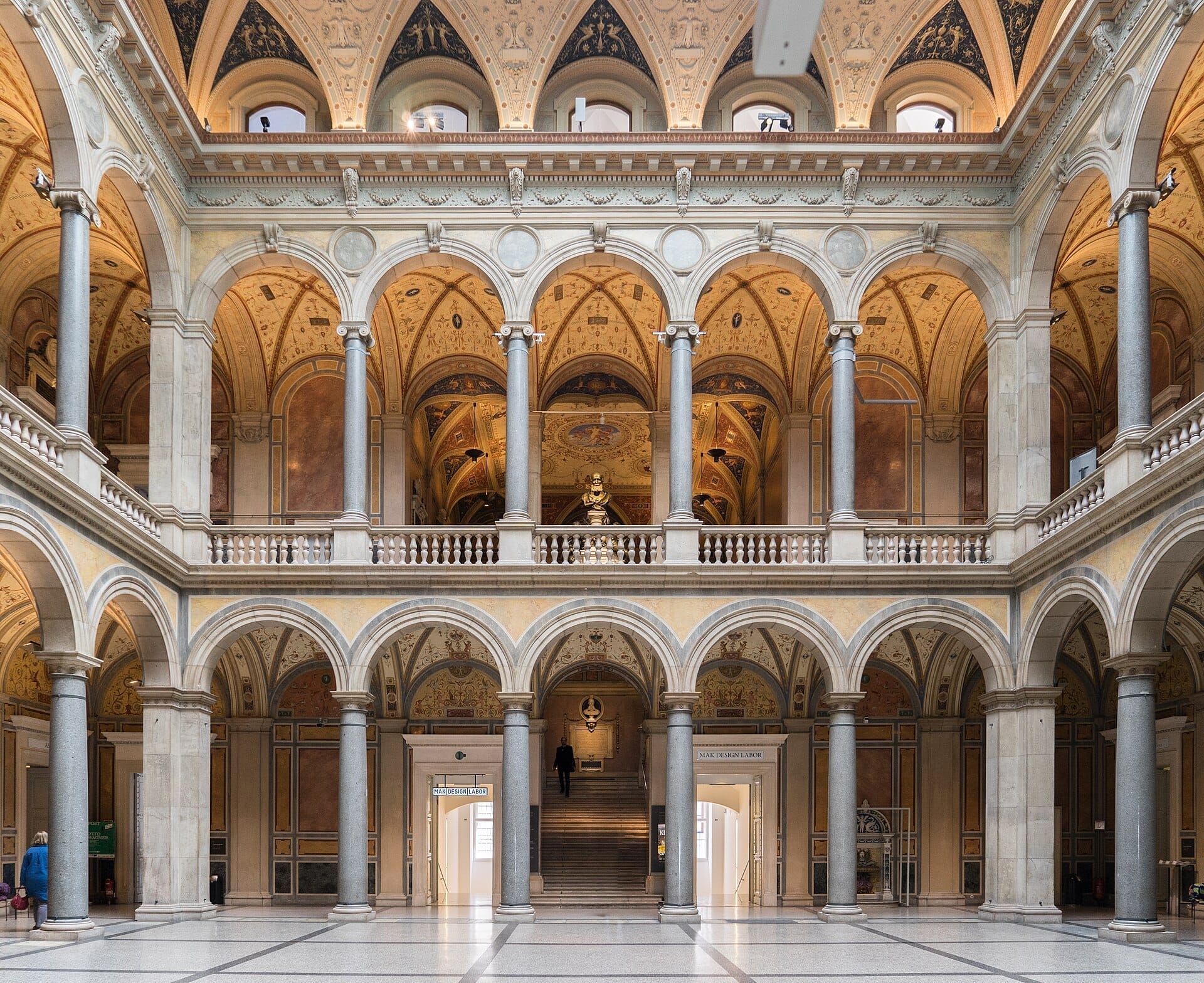
The main building on Stubenring presents the formal stone facade and arched windows typical of Ringstrasse historicism. It reads as serious and institutional from the street, which puts some visitors off before they even reach the door. That reaction is worth overriding. The interior offers a more varied experience than the exterior suggests: high gallery ceilings, elaborate decorative plasterwork, and a sequence of permanent collection rooms where contemporary designers were invited to create entirely new presentations for historic objects.
The result of those designer-curated rooms is one of the more unusual display approaches in European museology. Rather than uniform white walls and neutral cases, each room has its own visual logic, some austere and archival, others almost theatrical. The Wiener Werkstätte room is among the most celebrated, presenting the movement's furniture, textiles, and objects in a context that underlines how radical their early 20th-century design program actually was.
💡 Local tip
Pick up the floor plan at the ticket desk and identify two or three rooms you specifically want. The collection is large enough that unfocused wandering leads to fatigue before you reach the highlights.
Tickets & tours
Live prices and dates from our booking partner. If you book, we may earn a commission at no extra cost to you.
The Permanent Collection: What to Prioritize
The permanent galleries move through furniture and woodwork, textiles and carpets, glass and ceramics, metalwork, East Asian objects, and 20th-century design. The depth in each category would fill a dedicated specialist museum. For a first visit, a few areas stand out as genuinely irreplaceable.
The Wiener Werkstätte archive is the MAK's single most significant holding. The Werkstätte, the Viennese craft and design cooperative active from 1903 to 1932, produced furniture, jewelry, textiles, postcards, and domestic objects with a consistency of vision that influenced European design for decades. The MAK holds the largest collection of Werkstätte material in the world, including archive pieces rarely seen elsewhere. If you have any interest in early modernist design, this section alone justifies the ticket price.
The Oriental carpets and textiles room draws less foot traffic but contains pieces of extraordinary quality and age, some dating to the 16th century. The flat display format used for many carpets allows for close reading of pattern and dye, which vertical hanging does not. The East Asian collection, built largely from Habsburg imperial acquisitions, covers lacquerwork, ceramics, and textiles from China, Japan, and Korea with a scope that surprises first-time visitors unfamiliar with Vienna's imperial collecting habits.
The MAK's focus on applied and decorative arts places it in a different register from the fine-arts focus of the Kunsthistorisches Museum or the Belvedere. Visitors who find pure painting galleries tiring often find the MAK more engaging precisely because the objects invite you to think about function, material, and making.
How the Experience Shifts Through the Day
The MAK opens at 10:00 Tuesday through Sunday and stays open until 21:00 on Tuesdays, which is both its latest night and typically its quietest evening. Arriving shortly after opening on a weekday morning means you will share galleries with school groups in some rooms and almost no one in others. By midday on weekends, particularly in summer, the entrance hall and the more famous rooms fill with visitors on structured tours.
Tuesday evening is the practical recommendation for anyone who prefers space to think. After around 18:00, when the standard closing time applies to other days, foot traffic drops sharply. The gallery lighting in the permanent rooms feels more deliberate in lower natural light, and the designer-curated rooms in particular read better without crowds moving through them. This is also when the museum cafe tends to be calmer.
ℹ️ Good to know
The MAK is closed on Mondays but remains open on public holidays that fall on a Monday. If you are planning around a holiday, check the official calendar at mak.at before visiting.
Practical Logistics: Getting There, Getting In, Getting Around
The museum sits on Stubenring at the eastern end of the Ringstrasse boulevard, a short walk from the Danube Canal. The most direct route by public transport is the U3 line to Stubentor, which deposits you almost directly in front of the building. Tram line 2 also stops at Stubentor, and bus lines 3A and 74A stop at Stubentor and Weiskirchnerstraße respectively. The nearby Wien Mitte / Landstraße interchange connects to U4 and multiple S-Bahn lines for those coming from further afield.
Admission is €19 on-site or €18 if you book online in advance. Reduced tickets (for students, seniors, and other qualifying groups) cost €15.50 on-site or €14.50 online. Children and young people under 19 enter free. If you are planning multiple major museum visits, check whether the Vienna City Card or similar pass covers admission before paying at the door.
Accessibility is well-handled: a ramp and wheelchair-accessible elevator reach the ticket office, accessible restrooms are available, and guide dogs are permitted throughout. The gallery floors are smooth and level in most sections, making mobility aids practical. Photography is generally permitted in the permanent galleries without flash, though you should confirm the rules for any temporary exhibition.
💡 Local tip
Book tickets online to save €1 per person and avoid the ticket queue on busy mornings. The museum website at mak.at also shows current temporary exhibition schedules, which can significantly change what you will find on a given visit.
The MAK Garden and Exterior
Behind the main building, the MAK Garden (MAK-Garten) provides a low-key outdoor space that opens seasonally. It is not a major attraction in its own right, but on a warm afternoon it functions as a useful breathing point between gallery sections. The garden has been used for outdoor installations and events, which vary by year. In summer, the museum cafe extends outdoors here. On hot August days, the shadow of the old building falls across part of the garden by mid-afternoon, making it more comfortable than direct-sun alternatives along the canal.
Temporary Exhibitions and the MAK's Contemporary Role
The MAK runs a consistent program of temporary exhibitions alongside its permanent holdings, typically focusing on the intersection of historical craft, contemporary design, and architecture. Past programming has addressed topics from Vienna Secession graphics to digital fabrication and sustainability in design. The quality is generally high and the curatorial angle often more critical than the permanent collection's more reverential approach to historical objects.
The museum's engagement with Viennese modernism extends to its holdings related to the Wiener Secession movement, and a visit to both institutions in a single day gives a fuller picture of Vienna's extraordinary contribution to early 20th-century European design and art. The Secession building is about a 20-minute walk west along the Ring.
An honest note on expectations: the MAK does not deliver the kind of broad wow-factor that a first visit to the Kunsthistorisches Museum or the Upper Belvedere provides. It rewards knowledge and patience. Visitors who arrive hoping for an accessible highlight reel and leave after an hour often feel underwhelmed. Visitors who engage with the material on the museum's own terms, taking time with individual objects, reading the context panels, and connecting the applied arts holdings to Vienna's broader cultural history, tend to rank it among the city's most rewarding experiences.
Who Should Skip the MAK
If your Vienna itinerary is two days or fewer and you are prioritizing imperial palaces, the Belvedere, or the major fine arts collections, the MAK is a reasonable thing to cut. It is a specialist museum in the sense that its rewards scale with your interest in craft, design, and material culture. Visitors with young children may find the format challenging: the objects are mostly behind glass, the rooms are quiet by design, and there is limited interactive programming aimed at younger visitors. For families with children, options like the Naturhistorisches Museum or the Technisches Museum Wien offer more engagement.
If you are building a broader cultural itinerary and want guidance on where the MAK fits, the guide to Vienna's best museums sets out priorities across the city's major collections.
Insider Tips
- Tuesday evenings after 18:00 offer the quietest conditions in the permanent galleries. The lower foot traffic makes the designer-curated rooms significantly easier to absorb, and the cafe is calm enough to sit without a wait.
- The Wiener Werkstätte holdings are the MAK's single most important asset globally. Even if you have limited time, prioritize that section over a broad sweep of the whole building.
- The museum shop is unusually good by Vienna museum standards, carrying design-focused books, quality reproductions, and objects that reflect the collection's focus on craft. It is worth budgeting time and money for at the end of your visit.
- Temporary exhibitions sometimes require a separate ticket or supplement to the general admission. Check the current program on mak.at before you arrive so the additional cost is not a surprise at the door.
- The Stubenring location puts you close to the Stadtpark and the canal. A short walk east reaches the Danube Canal promenade, which is a pleasant way to decompress after a long gallery session, particularly in the evening.
Who Is Museum of Applied Arts (MAK) For?
- Design and decorative arts enthusiasts with an interest in the Wiener Werkstätte and early 20th-century modernism
- Architecture lovers exploring the Ringstrasse institutional buildings
- Visitors making a second or third trip to Vienna who have already covered the major fine arts institutions
- Researchers and students with interest in European craft, textile, or furniture history
- Slow travelers who prefer depth over breadth and are happy spending a half-day in a single institution
Nearby Attractions
Other things to see while in Innere Stadt (1st District):
- Albertina Museum
Housed in a former Habsburg palace at the edge of the Ringstrasse, the Albertina holds one of the largest and finest graphic art collections in the world. With over one million drawings and prints alongside rotating exhibitions of modern masters, it rewards both the casual visitor and the serious art traveler.
- Austrian National Library (Prunksaal State Hall)
The Prunksaal, or State Hall of the Austrian National Library, is a Baroque masterpiece built for Emperor Charles VI between 1723 and 1726. At roughly 80 metres long and crowned by Daniel Gran's sweeping ceiling frescoes, it is one of the most visually arresting interiors in central Europe, and still holds around 200,000 historic volumes in its carved walnut shelves.
- Burgtheater
The Burgtheater is Austria's national theatre and one of the most significant German-language stages in the world. Its Neo-Renaissance building on Vienna's Ringstraße dates to 1888, and its institutional history stretches back to the court of Empress Maria Theresa. Whether you come for a performance or a guided tour, it rewards attention.
- Café Central
Housed inside the Palais Ferstel in Vienna's historic first district, Café Central has been serving coffee and conversation since 1876. Once the gathering point for Freud, Trotsky, and a constellation of Central European intellectuals, it remains one of the most architecturally remarkable coffeehouses in the world.
Planning a trip? Discover personalized activities with the Nomado app.