Mtoni Palace Ruins (Beit-el-Mtoni): Zanzibar's Oldest Royal Ruin
Dating to 1829, Mtoni Palace Ruins are the oldest surviving remnants of Sayyid Said's royal palaces on Unguja. Sitting on the coast about 5–6 km north of Stone Town, the site offers a rare, unmediated encounter with Zanzibar's Omani sultanate past. It is quiet, atmospheric, and genuinely overlooked by most itineraries.
Quick Facts
- Location
- Malawi Road, approx. 5–6 kilometres north of Stone Town, Zanzibar City
- Getting There
- Taxi or hired scooter from Stone Town; dala-dala toward Bububu passes nearby — confirm stop locally
- Time Needed
- 45 minutes to 1.5 hours
- Cost
- Foreign adults USD 5 / children USD 2; local adults TZS 2,000 / children TZS 1,000 (confirm on arrival)
- Best for
- History seekers, architecture fans, travelers who want silence over spectacle
- Official website
- utaliismz.go.tz/tourism-sites/mtoni
What Mtoni Palace Ruins Actually Are
The Mtoni Palace Ruins, known in Swahili as Beit-el-Mtoni (also written Bait El Mtoni), are the skeletal remains of what was once the first royal palace built in Zanzibar. Built around 1829 during the reign of Sayyid Said bin Sultan, the Omani ruler who relocated his court from Muscat to Zanzibar and transformed the island into a commercial and political capital, Beit-el-Mtoni served as the primary royal residence before the seat of power eventually shifted closer to what is now Stone Town.
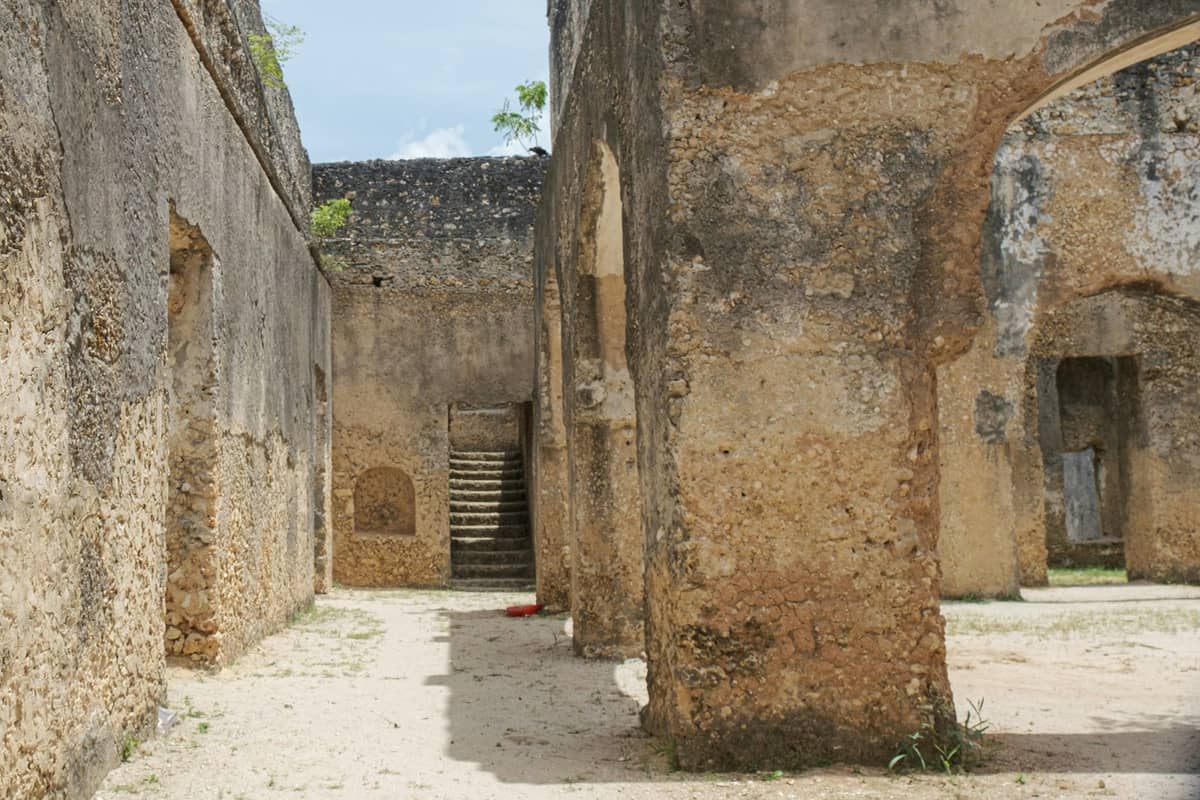
The Zanzibar government's tourism authority describes Mtoni as the oldest of Sayyid Said's island palaces, and the physical evidence supports that claim. What survives today includes the outer shell of a substantial multi-room structure, partial arches, weathered coral-stone walls, and a large circular tank that once served as a bathing chamber. The scale of the footprint tells you this was not a modest retreat. At its peak, the palace housed the sultan, his large household, dozens of concubines, slaves, and a menagerie that reportedly included flamingos and gazelles.
ℹ️ Good to know
The site is officially listed by the Zanzibar government tourism authority under the name 'Mtoni Ruins Palace.' No verified opening hours are published. Before making the trip, confirm current access times locally at your hotel or through the tourism office in Stone Town.
The Experience of Visiting
Arriving at Mtoni, the first thing you notice is the contrast with Stone Town. There is no hawker gauntlet at the gate, no souvenir stalls pressed up against the entrance, and, on most mornings, no meaningful crowd. The site sits beside the coast road north of the city, partially shaded by old trees, with mangroves and the channel visible beyond the ruins. The smell of salt water and damp stone is immediate.
The ruins are open to the sky. Walls that once supported a roof now frame rectangles of tropical sky, and the interior spaces fill with light differently at different hours. In the morning, the low eastern sun throws long shadows across the coral stone, making the texture of the walls readable in a way that afternoon flat-light simply does not. If you have any interest in photography or in understanding the architecture, morning is meaningfully better.
By midday, the site can feel harsh. There is limited shade within the ruins themselves, the stone radiates heat, and the experience becomes a test of endurance rather than contemplation. Late afternoon softens things again, and the light on the coastal side turns warm. Visiting close to sunset can be atmospheric, though you should confirm that the site is still accessible at that hour before planning around it.
💡 Local tip
Wear closed shoes or sturdy sandals. The ground inside the ruins is uneven, with loose rubble and rough coral stone. Flip-flops are workable but not ideal, especially if you want to move through the site at your own pace without watching every step.
Tickets & tours
Live prices and dates from our booking partner. If you book, we may earn a commission at no extra cost to you.
Zanzibar catamaran and snorkelling tour to Mnemba Marine Park
From 114 €Instant confirmationFree cancellationNyerere National Park two-day safari with two game drives
From 866 €Instant confirmationFree cancellationSerengeti National Park private three-day safari from Zanzibar
From 2.144 €Instant confirmationFree cancellationZanzibar north coast sunset dhow cruise
From 42 €Instant confirmationFree cancellation
Historical Context: Why This Palace Matters
Sayyid Said bin Sultan moved the Omani court to Zanzibar permanently in 1840, but Beit-el-Mtoni predates that move by over a decade, meaning it was already standing when he made Zanzibar the capital of his maritime empire. The palace was a statement of intent: Zanzibar was not a colony being managed from afar, it was to be the center of a trading network that stretched from the East African coast to the Persian Gulf and India. Cloves, ivory, and slaves passed through Zanzibari ports, and the wealth generated built structures like Mtoni.
One of the most historically vivid accounts of life at Mtoni comes from Princess Salme, a daughter of Sayyid Said who later converted to Christianity, eloped with a German merchant, and published her memoirs in the 1880s under the name Emily Ruete. Her writing describes Beit-el-Mtoni as a lively, chaotic household, full of children, animals, and constant activity. Reading her account before visiting gives the ruins a human dimension that the stones alone cannot.
For a deeper look at the princess whose childhood unfolded within these walls, the Princess Salme Museum in Stone Town provides primary-source material and personal objects that bring her story into focus.
The Omani-era architecture at Mtoni sits within a broader tradition of coral-stone building that defines Zanzibar's built environment. If the structural forms interest you, the Stone Town architecture guide provides context for how these buildings were constructed, financed, and used.
Practical Walkthrough: Getting There and Around the Site
Mtoni lies on Malawi Road, roughly five to six kilometres north of Stone Town along the western coast of Unguja. The most straightforward approach is a taxi from Stone Town, which should take fifteen to twenty minutes depending on traffic. Agree on a fare before you depart, and consider asking the driver to wait or arranging a return pickup time, since onward transport from the site itself is not reliable.
Dala-dala minibuses running toward Bububu pass along the coastal road and can get you close to the site, but the correct stop and walking distance should be confirmed locally before you rely on this option. It is viable and significantly cheaper than a private taxi, but requires patience with timing and route confirmation.
The ruins are not large. A self-guided exploration takes thirty to forty-five minutes if you move through methodically. There is no official audio guide and no interpretive panels of significant depth, so arriving with some background knowledge, whether from a guidebook or prior reading, makes the visit more rewarding. If you book a guided history tour of the Stone Town area, some operators include Mtoni as a stop. That context, delivered on-site, changes the experience considerably.
⚠️ What to skip
No verified accessibility information exists for this site. One travel listing describes it as not wheelchair-accessible, consistent with what ruined coral-stone sites typically involve. Visitors with limited mobility should verify conditions directly before making the journey.
Honest Assessment: What Works and What Does Not
Mtoni Palace Ruins reward a specific kind of traveler: someone comfortable with ambiguity, interested in history, and willing to do some imaginative reconstruction. The site is not a polished heritage experience. There are no glossy interpretive displays, no reconstructed rooms, and no obvious narrative thread guiding you from one space to the next. What you get is the raw material of history: scale, texture, and silence.
Travelers who need strong interpretation infrastructure, clear visitor flow, or physical comfort to engage with a site will likely find Mtoni disappointing. The ruins are genuinely evocative, but they are also genuinely ruined, and the gap between what was and what remains requires effort to bridge. If you prefer your historical attractions fully curated, the Slave Trade Museum or the Old Dispensary in Stone Town deliver a more structured experience. The House of Wonders remains closed for restoration after the 2020 collapse.
Visitors with children may find the open, explorable quality of the ruins engaging for older kids, though younger children will tire of it quickly. For a family-friendly historical stop closer to Stone Town, the House of Wonders offers more visual engagement.
Mtoni fits naturally into a broader exploration of Zanzibar's royal and colonial past. Combining it with the nearby Maruhubi Palace Ruins, which lie between Mtoni and Stone Town, makes the most of the journey north and lets you read the arc of 19th-century Omani palace building on the island.
Combining Mtoni With the Surrounding Area
The stretch of coast between Stone Town and Bububu contains several historically significant sites within a short distance of one another. Maruhubi Palace Ruins, also built during the Omani sultanate era, are closer to the city and often visited as a pair with Mtoni. The two sites are different enough architecturally to justify visiting both on the same half-day itinerary.
The Mangapwani area, further north, adds another layer to the same historical narrative. The Mangapwani slave caves are where enslaved people were hidden from British naval patrols after the formal abolition of the trade, connecting the wealth that built palaces like Mtoni to its human cost in an unavoidable way. That pairing, Mtoni followed by Mangapwani, makes for a sobering and important afternoon.
For a fuller understanding of Zanzibar's slave trade history and how it intersects with the sultanate period, the guide to Zanzibar's slave history provides essential background.
Insider Tips
- Visit in the first two hours after sunrise. The coral-stone walls take on a warm glow in early light, the heat has not yet built, and you will almost certainly have the site to yourself.
- Read Princess Salme's memoirs (published as 'Memoirs of an Arabian Princess') before or after visiting. Even a few pages about her childhood at Beit-el-Mtoni transforms the ruins from an abstract historical footnote into a place that once held a specific, documented human life.
- Ask your taxi driver to also stop at Maruhubi Palace Ruins on the way back to Stone Town. They sit between Mtoni and the city center, the detour adds fifteen minutes, and the admission cost is similarly modest. The two sites complement each other well.
- Bring water. There are no vendors or facilities at the site, the stone radiates significant heat by midday, and the visit, though short, is entirely outdoors.
- Admission prices listed on the Zanzibar government tourism page (USD 5 for foreign adults at time of writing) may differ from what is collected on arrival. Carry small denomination USD or Tanzanian shillings, and verify the current rate when you arrive rather than assuming the published figure is current.
Who Is Mtoni Palace Ruins For?
- History and archaeology enthusiasts who engage with fragmentary evidence rather than requiring a polished presentation
- Travelers combining Zanzibar with deeper Swahili coast or Omani heritage research
- Photographers interested in textured stone, tropical light, and architectural decay without crowds
- Visitors on a dedicated Stone Town history day who want to extend north of the city center
- Anyone who has read Princess Salme's memoirs and wants to stand inside the place she described
Nearby Attractions
Combine your visit with:
- Bwejuu Beach
Bwejuu Beach sits on Unguja's southeast coast, about 50 km from Stone Town, and delivers something increasingly rare on Zanzibar: a long stretch of sand without the resort crowds. The water is calm, the village is small, and the pace is slow. It suits travelers who want a beach day that feels like an escape rather than a performance.
- Cheetah's Rock Wildlife Sanctuary
Cheetah's Rock Wildlife Sanctuary is a small, guided wildlife experience on Unguja where visitors walk alongside rescued cheetahs, interact with servals, and meet a rotating cast of African species in semi-natural enclosures. It is expensive, deliberately exclusive, and unlike anything else on the island.
- Chumbe Island Coral Park
Chumbe Island Coral Park sits off Zanzibar's southwest coast and protects one of the Indian Ocean's most intact coral reef ecosystems. Reaching it requires advance planning, a boat transfer, and a genuine interest in marine conservation — but for the right traveler, nothing on the island compares.
- Kidichi Spice Farm & Persian Baths
A few kilometers inland from Zanzibar's northern coast road, the Kidichi Persian Baths preserve a rare piece of Omani sultanate architecture, complete with decorative plasterwork and domed ceilings. Paired with a working spice farm, this site offers a quieter, more considered alternative to the busier spice tours closer to Stone Town.
Planning a trip? Discover personalized activities with the Nomado app.