Mnajdra Temples: Malta's Most Atmospheric Prehistoric Site
Perched on Malta's rugged southern coastline near Qrendi, the Mnajdra Temples are a UNESCO World Heritage complex dating back over 5,500 years. Three interlocking structures of coralline limestone, engineered to track the sun's movement with architectural precision, make this one of the most significant prehistoric sites in the world.
Quick Facts
- Location
- Triq Ħaġar Qim, Qrendi, southern Malta
- Getting There
- Bus from Valletta to Ħaġar Qim stop; short walk to site
- Time Needed
- 1.5 to 2.5 hours including Ħaġar Qim
- Cost
- Paid entry; combined ticket with Ħaġar Qim. Check heritagemalta.mt for current prices
- Best for
- History enthusiasts, photography, quiet contemplation
What Mnajdra Actually Is
The Mnajdra Temples are a cluster of three megalithic structures built between approximately 3600 and 2500 BCE, making them contemporaries of the earliest phases of Stonehenge and centuries older than the Egyptian pyramids. They sit on a coastal limestone shelf about 497 metres south of the better-known Ħaġar Qim complex, sharing an archaeological park managed by Heritage Malta. Together, they form part of the UNESCO-inscribed Megalithic Temples of Malta, a World Heritage Site recognised in 1992.
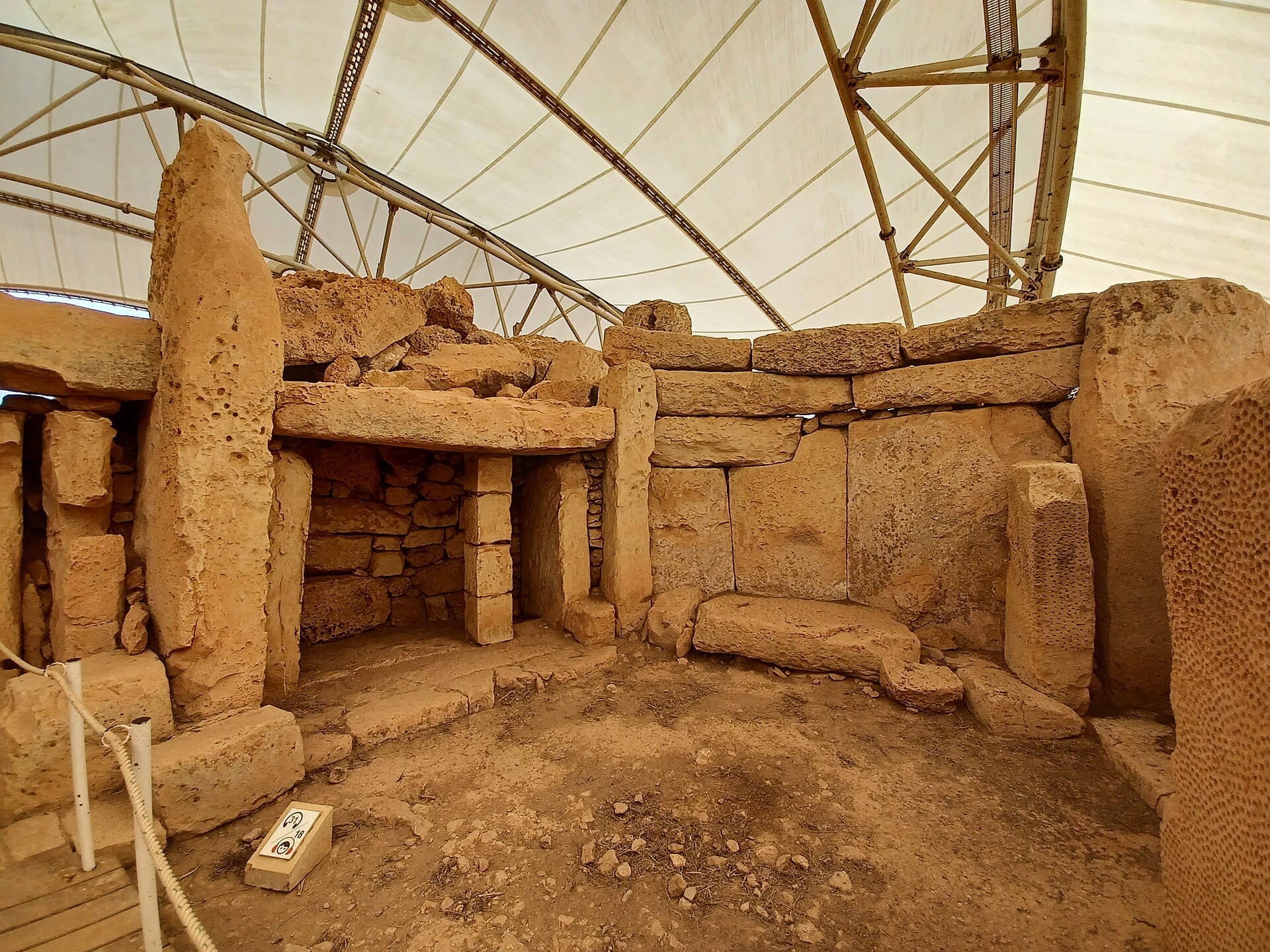
Three distinct structures make up the complex: the oldest of the three is a small three-apsed structure and arranged in a three-apsed plan; the South Temple, notable for its precisely engineered solar alignment; and the smaller Central Temple, tucked between them. The East Temple's limestone has weathered into rounded, almost organic forms, while the South Temple retains sharper edges and a sense of deliberate geometry. Walking between them, you get a tangible sense of a community that returned to this place across multiple generations, layering meaning and construction onto the same windswept cliff.
💡 Local tip
Mnajdra is included in a combined ticket with Ħaġar Qim. Visit both on the same morning, starting with Mnajdra at opening time when the light is low and the site is quietest.
The Solar Alignment: Why Mnajdra Is Different
What sets Mnajdra apart from other prehistoric sites, even from Ħaġar Qim a few hundred metres away, is its relationship with the sun. The doorway of the South Temple is oriented so that on the spring and autumn equinoxes, the first rays of sunrise pass through the entrance and illuminate the central altar with precise accuracy. During the solstices, the light falls on the edges of specific megaliths flanking the doorway, effectively creating a prehistoric calendar carved in stone.
This was not accidental. Researchers have calculated that the alignment works to within a few centimetres of what would be required for accurate solar tracking. Whether this served a ritual, agricultural, or administrative function is still debated, but the engineering competence required is extraordinary for a society that predates the wheel in Malta. Visiting on or near an equinox is an entirely different experience: a small crowd of astronomy enthusiasts and archaeoastronomers typically gathers at dawn to witness the effect.
For ordinary visits, the alignment is still visible in the spatial logic of the interior. Standing inside the South Temple and looking toward the entrance, you can see how the trilithon framing the doorway would funnel and focus light. The sense of intentionality is striking, even on an overcast day.
Tickets & tours
Hand-picked options from our booking partner. Prices are indicative; availability and final rates are confirmed when you complete your booking.
Gozo full-fay tour including Ggantija Temples
From 80 €Instant confirmationFree cancellationCity Sightseeing hop-on hop-off bus tour of Gozo
From 20 €Instant confirmationFree cancellationThe Malta Experience Audio-Visual Show and La Sacra Infermeria Tour
From 20 €Instant confirmationFree cancellationLuggage Storage in Malta
From 6 €Instant confirmationFree cancellation
What the Visit Feels Like
The path from the Ħaġar Qim visitor centre to Mnajdra is about a ten-minute walk along a stone-paved trail through open garrigue scrubland. The vegetation here is low and aromatic: thyme, wild fennel, and Mediterranean shrubs hug the ground, and the air carries a faint salt edge from the sea below. The sound of wind is almost constant on this exposed stretch of coast. By the time the temples come into view below the ridge, framed against the Mediterranean, the distance from the visitor centre already feels deliberate.
The site is covered by a large tensile shelter structure, installed in 2008 to protect the limestone from further weathering and acid rain. First-time visitors sometimes find this a visual shock: the white canopy reads as industrial against the prehistoric stones. In practice, the shelter reduces harsh midday shadow and actually improves visibility of carved details. It also makes the site usable on hot summer afternoons when Ħaġar Qim's exposed position becomes uncomfortable.
Inside the temples, the scale is more intimate than photographs suggest. The largest stones reach several metres in height, but the interior passages are narrow, and the apses curve inward in a way that feels almost enclosed. In the early morning, before tour groups arrive, the silence inside the complex is considerable. Later in the day, especially between 10am and 1pm in peak season, the site draws tour groups and the atmosphere shifts noticeably.
ℹ️ Good to know
Mnajdra was vandalised in 2001 when approximately 60 stones were damaged with hammers. The site was painstakingly restored by 2002. The incident accelerated the installation of the protective shelters and is part of why access within the temples is now managed carefully.
Historical and Cultural Context
The Maltese temple period, known broadly as the Ġgantija phase through the Tarxien phase, lasted roughly from 3600 to 2500 BCE. The civilisation that built Mnajdra left no written records and disappeared before the Bronze Age arrival of new peoples on the islands. What survives is architecture: temples, pitted decoration on stone surfaces, figurines, and animal bones suggesting ritual feasting or sacrifice. Mnajdra's builders quarried both globigerina limestone, a softer yellowish stone used for interior features, and the harder coralline limestone that forms the outer walls and has survived the millennia more intact.
The temples share a design language with other Maltese prehistoric complexes. If you've already visited the Ħaġar Qim Temples on the same site, you'll recognise the trefoil or cloverleaf apse plan, the pitted decoration on upright stones, and the use of threshold stones to define ritual space. Mnajdra's South Temple, however, is considered the best-preserved of all the Maltese temples and the most sophisticated in terms of its construction detail.
For deeper context on how this fits into Malta's extraordinary prehistoric legacy, the Ħal Saflieni Hypogeum in Paola offers the underground counterpart to the surface temples, and the Tarxien Temples in the south of Malta show the later phase of the same temple-building tradition. Our guide to Malta's ancient temples covers how to sequence all of these sites effectively.
Practical Walkthrough: Getting There and Around
Mnajdra is reached via the Ħaġar Qim and Mnajdra Archaeological Park, located along Triq Ħaġar Qim outside the village of Qrendi in southern Malta. By bus from Valletta, services run to the Ħaġar Qim area; check Malta Public Transport routes for the most current timetable, as rural bus frequency varies by season. The drive from Valletta takes roughly 25-30 minutes by car or taxi, and limited parking is available at the visitor centre.
Entry to Mnajdra is managed through the visitor centre at Ħaġar Qim, which includes a small interpretive museum with finds from both sites, replicas of key artefacts, and audiovisual content. A combined ticket covers both Ħaġar Qim and Mnajdra. Verify current pricing at heritagemalta.mt before your visit, as admission fees are subject to revision.
The path between the visitor centre and Mnajdra is partially paved and partially compacted stone. It involves gentle slopes and uneven surfaces. The temples themselves have low thresholds and narrow interior passages. Visitors with limited mobility should check accessibility details directly with Heritage Malta. Comfortable closed-toe shoes are advisable; the path and surrounding scrubland can be slippery after rain.
⚠️ What to skip
There is no shade on the path between Ħaġar Qim and Mnajdra, and the coastal cliff site receives full sun. In July and August, midday temperatures regularly exceed 35°C. Bring water, sunscreen, and a hat. Early morning visits are strongly advisable in summer.
Photography and Best Times to Visit
Morning light from the east falls directly on the temple facades during the first two hours after sunrise, giving the coralline limestone a warm, textured quality that afternoon light flattens out. The low angle also emphasises the pitting and surface decoration on interior stones. By mid-morning, tour groups begin arriving and the intimate atmosphere that makes early visits worthwhile disappears quickly.
The coastal backdrop visible from the path and the cliff edge below the temples adds a compositional element that Ħaġar Qim, set further back from the coast, lacks. On clear days, the island of Filfla, a small uninhabited limestone stack, sits about four kilometres offshore and is visible from the cliff path. This coastline, with its flat-cut salt pan character further north and the blue depth of the sea directly below, gives Mnajdra a setting that reads as genuinely ancient.
The equinoxes in March and September bring dedicated visitors for the solar alignment at dawn. If you're planning your trip around Malta's wider calendar of outdoor experiences, the best time to visit Malta guide covers seasonal trade-offs in more detail.
Who This Site Is For, and Who Might Not Enjoy It
Mnajdra rewards visitors who are willing to slow down and read a place carefully. The stones do not announce themselves. There are no grand vistas from inside the complex, no towering columns, no polished museum interiors. What is here is age, precision, and silence, and those things require a certain frame of mind to appreciate fully.
Visitors expecting a dramatic spectacle comparable to a major European cathedral or a well-staged museum exhibition may find the site underwhelming. The temples are low, partially reconstructed, and sheltered under a canvas canopy that is not aesthetically seamless. Children under ten often lose interest quickly unless accompanied by an adult who can contextualise what they're seeing. That said, for anyone with a genuine interest in prehistory, comparative archaeology, or the history of astronomy, Mnajdra is a serious site that stands alongside any comparable monument in Europe.
If you're building a broader itinerary around Malta's historical depth, the things to do in Malta guide and our 3-day Malta itinerary both factor in the southern temple sites as half-day commitments best paired with the Blue Grotto or Ghar Lapsi on the same coastal run.
Insider Tips
- Visit on a weekday rather than a weekend. The southern temple sites draw significant Sunday traffic from locals as well as tourists, and weekday mornings from Tuesday to Thursday are noticeably quieter.
- The on-site audioguide available at the visitor centre adds meaningful context that site signage alone does not provide. Factor in an extra 20 minutes at Ħaġar Qim before walking down to Mnajdra.
- If you visit near the spring equinox (around March 20-21), the solar alignment in the South Temple is visible at sunrise. Arrive well before dawn to position yourself inside the temple; numbers are limited by the small interior space.
- The path to Mnajdra passes through garrigue habitat. In spring (March to May), wild flowers including asphodels and Maltese rock-centaury are in bloom and make the walk itself worth taking slowly.
- Combine Mnajdra with Ghar Lapsi, a natural swimming inlet about 10 minutes drive along the coast. After a hot morning at the temples, the clear water there is a practical reward.
Who Is Mnajdra Temples For?
- Archaeology and prehistory enthusiasts who want to see one of the world's best-preserved Neolithic complexes
- Photographers seeking early morning light on ancient limestone with a coastal backdrop
- Travellers on a longer Malta itinerary who want to move beyond Valletta into the island's deeper historical layers
- Anyone visiting around the spring or autumn equinox to witness the solar alignment
- Couples and independent travellers who prefer quiet, unhurried visits to major heritage sites
Nearby Attractions
Combine your visit with:
- Blue Grotto
The Blue Grotto is a cluster of sea caves cut into Malta's southern limestone cliffs, accessible only by small traditional boats. The vivid phosphorescent blues inside are striking in morning light, but the experience depends heavily on sea conditions and timing.
- Dingli Cliffs
Standing at 253 metres above the Mediterranean, Dingli Cliffs form the most dramatic natural viewpoint in Malta. The clifftop road offers sweeping open-sea panoramas, a centuries-old limestone chapel at the edge, and a sunset that turns the rock face deep amber. No admission, no crowds (if you time it right), and no guide required.
- Għajn Tuffieħa Bay
Għajn Tuffieħa Bay sits on Malta's northwest coast, separated from the road by more than 200 steep steps — a deliberate filter that keeps it quieter than most Maltese beaches. The reward is a wedge of reddish-orange sand framed by green clay cliffs, a 17th-century watchtower on the headland, and water that shifts from pale aquamarine to deep cobalt by midday.
- Għar Dalam
Għar Dalam is a 144-metre cave in Birżebbuġa that preserves the bones of dwarf elephants, hippos, and bears from Malta's prehistoric past. The attached museum adds scientific depth to the raw geology of the cave itself. It is a serious natural history site, not a polished tourist spectacle.