Għar Dalam Cave and Museum: Malta's Ice Age Time Capsule
Għar Dalam is a 144-metre cave in Birżebbuġa that preserves the bones of dwarf elephants, hippos, and bears from Malta's prehistoric past. The attached museum adds scientific depth to the raw geology of the cave itself. It is a serious natural history site, not a polished tourist spectacle.
Quick Facts
- Location
- Għar Dalam Road, Birżebbuġa, Malta
- Getting There
- Bus routes 80 or 82 (Dalam stop, 1-min walk); parking on site
- Time Needed
- 1 to 1.5 hours
- Cost
- Adults €6.50 / Youths €5.00 / Children €4.00 / Under 5 free
- Best for
- Natural history, geology, curious travellers, families with older children
- Official website
- heritagemalta.mt/explore/ghar-dalam
What Is Għar Dalam?
Għar Dalam, which translates from Maltese as "Cave of Darkness," is one of the most significant palaeontological sites in the entire Mediterranean region. Located on the southeastern edge of Malta near the port town of Birżebbuġa, this 144-metre limestone cave contains sediment layers that record over 500,000 years of geological and biological history. The bones found here include the remains of dwarf elephants, hippopotamuses, brown bears, wolves, and giant swans, animals that roamed across a land bridge connecting Malta to Sicily and mainland Europe during Ice Age periods when sea levels were dramatically lower.
The deepest fossil-bearing layers date to more than 160,000 years ago. The earliest evidence of human habitation at the site dates to approximately 7,400 years ago, placing Għar Dalam at the very beginning of Malta's human story. This single cave, in other words, covers a sweep of time that stretches from the Pleistocene to the Neolithic. For a country with no land border and a total area of 316 square kilometres, that is a remarkable concentration of prehistoric evidence.
ℹ️ Good to know
Għar Dalam is managed by Heritage Malta and is open Tuesday to Sunday; check https://heritagemalta.mt for current hours and last admission. It is closed on Mondays. Heritage Malta Passport holders enter free.
The Cave: What You Actually See Underground
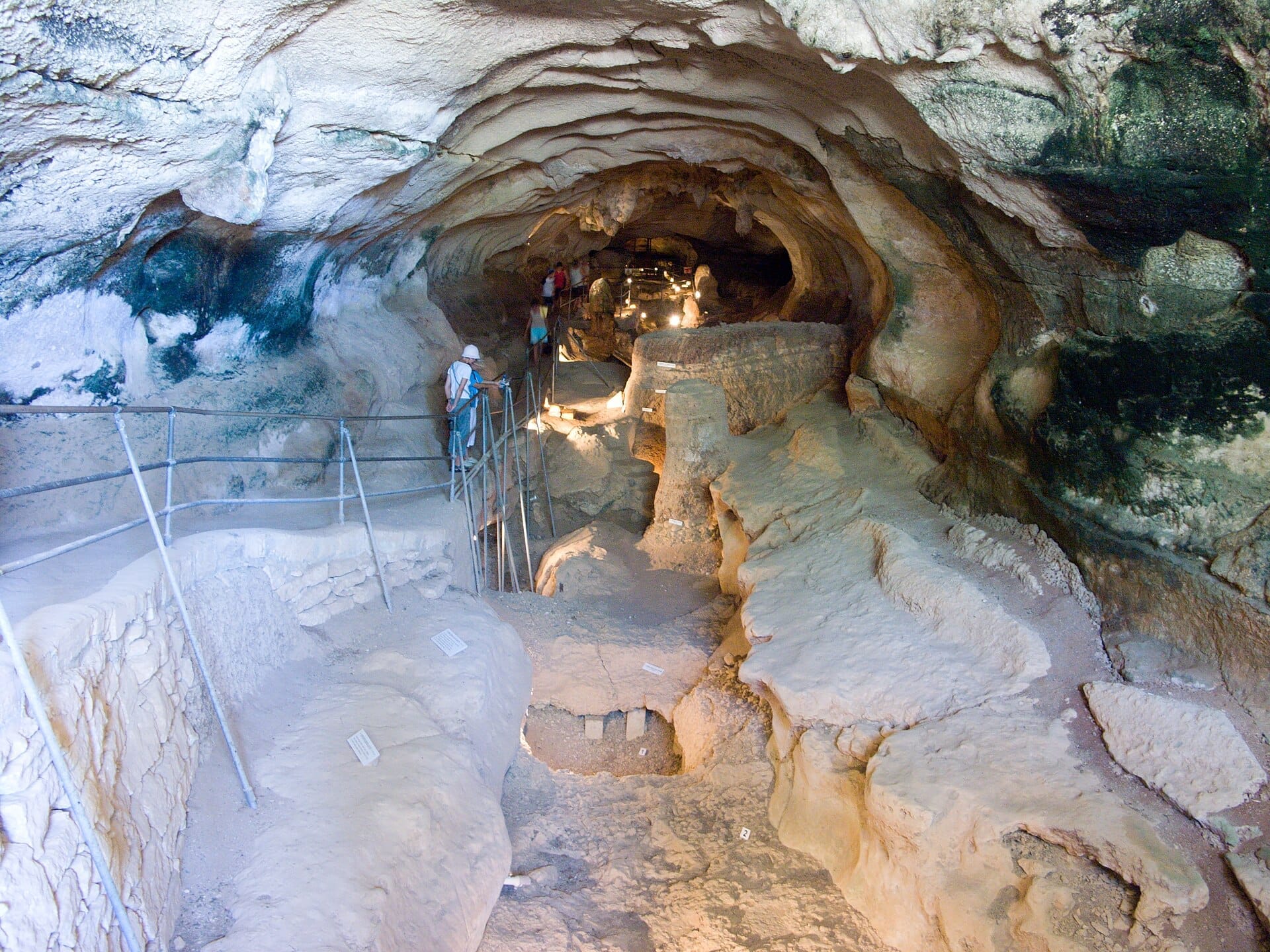
The public walking route inside the cave covers the first 50-70 metres of the 144-metre total length. The path is a wooden boardwalk that runs along the cave floor, lit just enough to see the walls and ceiling without destroying the atmosphere. The air inside is noticeably cooler and damper than outside, particularly welcome during Malta's hot summer months. The smell is earthy and faintly mineral, the kind of cool stillness that immediately communicates age.
The cave walls show clear banded sediment layers, and interpretation panels along the boardwalk explain what each layer represents in geological time. These are not theatrical reconstructions; they are the actual strata where bones were excavated. You are standing directly beside deposits that are hundreds of thousands of years old. That proximity, with no glass barrier or dramatic lighting rig between you and the geology, is quietly affecting in a way that museum displays rarely replicate.
The wooden walkway is firm but not wide, and the ceiling height varies. People with claustrophobia sometimes find the narrower sections uncomfortable, though the route never becomes a true squeeze. The cave is not wheelchair-accessible beyond the entrance; the visitor centre and museum are fully accessible. Audio guides are available in nine languages at the desk before you descend.
💡 Local tip
Bring a light layer even in summer. The cave interior holds at a noticeably lower temperature than the outside, and you will feel the difference quickly if you arrive in just a T-shirt after a warm bus journey.
Tickets & tours
Hand-picked options from our booking partner. Prices are indicative; availability and final rates are confirmed when you complete your booking.
City Sightseeing hop-on hop-off bus tour of Gozo
From 20 €Instant confirmationFree cancellationThe Malta Experience Audio-Visual Show and La Sacra Infermeria Tour
From 20 €Instant confirmationFree cancellationLuggage Storage in Malta
From 6 €Instant confirmationFree cancellation6-day heritage and attractions pass in Malta
From 80 €Instant confirmationFree cancellation
The Museum: Bones, Science, and Context
Before or after the cave walk, the two-room museum gives you the scientific framework to understand what you have just seen. The first room focuses on the fauna: actual fossilised bones of dwarf elephants and hippos are displayed in cases alongside explanatory panels that describe the land-bridge theory and the process of island dwarfism, the evolutionary tendency for large mammals to shrink in size over generations when isolated on islands with limited food resources. Malta's dwarf elephants were roughly the size of a large domestic pig.
The second room shifts to human prehistory, covering the Neolithic settlers who arrived around 7,400 years ago and whose presence is evidenced by pottery sherds and animal bones found in the upper cave layers. This section bridges naturally into the broader story of Malta's extraordinary temple-building civilisation, which flourished from around 3600 BCE.
If Għar Dalam sparks your interest in Malta's prehistoric period, the logical next stop is Ħaġar Qim Temples, roughly 20 kilometres to the west, where the Neolithic builders left their most dramatic architectural legacy. For a deeper read on the island's ancient past, the ancient temples of Malta guide provides useful historical grounding before you visit.
Visiting by Time of Day: What Changes and When
Għar Dalam does not draw the same volumes as Malta's coastal attractions, which means even at peak hours the site rarely feels overcrowded. That said, mid-morning on weekdays is the quietest window. School groups occasionally visit on weekday mornings, which can make the museum rooms feel livelier and louder than usual. If you prefer a contemplative experience in the museum, arrive at opening (9:00 AM) or after 2:00 PM when group tours have typically cleared out.
The cave itself changes very little by time of day since it has no natural light and the artificial lighting is fixed. What changes is the number of people on the boardwalk. The path is narrow enough that two groups passing in opposite directions creates mild congestion. Arriving early or late in the afternoon gives you more time to linger at the interpretation panels without feeling you are holding up a queue.
Weather matters more for the journey to and from the site than for the visit itself. The cave interior is always cool and rain-proof, making it a genuinely useful option on overcast or rainy days when beach-based plans fall apart. Summer heat makes the cool descent underground feel like relief.
How to Get There and What to Expect on Arrival
Bus routes 80 and 82 both serve a stop called "Dalam" within one minute's walk of the entrance. Both routes connect to Valletta, making Għar Dalam reachable from the capital without a car. Journey time from Valletta is roughly 35 to 45 minutes depending on route and traffic. If you are driving, there is a dedicated car park at the visitor centre.
The visitor centre itself is a modest single-storey building. There is a small gift shop near the entrance selling books on Maltese prehistory and natural history. Toilets are located inside the centre. There is no on-site café, so if you plan to spend longer in the area, bring water and a snack, particularly in summer when the area around Birżebbuġa can feel exposed and dry.
Birżebbuġa is a working harbour town rather than a tourist resort, with the industrial Freeport container terminal visible across the bay. It is worth pairing the cave visit with a walk down to St. Peter's Pool, a natural swimming area carved from flat limestone ledges about three kilometres further along the coast. The combination makes for a full half-day that mixes prehistory with one of Malta's most striking natural swimming spots.
Ecological and Scientific Standing
Għar Dalam is designated as part of the Natura 2000 network, the European Union's framework for protecting sites of significant ecological and geological value. This designation reflects not just the palaeontological importance of the fossil record but also the cave's role as a bat habitat. The deeper sections of the cave, which are not open to the public, provide roosting habitat for protected bat species.
The site has been studied since the 19th century, with systematic excavations beginning in the 1860s. The fossil assemblages extracted from Għar Dalam helped establish the scientific understanding of Pleistocene fauna in the central Mediterranean and contributed to broader debates about land connectivity between Europe and North Africa during glacial periods. For its size, the cave has punched well above its scientific weight.
Honest Assessment: Strengths and Limitations
Għar Dalam rewards curiosity. If you arrive with even a basic interest in deep time, natural history, or prehistoric Malta, the experience will feel worth every cent. The combination of the real, unmanufactured cave environment and the clearly presented museum creates a coherent and intellectually satisfying visit.
That said, expectations should be calibrated correctly. This is not a show cave with dramatic stalactites, laser lighting, or theatrical reconstructions. The publicly accessible section is short, the museum is modest in scale, and the site lacks the visual drama of Malta's coastal or architectural attractions. Visitors expecting a cinematic underground experience may find it underwhelming. Those looking for spectacle would be better served elsewhere.
The site is also less suitable for very young children who lack the attention span for museum interpretation panels. For families with younger children looking for a more interactive day out, Malta with kids covers better-suited options across the island.
⚠️ What to skip
The cave walkway involves a noticeable descent on a wooden boardwalk and is not wheelchair-accessible beyond the entrance level. Visitors with mobility difficulties should confirm specific access requirements directly with Heritage Malta before visiting.
Insider Tips
- If you hold or plan to buy a Heritage Malta Passport, Għar Dalam is one of the included sites. The passport pays for itself quickly if you visit three or more Heritage Malta properties during your trip.
- The cave temperature stays consistently cool regardless of season. On a July or August afternoon when outdoor Malta is at its hottest, the cave descent offers genuine physical relief, not just a sightseeing bonus.
- Ask at the desk about the audio guide before you go in. The panels inside the cave are good, but the audio track adds detail about the specific bones found at each sediment layer that the signs alone do not convey.
- Combine with St. Peter's Pool, a flat-rock natural swimming area about three kilometres southeast. It is one of Malta's best natural swimming spots and the two sites together form a logical half-day loop from Valletta.
- Arrive at 9:00 AM on a weekday to have the boardwalk entirely to yourself. The narrow path becomes genuinely crowded when two tour groups arrive simultaneously, and the experience is noticeably better in near-solitude.
Who Is Għar Dalam For?
- Natural history and palaeontology enthusiasts
- Travellers building a deeper picture of Malta beyond its coastal highlights
- Families with older children (10+) who engage with science and prehistory
- Visitors planning a broader day trip through Malta's prehistoric sites
- Anyone looking for an indoor, cool activity during peak summer heat
Nearby Attractions
Combine your visit with:
- Blue Grotto
The Blue Grotto is a cluster of sea caves cut into Malta's southern limestone cliffs, accessible only by small traditional boats. The vivid phosphorescent blues inside are striking in morning light, but the experience depends heavily on sea conditions and timing.
- Dingli Cliffs
Standing at 253 metres above the Mediterranean, Dingli Cliffs form the most dramatic natural viewpoint in Malta. The clifftop road offers sweeping open-sea panoramas, a centuries-old limestone chapel at the edge, and a sunset that turns the rock face deep amber. No admission, no crowds (if you time it right), and no guide required.
- Għajn Tuffieħa Bay
Għajn Tuffieħa Bay sits on Malta's northwest coast, separated from the road by more than 200 steep steps — a deliberate filter that keeps it quieter than most Maltese beaches. The reward is a wedge of reddish-orange sand framed by green clay cliffs, a 17th-century watchtower on the headland, and water that shifts from pale aquamarine to deep cobalt by midday.
- Għar Lapsi
Għar Lapsi is a raw, unspoiled cove on Malta's southern coast, where a natural sea cave opens directly into clear, shallow water. Free to access and easy to reach by car, it draws swimmers, snorkellers, and freedivers who want calm water and no crowds.