Għar Lapsi: Malta's Quiet Sea Cave and Swimming Cove
Għar Lapsi is a raw, unspoiled cove on Malta's southern coast, where a natural sea cave opens directly into clear, shallow water. Free to access and easy to reach by car, it draws swimmers, snorkellers, and freedivers who want calm water and no crowds.
Quick Facts
- Location
- South coast of Malta, near Siġġiewi, ~3 km from Blue Grotto
- Getting There
- Car recommended; follow signs from Siġġiewi or Zurrieq toward Xaqqa Cliffs. Limited bus service to the area.
- Time Needed
- 2–4 hours for swimming, snorkelling, and a meal
- Cost
- Free entry; bring cash for the on-site bar/restaurant
- Best for
- Snorkellers, freedivers, families seeking calm water, picnickers
What Is Għar Lapsi?
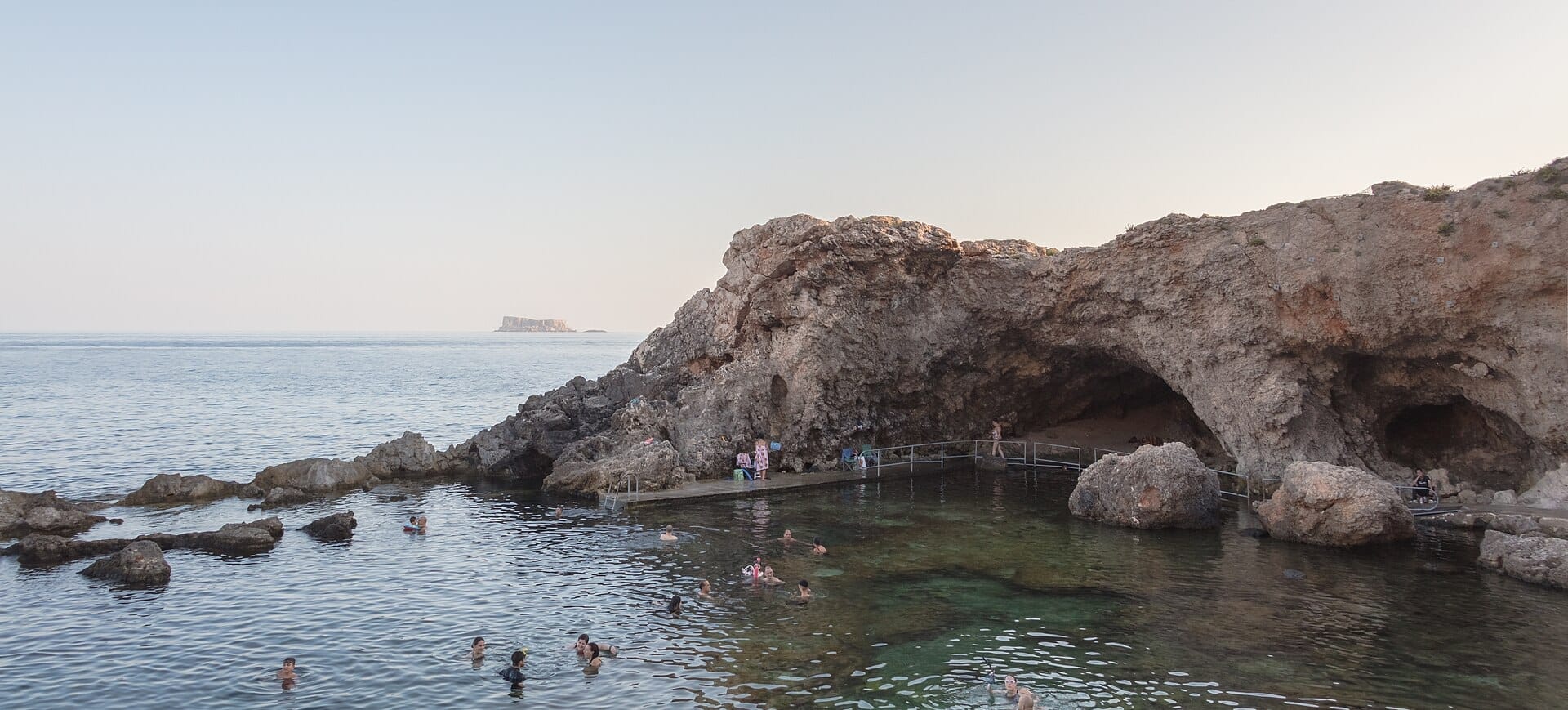
Għar Lapsi translates from Maltese as 'Cave of Ascension,' a name rooted in local religious tradition rather than the geology. The site consists of a natural sea cave cut into Malta's limestone southern cliffs, opening onto a sheltered cove that stays unusually calm even when the rest of the island's coastline is choppy. The cave portal measures roughly 5 metres high and 10 metres wide, descending into a main chamber about 12 metres deep. A dive tunnel extends approximately 40 metres into the rock at depths between 5 and 12 metres, making it one of the more interesting beginner freediving locations in the country.
Unlike the boat-tour spectacle of the nearby Blue Grotto, Għar Lapsi is a place people actually get into the water. There are no entry fees, no ticket booths, and no queues. The cove has concrete steps, a metal ladder into the water, a small car park, and a bar-restaurant that operates in the warmer months. That is essentially the full infrastructure. What draws people here is the water itself: clear, shallow enough for children near the edges, and deep enough for serious snorkelling just a few strokes out.
💡 Local tip
Arrive before 10 AM on summer weekends to get a parking spot and your choice of flat rocks to lay your towel. By midday the area fills with local families, and the limited shade disappears quickly.
The Cave and the Water: What to Expect
Standing at the top of the concrete steps on a calm morning, the first thing you notice is colour. The water inside the cave mouth shifts between turquoise and deep green depending on cloud cover and time of day, and the limestone walls are streaked ochre and white where centuries of salt spray have left their marks. The smell is clean and mineral, the way rocky coastline always smells when there's no sand to hold heat.
In the water, the snorkelling immediately rewards. Sea urchins cling to every rock below the waterline, so water shoes are strongly advised. Past the cave entrance, you enter calmer, darker water where the rocky ceiling filters the light into shifting blue columns. Shoals of small fish are consistently present. The dive tunnel is accessible to freedivers and confident swimmers, though it requires good breath control and a buddy, as portions of it have no overhead exit.
A small shrine, built by local fishermen, sits tucked into the rock face near the water's edge. It is easy to walk past without noticing, but it marks the site's deeper connection to the fishing communities of Siġġiewi and Zurrieq, who have used this cove for centuries. That lived-in quality, the combination of old devotion and daily swimming, gives Għar Lapsi a character that more packaged coastal spots tend to lack.
⚠️ What to skip
The cave and tunnel are NOT suitable for inexperienced swimmers alone. Currents can increase after rainfall or during unsettled weather. The cave interior has no overhead exit for most of its depth. Never snorkel inside the tunnel without a companion.
Tickets & tours
Hand-picked options from our booking partner. Prices are indicative; availability and final rates are confirmed when you complete your booking.
City Sightseeing hop-on hop-off bus tour of Gozo
From 20 €Instant confirmationFree cancellationThe Malta Experience Audio-Visual Show and La Sacra Infermeria Tour
From 20 €Instant confirmationFree cancellationLuggage Storage in Malta
From 6 €Instant confirmationFree cancellation6-day heritage and attractions pass in Malta
From 80 €Instant confirmationFree cancellation
How the Site Changes Through the Day
Early morning at Għar Lapsi is close to silent. The light hits the cave mouth from the east at a low angle, illuminating the interior in a way that is genuinely dramatic for photographers. A handful of local regulars, often older men from nearby villages, will already be in the water. The bar is usually not yet open, so bring your own water and snacks if you plan an early visit.
By mid-morning in July and August, the cove transitions sharply. Families arrive with fold-up chairs, cooler bags, and children in floaties. The flat rocks become occupied, and the car park gets tight. The bar opens, and the smell of coffee and eventually grilled food drifts across the cove. This is not a bad atmosphere, it is a genuinely local one, far more Maltese than tourist, but if you came for quiet contemplation you will have missed your window.
Late afternoon, after 4 PM, offers a second quieter window. Many families leave as the sun shifts behind the cliffs. The water temperature has peaked for the day. The light turns golden and hits the cave walls at a new angle. Serious underwater photographers often prefer the late afternoon for this reason, and the cave's interior colours are at their most saturated.
Historical and Cultural Context
The name 'Ascension' connects to the Catholic feast of the Ascension of Christ, and the site has long held religious significance for local fishing communities. The small fishermen's shrine near the water is not decorative: it was placed there deliberately by people who worked dangerous coastal waters and observed the old practice of marking sacred spots at sea entrances for protection. Malta's southern coast is dotted with similar informal devotional markers, part of a tradition that blends practical piety with maritime life.
Geographically, Għar Lapsi sits on the same stretch of limestone coastline as the Blue Grotto roughly 1 kilometre to the east. Both are products of the same geological process: wave action over millennia dissolving and collapsing the soft Maltese limestone into cave formations and sea arches. Malta's south coast is among the most cave-dense shorelines in the Mediterranean, a fact that has shaped the island's identity as a diving destination for decades.
For context on the broader coastal landscape, the Dingli Cliffs to the northwest represent the same geological shelf at its highest point, rising over 200 metres. Għar Lapsi sits at the bottom of that shelf, where the limestone meets the sea.
Getting There and Practical Logistics
The honest advice is: bring a car. The road from Siġġiewi descends toward the coast past the Għar Lapsi Tower, a watchtower built during the Knights of St John period, and the final section is a narrow winding lane with limited passing places. The small car park at the bottom is free. Arriving after 10 AM on any warm summer weekend risks finding it full, with cars parked informally along the lane.
Public bus connections to Għar Lapsi are limited and routes can change seasonally. Check Malta Public Transport for current schedules before relying on them. If you are combining the visit with a broader south coast day, the logical pairing is the Blue Grotto (boat trips depart from Wied iż-Żurrieq, a short drive away) and perhaps a stop at Ħaġar Qim Temples, which sits on the same coastal ridge about 3 kilometres west.
For those combining this with beach days elsewhere on the island, Għajn Tuffieħa Bay on the northwest coast offers a very different experience: sandy, surf-facing, and more dramatic in terms of cliff scenery, but far less sheltered for swimming.
ℹ️ Good to know
Water shoes are essential here. The entry into the water is over uneven rock and sea urchins are present throughout the shallows. Fins for snorkelling are useful but not required. There are no rental facilities on site, so bring your own equipment.
Freediving and Snorkelling at Għar Lapsi
Għar Lapsi has a genuine reputation in Malta's diving and freediving community. The main cave is beginner-friendly for freediving, with a maximum depth of around 20 metres and a reasonably straightforward entry from the shore. The dive tunnel, approximately 40 metres in length, is suitable for intermediate freedivers who are comfortable in enclosed spaces and have solid breath-hold ability. It is not, under any circumstances, a solo activity.
Several dive operators in Malta include Għar Lapsi on guided freediving and snorkelling itineraries. If you are new to freediving and want a structured introduction, a guided session with a local operator is worth considering. For those focused on scuba, the broader south coast offers excellent dive sites explored in detail in our Malta diving guide.
For snorkellers without freediving aspirations, the cave mouth and surrounding rocks offer plenty of interest in 2 to 4 metres of water. Parrotfish, wrasse, and damselfish are common. Octopus are occasionally spotted in rocky crevices in early morning before disturbance from swimmers. The visibility on calm days regularly exceeds 15 metres.
Who Will Not Enjoy This Place
Għar Lapsi is not a beach. There is no sand. Entry into the water involves stepping over sharp, uneven rock and descending a metal ladder. Anyone with limited mobility will find the access genuinely difficult, and the site has no formal accessibility infrastructure. Similarly, if you are expecting the visual spectacle of the Blue Grotto from a boat, this is a very different proposition: the cave is best appreciated from inside the water, not from above it.
Visitors who prefer organized amenities, clean changing rooms, lifeguards, or beach bars with full menus will likely be underwhelmed. The bar-restaurant is a simple affair and operates seasonally. There are no showers. This is a raw stretch of coast that happens to be especially good for swimming, and that rawness is precisely its appeal for those who value it.
Insider Tips
- The cave interior photographs best in early morning when low-angle light enters the portal directly. Bring an underwater camera or housing if you have one — the water clarity makes it worth the effort.
- The Għar Lapsi Tower, a small Knights-era watchtower on the approach road, is easy to miss but worth a brief stop. It sits on a promontory with views along the southern cliff line that most day visitors never see.
- The bar-restaurant is the only food option here and operates primarily in summer. If you are visiting in shoulder season (April, May, or October), check whether it is open before relying on it. Pack your own supplies to be safe.
- Combine a morning at Għar Lapsi with an afternoon visit to Ħaġar Qim and Mnajdra Temples on the coastal ridge above. The two sites are under 10 minutes by car and together make a full, varied south coast day.
- Locals who swim here regularly bring goggles and water shoes as a minimum. The sea urchin population in the shallows is dense and painful to discover barefoot.
Who Is Għar Lapsi For?
- Snorkellers and freedivers wanting accessible, clear-water cave diving without a boat
- Families with older children who are confident swimmers and willing to manage rocky entry
- Photographers looking for dramatic cave-mouth light in the early hours
- Travellers wanting an authentic local coastal experience away from organised tourist circuits
- South coast day-trippers combining caves, temples, and cliff scenery in a single loop
Nearby Attractions
Combine your visit with:
- Blue Grotto
The Blue Grotto is a cluster of sea caves cut into Malta's southern limestone cliffs, accessible only by small traditional boats. The vivid phosphorescent blues inside are striking in morning light, but the experience depends heavily on sea conditions and timing.
- Dingli Cliffs
Standing at 253 metres above the Mediterranean, Dingli Cliffs form the most dramatic natural viewpoint in Malta. The clifftop road offers sweeping open-sea panoramas, a centuries-old limestone chapel at the edge, and a sunset that turns the rock face deep amber. No admission, no crowds (if you time it right), and no guide required.
- Għajn Tuffieħa Bay
Għajn Tuffieħa Bay sits on Malta's northwest coast, separated from the road by more than 200 steep steps — a deliberate filter that keeps it quieter than most Maltese beaches. The reward is a wedge of reddish-orange sand framed by green clay cliffs, a 17th-century watchtower on the headland, and water that shifts from pale aquamarine to deep cobalt by midday.
- Għar Dalam
Għar Dalam is a 144-metre cave in Birżebbuġa that preserves the bones of dwarf elephants, hippos, and bears from Malta's prehistoric past. The attached museum adds scientific depth to the raw geology of the cave itself. It is a serious natural history site, not a polished tourist spectacle.