Tarxien Temples: Malta's Most Decorated Prehistoric Site
The Ħal Tarxien Prehistoric Complex is a cluster of four megalithic temples built between roughly 3250 and 2500 BC, making them among the oldest freestanding stone structures on Earth. Covered in spiral carvings, animal friezes, and ritual altars, this UNESCO World Heritage site sits quietly in a residential suburb southeast of Valletta, offering a rare and undervisited encounter with one of prehistory's most sophisticated island cultures.
Quick Facts
- Location
- Triq It-Tempji Neolitici, Paola, Malta (southeast of Valletta)
- Getting There
- 20-30 min by taxi from Valletta/Sliema; public bus with a 5-min walk to the entrance
- Time Needed
- 1 to 1.5 hours
- Cost
- Paid entry (verify current fees at Heritage Malta official site)
- Best for
- History enthusiasts, archaeology lovers, UNESCO site collectors
- Official website
- heritagemalta.mt/explore/hal-tarxien-prehistoric-complex
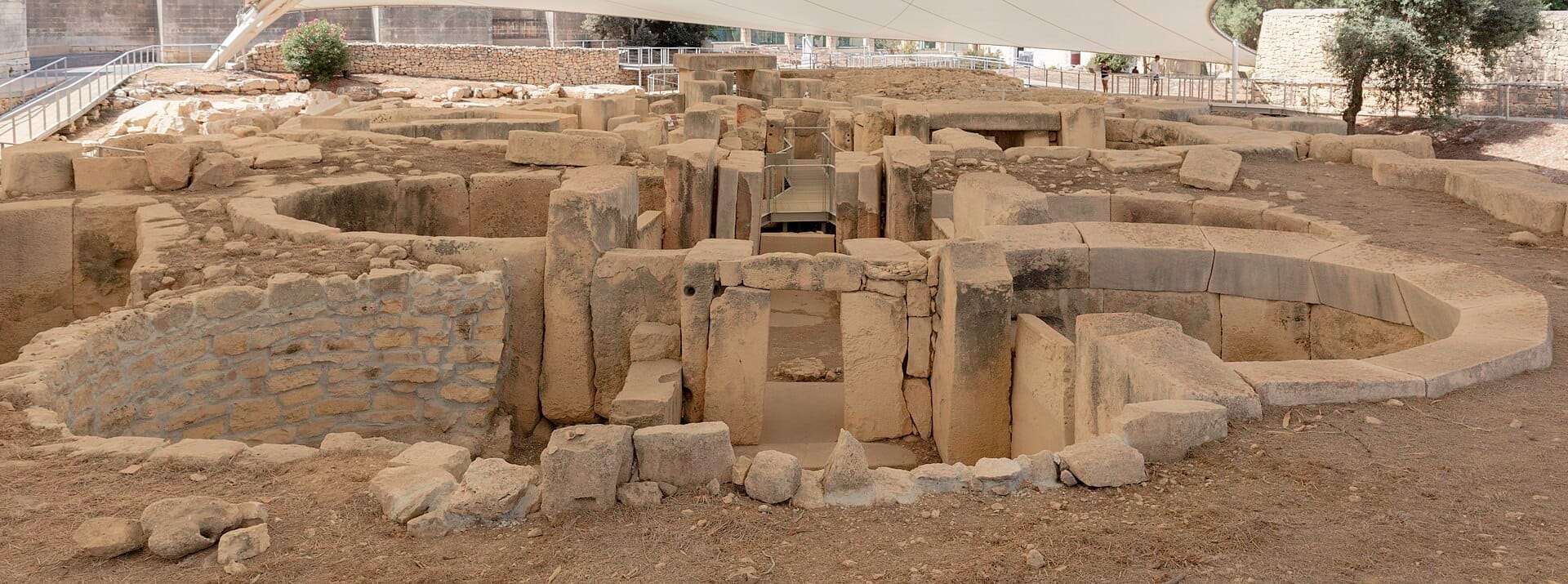
What the Tarxien Temples Actually Are
The Ħal Tarxien Prehistoric Complex is not a single structure but a group of four interconnected megalithic temples, each built at different periods between approximately 3600 and 2500 BC. The complex as a whole represents the peak of what archaeologists call the Maltese Temple Period, a phase of remarkable cultural and architectural development that appears to have evolved entirely on this island archipelago, with no direct counterpart anywhere else in the Mediterranean world.
Three of the temples date to the late Neolithic (the South, East, and Central temples), while the oldest structure on the site dates to around 3250 BC. A fourth temple, the smallest and most eroded, sits at the northern edge of the complex. The site was later readapted during the Early Bronze Age Tarxien Cemetery phase, roughly 2500-1500 BC, when the courtyards were used for cremation burials, a practice that left a distinct archaeological layer visible today.
For context on how these temples fit into Malta's broader prehistoric story, the Ħaġar Qim Temples and the Mnajdra Temples on the southwestern coast belong to the same UNESCO inscription and offer a complementary experience, particularly for their dramatic clifftop setting.
ℹ️ Good to know
The original carved stones on display at the site are replicas. The most intricate originals, including the famous half-figure of a large deity, were moved to the National Museum of Archaeology in Valletta for preservation. If you want to see the finest stonework up close, plan a follow-up visit there.
Discovery and Excavation: A Farmer's Field in 1913
The temples lay completely buried until 1913, when a local farmer began finding unusually large worked stones while plowing his field. He reported the find to the authorities, and between 1915 and 1919, Sir Themistocles Zammit, Malta's first professional archaeologist and a pivotal figure in the island's cultural identity, led the systematic excavation of the site. Zammit documented an extraordinary array of carved reliefs, animal bones interpreted as sacrificial remains, flint knives, and pottery, all pointing to a complex ritual life centered on these structures.
What Zammit uncovered challenged prevailing assumptions about the capabilities of prehistoric societies. These were not rough shelters or simple ceremonial cairns. The builders shaped massive limestone blocks, some weighing several tonnes, into precisely fitting curved apses, decorated interior walls with deeply incised spirals, and created a large statue of a deity, now only its lower half survives, that stands as one of the most significant prehistoric sculptures in Europe. The UNESCO designation came in 1992, recognizing the Megalithic Temples of Malta collectively as a World Heritage site.
Tickets & tours
Hand-picked options from our booking partner. Prices are indicative; availability and final rates are confirmed when you complete your booking.
Gozo full-fay tour including Ggantija Temples
From 80 €Instant confirmationFree cancellationCity Sightseeing hop-on hop-off bus tour of Gozo
From 20 €Instant confirmationFree cancellationThe Malta Experience Audio-Visual Show and La Sacra Infermeria Tour
From 20 €Instant confirmationFree cancellationLuggage Storage in Malta
From 6 €Instant confirmationFree cancellation
Walking Through the Complex
Entering the site, the scale feels modest at first. The temples sit within a low-walled enclosure in the middle of a modern residential neighborhood, and the contrast between the ancient stones and the surrounding apartment blocks is striking, occasionally disconcerting. Do not let this put you off. Once you step into the first apse, the materiality of the place takes over: the weight of the individual stones, the precision of the fitted joints, and the density of carved decoration across the South Temple's interior walls are genuinely arresting.
The South Temple is the most elaborately decorated and the focal point of most visits. Its interior walls carry the famous spiral reliefs and friezes of animals, including goats, pigs, and bulls, that are thought to relate to ritual offerings. The Central Temple holds the lower torso of the large cult statue, a fragment suggesting the original figure stood roughly 2.5 metres tall. The East Temple is the oldest of the three main structures and, while less decorated, shows clear evidence of sophisticated planning in its apse layout.
Pathways are clearly marked, and informational panels in English explain each section. The roofed covering that shelters the most vulnerable stonework creates an indoor-outdoor atmosphere that differs from the open-air Ħaġar Qim complex. On a hot summer afternoon, this partial shelter is genuinely useful. Wear comfortable shoes regardless: the stone surfaces and uneven ground demand careful footing.
💡 Local tip
Arrive when the site opens, or in the late afternoon about 90 minutes before closing, to avoid the peak tour group window in the middle of the day. The covered sections mean light is relatively stable throughout, so there is no strong photographic reason to prefer morning over afternoon.
Time of Day and Atmosphere
The Tarxien Temples sit in a working residential area, and the neighborhood itself contributes to the sensory experience in ways that Ħaġar Qim's clifftop isolation does not. In the morning, you will hear children heading to school a few streets away, dogs, the distant hum of traffic. The smell of sun-warmed limestone is present from mid-morning onward, and inside the covered sections it has a dry, slightly dusty quality that is specific to ancient stone environments.
The site is rarely overwhelmed with visitors in the way that Valletta's major attractions can be, but organized tour groups do arrive mid-morning and in the early afternoon. A group of 20 or 30 people fills the pathways noticeably, since the internal passages are narrow. If you visit independently rather than on a group tour, weekday mornings offer the most contemplative experience.
The Tarxien Temples pair naturally with a visit to the Ħal Saflieni Hypogeum, which is located roughly 500 metres away and is a subterranean prehistoric burial complex of equal or greater archaeological significance. Tickets for the Hypogeum must be booked well in advance, often weeks ahead, so plan that component first and build the Tarxien visit around it.
Cultural Significance: Why These Stones Matter
The Tarxien complex predates both Stonehenge and the Great Pyramids of Giza. The society that built these structures left no written language and no clear evidence of contact with contemporary civilizations in Egypt, Mesopotamia, or the Aegean. This makes the Maltese Temple Period an architectural and cultural phenomenon that remains partly unexplained: a sophisticated, apparently autonomous flourishing of megalithic construction on a small island in the central Mediterranean, followed by what seems to have been an abrupt societal collapse or transformation around 2500 BC.
The spiral motifs at Tarxien appear repeatedly across all the major Maltese temple sites and are thought to carry cosmological or ritualistic meaning, though the precise interpretation remains debated. The animal reliefs are some of the oldest pictorial representations of domesticated livestock found anywhere in southern Europe. For anyone with a serious interest in prehistoric art or the archaeology of the Mediterranean, this is primary source material at its most tangible.
For a broader framework of Malta's ancient past, the Ancient Temples of Malta guide covers all the major sites with practical comparison notes on which to prioritize based on your interests and available time.
Practical Details and Getting There
The site is managed by Heritage Malta and opening hours, as well as ticket prices, should be confirmed directly on the Heritage Malta website before your visit, as these details are subject to change. The complex is located in the Tarxien/Paola area, roughly 5 kilometres southeast of Valletta. A taxi from Valletta or Sliema takes 20 to 30 minutes depending on traffic and is the most straightforward option. Public buses reach the area, with the closest stop about a 5-minute walk from the entrance.
Accessibility at the site is limited in parts due to the ancient stone surfaces and narrow pathways. Heritage Malta does make efforts to accommodate visitors with mobility considerations, but it is worth contacting them directly if this is a concern. Photography is generally permitted throughout the complex, and the replica stonework means you can examine details closely without restriction.
⚠️ What to skip
Do not confuse the site replicas with originals. The most significant carved pieces, including the lower half of the large cult statue and the finest relief panels, are held at the National Museum of Archaeology in Valletta. If you visit Tarxien without knowing this, you may leave feeling the decoration is less impressive than its reputation suggests. Pair the two visits for a complete picture.
Who Should Skip It
Travelers with very limited time in Malta who are prioritizing beaches, Valletta's Baroque architecture, or nightlife will likely find the Tarxien Temples less rewarding than visitors who come with genuine curiosity about prehistory. The site is modest in size, the most impressive originals are held elsewhere, and without some background knowledge the carved replicas can seem unremarkable. Children under 10 may find the experience too static unless they have a particular interest in ancient history.
If you have a single day in Valletta and want to cover the highlights efficiently, the things to do in Valletta guide will help you prioritize, and the Tarxien Temples are best saved for a second day or combined with the Ħal Saflieni Hypogeum on a dedicated morning.
Insider Tips
- Book the Ħal Saflieni Hypogeum (500m away) several weeks in advance and schedule Tarxien on the same morning: the two sites together form the most complete prehistoric experience in Malta.
- The original carved stones, including the half-figure cult statue, are in the National Museum of Archaeology in Valletta's Republic Street. Visit there before or after Tarxien to see what the best-preserved work actually looks like.
- Informational panels at the site are reasonably thorough, but downloading Heritage Malta's official material or picking up a guidebook beforehand gives you significantly more interpretive depth than the on-site signage alone.
- The covered sections of the complex make this one of the few archaeological sites in Malta that remains reasonably comfortable to visit during a July or August midday, when most outdoor attractions become unpleasant in the heat.
- If you are building a broader itinerary around Malta's megalithic heritage, the sites at Ħaġar Qim and Mnajdra are about 45 minutes away by car and have a dramatically different, open-air clifftop setting that contrasts well with the enclosed suburban atmosphere of Tarxien.
Who Is Tarxien Temples For?
- Archaeology and prehistory enthusiasts who want to engage with one of Europe's oldest freestanding structures
- UNESCO World Heritage site visitors working through Malta's complete megalithic circuit
- History-focused travelers pairing the site with the nearby Ħal Saflieni Hypogeum
- Visitors who want a meaningful cultural half-day without crowds or high admission costs
- Travelers with a particular interest in prehistoric art, ritual culture, or Mediterranean archaeology
Nearby Attractions
Combine your visit with:
- Blue Grotto
The Blue Grotto is a cluster of sea caves cut into Malta's southern limestone cliffs, accessible only by small traditional boats. The vivid phosphorescent blues inside are striking in morning light, but the experience depends heavily on sea conditions and timing.
- Dingli Cliffs
Standing at 253 metres above the Mediterranean, Dingli Cliffs form the most dramatic natural viewpoint in Malta. The clifftop road offers sweeping open-sea panoramas, a centuries-old limestone chapel at the edge, and a sunset that turns the rock face deep amber. No admission, no crowds (if you time it right), and no guide required.
- Għajn Tuffieħa Bay
Għajn Tuffieħa Bay sits on Malta's northwest coast, separated from the road by more than 200 steep steps — a deliberate filter that keeps it quieter than most Maltese beaches. The reward is a wedge of reddish-orange sand framed by green clay cliffs, a 17th-century watchtower on the headland, and water that shifts from pale aquamarine to deep cobalt by midday.
- Għar Dalam
Għar Dalam is a 144-metre cave in Birżebbuġa that preserves the bones of dwarf elephants, hippos, and bears from Malta's prehistoric past. The attached museum adds scientific depth to the raw geology of the cave itself. It is a serious natural history site, not a polished tourist spectacle.