Mdina Old City Walls & Gates: Malta's Silent City on the Hill
Mdina's fortified walls and ornate gates form one of Malta's most striking historic landmarks, enclosing a medieval hilltop city with roots stretching back to Phoenician times. Entry is free, the views across the island are panoramic, and the atmosphere shifts dramatically between dawn quiet and midday crowds. This guide tells you what to expect at every hour.
Quick Facts
- Location
- Mdina, Western Region, Malta. Accessed via the Vilhena Gate (Main Gate) on the town's eastern side.
- Getting There
- Public buses from Valletta and other towns to the Mdina bus terminus. The Main Gate is a short walk across the dry moat. No private cars allowed inside the walls.
- Time Needed
- 1.5 to 3 hours to walk the perimeter, explore the gates, and take in the bastions. Add time for interior attractions.
- Cost
- Free. The walls, gates, and public bastions are open to all pedestrians at no charge.
- Best for
- History enthusiasts, architecture lovers, photographers, and anyone wanting sweeping views over central Malta.
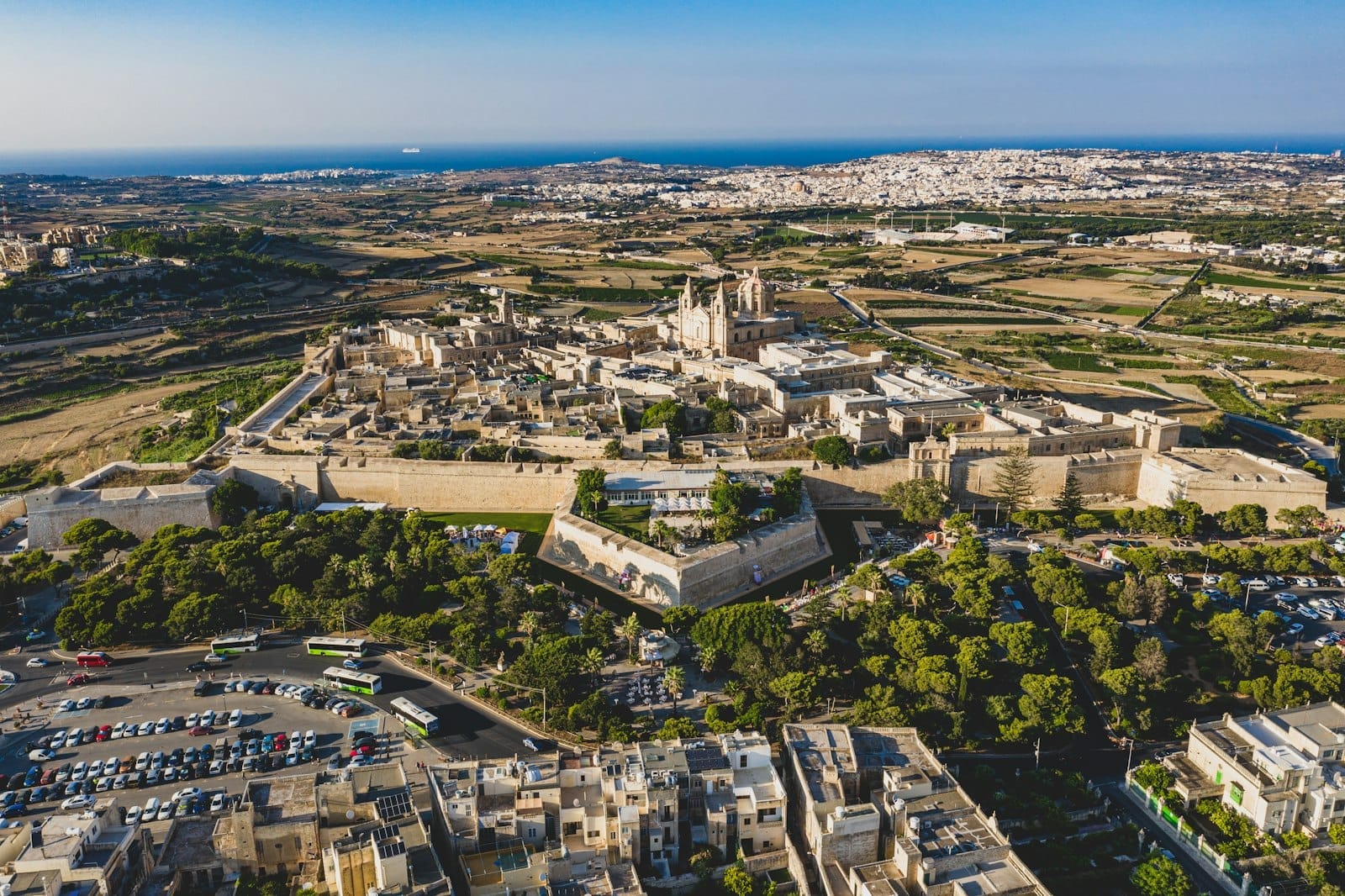
What Mdina's Walls and Gates Actually Are
L-Imdina, officially known in Maltese as such and historically styled Città Notabile (Notable City) by the Knights of St. John, is a fortified hilltop settlement rising roughly 150 metres above Malta's central plains. The walls and gates that encircle it are not a single construction project but a 2,700-year accumulation of defensive layers: Phoenician earthworks, Roman fortifications, Arab-era realignment, Norman repairs, and the signature Baroque stonework added by the Knights in the early 18th century.
Visiting the walls means walking an open-air archive. You cross a dry moat, pass through a gate that looks like a theatrical stage set, and immediately step into narrow limestone streets that have changed very little since the medieval period. The walls themselves are largely walkable from outside, and several bastions offer unobstructed sightlines south toward the sea and east toward Valletta's distant dome.
ℹ️ Good to know
Entry to the walls, gates, and public bastions is completely free and the area is accessible 24 hours a day. You do not need to book in advance. Individual attractions inside the city (such as the Cathedral Museum) have their own separate fees.
The Vilhena Gate: Where Every Visit Begins
The Vilhena Gate, also called the Main Gate, is the primary and most dramatic entrance to Mdina. Built in the early 1720s by the military engineer Charles François de Mondion on the orders of Grand Master António Manoel de Vilhena, it replaced earlier medieval gates that were demolished during 17th-18th century reconstruction. What stands today is a compact Baroque triumph arch in warm golden globigerina limestone, flanked by carved lions and decorated with coats of arms commemorating Vilhena's rule.
Up close, the sculptural detail rewards slow looking. The lions are worn smooth by centuries of Maltese humidity and sea-salt air, but the heraldic carvings above the arch remain sharply defined. A dry moat, originally dug to extend the city's defensive depth, separates the gate from the bus terminus and parking area. You cross it on a stone bridge that feels genuinely ancient even if the current surface has been repaired many times over.
Photography here is best in the first two hours after sunrise. The gate faces roughly east, so morning light catches the carved limestone directly, warming its colour to a deep honey tone. By midday, particularly in summer, the facade falls into flat light and the area in front of the gate fills with tour groups from cruise ships and day-trippers from Valletta. If you arrive at 8am, you may have the bridge almost entirely to yourself.
Tickets & tours
Hand-picked options from our booking partner. Prices are indicative; availability and final rates are confirmed when you complete your booking.
Mdina and Rabat Food and History Tour
From 68 €Instant confirmationFree cancellationMdina and Rabat walking tour Malta
From 22 €Instant confirmationFree cancellationMdina and the highlights of Malta guided tour with lunch
From 69 €Instant confirmationFree cancellationCity Sightseeing hop-on hop-off bus tour of Gozo
From 20 €Instant confirmationFree cancellation
The Greek's Gate and the Medieval Layers
Far fewer visitors make their way to the Greek's Gate (Bieb il-Griegi), tucked into the northern wall. Unlike the theatrical grandeur of the Vilhena Gate, this entrance is compact, slightly austere, and significantly older in character. While it received some Baroque exterior treatment during the Knights' era, its basic structure preserves the medieval proportions of the city's earlier defences. The name is thought to refer to the Greek-speaking Byzantine population that once inhabited this quarter.
Walking the exterior of the northern wall between the two gates reveals the physical complexity of Mdina's fortification history. The stonework changes texture and colour across different sections: rough, irregular courses in some stretches give way to the tightly fitted ashlar masonry of the 18th-century repairs. If you run your hand along the wall, you feel both the warmth the limestone holds from the sun and the subtle roughness of centuries of weathering.
The Bastion Views: What You See and When to See It
Mdina's elevated position, around 150 metres above sea level, makes its bastion walls some of the most rewarding viewpoints on the Maltese islands. The western bastions, which you reach by walking through the city from the Main Gate and continuing to the far end, look out over a landscape that reads like a topographic map: the terraced fields of Rabat immediately below, the church dome of Mosta rising to the north, and on clear days the faint blue ridge of the coast toward St. Paul's Bay.
The southeastern bastions look back toward Valletta, about 14 kilometres away. On winter mornings when the air is dry and clear, you can trace the capital's silhouette with some precision. This is also the view that explains why the Arabs chose to name this place Madīnah, meaning 'the city': a hilltop commanding sight lines in every direction was strategically irreplaceable. You can read more about how the island's fortified places relate to each other in this guide to the best viewpoints in Malta.
Late afternoon light on the western bastions is exceptional. From about two hours before sunset, the low sun turns the limestone of both the walls and the surrounding countryside an amber-gold that photographers specifically time their visits around. Bring a wide-angle lens if you have one: the low parapet walls let you frame the valley below cleanly without anything obstructing the foreground.
💡 Local tip
The bastion benches on the western side fill up at sunset. Arrive at least 45 minutes early in high season (June to September) to claim a good position. In winter, the same light effect happens earlier and the walls are nearly empty.
Historical Context: 2,700 Years in One Hilltop
Mdina's recorded history begins around the 8th century BC when Phoenician settlers, who called the place Maleth (thought to mean 'refuge'), recognized the strategic value of this limestone ridge and established a fortified settlement here. Roman control from approximately 218 BC transformed it into Melita, the administrative heart of the island. It was during Roman occupation that St. Paul is said to have converted the Roman governor Publius to Christianity following the famous shipwreck of 60 AD, a connection that still shapes Maltese religious identity.
Arab invaders took the island in 870 AD. After an initial period of disruption, they rebuilt and formally organized the hilltop city, giving it the name Madīnah that eventually became Mdina. The Arab spatial reorganization also established the roughly triangular footprint the city retains today. When the Normans arrived in 1091 under Roger I of Sicily, they repaired the walls and allowed the existing community structure to persist, a pattern of layered occupation that repeats throughout Maltese history. For a deeper read on the medieval period, the Knights of Malta history guide provides useful context.
The Knights of St. John arrived in Malta in 1530 and chose Birgu (now Vittoriosa) on the Grand Harbour as their operational base, effectively downgrading Mdina's political importance. Yet they retained it as a seat of the Maltese nobility and invested in its architecture. The 1693 earthquake that damaged much of the island prompted the construction campaign that produced the Vilhena Gate in 1724 and several of the Baroque palaces still lining the interior streets. After that, Mdina was largely bypassed by development, which is exactly why it survives in such intact condition today.
Practical Walkthrough: How to Move Through the Site
The standard approach is to arrive at the Mdina bus terminus, cross the bridge over the dry moat, and enter through the Vilhena Gate. From there, the main route through the city leads straight toward the Cathedral of St. Paul and the small central square. Most visitors turn around here and leave the way they came, missing the perimeter walk entirely.
To get the most out of the walls, take the first left after entering the Main Gate and follow the interior street that runs along the northern edge of the city toward the Greek's Gate. From there, continue around to the western bastions, which offer the best elevated views. The circuit back to the Main Gate takes 30 to 45 minutes at a relaxed pace, not counting time spent at viewpoints. Rabat, the town immediately adjacent to Mdina, is worth combining into the same visit: it houses St. Paul's Catacombs and the Domus Romana, both within a 5-minute walk of the Main Gate.
Mdina's cobblestone streets are uneven throughout and the inclines, while not severe, require reasonable mobility. There are steps at several points along the perimeter route, and the gateway arches, while wide enough for two people side by side, are not accessible to wheelchairs without assistance. Horse-drawn karozzin carriages operate from outside the Main Gate and offer a flat-surface tour of the interior streets, which some visitors with mobility limitations find useful. Note that the carriage rides cover interior streets only, not the external bastion walkway.
⚠️ What to skip
Mdina is a living city with a small permanent residential population. Streets are quiet out of respect for residents as well as historical atmosphere. Keep noise levels low, particularly in early morning and evening hours. Photography of private doorways and interiors is not always welcomed.
How the Atmosphere Changes Through the Day
Before 9am on a weekday morning, Mdina has an almost surreal stillness. The light is low, the stone glows softly, and the only sounds are distant church bells, the occasional pigeon, and your own footsteps on the cobbles. This is where the nickname 'Silent City' comes from: not silence as absence, but silence as texture.
By 10am in high season, the first tour buses arrive at the terminus. Groups move through the Main Gate and toward the cathedral square in tight formations. The central streets become noticeably crowded by 11am. By contrast, the outer perimeter walls, particularly the northern section between the two gates, see a fraction of the foot traffic even at peak times. If you find the main route congested, follow the perimeter and you will be almost alone.
Evening visits after 5pm bring a different crowd: local Maltese families walking after work, couples at the bastion walls watching the light fade, and a handful of late-staying tourists. Most cafes and shops inside the walls close or begin closing by 6pm. The walls stay fully accessible through the night, and the floodlit Main Gate at night is genuinely atmospheric, though the narrow streets are very dark away from the lit areas. Carry a phone torch if you plan to walk the perimeter after dark.
Mdina fits naturally into a broader itinerary exploring Malta's interior. If you are planning a full day in the central region, consider pairing it with the Palazzo Falson inside the city walls, and then continuing to the Rabat sites afterward. For planning a multi-day visit, the Malta 3-day itinerary covers how Mdina fits alongside the island's other major sites.
Who Should Skip This, and When
Mdina's walls and gates are a passive, observational experience. There are no exhibits on-site, no guided interpretation of the walls themselves, and no infrastructure to explain what you are looking at unless you have done some reading in advance or hired a guide. Visitors expecting an interactive museum experience will find the exterior walls underwhelming without that context.
Travellers with significant mobility limitations should note that the perimeter walk involves uneven cobblestones and some steps with no alternative routes. The Main Gate bridge is level and accessible, but the bastion walkway is not reliably so throughout. If midday summer heat is a concern, the lack of shade along the external walls makes a July or August afternoon visit uncomfortable; the same visit in April or October is far more pleasant.
Insider Tips
- The gate's best light is in the 60 minutes after sunrise. If you can reach the bus terminus by 7:30am in summer, you will have the bridge and gate facade almost entirely to yourself for photography.
- Walk the northern wall between the Vilhena Gate and the Greek's Gate before heading to the cathedral. Most visitors go straight through the city; the perimeter route is quieter and shows you the actual medieval fabric of the walls.
- The western bastion benches face directly into the sunset. In summer, locals arrive 30 to 40 minutes before sunset. Arrive earlier than you think you need to.
- Rabat is directly adjacent and shares the same bus stop. After Mdina, the 5-minute walk to St. Paul's Catacombs makes this one of the most efficient double-stops in Malta without needing any extra transport.
- If you are visiting during a summer evening, the Main Gate is floodlit after dark and almost no one photographs it at night. The crowds are gone and the quality of light on the carved limestone is striking.
Who Is Mdina Old City Walls & Gates For?
- History and architecture enthusiasts who want one of the best-preserved medieval fortified cities in the Mediterranean
- Photographers looking for golden-hour light on Baroque stonework and panoramic island views
- Budget travellers: the walls, gates, and bastion views cost nothing to visit
- Visitors combining Mdina with Rabat's Roman and early Christian sites for a half-day cultural itinerary
- Travellers who want somewhere quieter than Valletta with comparable historical depth
Nearby Attractions
Other things to see while in Mdina:
- Palazzo Falson Historic House Museum
Palazzo Falson Historic House Museum preserves eight centuries of Mdina history within one of Malta's oldest standing residences. From Arabesque windows to a rooftop café with panoramic views, it rewards visitors who want more than the Silent City's famous streetscapes.
- St. Paul's Cathedral, Mdina
St. Paul's Cathedral dominates Mdina's central square with a honey-gold Baroque facade that has anchored Malta's spiritual life for over three centuries. Built on a site linked to Christianity's earliest arrival on the island, it rewards visitors who take time to understand what they are looking at.