St. Paul's Catacombs, Rabat: What to Expect Inside Malta's Largest Ancient Burial Complex
St. Paul's Catacombs in Rabat is Malta's largest underground burial complex, covering more than 2,000 square metres of hand-cut limestone tunnels used from the Punic period through the Byzantine era. It is one of the most significant archaeological sites in the Mediterranean, and far more atmospheric than most visitors expect.
Quick Facts
- Location
- Triq Ħal-Bajjada, Rabat, Malta
- Getting There
- Bus to Rabat terminus, then a 5-minute walk; Mdina is a short walk away
- Time Needed
- 1 to 1.5 hours
- Cost
- Adults (18+) €6.00 | Youths (12-17) €4.50 | Senior Citizens (60+) €4.50 | Concessions & Students €4.50
- Best for
- History lovers, archaeology enthusiasts, travellers seeking shade on hot days
- Official website
- heritagemalta.mt/explore/st-pauls-catacombs
What St. Paul's Catacombs Actually Is
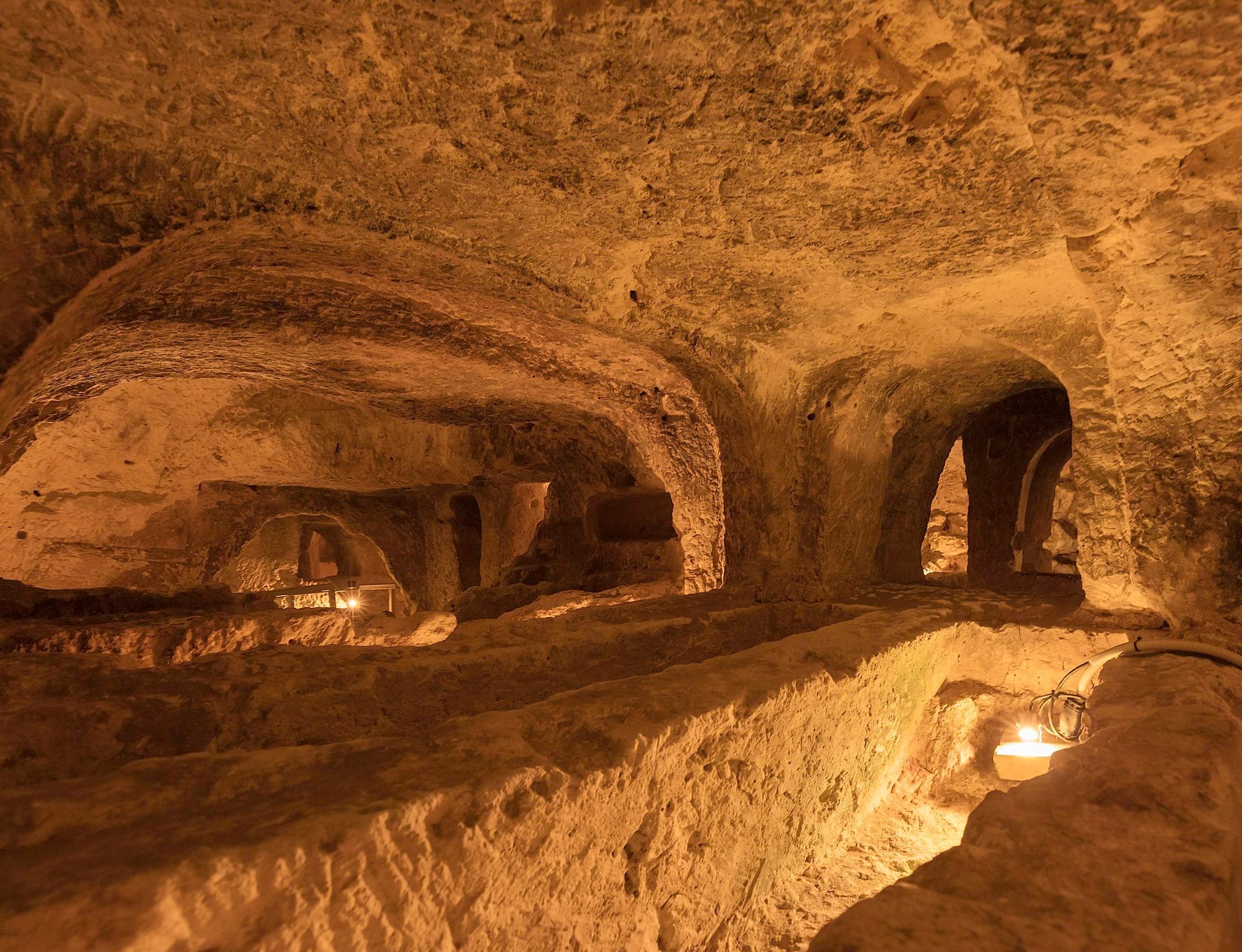
St. Paul's Catacombs is not a single tunnel with a few carved niches. It is a sprawling subterranean complex of more than 30 individual hypogea, collectively covering over 2,000 square metres of rock-cut passageways beneath the streets of Rabat. More than 20 of these chambers are open to visitors, making it far more extensive than the name alone suggests.
The site sits on Triq Ħal-Bajjada, a quiet residential street in Rabat, immediately adjacent to the ancient walled city of Mdina. The proximity to Mdina is not coincidental: Rabat was historically the suburb of Mdina, and the two settlements share more than 2,500 years of layered history. The catacombs sit just outside the old city walls, exactly where Roman and later Byzantine-era communities would have placed their dead, since burial within city limits was prohibited under Roman law.
ℹ️ Good to know
Opening hours: Daily 09:00–17:00. Last admission is at 16:30. No seasonal closures are listed, but Heritage Malta occasionally closes sites for conservation work. Check their website before visiting.
History: From Punic Rock-Cutting to Christian Ritual
The earliest sections of the complex date to the Punic and early Roman periods, roughly the 3rd to 4th centuries BC, when Semitic communities were already cutting tombs into Malta's soft globigerina limestone. The rock is extraordinarily workable: it can be carved with hand tools and hardens on exposure to air, which is why it has been used for everything from temple blocks to fortress walls across Malta's history.
By the 4th and 5th centuries AD, the site had taken on a distinctly early Christian character. The distinctive circular agape tables carved into the floor of several chambers are among the most compelling features here. These low stone tables, surrounded by curved benches cut from the same rock, were used for communal funeral meals, a practice borrowed partly from Roman tradition and adapted into early Christian mourning rites. You will not find anything quite like them at other catacomb sites in Europe.
The complex continued in use through the Byzantine period, roughly the 7th to 8th centuries AD, before eventually falling out of use and largely disappearing from public knowledge. Systematic archaeological clearance began in 1894 under Dr. A.A. Caruana, and the site was gradually documented and opened to the public. Today it is managed by Heritage Malta and carries the European Heritage Label, a designation recognising its significance to shared European cultural history. For broader context on how this era shaped the islands, the Knights of Malta history guide traces the longer arc of Maltese history from Roman times onward.
It is worth clarifying one common point of confusion: the site is named in association with St. Paul's Grotto, located nearby in Rabat, where tradition holds that the Apostle Paul sheltered after his shipwreck on Malta around 60 AD. There is no direct archaeological or historical link between the catacombs and St. Paul himself. The naming reflects the concentration of early Christian heritage in this corner of Rabat, not a specific biblical connection.
Tickets & tours
Hand-picked options from our booking partner. Prices are indicative; availability and final rates are confirmed when you complete your booking.
City Sightseeing hop-on hop-off bus tour of Gozo
From 20 €Instant confirmationFree cancellationThe Malta Experience Audio-Visual Show and La Sacra Infermeria Tour
From 20 €Instant confirmationFree cancellationLuggage Storage in Malta
From 6 €Instant confirmationFree cancellation6-day heritage and attractions pass in Malta
From 80 €Instant confirmationFree cancellation
What You Actually See Underground
Entering the catacombs from the modern Heritage Malta visitor centre, you descend a staircase into a corridor of pale limestone that drops the temperature noticeably, even in August. The air carries the faint mineral smell of damp stone, cool and still. The main passages are lit with recessed lighting, enough to navigate clearly, but the deeper alcoves remain in shadow at the edges.
The burial niches range from simple arcosolium tombs, arched recesses cut into the walls at standing height, to window tombs and the elaborate baldachin tombs that sit raised on carved pedestals in the centre of chambers. The baldachin form is particularly unusual: a canopied stone bed with a carved arch overhead, designed for wealthier individuals. The variation in tomb type across a single complex reflects the multi-faith, multi-class society that used these tunnels. Jewish, pagan, and Christian communities appear to have buried their dead here, separated by hypogeum rather than by segregated cemeteries.
The agape tables mentioned in the historical section are not recreations. They are original, carved in place, and the wear on their surfaces is genuine. Standing in one of these circular chambers with a carved table at knee height and shallow benches curving around you gives a concrete sense of the rituals performed here seventeen centuries ago. It is one of the more quietly affecting experiences on the island.
💡 Local tip
Bring a light layer. Even in peak summer, the underground temperature hovers around 18°C. The contrast with surface heat is stark, and the stay inside is long enough to feel it.
Visiting by Time of Day: When to Go
The underground environment means that light and temperature do not vary the way they would at an outdoor site. However, crowd patterns are significant. Tour groups from Valletta and cruise ships tend to arrive between 10:00 and 12:30, and the narrower passages can feel cramped when multiple groups occupy the same section. Morning visits at opening time (09:00) or mid-afternoon arrivals from around 14:00 onward are noticeably quieter.
The Heritage Malta visitor centre includes an introductory exhibition before the underground descent. This is worth spending time on before heading down. It provides enough context to make the carved details meaningful rather than just decorative. Allow around 20 minutes for the surface exhibition and 45 to 60 minutes underground, depending on pace.
Photography is permitted without flash. The lighting is designed for conservation as much as visibility, so some sections are dimmer than a smartphone camera handles well. A camera with manual ISO control will produce better results than automatic modes in the darker alcoves.
Getting There and Combining with Nearby Sights
Rabat is well-served by Malta Public Transport. Buses from Valletta and Sliema connect regularly to the Rabat terminus, and the catacombs are roughly a five-minute walk from the bus stop. If you are driving, parking is available in the streets around Rabat, though spaces fill up on weekend mornings when the area sees heavier local and tourist traffic.
Most visitors combine St. Paul's Catacombs with a walk through Mdina's old city, which is immediately adjacent. The two sites complement each other well: Mdina for the medieval street-level experience, the catacombs for what lies beneath. Allow at least half a day for both. If you have a full day, the Domus Romana in Rabat, a preserved Roman townhouse with fine mosaic floors, is a five-minute walk from the catacombs and rounds out the picture of Roman-era life in this part of Malta.
For those planning broader itineraries, Rabat and Mdina are logical stops on any route through central Malta. The Malta 3-day itinerary places these two sites together on a single day, which is the most efficient approach for short-stay visitors.
Accessibility and Who Should Manage Expectations
The underground nature of the site creates real limitations for visitors with mobility difficulties. The main entrance involves a staircase, and the passages vary in ceiling height and floor surface. Some sections require ducking or careful footing on uneven stone. Heritage Malta has not published detailed accessibility specifications for this site; if you or someone in your group uses a wheelchair or has significant mobility restrictions, contact Heritage Malta directly before visiting.
Visitors who prefer open-air experiences, or who find enclosed or dim spaces uncomfortable, may find the catacombs stressful rather than interesting. The passages are not extremely narrow, but some chambers are low-ceilinged, and there is no natural light below ground. People with claustrophobia should consider this carefully before purchasing tickets.
Young children often find the site genuinely engaging, especially if the concept of ancient tunnels and burial chambers is introduced before going in. The site does not display human remains, which makes it appropriate for curious younger visitors without being graphic. Teenagers with an interest in history typically find it one of the more memorable stops in Malta.
Practical Details at a Glance
- Address: Triq Ħal-Bajjada, Rabat, Malta
- Hours: Daily 09:00–17:00, last admission 16:30
- Adults (18+) €6.00 | Youths (12-17) €4.50 | Seniors (60+) €4.50 | Students & concessions €4.50
- Managed by Heritage Malta; European Heritage Label site
- Photography permitted, no flash
- Wear a light layer regardless of season
- Nearest bus: Rabat terminus, 5-minute walk
Insider Tips
- Arrive at 09:00 when the site opens. Tour groups rarely appear before 10:00, so the first hour underground is often yours alone, which changes the atmosphere entirely.
- Spend time in the Heritage Malta exhibition before descending. The agape table displays and burial type diagrams make the underground details far more legible.
- The baldachin tombs in the larger hypogea are the most architecturally distinctive feature. Take time with them rather than moving quickly through to the next passage.
- Combine your visit with the Domus Romana, a five-minute walk away on Museum Esplanade. The two sites together give a fuller picture of Roman-era Rabat than either does alone.
- If you plan to visit multiple Heritage Malta sites during your trip, check their website for combination ticket options, which can offer better value than individual admissions.
Who Is St. Paul's Catacombs For?
- History and archaeology enthusiasts who want substance, not just scenery
- Travellers visiting Mdina who want to extend the day with something genuinely different
- Families with curious older children or teenagers
- Visitors seeking a cool, shaded experience during Malta's hot summer months
- Anyone interested in early Christian history and its material culture in the Mediterranean
Nearby Attractions
Other things to see while in Rabat:
- Domus Romana
Hidden in plain sight on the edge of Rabat and Mdina, the Domus Romana is one of Malta's most rewarding museum experiences. A 1st-century BC aristocratic townhouse preserves some of the finest Roman mosaics in the Mediterranean, housed in a purpose-built museum that has stood since 1882. Small in footprint, but dense with history.