Café Majestic: Porto's Belle Époque Café Worth Knowing Before You Visit
Café Majestic has anchored Rua de Santa Catarina since 1921, its gilded mirrors, carved woodwork, and marble tables making it one of the most photographed café interiors in Portugal. This guide covers what the experience actually feels like, the best times to visit, and who will leave satisfied.
Quick Facts
- Location
- Rua Santa Catarina 112, Baixa, Porto
- Getting There
- Walk from Bolhão Metro Station (Blue/Yellow Line)
- Time Needed
- 30–90 minutes depending on whether you sit
- Cost
- No entry fee; prices reflect a premium café menu (verify current rates)
- Best for
- Architecture lovers, photography, slow mornings, literary history
- Official website
- www.cafemajestic.com/en/Utilities/Homepage.aspx
What Café Majestic Actually Is
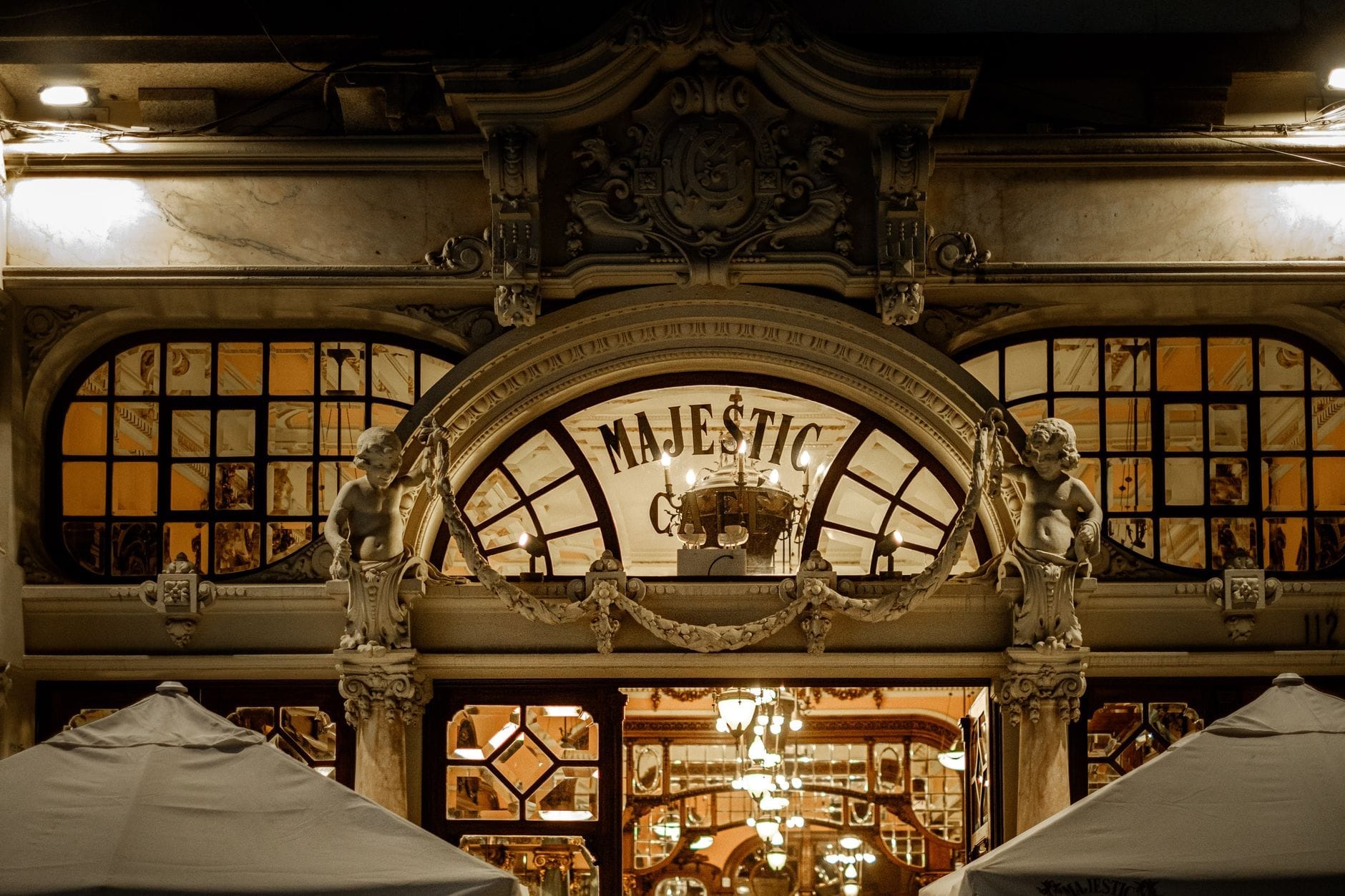
Café Majestic is a historic café-restaurant at Rua Santa Catarina, 112 in Porto's Baixa district, operating since its original opening in 1921. It is not a museum, and it does not charge an entry fee. You walk in, sit down, order, and drink. The reason people plan a visit around it is the interior: floor-to-ceiling carved woodwork in dark walnut, arched gilt mirrors, white-gloved servers, and leather banquettes that create a room which feels genuinely untouched by the design trends of the last century.
The café was built in the Belle Époque style at a moment when Porto's merchant class wanted a European salon culture to call its own. After decades of declining upkeep, it was fully restored and reopened in 1994. The restoration preserved the original aesthetic rather than modernizing it, which is why the space reads as authentic rather than theatrical. The carved ceiling plasterwork, the wall sconces, and the long central corridor of tables all date to the original fit-out or are faithful recreations of it.
ℹ️ Good to know
Opening hours: Monday to Saturday, 9:00 AM to 11:00 PM. The café is closed on Sundays. No advance booking is required to enter, but waits for a table during peak hours can stretch to 20–30 minutes.
The Interior: What You Will Actually See
Step through the brass-handled front door and you enter a long, narrow room lit by wall-mounted lanterns and natural light from the street-facing windows. The immediate impression is of weight and warmth: dark wood paneling covers every wall to shoulder height, topped by ornate plasterwork picked out in cream and gold. Cherub carvings frame the mirrors, and the mirrors themselves reflect the room back in amber tones that make everything look slightly theatrical.
The tables along the windows are the most coveted seats. From there, you have a direct view of Rua de Santa Catarina's foot traffic while remaining insulated from its noise. The leather banquettes are firm and the marble tabletops cool to the touch. The room smells of fresh coffee, warm pastry, and very faintly of furniture polish, a combination that is more pleasant than it sounds on paper.
Photographers should know that the best light inside the café falls in the mid-morning hours on clear days, when sunlight enters from the east-facing windows and catches the gilt details on the mirrors and ceiling. By afternoon, the light is flatter and the room more crowded. The café does not prohibit photography, but the servers are busy and the tables are close together, so shooting without disturbing other guests takes some patience.
Tickets & tours
Hand-picked options from our booking partner. Prices are indicative; availability and final rates are confirmed when you complete your booking.
Serralves All-Access Pass
From 24 €Instant confirmationFree cancellationSantiago de Compostela Full-Day Tour
From 79 €Instant confirmationFree cancellationPeneda Geres park full-day tour from Porto
From 100 €Instant confirmationFree cancellationPorto historical center and the best viewpoints on a tuk-tuk
From 39 €Instant confirmationFree cancellation
Time of Day: How the Experience Changes
At opening time, around 9:00 AM, Café Majestic is as close to peaceful as it gets. A small number of locals and early-rising travelers occupy the window seats with newspapers and coffee. The servers move unhurriedly, the room is cool, and you can hear the soft clink of cups without the background noise of a packed house. If you want the café at its most atmospheric and least crowded, this is the window.
By 11:00 AM, the photography groups begin to arrive. These are often day-tour visitors who stop briefly, take pictures from the doorway or just inside, and leave without ordering. This is a known pattern and one the staff manage with practiced efficiency. If you are seated at a table, the flow of non-ordering visitors around you is a minor distraction rather than a serious problem.
Midday through early afternoon is the busiest period. The full lunch menu is in service, most tables are occupied, and the ambient noise level rises considerably. The experience is still pleasant, but it is a different experience from the morning. If your primary interest is the architecture, a weekday morning visit is significantly more rewarding than a Saturday at noon.
💡 Local tip
Weekday mornings between 9:00 AM and 10:30 AM offer the best combination of available seating, good interior light, and relative quiet. Avoid Saturday midday if you have any flexibility.
Historical and Cultural Context
When Café Majestic opened in 1921, Rua de Santa Catarina was already Porto's primary commercial artery, a role it still holds today. The café was conceived as a meeting place for Porto's intellectual and artistic class, modeled on the grand café culture of Lisbon and Paris. The name 'Majestic' was chosen deliberately to signal ambition and to distinguish it from the plainer tascas and tabernas that served the working population nearby.
The café sits within the broader context of Porto's Baixa district, a neighborhood whose commercial identity has been shaped over centuries by the trade routes that passed through the city. Rua de Santa Catarina remains a pedestrianized shopping street that draws both locals and visitors, and understanding it as a living street rather than a historic set piece adds depth to the Café Majestic visit. For context on the street itself, see our guide to Rua de Santa Catarina.
The 1994 restoration was a significant cultural decision. At the time, the café had deteriorated and its future was uncertain. The decision to restore rather than repurpose it reflected a broader movement in Porto to preserve the city's early twentieth-century commercial architecture, a movement that has since extended to other civic and ecclesiastical buildings across the center. Café Majestic is often cited as an early example of this approach succeeding commercially as well as architecturally.
Managing Expectations: Is It Worth It?
Café Majestic is genuinely one of the finest Belle Époque café interiors in Portugal. That is a fair and defensible statement. It is also a place that has been on every Porto itinerary for years, which means the experience of visiting it now includes navigating its own popularity. The prices reflect the location and the prestige; you will pay more for a coffee here than almost anywhere else on the street.
Whether that premium is worthwhile depends on what you want from the visit. If you want to sit in a beautiful room for an hour with a coffee and a pastel and absorb the space at your own pace, the price is reasonable for what you get. If you want a quick photographic proof of having been there without sitting down, you can often accomplish that from just inside the entrance without ordering, though the staff are understandably more welcoming to paying guests.
Travelers who are primarily interested in Porto's café culture without the queue or the premium pricing have other options nearby. The Mercado do Bolhão a short walk north offers a very different but equally authentic experience of Porto's commercial heritage. And if your broader interest is in Porto's architectural landscape, São Bento Railway Station is a ten-minute walk and contains one of the most remarkable tiled interiors in the country.
Getting There and Practical Notes
Café Majestic is at Rua Santa Catarina 112, on the main pedestrianized section of the street. The most practical transit approach is the Porto Metro: Bolhão station on the Blue (A) and Yellow (D) lines places you a three-minute walk from the café. From the city center, including Avenida dos Aliados, the walk along Rua de Santa Catarina is direct and takes under ten minutes.
There is no dedicated parking nearby. Drivers are best served by the underground car parks around Bolhão or the Boavista area and then walking in. Uber and Bolt both serve this part of the city, and drop-off on or near Rua de Santa Catarina is generally straightforward outside of peak hours when the area is busiest with pedestrian traffic.
If you are combining the visit with a broader walk through Porto's Baixa district, the café fits naturally into a Porto walking tour that could also take in the Clérigos Tower, the Palácio da Bolsa, and the riverfront at Cais da Ribeira.
⚠️ What to skip
The café is closed on Sundays. If Porto is on a weekend itinerary, plan accordingly. There is no published accessibility statement on the official site; travelers with mobility considerations should contact the café directly before visiting.
Insider Tips
- Order at least one item: even a single espresso or a glass of water signals to the staff that you are a guest rather than a tourist treating the room as a free attraction. The service changes noticeably.
- The window tables on the Rua de Santa Catarina side are allocated as they become available, not pre-assigned. If the host offers you a table further back, it is fine to wait a few minutes and ask politely for a window seat when one opens.
- The café does not have a loud formal dress code, but very casual beachwear looks out of place in the room. Light smart-casual clothes suit the atmosphere without any inconvenience.
- If you visit in the morning and the room is nearly empty, it is worth walking the full length of the café toward the back. The room narrows slightly toward the rear and the carved details on the back wall are often missed by visitors who only photograph the entrance section.
- The pastel de nata here is competently made but not exceptional. The café's stronger suit is its coffee and its traditional hot chocolate, which has a density and warmth that suits the room perfectly on a cool morning.
Who Is Majestic Café For?
- Architecture enthusiasts who want to experience a preserved Belle Époque interior in active use
- Photographers focused on interiors, specifically carved woodwork, gilded mirrors, and ambient light
- Travelers on a slow morning with no schedule pressure who want to settle into Porto's café culture
- Literary travelers with an interest in early twentieth-century European salon culture
- Couples looking for a refined, unhurried stop in the middle of a day's walking
Nearby Attractions
Other things to see while in Baixa:
- Avenida dos Aliados
Avenida dos Aliados is the ceremonial spine of central Porto, a wide early-20th-century boulevard stretching from Praça da Liberdade to Porto City Hall. Free to visit at any hour, it serves as Porto's civic stage, commercial main street, and the most direct introduction to the city's architectural ambitions.
- Capela das Almas
Standing on Porto's main shopping street, the Capela das Almas is one of the most photographed facades in the city. Its nearly 16,000 hand-painted blue-and-white azulejo tiles tell stories of saints across 360 square metres of exterior wall. Entry is free, and it takes less than 30 minutes to absorb properly.
- Clérigos Church
Rising 75 metres above the rooftops of Baixa, Clérigos Tower is the defining silhouette of the Porto skyline. The complex combines a beautifully preserved Baroque church, a small museum, and one of the city's most rewarding panoramic viewpoints, all within a few minutes' walk of the city's main commercial streets.
- Clérigos Tower
Standing 75 metres above Porto's rooftops, the Torre dos Clérigos is the tallest campanile in Portugal and the city's most instantly recognisable silhouette. Built between 1754 and 1763 to a design by Italian-born architect Nicolau Nasoni, it rewards those willing to climb its 200-plus steps with a panorama that stretches from the Douro river to the Atlantic. This page covers what the experience actually delivers, how crowds behave at different times of day, and everything you need to plan your visit.