Capela das Almas: Porto's Extraordinary Chapel of Nearly 16,000 Tiles
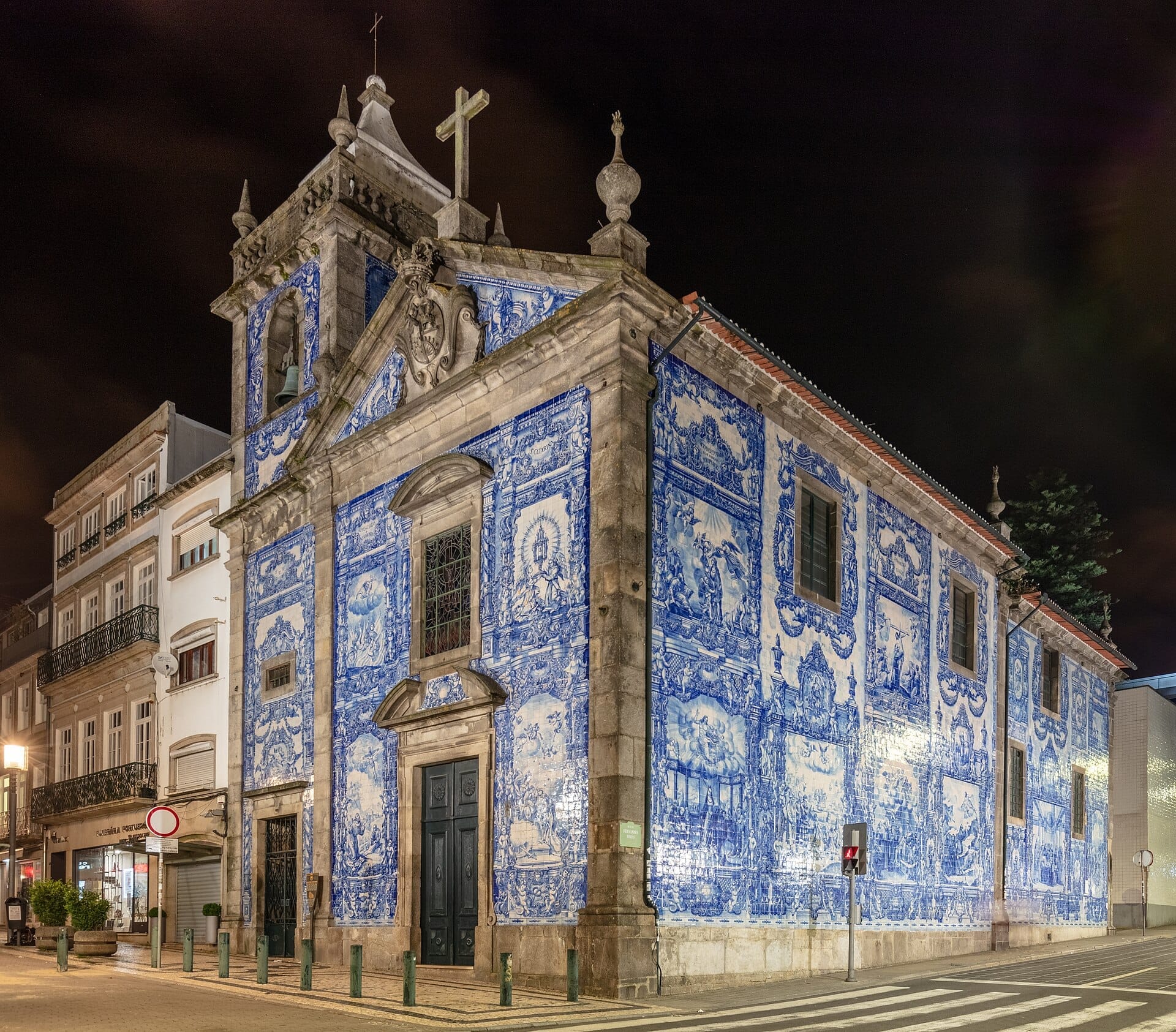
Standing on Porto's main shopping street, the Capela das Almas is one of the most photographed facades in the city. Its nearly 16,000 hand-painted blue-and-white azulejo tiles tell stories of saints across 360 square metres of exterior wall. Entry is free, and it takes less than 30 minutes to absorb properly.
Quick Facts
- Location
- Rua de Santa Catarina 428, Baixa, Porto
- Getting There
- Bolhão Metro Station (lines A, B, C, E, F) — essentially at the door
- Time Needed
- 15–30 minutes for the exterior; longer if you attend Mass
- Cost
- Free entry
- Best for
- Architecture lovers, azulejo enthusiasts, photography, and anyone walking Rua de Santa Catarina
What Is the Capela das Almas?
The Capela das Almas, officially also known as the Capela de Santa Catarina, sits at the corner of Rua de Santa Catarina and Rua Fernandes Tomás in Porto's Baixa district. In English it translates as the Chapel of Souls, a name that fits the gravity of what you see on its walls: narrative scenes depicting the deaths of saints, rendered in thousands of hand-painted tiles. The chapel is a functioning place of Catholic worship, not a museum, which gives it a very different atmosphere from the more tourist-packaged experiences nearby.
Despite sitting directly on Porto's busiest pedestrian shopping street, the chapel manages to stop people mid-stride. Its facade is genuinely arresting in a way that photographs do not fully capture. If you are already planning to walk Rua de Santa Catarina, which connects the Bolhão area to the Batalha neighbourhood, the chapel is simply unavoidable. And that is not a complaint.
The Tile Facade: What You Are Actually Looking At
The exterior is covered in approximately 16,000 blue-and-white azulejo tiles across roughly 360 square metres of wall. The tilework was installed in 1929, designed by artist Eduardo Leite and produced at the Viúva Lamego ceramic factory in Lisbon. The scenes depicted include episodes from the lives of Saint Francis of Assisi and Saint Catherine of Alexandria, among others. The figures are rendered in a classical narrative style, with expressive faces and layered compositions that reward close examination rather than a glance from the pavement.
The blue-and-white palette is consistent with the broader Portuguese azulejo tradition, which you can trace across the city. For a deeper understanding of what you are looking at here, the azulejo tiles guide for Porto provides useful context on the historical development of the form, including why the tilework revival of the early 20th century produced so many of the facades visitors now photograph across the city.
💡 Local tip
The tiles read best in flat, diffused light. Overcast mornings, common in Porto from October to March, actually produce more even illumination across the facade than the harsh midday sun of summer, which creates strong shadow contrasts across the relief surfaces.
Tickets & tours
Hand-picked options from our booking partner. Prices are indicative; availability and final rates are confirmed when you complete your booking.
Peneda Geres park full-day tour from Porto
From 100 €Instant confirmationFree cancellationPorto historical center and the best viewpoints on a tuk-tuk
From 39 €Instant confirmationFree cancellationPorto 48 hours hop-on hop-off bus tour
From 22 €Instant confirmationFree cancellationSecret Porto walking tour
From 35 €Instant confirmationFree cancellation
A Brief History: From Wooden Shrine to Tiled Landmark
The chapel's origins trace to the early 18th century, when a modest wooden structure was erected on this site in honour of Saint Catherine. The street that runs past it, Rua de Santa Catarina, takes its name from this dedication. Over the following centuries the chapel was rebuilt and expanded in stone, eventually becoming the baroque-influenced structure visible today. The dramatic tiled exterior came much later, in 1929, as part of a wider Portuguese interest in applying azulejo decorative programmes to public-facing architecture.
What this means for the visitor is that the chapel is not a medieval relic but a layered product of different eras. The bones are 18th-century ecclesiastical architecture; the facade is early 20th-century decorative ambition. The combination is one of the more honest examples of how Porto's built environment accumulates meaning across centuries without necessarily being self-conscious about it.
How the Experience Changes by Time of Day
The chapel opens early, at around 07:30 on both weekdays and weekends. At that hour, Rua de Santa Catarina belongs mostly to delivery workers, local residents heading to work, and the occasional early-rising visitor. The air still carries a morning damp from the Atlantic, and the street tiles are often wet from overnight rain or cleaning. This is when the chapel facade is at its quietest and most photogenic, with almost no foot traffic competing for space in front of it.
By late morning, especially between 10:00 and 13:00, the street becomes one of Porto's most congested pedestrian corridors. Tour groups arrive in pulses, often stopping directly in front of the chapel for guided explanations. Space on the pavement is genuinely limited, and getting a clear photograph of the full facade requires patience or an early arrival. Weekend mornings between 10:00 and noon are the most pressured periods.
In the afternoon, the chapel has limited weekend hours, closing around 12:45 for part of the day before reopening for afternoon Mass. On weekdays it stays open until around 18:00. The late afternoon light from the west can catch the upper portions of the facade nicely in summer, but the street itself remains busy until early evening.
⚠️ What to skip
On Saturday and Sunday mornings, the chapel closes around 12:45 and reopens later for afternoon Mass. Specific Mass times vary, so if attending a service matters to your visit, check local parish notices in advance rather than assuming continuous access.
Inside the Chapel
Most visitors spend the majority of their time outside, studying the tile panels. The interior is smaller than the facade suggests, as is common with chapels of this type. It is a working religious space, not arranged for tourism, and that restraint is part of what makes a visit worthwhile. The nave is simply proportioned, with the kind of quiet intensity that comes from a building used daily for prayer over three centuries. The smell of candle wax and wood is noticeable immediately on entering.
Visitors are welcome during open hours outside of active services, but standard church etiquette applies. Keep voices low, dress modestly, and be aware that this is not a performance space. Photography inside should be approached with discretion.
Getting There and Practical Logistics
Bolhão Metro Station (served by lines A, B, C, E, and F) is effectively adjacent to the chapel, making it one of the easiest major attractions in Porto to reach by public transport. The Mercado do Bolhão is roughly 30 metres away, which means a visit to the chapel pairs naturally with a morning at the market. If you are approaching on foot from São Bento Railway Station, the walk up Rua de Santa Catarina takes around 10 minutes and is uphill but not steep.
The street itself is paved with traditional Portuguese cobblestones in sections, which can be uneven underfoot. Flat, closed-toe shoes are more comfortable than sandals or heels for walking this area. There is no dedicated parking nearby, and the surrounding streets are not practical for driving, so public transit or walking is genuinely the better approach.
Accessibility details for the interior, including information on step-free access or adapted facilities, are not clearly documented in current public sources. Visitors with specific mobility requirements are advised to contact the parish directly or confirm conditions on arrival.
Photography: What Works and What Doesn't
The full facade requires you to step back considerably on a narrow street. A wide-angle lens or the ultra-wide mode on a smartphone helps, but the pavement width means even then you will be capturing some of the street scene rather than a clean building shot. This is not a flaw, it is the reality of an urban chapel on a working commercial street. Some of the best photographs taken here include the foreground movement of pedestrians, which gives scale to the tile panels.
Detail shots of individual tile panels are often more rewarding than attempts at a full-facade image. The narrative scenes of saints are clearly defined, and getting close enough to read the painted expressions repays the effort. Early morning, with flat light and fewer people, is the practical window for both approaches.
ℹ️ Good to know
The chapel is about a 10-minute walk from the Igreja de Santo Ildefonso, another major azulejo-covered church in Porto. If tile architecture is your primary interest, both can be visited in a single morning on foot.
Who Should Skip This Attraction
Travelers whose priority is sweeping river views, port wine tasting, or Porto's more theatrical interior spaces will find the Chapel of Souls comparatively modest. It is not a grand cathedral with soaring vaults; it is a small neighbourhood chapel with a remarkable exterior. Those already visiting Igreja de São Francisco or the Clérigos Church will find the interior here far simpler. The chapel is not worth a dedicated cross-city journey on its own merits. However, for anyone already in the Baixa neighbourhood, passing it without stopping would be a genuine oversight.
Insider Tips
- Arrive before 09:00 on a weekday to photograph the facade without tour groups. The street is largely clear until around 09:30, and the morning light from the east is soft and even at that hour.
- Stand at the far corner of Rua Fernandes Tomás, diagonally opposite the chapel, to get the most complete view of the full tiled facade without distortion from a narrow street angle.
- The Viúva Lamego ceramic factory that produced these tiles in 1929 is still operating in Lisbon and has its own showroom worth visiting if you travel south. Knowing the provenance adds a layer of meaning to what you are looking at.
- If you want to photograph the chapel facade reflected in wet pavement, come in the morning after overnight rain, which is common between October and March. The reflection almost doubles the visual impact of the tile panels.
- The chapel is a practical landmark for orienting yourself in Baixa: it sits at roughly the midpoint of Rua de Santa Catarina, making it a useful reference point when exploring the neighbourhood on foot.
Who Is Capela das Almas For?
- Architecture and design enthusiasts who want to understand Porto's azulejo tradition in an active, non-museum context
- Photographers looking for a technically demanding and visually rich facade subject in the city centre
- Visitors on a tight schedule who want a significant cultural experience without an entrance fee or time commitment
- Travellers combining a morning at Mercado do Bolhão with nearby cultural stops
- Anyone following a walking route through Baixa who wants to understand how religious architecture and everyday commercial life coexist in Porto
Nearby Attractions
Other things to see while in Baixa:
- Avenida dos Aliados
Avenida dos Aliados is the ceremonial spine of central Porto, a wide early-20th-century boulevard stretching from Praça da Liberdade to Porto City Hall. Free to visit at any hour, it serves as Porto's civic stage, commercial main street, and the most direct introduction to the city's architectural ambitions.
- Clérigos Church
Rising 75 metres above the rooftops of Baixa, Clérigos Tower is the defining silhouette of the Porto skyline. The complex combines a beautifully preserved Baroque church, a small museum, and one of the city's most rewarding panoramic viewpoints, all within a few minutes' walk of the city's main commercial streets.
- Clérigos Tower
Standing 75 metres above Porto's rooftops, the Torre dos Clérigos is the tallest campanile in Portugal and the city's most instantly recognisable silhouette. Built between 1754 and 1763 to a design by Italian-born architect Nicolau Nasoni, it rewards those willing to climb its 200-plus steps with a panorama that stretches from the Douro river to the Atlantic. This page covers what the experience actually delivers, how crowds behave at different times of day, and everything you need to plan your visit.
- Igreja do Carmo
Igreja do Carmo is one of Porto's most photographed buildings, its entire side façade covered in a sweeping blue-and-white azulejo tile panel added in 1912. But the church rewards visitors who go beyond the exterior: inside, seven gilded altars and a single soaring nave of late Baroque craftsmanship await, along with catacombs and the curious 'Hidden House' tucked into the wall between two churches.