Igreja do Carmo, Porto: The Azulejo Church That Rewards a Closer Look
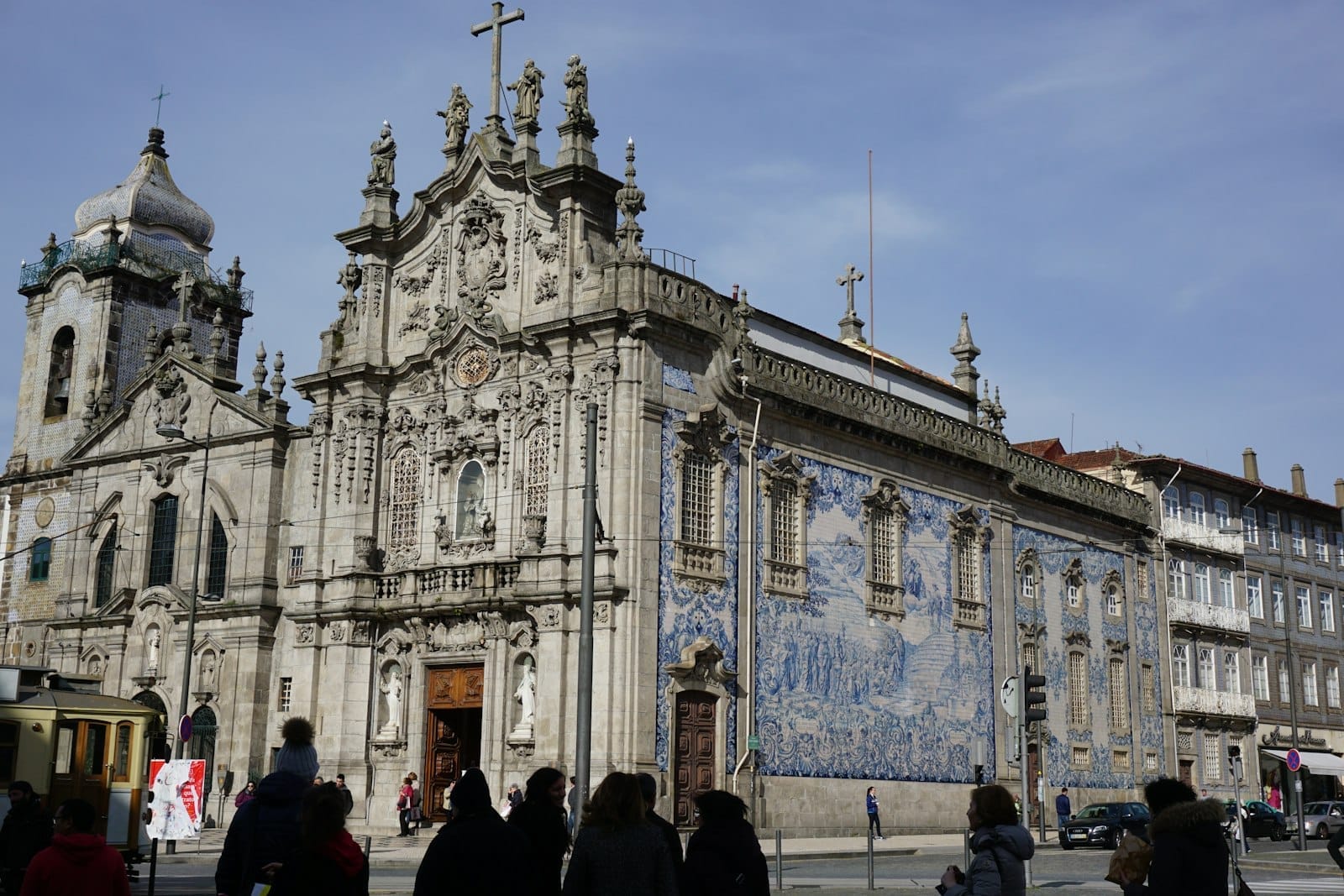
Igreja do Carmo is one of Porto's most photographed buildings, its entire side façade covered in a sweeping blue-and-white azulejo tile panel added in 1912. But the church rewards visitors who go beyond the exterior: inside, seven gilded altars and a single soaring nave of late Baroque craftsmanship await, along with catacombs and the curious 'Hidden House' tucked into the wall between two churches.
Quick Facts
- Location
- Rua do Carmo, Baixa, Porto, Portugal
- Getting There
- Aliados Metro (Line D), STCP buses including 200, 201, 207 and others
- Time Needed
- 45–90 minutes (church only: 45 min; full touristic circuit: up to 90 min)
- Cost
- Church entry free; touristic circuit (catacombs, Hidden House, halls, sacristy) €7 — verify on-site
- Best for
- Architecture lovers, azulejo tile enthusiasts, history buffs, photography
What Makes Igreja do Carmo Worth Your Time
Igreja do Carmo stands at the top of Rua do Carmo in Porto's Baixa district, and even from a hundred metres away, the side wall stops you mid-step. The entire flank of the building is blanketed in thousands of blue-and-white azulejo tiles, forming one of the largest tile panels in the city. Up close, the scenes reveal themselves: Carmelite friars on Mount Carmel, the founding mythology of the order rendered in 18th-century-style illustration on early 20th-century ceramic. It is precise, narrative art on a monumental scale, and the effect is unlike anything else in Porto's already tile-rich streetscape.
The church itself, constructed between 1756 and 1768 in late Baroque and rococo style, was designed by José de Figueiredo Seixas, a disciple of the celebrated architect Nicolau Nasoni. It sits immediately adjacent to the older Igreja das Carmelitas, and the two façades together form a nearly unified frontage on Rua do Carmo. The pairing is intentional: the Carmelitas church was reserved for an enclosed Carmelite convent, while the Carmo church served the Third Order of Our Lady of Carmo. To prevent any contact between the two communities, a narrow house was inserted between the two walls. That structure, known as the Casa Escondida (Hidden House), is now part of the paid touristic circuit and remains one of Porto's more unusual interior discoveries. If you want to understand how Porto's churches connect to its wider azulejo heritage, the Porto azulejo tiles guide provides essential context.
💡 Local tip
The azulejo panel faces south and west, so morning light falls flat on it. Afternoon light, especially from around 2pm onward, brings out the blue tones sharply and reduces glare from the pavement. If photography is your priority, plan accordingly.
The Exterior: Reading the Azulejo Panel
The tile panel was added in 1912, more than 140 years after the church was built. It was designed by Silvestro Silvestri and manufactured in Vila Nova de Gaia, the same riverside area where port wine matures in oak barrels across the Douro. The choice to clad the side wall in tiles was partly practical, partly aesthetic. Porto's Atlantic climate, with its persistent damp and occasional driving rain, is not kind to bare stone. Tiles protect the wall while transforming it into a public artwork visible from across the street.
The panel depicts scenes from the life of the Carmelite Order: hermits on Mount Carmel in the Holy Land, the miraculous events associated with the Brown Scapular, and figures of prophets and saints central to Carmelite tradition. Each scene is framed in decorative borders and connected by flowing vegetal motifs typical of early 20th-century Portuguese tile design. The composition rewards a slow, left-to-right reading, though most visitors photograph it from the middle distance and move on. Spending ten minutes close to the tiles, reading the narrative, is a different and more satisfying experience.
The main western façade, facing Rua do Carmo directly, is granite, as is common with Porto's Baroque churches. The carved stonework includes figures of angels, floral reliefs, and the heraldic emblems of the Carmelite Order. The bell tower rises at the southern end. The contrast between the carved grey granite of the front and the tiled blue-and-white panel of the side is part of what makes the building so visually arresting.
Tickets & tours
Hand-picked options from our booking partner. Prices are indicative; availability and final rates are confirmed when you complete your booking.
Serralves All-Access Pass
From 24 €Instant confirmationFree cancellationSantiago de Compostela Full-Day Tour
From 79 €Instant confirmationFree cancellationPeneda Geres park full-day tour from Porto
From 100 €Instant confirmationFree cancellationPorto historical center and the best viewpoints on a tuk-tuk
From 39 €Instant confirmationFree cancellation
Inside the Church: Gilded Altars and a Single Nave
Entry to the church proper is free and open during mass and rosary hours posted at the entrance. The interior is a single nave, which means nothing interrupts your view from the entrance to the high altar. The walls and altars are covered in gilded carved woodwork, the style known as talha dourada that became a signature of Porto's religious interiors in the 17th and 18th centuries. Igreja do Carmo has seven altars in this style, carved by sculptor Francisco Pereira Campanha, and the effect when afternoon light enters through the high windows is of a space that seems to glow from its own surfaces.
The church opened for worship on 24 July 1768, and it remains an active parish. This matters practically: weekday mornings often see locals attending mass rather than tourists, and the atmosphere is genuinely devotional rather than purely museological. Visitors are welcome but are expected to observe quiet. Dress modestly: shoulders and knees covered is the standard expectation at Portuguese churches.
The nave is not large. Unlike Porto Cathedral or the Igreja de São Francisco, which command imposing scale, Carmo works at a more intimate register. The gilding and carving are concentrated and detailed rather than overwhelming. If you have already visited the larger and more theatrical Igreja de São Francisco, Carmo will feel refined and precise by comparison rather than redundant.
ℹ️ Good to know
Igreja do Carmo is an active parish church. Mass schedules take precedence over tourist visits. If you arrive during a service, wait at the entrance or return later. Weekday afternoons are typically the least interrupted time for unhurried exploration.
The Touristic Circuit: Catacombs and the Hidden House
For €7 (verify on-site, as prices can change), visitors can access the paid touristic circuit, which includes the catacombs beneath the church, the decorated halls and sacristy, and the Casa Escondida. The catacombs are not theatrical in the Paris or Rome sense: they are modest, early modern burial spaces beneath the church floor, giving a concrete sense of the church's role as a place of community burial for the Third Order's membership.
The Casa Escondida, or Hidden House, is the most unusual element. It occupies the narrow gap between the shared wall of the Carmo and Carmelitas churches, inserted specifically to separate a men's Third Order community from an enclosed women's convent. The house is only one room wide, its windows looking out onto the street on one side, its back wall the dividing structure between two religious communities. It was reportedly inhabited as recently as the 20th century. The space is intimate to the point of claustrophobia and remains one of Porto's more genuinely strange discoveries.
Visitors with reduced mobility should note that the catacombs, upper halls, and Hidden House involve stairs and narrow passages. The ground-floor church is accessible at no charge and provides the essential experience without requiring the paid circuit. No official step-free access information for the interior circuit is provided by the church; if this is a concern, contact the church directly before visiting.
When to Visit and How to Get There
Igreja do Carmo sits at the top of Rua do Carmo, which connects directly to the Praça de Gomes Teixeira and is a short walk from Aliados Metro station on Line D. The walk from Aliados takes around five minutes uphill through Baixa's compact street grid. A long list of STCP bus lines (including 200, 201, 207, and 208) stop nearby.
General church visiting hours for the touristic circuit are daily from 09:30 to 17:00 in winter (01 November to 31 March) and from 09:30 to 18:00 in summer (01 April to 31 October); these times should be confirmed on-site or by phone, as mass schedules and seasonal adjustments can affect access. The church is very close to several other major attractions in Baixa, including Livraria Lello and Clérigos Tower, making it easy to combine into a single morning walk.
The Baixa district is compact and walkable but notably hilly. Rua do Carmo rises steeply from the lower city, and the street itself is paved with cobblestones that become slippery when wet. Wear flat-soled shoes with grip, particularly in autumn and winter when Porto's Atlantic rainfall makes the stones treacherous. In summer, the narrow streets funnel heat in the afternoon, so a morning visit is more comfortable.
⚠️ What to skip
Rua do Carmo is a busy tourist corridor and can become crowded between 10am and 2pm in peak season (July–August). If you visit then, the exterior tile panel will have groups standing in front of it. Early morning, before 9am, is the best time for undisturbed photography of the façade.
Photography, Context, and Verdict
Igreja do Carmo is one of Porto's most photographed façades, and like all such places, there is a version of visiting it that is purely transactional: you arrive, you photograph the azulejo panel, you leave. That is a reasonable choice if your itinerary is compressed. But the church justifies more time than most visitors give it. The interior is genuinely fine, and the Hidden House is unlike anything else in the city.
For photography, a wide-angle lens or the wide setting on a phone works well for the full tile panel. A close-up of the tile narrative details rewards a longer focal length or proximity. The street is narrow enough that fitting the entire façade in frame requires stepping back to the far pavement. The adjacent Igreja das Carmelitas, which most visitors ignore, has its own carved granite façade worth examining. Together, the two churches and the tiny house between them form a small architectural essay on the organization of Catholic religious life in 18th-century Porto. For broader context on Porto's churches and religious architecture, a dedicated guide covers the full range of the city's ecclesiastical heritage.
Who might skip this? Visitors who find Baroque interiors repetitive after touring several Porto churches in a single day may feel some fatigue here, though the Hidden House remains a differentiating element. Those with limited mobility who cannot access the paid circuit will still find the free church visit worthwhile, but will miss about half of what makes Carmo distinctly interesting. If rain is heavy, the azulejo panel is still visible and somewhat protected under the eaves, but the street experience is diminished.
Fitting Igreja do Carmo Into Your Porto Itinerary
Igreja do Carmo is most naturally visited as part of a morning in Baixa and upper Porto. A logical sequence starts at São Bento Railway Station for its extraordinary azulejo interior, then walks uphill through Rua das Flores to Carmo, before continuing to Clérigos Tower for panoramic views. This covers three of the most architecturally significant buildings in Baixa in roughly two to three hours and requires no transit between stops.
If you are working from a two- or three-day framework, the Porto 2-day itinerary places Carmo within a morning Baixa circuit that balances walking time, key monuments, and enough flexibility to linger where you want. The church's free entry also fits naturally into a budget-focused Porto visit, where even the paid circuit at €7 represents strong value for the combination of catacombs, sacristy, decorated halls, and the Hidden House.
Insider Tips
- The best angle for photographing the full azulejo panel is from the far pavement on Rua do Carmo, as far up the street as possible. This gives you the widest view without distortion. A cloudy day actually produces more even colour rendering than bright direct sunlight, which can wash out the blue tones.
- The touristic circuit is rarely busy, even when the exterior draws crowds. If the street feels overrun, step inside and buy the circuit ticket: you will often have the catacombs and Hidden House largely to yourself.
- The adjacent Igreja das Carmelitas is often overlooked entirely by visitors focused on Carmo. Its granite façade and interior are early 17th-century and predate the Carmo church by roughly a century. It is worth a five-minute detour.
- Weekday mornings between 7:30 and 9:00 are when the church is used primarily by local parishioners. If you want to see the space as a living place of worship rather than a tourist site, arriving early on a Tuesday or Wednesday provides a different atmosphere entirely.
- The Praça de Gomes Teixeira, immediately in front of the churches, has benches and a fountain. It is one of the calmer squares in central Porto and a good place to sit and look at the dual façades together before or after entering.
Who Is Igreja do Carmo For?
- Architecture and design enthusiasts interested in late Baroque and rococo ecclesiastical buildings
- Photography-focused travellers who want a landmark azulejo exterior combined with a rich interior
- History and culture visitors who want to understand Porto's religious and social history through built fabric
- Budget travellers: the church is free to enter, and the paid circuit is low-cost for what it includes
- Visitors building a half-day walking tour of Baixa who want to combine several major monuments efficiently
Nearby Attractions
Other things to see while in Baixa:
- Avenida dos Aliados
Avenida dos Aliados is the ceremonial spine of central Porto, a wide early-20th-century boulevard stretching from Praça da Liberdade to Porto City Hall. Free to visit at any hour, it serves as Porto's civic stage, commercial main street, and the most direct introduction to the city's architectural ambitions.
- Capela das Almas
Standing on Porto's main shopping street, the Capela das Almas is one of the most photographed facades in the city. Its nearly 16,000 hand-painted blue-and-white azulejo tiles tell stories of saints across 360 square metres of exterior wall. Entry is free, and it takes less than 30 minutes to absorb properly.
- Clérigos Church
Rising 75 metres above the rooftops of Baixa, Clérigos Tower is the defining silhouette of the Porto skyline. The complex combines a beautifully preserved Baroque church, a small museum, and one of the city's most rewarding panoramic viewpoints, all within a few minutes' walk of the city's main commercial streets.
- Clérigos Tower
Standing 75 metres above Porto's rooftops, the Torre dos Clérigos is the tallest campanile in Portugal and the city's most instantly recognisable silhouette. Built between 1754 and 1763 to a design by Italian-born architect Nicolau Nasoni, it rewards those willing to climb its 200-plus steps with a panorama that stretches from the Douro river to the Atlantic. This page covers what the experience actually delivers, how crowds behave at different times of day, and everything you need to plan your visit.