São Bento Railway Station: Porto's Most Spectacular Train Hall
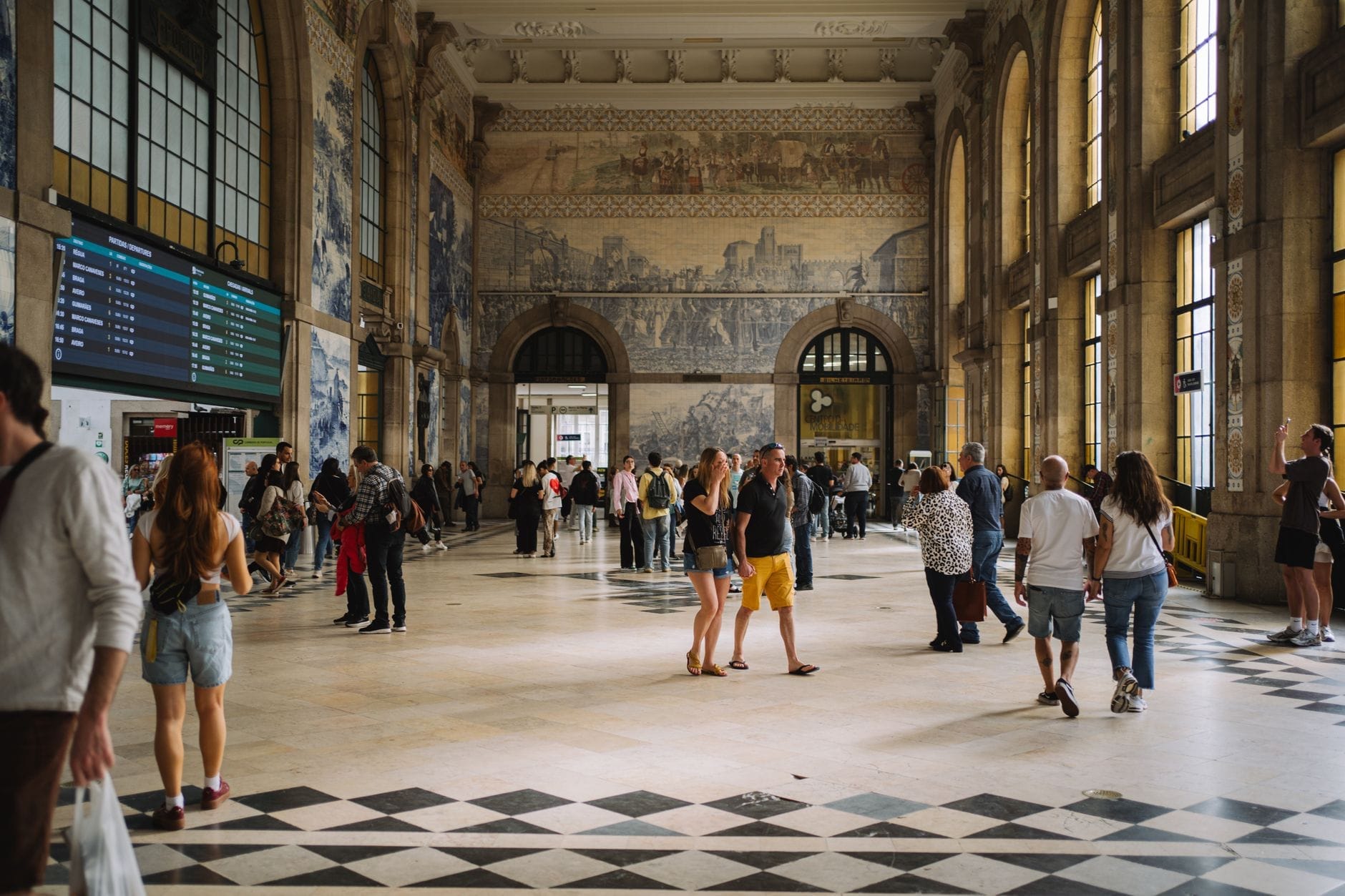
São Bento Railway Station is not just a transit hub, it is one of Porto's most impressive architectural spaces. Its grand vestibule is lined with roughly 20,000 hand-painted azulejo tiles depicting Portuguese history, making it a working station that doubles as a gallery. Entry is free.
Quick Facts
- Location
- Praça de Almeida Garrett, Baixa, Porto
- Getting There
- Metro Line D – São Bento station (direct)
- Time Needed
- 20–45 minutes to explore the vestibule properly
- Cost
- Free to enter; train tickets sold separately
- Best for
- Architecture lovers, history enthusiasts, azulejo tile fans
- Official website
- www.cp.pt
What São Bento Railway Station Actually Is
São Bento Railway Station, known in Portuguese as Estação de São Bento, sits at the edge of Praça de Almeida Garrett in the heart of Porto's Baixa district. It is a fully operational train station serving urban and regional routes, but it is also one of the most admired interior spaces in Portugal. The reason is the entrance hall: a soaring vestibule covered floor to near-ceiling with approximately 20,000 azulejo tiles painted by the artist Jorge Colaço between 1905 and 1916, the year the current station building officially opened to the public.
The building itself was designed by architect José Marques da Silva, who studied at the École des Beaux-Arts in Paris. The exterior is a composed Beaux-Arts façade in granite, understated by Porto's standards and easy to underestimate from the street. What waits inside is a different matter entirely. The contrast between the plain stone exterior and the luminous blue-and-white interior is part of what makes the experience so striking.
💡 Local tip
Entry to the station hall is completely free. You do not need a train ticket to walk in and view the tiles. Just push through the main doors off Praça de Almeida Garrett.
The Azulejo Panels: What You Are Looking At
The tile panels are not decorative filler. Jorge Colaço painted four large narrative compositions specifically for this space, each depicting a chapter of Portuguese history and regional life. The two largest panels, dominating the upper walls of the main hall, show scenes from the history of transportation and major medieval battles, including the Battle of Valdevez and other pivotal episodes such as royal entries into Porto. The lower register panels shift in tone, depicting scenes of rural life and folk traditions from different regions of northern Portugal: ox carts, harvests, festivals, and pastoral landscapes rendered in the characteristic indigo blue on white tin glaze.
Spending time with these panels rewards patience. Stand back to read the full composition, then move close to see individual brushwork and facial expressions. Colaço worked within the azulejo tradition but brought a painterly, almost academic precision to the figures. The scale is ambitious: some of the battle scenes contain dozens of individual soldiers rendered in detail, their armor and posture studied and specific.
If you want deeper context for what you are seeing, the Porto azulejo tiles guide explains the history of the medium from its Moorish origins through to 20th-century artists like Colaço. Understanding the tradition makes the São Bento panels considerably more meaningful.
Tickets & tours
Hand-picked options from our booking partner. Prices are indicative; availability and final rates are confirmed when you complete your booking.
Sao Bento da Vitoria Monastery Tour with Fado Concert
From 24 €Instant confirmationFree cancellationSerralves All-Access Pass
From 24 €Instant confirmationFree cancellationSantiago de Compostela Full-Day Tour
From 79 €Instant confirmationFree cancellationPeneda Geres park full-day tour from Porto
From 100 €Instant confirmationFree cancellation
How the Experience Changes by Time of Day
The station is busy throughout the day, but the texture of that activity shifts by the hour. Early morning, from around 7:30 AM to 9:00 AM, is when it functions most purely as a train station. Commuters move purposefully through the hall, rolling luggage, checking phones, the tile panels largely ignored by people who pass them every working day. The light at this hour is soft, filtering through the tall arched windows, and the space carries a low hum of footsteps and announcements.
By mid-morning, the commuter current shifts and tour groups begin arriving. Between roughly 10:00 AM and 1:00 PM on any day with good weather, the vestibule fills with visitors craning their necks at the upper panels, selfie sticks extended, guides speaking in clusters of French, German, and Spanish. This is when photography becomes harder and the reflective quality of the space is harder to access.
Late afternoon, particularly from 4:30 PM onward, brings a quieter window. The large tour groups have generally moved on, afternoon light enters from the west-facing windows at a lower angle and warms the interior, and the hall settles into a more contemplative rhythm. This is the best time to photograph the tiles without crowds in frame, and the best time to simply stand and look.
💡 Local tip
Arrive before 9:00 AM or after 4:30 PM for noticeably fewer tour groups. Midday in summer is the most crowded stretch by a significant margin.
Historical Context: What Stood Here Before
The station's name carries a layer of history that precedes the railway entirely. Before Marques da Silva's building, the site was occupied by the Convent of São Bento de Avé-Maria, a Benedictine convent founded in the 16th century. The convent was dissolved following the Liberal Wars of the 1830s, after which Portugal suppressed most of its religious orders and repurposed their properties. The site sat in various states of partial use before the railway company acquired it for the new terminus.
The decision to commission large-scale azulejo murals for a railway station was deliberate and nationalistic. The late 19th and early 20th centuries saw a Portuguese cultural movement that placed azulejo work at the centre of a revived national identity, part of a broader effort to assert historical depth and artistic heritage. São Bento was inaugurated in 1916, during a period when Portugal was also navigating World War One, and the imagery of medieval conquest and rural tradition carried particular ideological weight.
Getting There and Navigating the Surrounding Area
São Bento station sits at the bottom of the Baixa hill, a short walk from the Ribeira waterfront and within comfortable distance of many of Porto's central attractions. Metro Line D stops directly at São Bento, making it one of the most accessible points in the city. From the airport, take Metro Line E to Trindade, transfer to Line D, and São Bento is one stop further south.
The station is a natural starting or ending point for exploring central Porto. From the front steps, you can walk down to Cais da Ribeira in under ten minutes, or head up through the old city toward Clérigos Tower and Livraria Lello in around fifteen. The station is also the departure point for regional trains to Braga, Guimarães, Aveiro, and the Douro Valley line, making it the gateway for day trips outside the city.
For travelers planning a fuller exploration of the city's transit options and how to connect the neighborhoods, the getting around Porto guide covers the metro, trams, buses, and on-foot routes in detail.
Photography: Making the Most of the Interior
The vestibule is challenging to photograph well because the space is tall and relatively enclosed, the tiles are reflective, and the light sources are uneven. A wide-angle lens or smartphone panorama mode captures more of the hall's scale but introduces distortion at the edges. The best single-frame compositions tend to be taken from the far end of the hall looking back toward the main entrance, where you pick up the arched windows as a light source against the dark ironwork of the ceiling structure.
For close-up tile detail, any standard lens will do, but a polarizing filter significantly reduces glare from the glazed tile surface. Without one, flat overcast exterior light on a cloudy day actually produces more even tile photography than direct sun, which creates hard reflections. Flash photography is not prohibited but reflects badly off the tiles and rarely improves the result.
⚠️ What to skip
The station is a working transit hub. Keep clear of the ticket barriers and platform areas if you are not traveling by train. Staff are generally tolerant of visitors photographing the hall, but blocking the flow of commuters is not appreciated.
Limitations and Who Might Not Enjoy This
São Bento is genuinely extraordinary as a public space, but it is easy to overpromise it. The entire visitable area is essentially one room, the entrance vestibule. There is no museum-style interpretation, no audio guide available at the station itself, and no English-language signage explaining the tile panels in detail. Visitors who walk in without prior knowledge of the azulejo tradition or Portuguese history may find themselves admiring something beautiful without fully understanding what they are looking at.
The station is also almost always busy during daylight hours. If you are traveling in July or August, the midday crowd is dense enough to be genuinely unpleasant for anyone who dislikes close-quarters sightseeing. On rainy days, which are common in Porto between November and March, the vestibule fills quickly with people sheltering from the weather, which adds noise and reduces the contemplative quality of the space.
Travelers who are not particularly drawn to decorative arts or historical iconography may find that 15 minutes is enough. It is worth stopping even on a tight itinerary, but it is not the kind of attraction that rewards a long dedicated visit unless tile work and Portuguese history are specific interests.
Insider Tips
- The ticket office hours often listed online (for example, around 8:00 AM to 6:00 PM on weekdays and 9:00 AM to 4:30 PM on Saturdays, closed Sundays) refer to specific staffed ticket windows for certain train services and may vary; the hall itself is accessible throughout the station's broader operating hours, which currently extend from early morning (around 5:00 AM) until at least midnight as long as trains are running.
- Look up at the iron ceiling structure above the tile panels. The architectural metalwork framing the glass roof is a separate reward that most visitors miss entirely because they are focused on the walls at eye level.
- The regional train to the Douro Valley departs from São Bento station. If you are planning a day trip along the river, you can combine your tile viewing with catching the morning service, making the station visit a practical part of the journey rather than a separate stop.
- The praça outside the station, Praça de Almeida Garrett, is a useful orientation point. The stone steps leading up from it toward the cathedral and the old city are one of Porto's better street-level approaches to the historic centre.
- If you want a clear photograph of the full tile panorama with minimal people visible, your best chance on weekdays is shortly after the station opens in the early morning, before most tour buses and large groups begin arriving from the hotel districts.
Who Is São Bento Railway Station For?
- Architecture and design enthusiasts who want to see Portuguese azulejo tilework at its most ambitious scale
- History-focused travelers interested in how Portugal represented its own past in public spaces
- Photographers looking for a dramatic interior subject that requires no admission fee
- Travelers using regional trains to reach the Douro Valley or northern cities, for whom São Bento is a practical and beautiful departure point
- First-time visitors to Porto wanting a central, free, and genuinely impressive first impression of the city
Nearby Attractions
Other things to see while in Baixa:
- Avenida dos Aliados
Avenida dos Aliados is the ceremonial spine of central Porto, a wide early-20th-century boulevard stretching from Praça da Liberdade to Porto City Hall. Free to visit at any hour, it serves as Porto's civic stage, commercial main street, and the most direct introduction to the city's architectural ambitions.
- Capela das Almas
Standing on Porto's main shopping street, the Capela das Almas is one of the most photographed facades in the city. Its nearly 16,000 hand-painted blue-and-white azulejo tiles tell stories of saints across 360 square metres of exterior wall. Entry is free, and it takes less than 30 minutes to absorb properly.
- Clérigos Church
Rising 75 metres above the rooftops of Baixa, Clérigos Tower is the defining silhouette of the Porto skyline. The complex combines a beautifully preserved Baroque church, a small museum, and one of the city's most rewarding panoramic viewpoints, all within a few minutes' walk of the city's main commercial streets.
- Clérigos Tower
Standing 75 metres above Porto's rooftops, the Torre dos Clérigos is the tallest campanile in Portugal and the city's most instantly recognisable silhouette. Built between 1754 and 1763 to a design by Italian-born architect Nicolau Nasoni, it rewards those willing to climb its 200-plus steps with a panorama that stretches from the Douro river to the Atlantic. This page covers what the experience actually delivers, how crowds behave at different times of day, and everything you need to plan your visit.