Igreja de São Francisco: Porto's Ornate Church
A Gothic church on the outside, a Baroque fever dream on the inside. Igreja de São Francisco contains one of Europe's most extravagant gilded interiors, plus a network of catacombs beneath your feet. Here is everything you need to visit well.
Quick Facts
- Location
- Rua do Infante D. Henrique, Ribeira, Porto
- Getting There
- São Bento metro (~5 min walk); Tram Line 1, Infante stop
- Time Needed
- 45–90 minutes (church + museum + catacombs)
- Cost
- Approx. €7.50–€10 adults; discounts with Porto Card and for students/seniors; children under 12 free (verify on-site)
- Best for
- History lovers, architecture enthusiasts, curious travellers
- Official website
- ordemsaofranciscoporto.pt/igrejas
What Is Igreja de São Francisco?
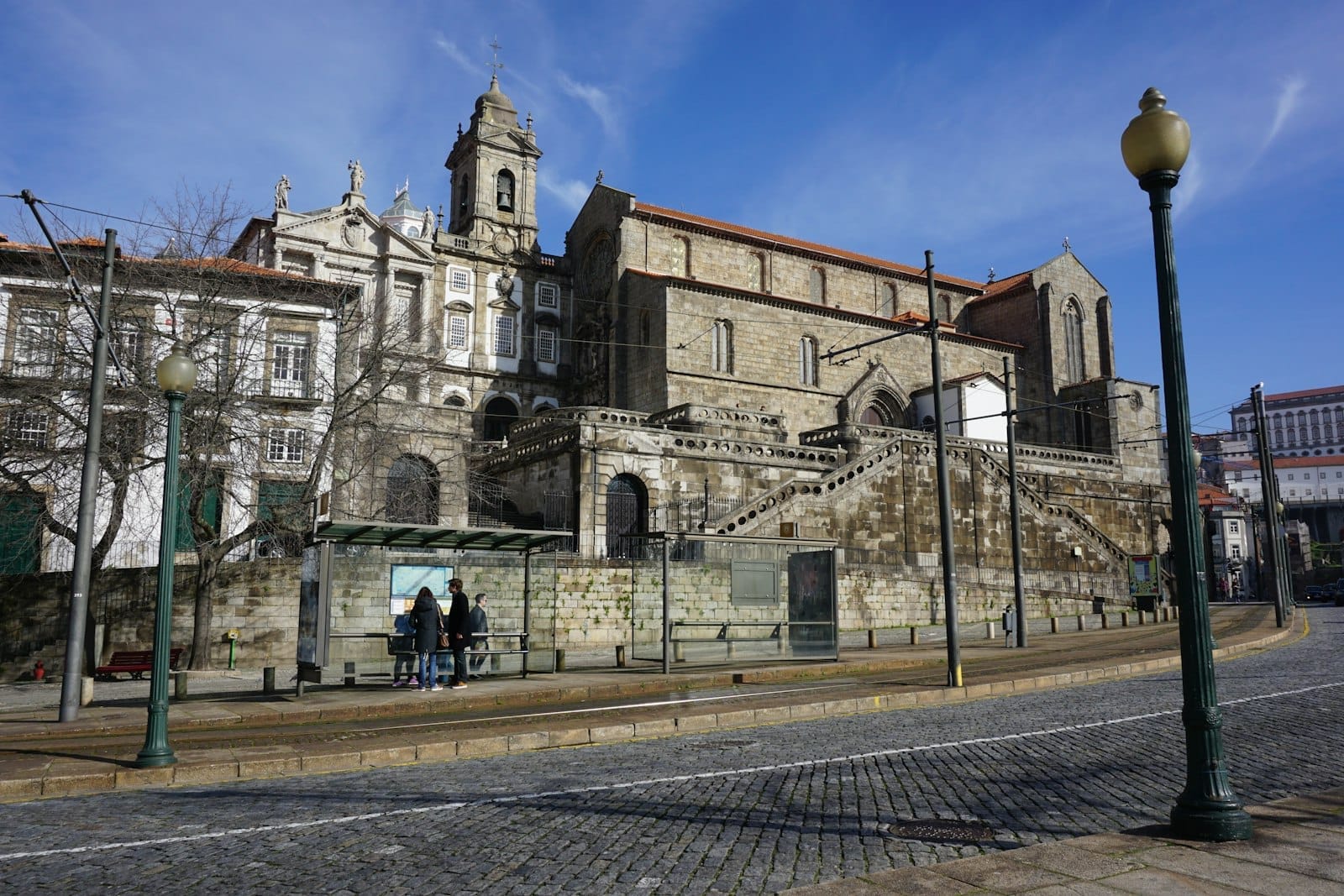
Igreja de São Francisco, the Church of Saint Francis, sits at the edge of Porto's Ribeira quarter near the Douro riverfront. From the street, it looks like exactly what it is: a church in grey granite, restrained and angular, whose current Gothic shell dates to the 14th century. The facade gives almost nothing away about what is inside. That contrast is precisely what makes this one of the most genuinely surprising buildings in Portugal.
The Franciscan Order established a presence in Porto around 1223, with the original convent dedicated to Saint Francis beginning in 1244. The current church grew out of that foundation. In the early 18th century, decades after the main structure had stood in relative austerity, craftsmen began covering every surface of the interior with carved gilded woodwork in the Portuguese Baroque style known as talha dourada. The result is an interior where every column, every arch, every niche and capital is smothered in gold-leafed relief carving. The Franciscan Order established a presence in Porto around 1223, with the original convent dedicated to Saint Francis beginning in 1244. The current church grew out of that foundation. In the early 18th century, decades after the main structure had stood in relative austerity, craftsmen began covering every surface of the interior with carved gilded woodwork in the Portuguese Baroque style known as talha dourada. The result is an interior where every column, every arch, every niche and capital is smothered in gold-leafed relief carving. Estimates commonly cite around 300 kilograms of gold used in the decoration, though the figure should be treated as an approximation.
The church has been classified as a National Monument since 1910 and sits within Porto's historic centre, a UNESCO World Heritage Site since 1996. Your ticket covers three distinct areas: the church itself, a small adjacent museum, and the catacombs beneath the floor. For more on Porto's broader religious heritage, see our guide to Porto's most significant churches.
The Interior: What You Are Actually Looking At
Step inside and the shift is abrupt. The Gothic nave, Step inside and the shift is abrupt. The Gothic nave should read as cool and spare. Instead, every pillar and wall surface is carved in wood and finished in gold leaf. The eye does not know where to settle. There are angels, vines, animals, shields, biblical figures, and botanical motifs coiling around every architectural element from the floor to the ceiling vaults. The limestone of the original Gothic structure peeks through in places, but only just. should read as cool and spare. Instead, every pillar and wall surface is carved in wood and finished in gold leaf. The eye does not know where to settle. There are angels, vines, animals, shields, biblical figures, and botanical motifs coiling around every architectural element from the floor to the ceiling vaults. The limestone of the original Gothic structure peeks through in places, but only just.
The most photographed feature is the main retable and the carved tree of Jesse on the north wall: a towering genealogical sculpture depicting the lineage of Christ from Jesse through David to the Virgin Mary, with figures emerging from the branches of a carved tree. It is technically detailed and compositionally ambitious. Even visitors who are not particularly interested in religious iconography tend to stop in front of it.
💡 Local tip
Photography without flash is generally permitted inside the church. The low, warm lighting inside makes a tripod or a phone with good low-light capability genuinely useful. The retable and tree of Jesse are on the dimmer side of an already dim interior, so don't rely on automatic camera modes.
The smell inside the church is cool stone and faintly sweet wood: old, dry, preserved. In summer, the thick granite walls keep the temperature noticeably lower than the street outside, which is a relief on hot August days when the Ribeira heats up considerably. In winter, those same walls make the space feel cold and vault-like, so dress with a layer you can add.
Tickets & tours
Hand-picked options from our booking partner. Prices are indicative; availability and final rates are confirmed when you complete your booking.
Sao Bento da Vitoria Monastery Tour with Fado Concert
From 24 €Instant confirmationFree cancellationSerralves All-Access Pass
From 24 €Instant confirmationFree cancellationSantiago de Compostela Full-Day Tour
From 79 €Instant confirmationFree cancellationPeneda Geres park full-day tour from Porto
From 100 €Instant confirmationFree cancellation
The Catacombs: A Different Kind of Visit
Beneath the church floor lies a network of burial vaults that served the affiliated Third Order of Saint Francis for centuries. The catacombs are part of the standard ticket and most visitors spend 15 to 20 minutes below ground. The space is genuinely dim, with an ossuary visible through a glass floor in some areas. This is not a dramatised experience designed for horror tourists: it is a real ossuary space, and the tone is solemn rather than theatrical.
The catacombs are the section of the visit most likely to be unsettling for younger children or anyone not expecting it. The ground is uneven and the ceilings low in parts. Visitors with claustrophobia should be aware that some passages are narrow. That said, the space is well maintained and not overcrowded.
⚠️ What to skip
The catacombs involve uneven surfaces, low ceilings in places, and bone remains visible through grates. The main church also has steps and an uneven floor. Visitors with reduced mobility should contact the site directly before visiting to confirm current access provisions.
Historical Context: Why This Church Looks the Way It Does
The tension between the Gothic shell and the Baroque interior is not an accident or a renovation mistake. It reflects about 300 years of separate decisions. The original Franciscan order, which built the church, was committed to architectural simplicity as a theological position. The riot of gold that came later was funded and executed by the Third Order of Saint Francis, a lay confraternity of wealthy Porto merchants who attached themselves to the Franciscan order in the 17th and 18th centuries. The gold is their legacy as much as it is a religious statement.
Portugal in the early 18th century was receiving enormous quantities of gold from its colony in Brazil. The timing is not coincidental. Brazilian gold funded much of the gilded woodwork that now defines Portuguese Baroque church interiors across the country, and São Francisco is among the most extreme examples of the form.
Understanding this period also helps explain why Porto's streetscape is layered the way it is: Gothic foundations, Baroque overlays, azulejo tile facades, and 20th-century additions all coexist in the historic centre. For a broader introduction to the city's visual culture, the guide to Porto's azulejo tile tradition connects many of the same artistic threads.
When to Visit and How Crowds Behave
Opening hours follow a seasonal pattern. From 1 April to 30 September, the ticket office is open from 09:00 to 20:00. From 1 October to 31 March, hours are 09:00 to 19:00. Opening hours follow a seasonal pattern. From 1 April to 30 September, the ticket office is open from 09:00 to 20:00. From 1 October to 31 March, hours are 09:00 to 19:00. The site is closed on 25 December. Visiting immediately at opening, around 09:00, means you will often have the nave to yourself or close to it. By 11:00, tour groups arrive and the interior becomes noticeably crowded, with guides speaking in multiple languages simultaneously. The acoustics of a stone vault do not help. Visiting immediately at opening, around 09:00, means you will often have the nave to yourself or close to it. By 11:00, tour groups arrive and the interior becomes noticeably crowded, with guides speaking in multiple languages simultaneously. The acoustics of a stone vault do not help.
Late afternoon in summer (after 17:00) offers another window of relative calm as day-trip groups thin out. Midday in July and August is the worst time: the Ribeira neighbourhood is at peak capacity, queues can form at the ticket window, and the acoustic noise inside the church competes with the visual overload.
If you are combining this visit with the nearby riverfront and the palaces, the most efficient loop starts at São Francisco at opening, continues along Cais da Ribeira for a mid-morning walk, and crosses to Vila Nova de Gaia on the lower deck of the Dom Luís I Bridge for the afternoon port wine lodges. That sequence avoids the midday tourist peak at all three.
ℹ️ Good to know
Ticket prices are approximately €7.50–€10 for adults, Ticket prices are approximately €7.50–€10 for adults, with discounts for Porto Card holders and students. Check on-site or at the official website before visiting, as prices are subject to change.
Getting There and Practical Logistics
The church is on Rua do Infante D. Henrique in the Ribeira quarter. The most straightforward approach from central Porto is on foot from São Bento station, about five minutes downhill toward the river. From the Aliados area, allow around ten minutes walking. If you haven't yet taken the historic tram, this is a reasonable way to arrive from Foz do Douro or the Massarelos area along the riverbank.
STCP bus lines 1, 23, 49, 57, and 91 stop within a few minutes' walk. If you're navigating Porto's public transport for the first time, the guide to getting around Porto covers the Andante card system and which zones apply to different journeys.
Parking in the Ribeira is extremely limited and the streets are narrow. Walking or using transit is strongly preferable to arriving by car. The area around the church is cobblestoned, which is standard for this part of Porto, so flat-soled shoes with grip are a sensible choice.
The Palácio da Bolsa Connection
Directly adjacent to the church stands the Palácio da Bolsa, the 19th-century stock exchange building whose Arab Room is another of Porto's most extravagant interiors. The two buildings share a block and are often visited together. They make an interesting pairing precisely because they represent different eras of Porto's wealth display: medieval merchant piety at São Francisco, and 19th-century liberal commercial confidence at the Bolsa. Directly adjacent to the church stands the Palácio da Bolsa, the 19th-century stock exchange building whose Arab Room is another of Porto's most extravagant interiors. The two buildings share a block and are often visited together. They make an interesting pairing precisely because they represent different eras of Porto's wealth display: medieval merchant piety at São Francisco, and 19th-century liberal commercial confidence at the Bolsa.
The surrounding streets are also worth your time. Rua das Flores runs north from this neighbourhood toward the Baroque facades of the city centre and is one of the more photogenic streets in Porto for architectural detail.
Who Should Manage Expectations
Igreja de São Francisco is a genuinely remarkable interior, but a few categories of visitor may find it less rewarding than expected. If you are travelling with young children who are not patient in indoor, low-light environments, the experience will likely be short and stressful. The catacombs are not suitable for children who are sensitive to imagery of human remains. If religious heritage does not interest you as a category, the church will probably feel like a lot of gold to look at without interpretive context. There is limited printed interpretation inside the nave; the space speaks mainly through visual impact rather than museum-style explanation.
Visitors with reduced mobility should contact the church in advance. The historic building involves steps at the entrance, an uneven stone floor, and narrow passages in the catacombs. There is no indication of a lift or comprehensive step-free route through the full visit, so confirming conditions before arrival is important.
Insider Tips
- Arrive at 09:00 when the ticket office opens. The nave is often empty for the first 30–40 minutes before tour groups begin arriving, and the silence combined with the gold interior is a genuinely different experience from the crowded midday version.
- The tree of Jesse carving is on the north wall and receives the least natural light. Position yourself at a slight angle rather than straight on and use the ambient candlelight areas nearby to help your eyes adjust before trying to photograph the detail.
- Buy the Porto Card before visiting if you are planning to see several attractions. The 20–25% discount at São Francisco alone partially offsets the card's cost, and São Bento station's ticket office is five minutes up the hill from the church entrance.
- The museum section attached to the church is small but contains painted panels and sacred objects that give useful context to the order that funded the gilding. Most visitors skip it in under ten minutes, but spending twenty means you leave with a clearer sense of who actually paid for all that gold.
- The building is closed on Christmas Day. If you are visiting Porto in late December, check the official website for any additional holiday closures, as opening hours can be adjusted during the festive period.
Who Is Igreja de São Francisco For?
- Architecture and design enthusiasts who want to understand the Portuguese Baroque at its most extreme
- History travellers interested in the intersection of colonial wealth and religious patronage
- Photographers drawn to low-light, high-contrast interior spaces
- Travellers doing a focused Ribeira half-day that combines riverfront, church, and the adjacent Palácio da Bolsa
- Anyone visiting Porto for the first time who wants a single building that explains the city's medieval and early modern character in one hour
Nearby Attractions
Other things to see while in Ribeira:
- Cais da Ribeira
Cais da Ribeira is Porto's historic riverside promenade along the north bank of the Douro, part of the UNESCO World Heritage-listed centre. Free to walk, lined with colourful buildings and boat tour kiosks, it is one of Portugal's most recognisable urban waterfronts.
- Casa do Infante
Casa do Infante stands on Rua da Alfândega in the heart of Porto's Ribeira district, occupying a site that has been central to the city's life since the Roman period. Built as a royal customs house in 1325 and later named for Prince Henry the Navigator, traditionally regarded as having been born here in 1394, it now operates as a unit of the Museu do Porto, housing archaeological remains and centuries of civic records beneath one roof.
- Dom Luís I Bridge
The Ponte Dom Luís I is a double-deck iron arch bridge spanning the Douro River between Porto's Ribeira quarter and Vila Nova de Gaia. Open 24 hours a day and free to cross on foot, it rewards visitors with sweeping river views from both its road-level walkway and its elevated metro deck, 45 metres above the water.
- Douro River Cruise
A Douro River cruise transforms Porto's skyline into a living panorama of medieval towers, port wine lodges, and six iron bridges. Whether you take a 50-minute sightseeing loop or a multi-day voyage into the Alto Douro Wine Region, the river gives you a perspective on Porto and its surroundings that no viewpoint on land can match.