Rua das Flores, Porto: The Street of Flowers Worth Slowing Down For
Rua das Flores is Porto's most architecturally layered pedestrian street, connecting São Bento Station to the Ribeira riverside through 500 years of aristocratic facades, azulejo-tiled church fronts, and artisan workshops. It is free to walk, open at any hour, and dense enough with detail to reward a slow, unhurried visit.
Quick Facts
- Location
- Rua das Flores, 4050-253 Porto, Portugal — between São Bento Station and Largo São Domingos, Ribeira
- Getting There
- São Bento Railway Station (the street begins directly opposite the station entrance)
- Time Needed
- 30–60 minutes to walk and browse; longer if you stop at the Misericórdia Museum or a café
- Cost
- Free to walk; individual venues (e.g., Misericórdia Museum) charge their own admission
- Best for
- Architecture lovers, slow walkers, history readers, coffee breaks, photography
What Rua das Flores Actually Is
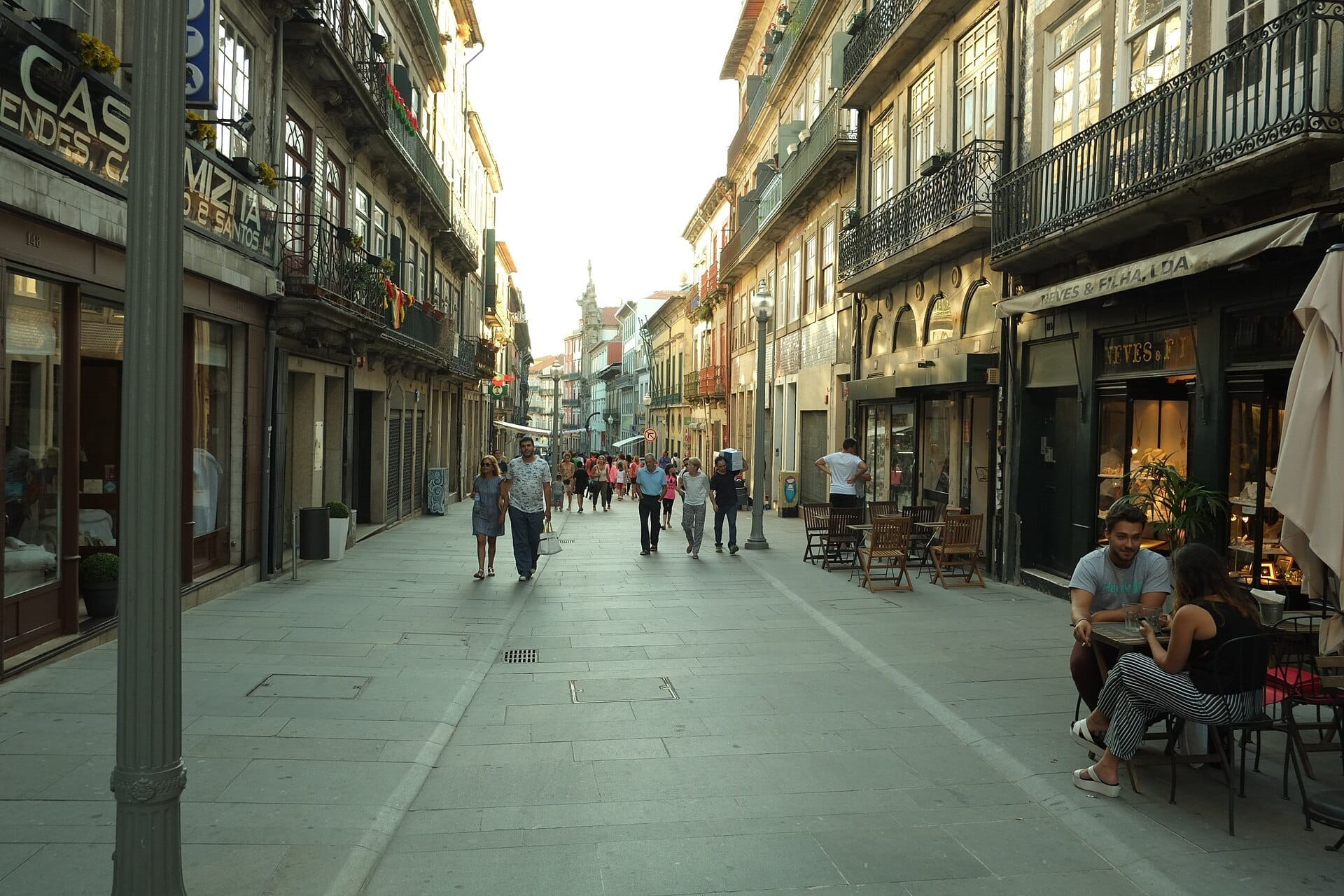
Rua das Flores, whose full historical name was Rua de Santa Catarina das Flores, is a pedestrianized street in Porto's UNESCO-listed historic centre. Opened in 1521 during the reign of King Manuel I on land owned by the Bishop of Porto, it was designed to link Largo de São Domingos with the city centre. That five-hundred-year-old urban logic is still legible today: the street reads as a deliberate connector between the city's upper districts and the riverfront Ribeira quarter below.
The name 'Street of Flowers' does not come from window boxes or market stalls. It most likely derives from the flower merchants and goldsmiths who traded here in earlier centuries. Today the commerce has shifted toward specialty coffee, independent bookshops, jewelers, and ceramic shops, but the aristocratic bones of the street remain: coats of arms carved above doorways, wrought-iron balconies on 17th- to 19th-century facades, and tiled church frontages that catch the afternoon sun.
💡 Local tip
The street begins just across from São Bento Railway Station — one of the easiest orientation points in Porto. Step out of the station, cross the square, and you are at the top of Rua das Flores.
Walking the Street: What You See and Feel
Rua das Flores runs gently downhill from north to south. The incline is noticeable but not steep, and the smooth granite paving can be slippery after rain, so footwear with grip is worth considering. The street is narrow enough that building facades on both sides create a corridor effect, framing the view ahead and amplifying sound: conversations, coffee grinders, pigeons, the occasional street musician.
At the top, near São Bento, the character is more civic and commercial. As you descend, the scale of buildings shifts slightly and the pace of foot traffic slows. Cafe tables spill onto the street in the mid-section, where the widening pavement invites lingering. Closer to the bottom, the street opens toward Largo São Domingos and the path to the Ribeira riverfront begins.
The facades demand attention at close range. Look above shopfronts at the upper storeys: you will find carved stone armorials, pairs of tall shuttered windows, and balconies with decorative ironwork that dates to periods when this address signaled prosperity. Several buildings carry azulejo tile panels, connecting Rua das Flores to the broader tradition of decorative tile work found across Porto — a tradition explored in detail in the Porto azulejo tiles guide.
Tickets & tours
Hand-picked options from our booking partner. Prices are indicative; availability and final rates are confirmed when you complete your booking.
Serralves All-Access Pass
From 24 €Instant confirmationFree cancellationSantiago de Compostela Full-Day Tour
From 79 €Instant confirmationFree cancellationPeneda Geres park full-day tour from Porto
From 100 €Instant confirmationFree cancellationPorto historical center and the best viewpoints on a tuk-tuk
From 39 €Instant confirmationFree cancellation
Historical and Cultural Weight
Porto's historic centre was inscribed on the UNESCO World Heritage List in 1996, and Rua das Flores sits comfortably inside that boundary. The street's 16th-century origins place it in the same era as Porto's expansion beyond its medieval walls under the influence of Manueline-period prosperity connected to Atlantic trade. Unlike some of Porto's more dramatic monuments, Rua das Flores carries its history through accumulated civilian architecture rather than a single landmark gesture.
The most significant building on the street is the Church and Museum of the Misericórdia do Porto, a mercy brotherhood foundation with roots in the 16th century. The church facade is covered in blue-and-white azulejo panels and is one of the most photographed frontages on the street. The museum inside holds a notable collection of sacred art and the famous Fons Vitae painting. Admission to the museum is ticketed separately from walking the street.
Rua das Flores also sits in direct proximity to some of Porto's most visited individual attractions. São Bento Railway Station, whose grand hall is lined with approximately 20,000 azulejo tiles depicting Portuguese history, is steps from the top of the street. The Palácio da Bolsa and the Igreja de São Francisco are a short walk downhill toward the Ribeira, making Rua das Flores a natural spine for a morning walking route through the historic core.
How the Street Changes Through the Day
Early morning, roughly before 9:00, Rua das Flores belongs to delivery workers, local residents with coffee in hand, and the occasional photographer catching facades in clean, low-angle light. The stone takes on a grey-gold tone in morning sun, and the street is quiet enough to hear your own footsteps. This is the best window for photography: no crowds obscuring the architecture, no cafe furniture blocking sightlines.
By mid-morning, the cafes are full and the tourist flow builds steadily, especially between 10:00 and 13:00. The street is pedestrianized, so there is no traffic noise, but at peak hours in summer it can become congested enough that walking freely at your own pace requires some patience. This is when the street is most photographed and most commercially alive, but least suited for quiet observation.
Late afternoon, after 17:00, the light shifts to a warmer register, falling at a lower angle across the tiled facades and wrought-iron balconies. Visitor numbers thin as the day-trippers head back, and the street regains a calmer texture. Evening brings a different crowd: people heading to dinner, couples on unhurried walks. Some shops close by 19:00 or 20:00, but the street itself remains accessible at all hours.
ℹ️ Good to know
Rua das Flores is a public street with no opening hours or admission. The Misericórdia Museum has its own ticketed entry and posted hours; verify these directly before visiting, as they may change by season.
Practical Navigation: Getting There and Around
The simplest arrival is via São Bento Station, served by suburban rail lines and within easy walking distance of the city's central metro stops. Exit the station and the street is directly in front of you on the left side of the square. No map is needed for the first step.
On foot from the Ribeira riverfront, the walk uphill takes roughly five to eight minutes. From Livraria Lello, Porto's famous bookshop on Rua das Carmelitas, it is a two-minute walk east. The geographic position of Rua das Flores makes it almost unavoidable on any central Porto walking itinerary: it sits between the most visited transit hub and the most visited waterfront, so most visitors pass through whether they intend to or not.
If you are planning a structured day in the historic centre, a Porto walking tour that begins at São Bento and descends through Rua das Flores to the Ribeira is a logical and rewarding sequence.
⚠️ What to skip
The granite paving stones become slick when wet. Porto's autumn and winter months bring regular rain; flat-soled shoes or leather-soled dress shoes on a wet Rua das Flores are a genuinely poor combination.
Photography, Shopping, and What to Eat Here
For photography, the Misericórdia Church facade is the single most striking frontage, best caught in morning or late-afternoon light when the blue-and-white tiles are not blown out by direct overhead sun. The upper section of the street, nearest São Bento, offers long symmetrical sightlines if you arrive before the cafe furniture appears. Shooting upward from the lower end of the street captures the vertical layering of the facade architecture more than a direct-facing approach.
Shopping on Rua das Flores has shifted noticeably toward quality independent retail over the past decade. You will find jewelers working in gold filigree, a craft with deep roots in northern Portugal, alongside ceramic workshops, specialty coffee roasters, concept stores, and a handful of independent restaurants. The street does not have a covered market or food hall, but its southern end connects quickly toward the Ribeira, where food options expand significantly.
If you are building a fuller day around the area, the Cais da Ribeira waterfront promenade is a short walk downhill from the street's southern end, offering an entirely different spatial experience: open sky, river views, and waterside restaurants replacing the vertical enclosure of Rua das Flores.
Is It Worth Your Time?
Rua das Flores is frequently listed among Porto's top streets, and on the whole that reputation is fair, though it deserves some qualification. As a pedestrian street in a tourist-heavy city, it attracts high foot traffic during summer months and holiday weekends. Visitors hoping for a quiet, local-feeling backstreet will not find that here, especially between 10:00 and 17:00 in July or August.
What the street genuinely offers is one of Porto's most concentrated stretches of layered civil architecture: 500 years of facades accumulated over a single block, at human scale, for free. It connects two of Porto's most significant transit and tourist anchor points in a way that is pleasant rather than merely functional. For first-time visitors, it is a near-essential link in any central Porto walking sequence. For returning visitors, the detail in the upper-floor facades rewards the kind of slow, upward-looking attention that a first visit rarely allows.
Visitors who prioritize uncrowded streets, local residential atmosphere, or off-the-radar discoveries may find the street somewhat overexposed during peak hours. Those with significant mobility limitations should note the downhill gradient and potentially wet stone paving.
Insider Tips
- Arrive before 9:00 in the morning for the cleanest photography conditions and the most atmospheric quiet: delivery crates, a bakery smell drifting from a side door, nobody blocking your sightlines.
- Look above the shopfronts on the east side of the street for carved stone coats of arms. They are easy to miss when you are watching where you step, but they are among the most direct evidence of the street's aristocratic 17th- and 18th-century residential history.
- The Misericórdia Museum interior, including the Fons Vitae painting attributed to the circle of Jan van Scorel circa 1520, is one of the most undervisited collections in the historic centre. The queue is rarely long, and the ticketed entry is worth considering if you have an hour.
- The side streets branching off Rua das Flores, particularly toward Largo do Corpo da Guarda, are quieter and architecturally interesting in their own right. Exploring one or two detours adds five minutes and a different perspective on the same neighbourhood fabric.
- On weekend mornings in spring and early autumn, a small number of artisan stalls sometimes set up near the lower end of the street. There is no guarantee of this, but if you arrive around 10:00 on a dry Saturday, you may find local ceramics and handmade goods before the main crowds appear.
Who Is Rua das Flores For?
- First-time visitors to Porto who want a single walk that connects São Bento Station to the Ribeira through maximum architectural density
- Photography enthusiasts interested in Baroque civil facades, azulejo tile frontages, and wrought-iron balconies in a single frame
- History readers who appreciate the accumulated layers of a street that has been continuously occupied and commercially active since 1521
- Slow travelers who combine the walk with a long coffee stop, a browse through a ceramic or filigree jewellery shop, and a visit to the Misericórdia Museum
- Travelers on a tight budget who want to experience Porto's historic centre without spending anything on admission
Nearby Attractions
Other things to see while in Ribeira:
- Cais da Ribeira
Cais da Ribeira is Porto's historic riverside promenade along the north bank of the Douro, part of the UNESCO World Heritage-listed centre. Free to walk, lined with colourful buildings and boat tour kiosks, it is one of Portugal's most recognisable urban waterfronts.
- Casa do Infante
Casa do Infante stands on Rua da Alfândega in the heart of Porto's Ribeira district, occupying a site that has been central to the city's life since the Roman period. Built as a royal customs house in 1325 and later named for Prince Henry the Navigator, traditionally regarded as having been born here in 1394, it now operates as a unit of the Museu do Porto, housing archaeological remains and centuries of civic records beneath one roof.
- Dom Luís I Bridge
The Ponte Dom Luís I is a double-deck iron arch bridge spanning the Douro River between Porto's Ribeira quarter and Vila Nova de Gaia. Open 24 hours a day and free to cross on foot, it rewards visitors with sweeping river views from both its road-level walkway and its elevated metro deck, 45 metres above the water.
- Douro River Cruise
A Douro River cruise transforms Porto's skyline into a living panorama of medieval towers, port wine lodges, and six iron bridges. Whether you take a 50-minute sightseeing loop or a multi-day voyage into the Alto Douro Wine Region, the river gives you a perspective on Porto and its surroundings that no viewpoint on land can match.