The London Eye: A Clear-Eyed Guide to London's Giant Observation Wheel
Standing 135 metres above the South Bank, the London Eye offers a slow, 30-minute rotation with panoramic views across central London. This guide covers ticket prices, the best time to visit, what the experience actually feels like, and whether it's worth your money.
Quick Facts
- Location
- Riverside Building, County Hall, South Bank, London SE1 7PB (London Borough of Lambeth)
- Getting There
- Waterloo (Underground & National Rail, ~5 min walk); Westminster, Embankment, and Charing Cross also walkable
- Time Needed
- 45–90 minutes including queuing and boarding; the rotation itself lasts approximately 30 minutes
- Cost
- Standard adult tickets from approximately £30–£40 online; prices are dynamic and change by date. Check londoneye.com for current pricing.
- Best for
- First-time London visitors, families, clear-weather days, and anyone who wants a structured, elevated view of the city
- Official website
- www.londoneye.com
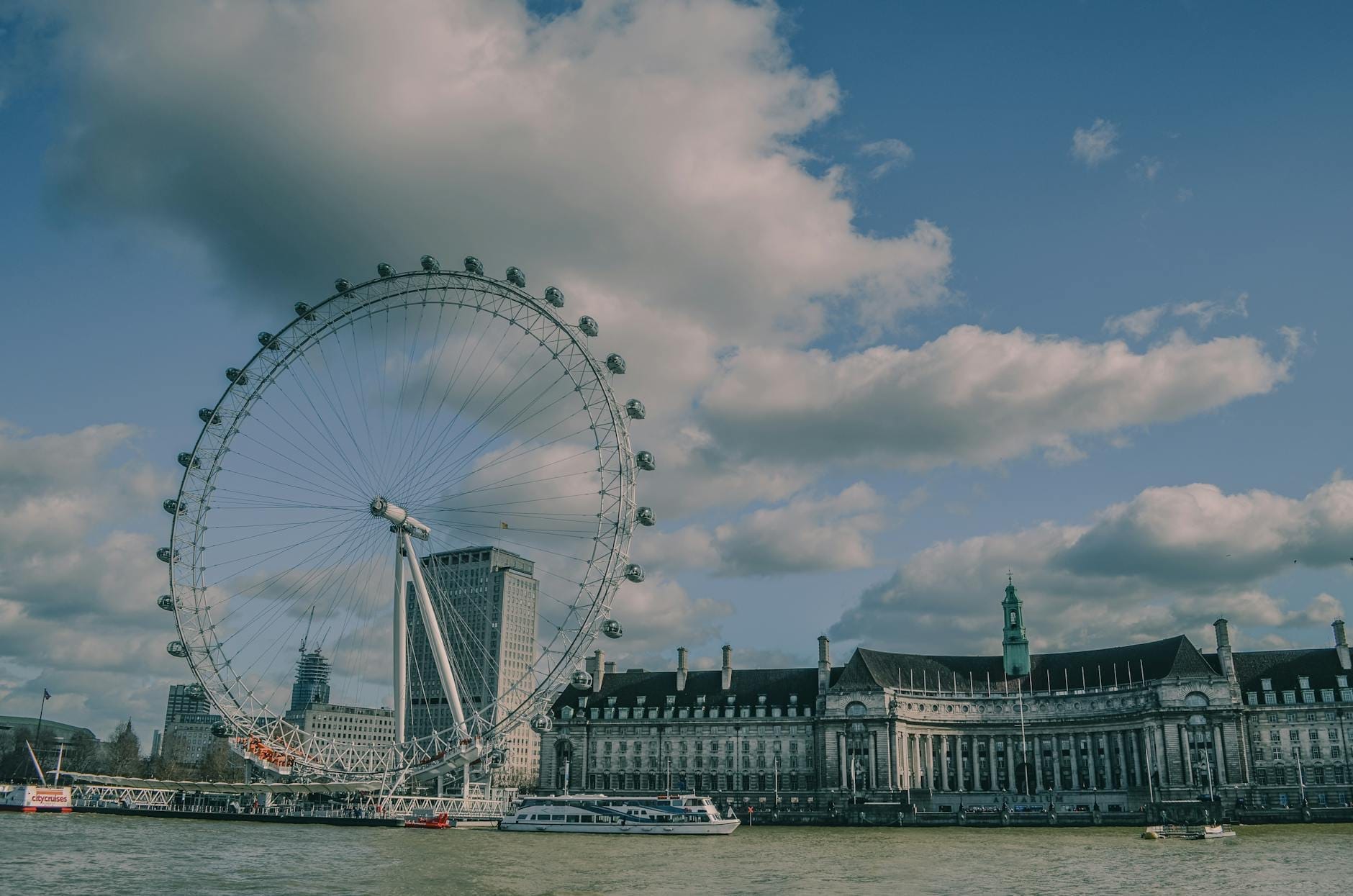
What the London Eye Actually Is
The London Eye is a cantilevered observation wheel standing 135 metres (443 ft) tall on the South Bank of the River Thames, supported entirely from one side. That engineering choice is not incidental: there is no central axle connecting both ends, which is what earns it the designation of the world's tallest cantilevered observation wheel. Its wheel diameter is 120 metres, and it carries 32 enclosed, climate-controlled glass capsules, each holding up to 25 passengers. One full rotation takes approximately 30 minutes, which means the wheel moves slowly enough that boarding and disembarking happen while it is in motion, without stopping.
Construction began in 1998, and after a ceremonial opening by Prime Minister Tony Blair in 1999, the wheel opened to paying visitors in March 2000. It was originally known as the Millennium Wheel, conceived as a temporary structure to mark the turn of the century. It was never removed, and today it is one of the most visited paid attractions in the United Kingdom. The attraction is currently branded as The London Eye, with Coca-Cola and EDF Energy holding previous naming sponsorship rights.
💡 Local tip
Book online in advance. The London Eye uses dynamic pricing, meaning tickets bought at the door are generally more expensive than those purchased ahead of time on londoneye.com. Booking a specific time slot also reduces time spent in the external queue.
The View: What You Can Actually See
On a clear day, the capsule-level views extend up to 40 kilometres in every direction, taking in a sweep of London that no other single vantage point replicates at this scale. As the wheel climbs on the eastern arc, you look directly across the Thames toward the Houses of Parliament and the towers of Westminster. Big Ben's clock face is level with your line of sight at around the midpoint of the ascent, which creates an unexpectedly intimate perspective on a building usually seen from street level below.
Continuing upward, the view opens north toward the City of London and Canary Wharf, with the cluster of skyscrapers around the Shard, the Gherkin, and Leadenhall Market visible if conditions allow. The Shard itself stands across the river at roughly the same height, so on clear days you see it more or less at eye level. To the south, inner south London spreads out flatly, and Wembley Stadium's arch is faintly visible on days with good visibility. If you are interested in what the skyline looks like from a different angle entirely, the Sky Garden at 20 Fenchurch Street offers a comparable elevation for free, though with a more eastward focus.
The capsules are fully enclosed and the glass is curved, which means photography through the panels can pick up reflections and some distortion, particularly when the interior is bright relative to the outside sky. For the cleanest shots, press your camera or phone lens gently against the glass to eliminate glare, and shoot from the inner edges of the capsule rather than the centre where condensation and smudging from other visitors accumulates.
⚠️ What to skip
London's weather is the single biggest variable affecting this experience. On overcast or foggy days, visibility can drop to under a kilometre, reducing the view to a grey murk with only nearby buildings visible. Check the forecast before you book a time slot. Mornings in summer (before 10:30) and late-afternoon slots in spring tend to offer the best light and clearest conditions.
Tickets & tours
Hand-picked options from our booking partner. Prices are indicative; availability and final rates are confirmed when you complete your booking.
Thames Rockets Ultimate London Speedboat Experience
From 69 €Instant confirmationWindsor Castle tour from London with London-eye ticket
From 101 €Instant confirmationFree cancellationLondon Eye champagne experience
From 46 €Instant confirmationLondon guided tour with optional London Eye
From 153 €Instant confirmationFree cancellation
How the Experience Changes by Time of Day
The London Eye operates from around 10:00 (opening times vary seasonally, with Saturday hours typically running to 20:30 and weekday hours often closing around 18:00; always confirm at londoneye.com before visiting). The time of day you choose has a real effect on what you see and how crowded the experience feels.
Morning visits, particularly on weekdays, tend to see shorter external queues and a calmer atmosphere inside the capsule. The South Bank itself is quieter before midday, which means the riverside approach to the wheel is pleasant rather than congested. However, hazy summer mornings can limit visibility until the sun burns off the low cloud, typically by 10:30–11:00.
The most visually rewarding time is the hour before sunset in good weather. The Thames catches the light at an angle that turns the water orange and copper, the Houses of Parliament glow against the sky, and the city's western horizon becomes dramatic. Sunset ride bookings during summer (June to August) fill quickly; these slots often sell out days in advance. The ride after dark, when the wheel itself is lit and city lights spread across the horizon in every direction, is a different kind of spectacle: less informative, more atmospheric.
Practical Walkthrough: Getting There and Boarding
The London Eye sits on the South Bank between Westminster Bridge and Hungerford Bridge, directly beside County Hall. The most straightforward route is to take the Underground or National Rail to Waterloo station, exit toward the South Bank, and walk roughly five minutes along the riverside. Alternatively, Westminster station (Jubilee and Circle/District lines) puts you on the north bank; cross Westminster Bridge on foot for a classic approach with the wheel growing in size as you walk. The South Bank is entirely flat and step-free from Waterloo, making it one of London's most accessible riverside routes.
Upon arrival, ticket holders with pre-booked time slots follow signage to the boarding queue, which is separate from the walk-up ticket desk. Have your booking confirmation ready on your phone or printed. The actual boarding process is efficient: a short ramp leads to the loading platform, and the capsule door is held open as the wheel rotates slowly past. Most passengers find the boarding straightforward, but if you have mobility requirements, the attraction has dedicated accessibility boarding provisions. Confirm details directly with the London Eye's accessibility team before your visit as procedures can vary.
Once inside, the capsule is large enough to circulate freely. There are benches in the centre and around the perimeter, though most people stand and move around the glass edges throughout the rotation. The capsule carries up to 25 people, and during peak periods you may share it with a full complement of strangers. If the social dynamic matters to you, private capsule bookings are available at a significantly higher price.
ℹ️ Good to know
The London Eye is part of the South Bank's wider cultural corridor. Before or after your ride, the Southbank Centre, Tate Modern, and the riverside food and drink options at Bernie Spain Gardens are all within a 15-minute walk. Building in an hour on either side makes the trip considerably more rewarding than treating the Eye in isolation.
The South Bank Context: Where the Eye Sits
The London Eye does not exist in isolation. The stretch of riverside around it is one of London's most consistently active pedestrian zones, populated at almost every hour by a mix of commuters, tourists, street performers, and weekend runners. The smell of roasting nuts from riverside carts mingles with the damp air off the Thames, and on weekends the sound of buskers drifts up from the arches beneath the Hungerford Bridge. For anyone spending a day in this part of the city, the Southbank Centre and the Tate Modern anchor either end of a walkable cultural strip that can fill an entire day.
County Hall, the grand Edwardian building immediately adjacent to the wheel, houses the Sea Life London Aquarium and several other attractions at ground level. The London Eye sits precisely at the junction between the administrative south bank and the cultural south bank, which means the streets behind it are surprisingly quiet, while the riverfront itself remains lively. For more on how to structure a full day here, see the River Thames guide which covers the whole waterfront from east to west.
Is the London Eye Worth It?
At approximately £30–£40 per adult for a 30-minute experience, the London Eye is not cheap for what it is. The Worth Knowing: on a clear day, the view is impressive and the 360-degree aerial perspective on central London is hard to replicate without taking a flight. For first-time visitors, or anyone with children who want a structured, contained, and relatively gentle elevated experience, it earns its price.
For visitors who have already been to London before, or who prioritise value, there are free or lower-cost alternatives. Primrose Hill offers a wide northern panorama for free. The Sky Garden at 20 Fenchurch Street is free to enter with a reservation. The view from the top of St Paul's Cathedral's Stone Gallery is architecturally richer and costs less. The London Eye wins on convenience, accessibility, and the specific drama of looking straight down at the Thames and Parliament from directly above, but if budget is a concern, alternatives exist.
If you are travelling with a London Pass or considering one, the Eye is sometimes included in package deals worth checking before you book independently. See the London Pass guide for a current breakdown of what's included and whether it stacks up against buying tickets separately.
Insider Tips
- Dynamic pricing means the cheapest standard tickets are available weeks in advance for off-peak weekday slots. The most expensive walk-up tickets can cost nearly double the online advance price for the same experience.
- For the best angle on the Houses of Parliament, position yourself on the eastern side of the capsule as the wheel reaches its highest point. The view from directly above is the most dramatic and compresses in a way that looks spectacular in photographs.
- If you book a standard ticket, arrive at least 10 minutes before your time slot. Arriving late can result in losing your slot and being rebooked to a later time, even if there are empty capsules.
- The wheel does not stop for boarding, which can feel unsettling for very young children or anyone nervous about moving platforms. Reassuringly, the speed is extremely slow (roughly a quarter of a metre per second) and the step onto the capsule is small and flat.
- Sunset slots in summer book up quickly and typically cost more. If that timing is important to you, book as early as possible in your trip planning, not on the day you want to go.
Who Is London Eye For?
- First-time visitors to London who want an orienting, panoramic overview of the city's layout
- Families with children who want a contained, accessible, and clearly structured attraction
- Couples looking for a sunset or evening ride with atmospheric city lighting
- Visitors with mobility requirements, as the flat capsule and step-free approach make it one of London's more accessible elevated viewpoints
- Photographers who want a unique elevated angle on Westminster, the Thames, and the central London skyline
Nearby Attractions
Other things to see while in South Bank:
- Battersea Park
Battersea Park is a 200-acre Victorian park on the south bank of the River Thames, offering free entry, formal gardens, a children’s zoo, riverside paths, and a notable Buddhist Peace Pagoda. Less crowded than Hyde Park yet surprisingly rich in things to do, it rewards a slow, unhurried visit at any time of year.
- Battersea Power Station
Once derelict for nearly three decades, Battersea Power Station reopened in October 2022 as one of London's most dramatic mixed-use destinations. Entry to the main building and public spaces is free, while the glass chimney lift, Lift 109, offers one of the city's most unusual viewpoints. Here is everything you need to plan a visit.
- Borough Market
Borough Market has stood near London Bridge for around 1,000 years, making it one of the oldest food trading sites in Britain. Today it draws traders selling everything from aged cheeses and cured meats to freshly baked bread and street food from around the world. Entry is free, and the Victorian market buildings add a sense of occasion that most food halls simply cannot match.
- Imperial War Museum London
The Imperial War Museum London is one of the city's most thoughtfully constructed free attractions, covering conflict from the First World War to the present day. Housed in a former psychiatric hospital, it combines large-scale hardware, deeply personal testimony, and unflinching Holocaust galleries into an experience that is hard to shake.