The London Dungeon: 1,000 Years of Dark History Brought Terrifyingly to Life
Buried in the underground vaults of County Hall on the South Bank, The London Dungeon is a live actor-led experience that drags visitors through a thousand years of London's most gruesome history. From Jack the Ripper to Sweeney Todd, it's theatrical, loud, and deliberately unsettling — and whether it's worth your time depends entirely on what kind of traveller you are.
Quick Facts
- Location
- County Hall, Westminster Bridge Road, London SE1 7PB (South Bank)
- Getting There
- Waterloo Station (Jubilee, Bakerloo lines) — 5-minute walk. Also reachable from Westminster and Embankment stations.
- Time Needed
- Approximately 75–90 minutes for the full experience
- Cost
- From £27 (adult) / £19 (child) online in advance. Walk-up prices are higher. Timed entry slots required.
- Best for
- Teens, horror fans, groups looking for something theatrical and interactive
- Official website
- www.thedungeons.com/london
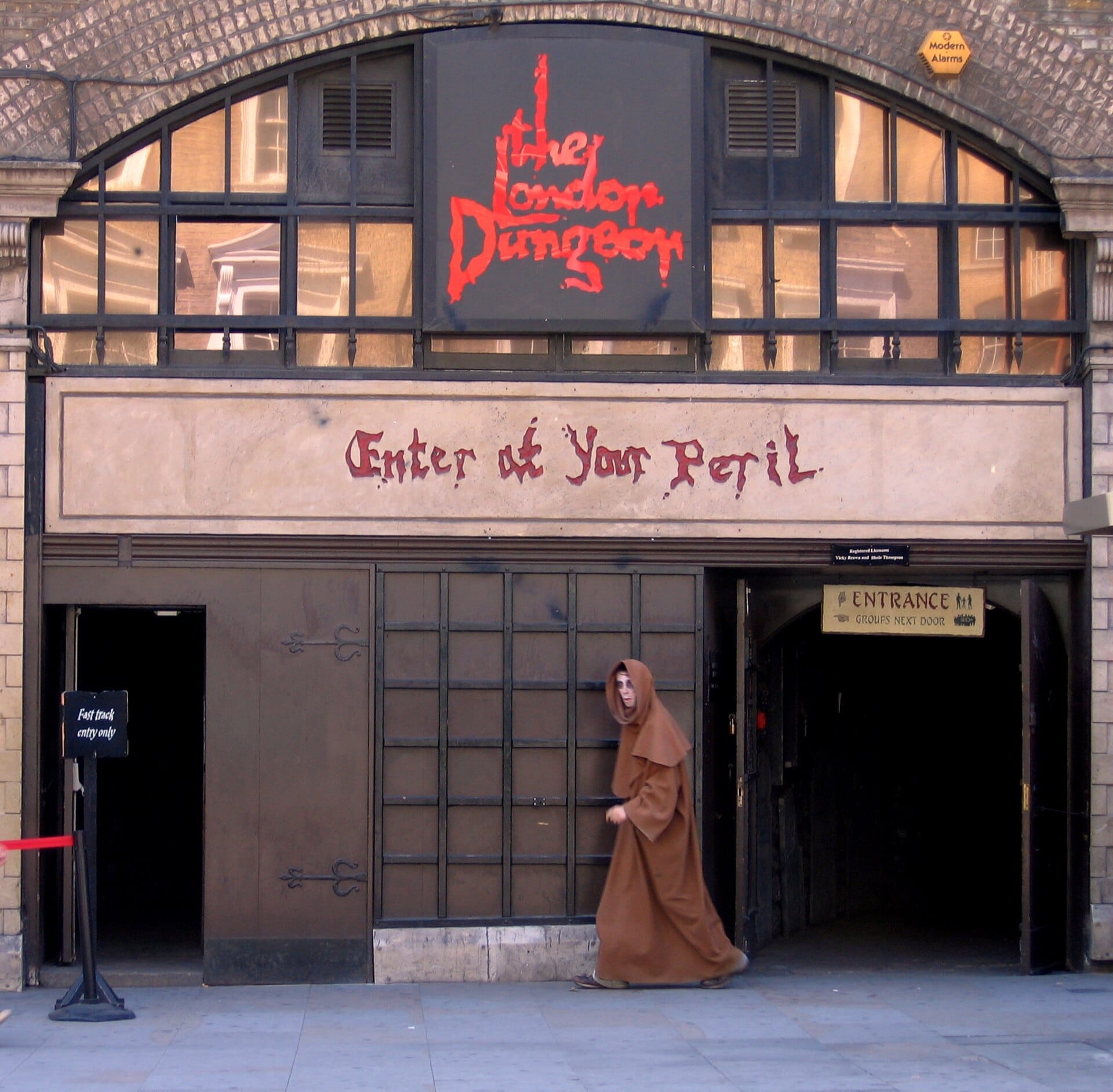
What Is The London Dungeon, Really?
The London Dungeon is not a museum. It is not a haunted house. It sits somewhere between the two: a live theatrical walk-through experience in which professional actors play some of history's most notorious characters, guiding groups through elaborately designed sets that recreate scenes from London's dark past. Think of it as immersive theatre with a horror sensibility and a deliberate emphasis on making audiences scream.
Since relocating to the underground vaults beneath County Hall in 2013, the attraction has settled into a format that works well for what it is. The building itself adds atmosphere — County Hall is a hulking Edwardian structure on the South Bank, and the dungeon occupies its lower reaches. The corridors are narrow, the lighting is minimal, and the sound design is aggressive. The production values are high for a commercial attraction of this type.
The experience covers roughly 1,000 years of London history through around 19 scenes and two rides. Characters include Jack the Ripper, Sweeney Todd, Henry VIII, and Guy Fawkes. If you're planning a wider South Bank visit, it sits immediately adjacent to the London Eye and a short walk from the Southbank Centre, making it easy to combine into a full day along the river.
A Brief History of the Attraction
The London Dungeon opened in 1974, originally on Tooley Street in Southwark. It began as a walk-through waxworks exhibition focused on medieval torture and execution, targeting the same morbid curiosity that has drawn crowds to public executions, anatomical theatres, and penny dreadfuls for centuries. London has always had a commercial appetite for its own darkness.
Over the following decades the attraction evolved from static displays toward actor-led performances, a format that proved far more effective at generating the genuine reactions visitors were seeking. By the time it relocated to County Hall in 2013, the experience had been rebuilt from the ground up as a timed, guided group tour through a sequence of theatrical scenes, each with its own lighting rig, sound system, and cast of trained performers.
County Hall itself was built between 1911 and 1933 and served as the headquarters of the Greater London Council until Margaret Thatcher's government abolished it in 1986. The building's lower levels, with their low vaulted ceilings and stone-clad corridors, happen to be an unusually convincing backdrop for an attraction about damp, fear, and centuries of urban cruelty.
Tickets & tours
Hand-picked options from our booking partner. Prices are indicative; availability and final rates are confirmed when you complete your booking.
Harry Potter Walking Guided Tour with Thames Cruise and London Dungeon
From 113 €Instant confirmationFree cancellationHarry Potter Guided Walking Tour with London Dungeons Tickets
From 98 €Instant confirmationFree cancellationLondon Walking Tour with Entrance Ticket to The London Dungeon
From 110 €Instant confirmationFree cancellationWestminster Walking Tour and London Dungeon Entry
From 113 €Instant confirmationFree cancellation
What the Experience Actually Feels Like
You arrive at a ground-level entrance on Westminster Bridge Road and are processed in timed entry groups. The queuing area is already in character: dim lighting, unsettling ambient sound, and occasional actor appearances. By the time your group is admitted, the temperature has dropped noticeably and the air carries a faint theatrical fog smell that never quite goes away.
💡 Local tip
Book online in advance with a specific timed entry slot. Not only is it cheaper than walk-up, but groups are capped in size, and arriving without a booking on a Saturday can mean turning away.
The tour moves through a series of scenes, each running about three to five minutes. Actors perform directly to your group, sometimes separating individuals from the crowd, using call-and-response comedy alongside genuine attempts to frighten. The tone shifts scene by scene: some moments are darkly funny, others are designed for jump scares. The plague scene, the Jack the Ripper sequence, and the courtroom segment are among the most consistently effective.
Two mechanical elements are included in the ticket price: a boat ride through dark water with moments of sudden illumination, and the Drop Dead drop ride, a two-storey free-fall simulator. The drop ride is optional, with a bypass route clearly signposted. Neither is thrilling by theme park standards, but both are well integrated into the narrative.
The total experience runs approximately 75 to 90 minutes. There is no option to slow down or explore independently — the guided group format keeps everyone moving at the same pace. If someone in your group is distressed, there are clearly marked exit routes throughout.
Timing Your Visit: When to Go and When to Avoid
School holidays — half-terms, Easter, and the summer months of July and August — are when the attraction is at its most crowded and loudest. Groups back up between scenes and some of the theatrical tension is lost when you can hear the next performance happening through the wall. Weekday visits outside of school holiday periods offer a noticeably different experience: smaller groups, more actor engagement, and slightly longer scenes.
Opening hours vary by date. Typical weekday hours run from 10:00 to 17:00, Saturday from 10:00 to 18:00, and Sunday from 10:00 to 17:00, but these change seasonally and around public holidays. The official booking calendar on the website shows exact slot availability, and checking it before planning your day is essential rather than optional.
⚠️ What to skip
The experience involves sustained darkness, sudden loud noises, fog effects, strobe-style lighting, and direct actor confrontation. It is not suitable for children under 5, who are not admitted. The recommended minimum age is 12. Anyone with severe anxiety about enclosed spaces or phobias related to darkness should consider this carefully before booking.
Weather is irrelevant to the experience itself since everything is underground and indoors. This makes the London Dungeon a reasonable option for a rainy afternoon, though the same logic applies to everyone else in the city looking for indoor activities, so weekend rainy days tend to be particularly busy.
Getting There and Practical Logistics
Waterloo Station is the most convenient public transport hub, about a 10-minute walk from the entrance. From Waterloo you can arrive via the Jubilee, Bakerloo, or Northern lines on the Underground, or by mainline National Rail services. Westminster Station on the Jubilee and Circle lines is also walkable in around eight minutes across Westminster Bridge. Embankment and Charing Cross stations add another five minutes on foot.
Multiple bus routes serve the area along Westminster Bridge Road and the South Bank. If you're traveling from further afield, the Transport for London network covers all the options — an Oyster card or contactless bank card will cover any of these routes without needing to buy separate tickets.
There is no dedicated parking at County Hall itself. Driving to the South Bank is generally inadvisable due to the central London Congestion Charge zone, limited parking, and the ease of public transport alternatives.
Lockers are available at the entrance for bags and coats. Bringing large luggage is not recommended. Photography inside the experience is not permitted during the live actor scenes — the official photography zone is at the end of the experience near the gift shop.
Is It Worth the Ticket Price?
At upward of £27 per adult, the London Dungeon sits at the expensive end of London's commercial attractions. For that price you receive roughly 90 minutes of high-production live performance that, for the right audience, delivers consistently on its promises. For the wrong audience, it is an expensive exercise in mild discomfort.
If you hold a London Pass, the London Dungeon is included, which significantly improves the value calculation if you're visiting multiple paid attractions in the same period.
Compared with other South Bank entertainment options, the Dungeon occupies a distinct niche. It is not educational in any serious sense — the history is heavily dramatised and the accuracy is secondary to atmosphere. But it is well-crafted entertainment, and the actors are, without exception, skilled performers who manage unpredictable crowds with noticeable professionalism.
If you're looking for more substantive historical depth nearby, the Imperial War Museum is free to enter and a short walk south. If you want a different angle on London's darker history, Shakespeare's Globe sits along the same stretch of riverbank and tells a more layered story about the area's past as a place of public entertainment and lawlessness.
Who Should Think Twice Before Going
Adults travelling without children or teenagers and looking for genuine historical insight are likely to find this unsatisfying. The content is dramatised to the point of pantomime in several scenes, and any factual grounding is incidental to the scare. History enthusiasts expecting something akin to a museum would be better served elsewhere on the South Bank.
Anyone with a diagnosed anxiety disorder, claustrophobia, or strong phobias around darkness, sudden noise, or confrontation should approach with significant caution. The experience is designed to be deeply uncomfortable, and there is no way to moderate the intensity once inside beyond exiting entirely. Young children, even those above the technical age threshold, may find it traumatic rather than entertaining.
Visitors seeking a leisurely, self-paced attraction will also find the format frustrating. There is no pausing, no rewinding, and no opportunity to linger in a scene you found interesting. You move at the actors' pace throughout.
Insider Tips
- Buy tickets online at the earliest possible opportunity and choose a weekday morning slot outside school holidays. Groups are smaller, actors have more time with each group, and scenes run longer. The difference between a Tuesday in October and a Saturday in August is substantial.
- The drop ride has a separate queue at the end of the experience. If your group is divided about riding it, designate a meeting point near the exit beforehand — the area gets congested and it's easy to lose people in the dim lighting.
- Actors are permitted and encouraged to interact with individual audience members. Standing near the back of your group will not guarantee you avoid being singled out, but standing at the very front generally increases your exposure. If someone in your group is uncomfortable with direct confrontation, let them position themselves centrally.
- The gift shop at the end is the only place photography is officially encouraged and selfie props are available. It is also a useful decompression zone for children or anyone who found the experience more intense than expected.
- Combine the visit with a walk along the South Bank before or after. The stretch between Westminster Bridge and Borough Market rewards an hour or two of wandering, and the contrast between the open riverside atmosphere and the underground experience makes each more vivid by comparison.
Who Is The London Dungeon For?
- Teenagers and school-age groups looking for something interactive rather than passive
- Families with children aged 12 and above who enjoy theatrical horror and can handle jump scares
- Friends or couples seeking a shared adrenaline experience with a historical backdrop
- Visitors on a rainy day who want a full indoor programme with no weather dependency
- London Pass holders for whom the value equation tips clearly in favour of visiting
Nearby Attractions
Other things to see while in South Bank:
- Battersea Park
Battersea Park is a 200-acre Victorian park on the south bank of the River Thames, offering free entry, formal gardens, a children’s zoo, riverside paths, and a notable Buddhist Peace Pagoda. Less crowded than Hyde Park yet surprisingly rich in things to do, it rewards a slow, unhurried visit at any time of year.
- Battersea Power Station
Once derelict for nearly three decades, Battersea Power Station reopened in October 2022 as one of London's most dramatic mixed-use destinations. Entry to the main building and public spaces is free, while the glass chimney lift, Lift 109, offers one of the city's most unusual viewpoints. Here is everything you need to plan a visit.
- Borough Market
Borough Market has stood near London Bridge for around 1,000 years, making it one of the oldest food trading sites in Britain. Today it draws traders selling everything from aged cheeses and cured meats to freshly baked bread and street food from around the world. Entry is free, and the Victorian market buildings add a sense of occasion that most food halls simply cannot match.
- Imperial War Museum London
The Imperial War Museum London is one of the city's most thoughtfully constructed free attractions, covering conflict from the First World War to the present day. Housed in a former psychiatric hospital, it combines large-scale hardware, deeply personal testimony, and unflinching Holocaust galleries into an experience that is hard to shake.