Leighton House Museum: Inside London's Most Extraordinary Victorian Interior
Once the private home and studio of Victorian painter Frederic, Lord Leighton, Leighton House Museum in Kensington is unlike anything else in London. Its centrepiece, the gilded Arab Hall lined with 700-year-old Iznik tiles, makes it one of the most visually arresting rooms in the city. Step inside a world where Orientalist fantasy meets High Victorian ambition.
Quick Facts
- Location
- 12 Holland Park Road, London W14 8LZ (Kensington & Chelsea)
- Getting There
- High Street Kensington (Circle & District lines) or Kensington (Olympia); buses 9, 23, 27, 28, 49, 328, C1
- Time Needed
- 1.5 to 2.5 hours
- Cost
- Adults £14, Concessions £12 (verify current prices at RBKC website)
- Best for
- Art history lovers, architecture enthusiasts, photography, design inspiration
- Official website
- www.rbkc.gov.uk/museums/leighton-house
What Is Leighton House?
Leighton House Museum is a Grade II listed historic house museum at 12 Holland Park Road in the Royal Borough of Kensington and Chelsea. It was built from 1864 onwards as the personal residence and working studio of Frederic, Lord Leighton — one of the most celebrated painters of the Victorian era, and the first British artist to receive a hereditary peerage. The house was designed in close collaboration with architect George Aitchison and expanded incrementally over roughly three decades, each addition reflecting Leighton's evolving tastes and growing international reputation.
Leighton died in 1896, and the house opened to the public as a museum in 1929, and since 1926 it has been under the governance of the local council (now the Royal Borough of Kensington and Chelsea). In 2026, it marks 100 years since it became a public museum — a milestone that makes this a particularly good moment to visit. A major renovation project completed in recent years introduced step-free access throughout, upgraded facilities, and restored several key interiors to closer approximations of how they appeared in Leighton's lifetime.
ℹ️ Good to know
Opening hours: Wednesday to Monday, 10:00–17:30 (last entry 16:30). Closed Tuesdays. Confirm hours on the RBKC official website before visiting, especially around bank holidays.
The Arab Hall: The Room That Stops You in Your Tracks
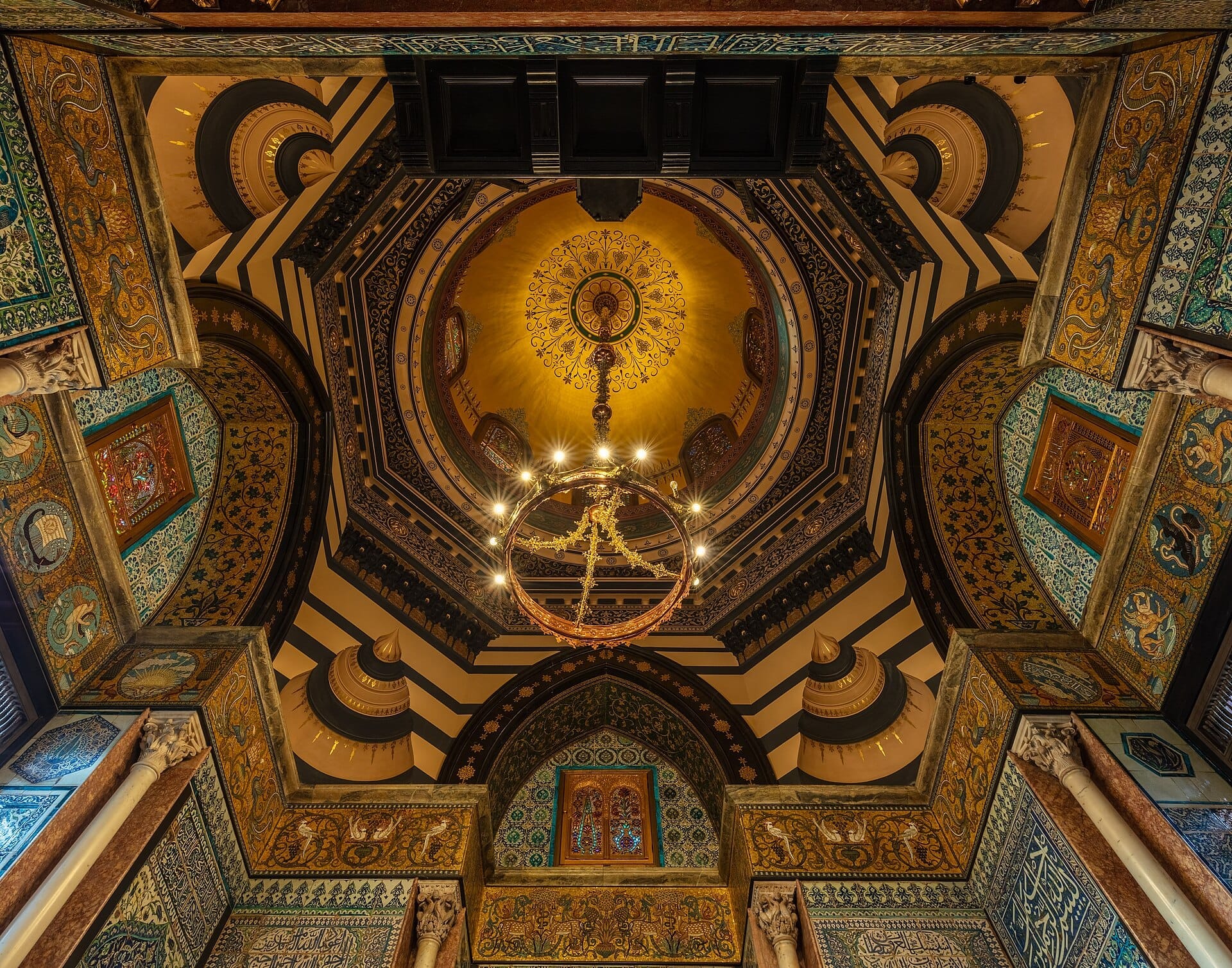
No description of Leighton House is complete without confronting the Arab Hall, the structure added to the house in 1877–1879 and the single most extraordinary room in the building. Leighton assembled over 700 antique Iznik tiles — many dating back to the 16th and 17th centuries — sourced from across the Middle East and North Africa during his travels and through contacts in Damascus, Cairo, and Rhodes. They line the walls from floor to mid-height in blues, greens, and whites, an intricate geometry of pomegranates, cypress trees, and arabesques.
Above the tiles, a gilded mosaic frieze by Walter Crane circles the room. A central fountain of black marble sits on the floor, feeding a shallow pool. The whole space is crowned by a golden dome pierced with a latticed lantern that filters light differently depending on the weather and time of day. On a bright morning, the dome throws warm, honeyed light across the tiles; on an overcast afternoon, the colours turn cooler and more saturated. Both moods are worth experiencing.
The Arab Hall was not built as a functional room for entertaining in the traditional Victorian sense. It was closer to a personal gallery, a meditation on the Orientalist aesthetic that captivated many European artists in the nineteenth century. Leighton was a serious collector, not a dilettante. The tiles are genuine antiques, not reproductions, and the care with which they were arranged — some with deliberate cuts to maintain decorative flow around corners — reflects months of planning.
💡 Local tip
Photography tip: The Arab Hall photographs best in the morning when natural light enters from above. If you visit in the afternoon, consider using the ambient light rather than a flash to preserve the tile colours' true depth.
Tickets & tours
Hand-picked options from our booking partner. Prices are indicative; availability and final rates are confirmed when you complete your booking.
Guided tour inside Westminster Abbey and outside the Houses of Parliament
From 103 €Instant confirmationFree cancellationHouses of Parliament and Westminster Abbey guided tour
From 149 €Instant confirmationFree cancellationLondon Main Sights Guided Tour with Visit to The Houses of Parliament
From 110 €Instant confirmationFree cancellationHouses of Parliament and Westminster Walking Tour
From 110 €Instant confirmationFree cancellation
The Studio and State Rooms: Inside a Victorian Artist's World
Beyond the Arab Hall, the house reveals itself as a layered, carefully considered space where private life and artistic ambition overlapped constantly. Leighton's main studio on the upper floor is the largest room in the house: a tall, north-lit space with a double-height ceiling designed to allow him to work on the monumental canvases — many over three metres wide — that made his reputation at the Royal Academy. The studio's proportions feel different from the rest of the house, more austere, calibrated for work rather than display.
The Silk Room and Narcissus Hall display a selection of Leighton's own paintings alongside works from his contemporaries in the Aesthetic Movement, including pieces by G.F. Watts and John Everett Millais. The collections rotate periodically, so the specific works on display will vary. The walls in several rooms are hung in deep, saturated Victorian colours — rust reds, sage greens, dark teal — which is deliberate and accurate to the period rather than a modern curatorial choice.
The ground-floor rooms include the entrance hall and the dining room, and the layout of the whole house flows in a single direction, making it straightforward to follow even without a guide. The museum provides a room-by-room printed guide included with admission, which is worth picking up at the entrance.
History and Context: Leighton in His Time
Frederic Leighton was born in Scarborough in 1830 and trained on the European continent, studying in Florence, Frankfurt, and Rome before settling in London. His large-scale paintings of classical subjects, drawn from ancient Greek and Roman mythology, made him enormously fashionable in the 1860s and 1870s. Queen Victoria purchased his painting Cimabue's Celebrated Madonna in 1855 — before he was thirty — and his career never looked back. He became President of the Royal Academy in 1878 and was elevated to the peerage as Baron Leighton of Stretton just one day before his death in 1896, making his title famously one of the shortest-lived peerages in British history.
The house sits within the broader context of Holland Park, an area that in the second half of the nineteenth century attracted a cluster of successful artists who built large studio-homes with the proceeds of their work. This loose community — sometimes called the Holland Park Circle — included Valentine Prinsep, G.F. Watts, and Hamo Thornycroft. Their houses were designed to be both workplaces and theatrical domestic environments, blurring the line between home and gallery. Leighton's was the most ambitious and architecturally complex of them all.
The neighbourhood still carries that legacy. Nearby Kensington Palace and the broader Kensington and Chelsea area form one of London's densest concentrations of cultural institutions, and Leighton House fits naturally into a day that includes the major museums nearby.
Practical Walkthrough: How to Make the Most of Your Visit
The museum is compact enough to cover thoroughly in around two hours, though visitors with a strong interest in Victorian art and decorative arts frequently stay longer. The ground floor takes around forty minutes if you read the labels carefully. The upper floor, including the studio, takes another thirty to forty minutes. The garden — restored and replanted as part of the recent renovation — is worth ten minutes on its own in decent weather, and the De Morgan Café on the ground floor is a reasonable stop if you need a break mid-visit.
Arrive at opening time (10:00) if your priority is the Arab Hall. This is when visitor numbers are lowest and the morning light in the dome is at its best. By midday the rooms, which are not large, can feel crowded on weekends. If you can only visit in the afternoon, a Wednesday or Thursday tends to be quieter than the weekend. The museum's intimate scale means a group of even twenty visitors in the Arab Hall simultaneously will make the space feel full.
The nearest Underground station is High Street Kensington on the Circle and District lines, roughly a 10-minute walk via Kensington High Street and Melbury Road to Holland Park Road. Kensington (Olympia) is also close. If you are arriving by bus, several routes including the 9, 27, 28, and 49 stop nearby. There is no dedicated car park; street parking in the surrounding residential area is metered.
⚠️ What to skip
The house's historic interiors mean some rooms have limited space. On peak weekend afternoons, access to the Arab Hall can involve short waits. Booking tickets in advance online is recommended, particularly on Saturdays.
If you are building a wider day out, the Natural History Museum, the Victoria and Albert Museum, and the Design Museum are all within a 15 to 20-minute walk and between them represent some of the finest publicly accessible collections in the world.
Accessibility, Facilities, and Practical Details
The recent renovation programme introduced step-free access throughout the museum, a significant improvement for a building of this age and footprint. The accessible route covers the main exhibition spaces, the garden, the shop, and the De Morgan Café. The museum's official website provides detailed access information, and it is worth checking in advance if you have specific requirements.
Photography is permitted throughout the museum for personal non-commercial use. Audio guides are available. The shop stocks a thoughtful selection of art books, prints, and design-led gifts, and is worth a browse even if you are visiting on a tight budget. Admission to the shop and café does not require a ticket.
Leighton House does charge for admission, which some visitors find surprising for a relatively compact collection. If you plan to visit multiple paid attractions in a day, it is worth checking whether the London Pass offers a saving on your specific itinerary.
Worth Knowing: Is It Worth Your Time?
For anyone with an interest in Victorian art, decorative arts, the Aesthetic Movement, or architectural history, Leighton House is one of the most rewarding two hours you can spend in London. There is nothing quite like it anywhere else in the city. The Arab Hall alone justifies the visit for many people.
Those expecting a broad survey museum with large permanent collections will find it limited. The house is, at its core, a single artist's home. The painting collection, though strong, is not vast. Visitors who come for 'Victorian paintings' in general rather than specifically for Leighton and his circle may find the experience narrower than anticipated. If you are looking for quantity of Victorian art, the Tate Britain collection is free and much larger.
The admission price of £14 per adult is the other consideration. For London, this is mid-range for a paid museum, and the experience is distinctive. Whether it represents value depends entirely on your interest level. Casual visitors who know little about Leighton may feel the entry cost is steep for what is, physically speaking, a fairly small house.
Insider Tips
- Visit on a weekday morning, ideally Wednesday or Thursday, to have the Arab Hall almost to yourself. Weekend afternoons are the most crowded and the least atmospheric for photography.
- Look closely at the Iznik tile arrangement in the Arab Hall: some tiles have been carefully cut and pieced together to maintain the decorative pattern around architectural interruptions like windows and doorways. This level of craft is easy to miss if you are just scanning the room.
- The garden, restored as part of the recent renovation, is small but quietly lovely and almost always empty. It makes a good pause between the ground and upper floors, and gives you a clearer sense of the house's exterior silhouette.
- The De Morgan Café takes its name from William De Morgan, the ceramic artist and close friend of Leighton who supplied the blue and white decorative tiles used elsewhere in the house. His work is also represented in the collection — worth looking for on the lower floors.
- 2026 marks 100 years since Leighton House opened as a public museum under the Royal Borough. The anniversary may bring special exhibitions or events; check the RBKC website when planning your visit.
Who Is Leighton House Museum For?
- Victorian art and design enthusiasts who want depth over breadth
- Architecture lovers interested in the intersection of Orientalism and High Victorian domestic design
- Photographers looking for unusual interior subjects in London
- Visitors building a full Kensington cultural day alongside the major nearby museums
- Travellers who prefer slower, more contemplative museum experiences over large crowded institutions
Nearby Attractions
Other things to see while in Kensington & Chelsea:
- Chelsea Physic Garden
Founded in 1673 by the Worshipful Society of Apothecaries, Chelsea Physic Garden is a four-acre walled enclosure in the heart of Chelsea containing over 4,500 medicinal, edible, and historically significant plants. It is the second-oldest botanic garden in Britain and one of the quietest places you will find in central London.
- The Design Museum
Housed in the dramatically restored former Commonwealth Institute building on Kensington High Street, the Design Museum is one of Europe's most respected institutions dedicated to design, architecture, fashion, and product innovation. Entry to the permanent collection is free, while rotating exhibitions draw on names from global creative culture.
- Harrods
Founded in 1849 and occupying over a million square feet in Knightsbridge, Harrods is as much a London spectacle as it is a shop. Whether you're browsing the Food Halls or shopping the designer floors, here's exactly what to expect.
- Hyde Park
Hyde Park is one of London's eight Royal Parks, covering 142 hectares in the heart of the city. Free to enter, open until midnight, and rich in history stretching back to a Tudor hunting ground, it rewards visitors who pace themselves and explore beyond the obvious.