Koh Phi Phi Don: What to Know Before You Go
Koh Phi Phi Don is the largest and only inhabited island in the Phi Phi group, sitting within Krabi Province roughly midway between the mainland and Phuket. It combines dramatic limestone cliffs, clear turquoise water, and a compact central village with a reputation that has grown considerably since the early 2000s. This guide tells you what the experience actually looks like, when to go, and whether it suits your style of travel.
Quick Facts
- Location
- Ao Nang, Mueang Krabi District, Krabi Province, Thailand
- Getting There
- Ferry or speedboat from Krabi Town or Phuket; boats arrive at Tonsai Pier
- Time Needed
- Full day minimum; overnight strongly recommended to experience the island outside peak crowd hours
- Cost
- No island-wide admission fee; national park fees may apply to specific nearby sites — confirm with your operator before travel
- Best for
- Snorkeling day trips, island-hopping bases, beach stays, and travellers with time to linger
- Official website
- www.tourismthailand.org/Destinations/Provinces/ko-phi-phi/359
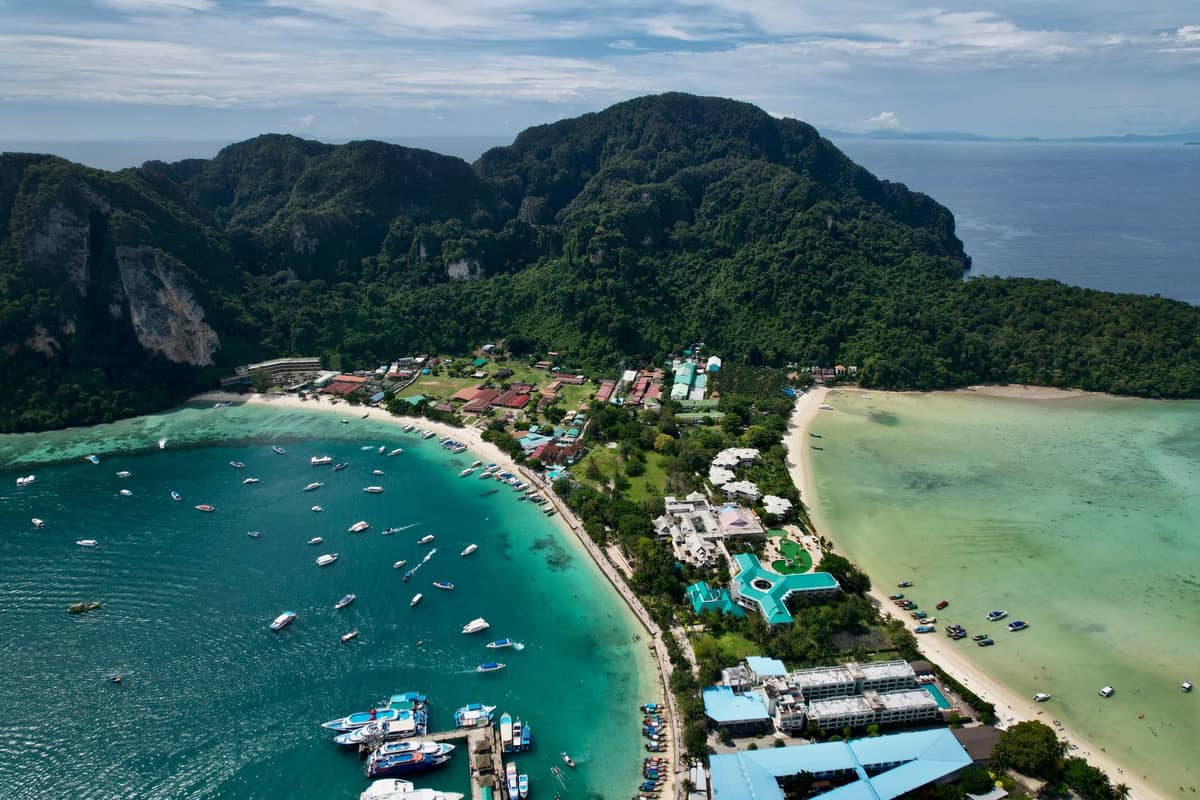
What Koh Phi Phi Don Actually Is
Koh Phi Phi Don is the largest island in the Phi Phi archipelago, measuring roughly 8 km long and 3.5 km wide. It is the only inhabited island in the group, home to a permanent local community as well as a tourism infrastructure that has expanded dramatically over the past two decades. The island's geography is striking: two limestone massifs connected by a flat, narrow isthmus of sand called Tonsai, where the main pier, shops, restaurants, and guesthouses are concentrated. This bottleneck is simultaneously the island's most convenient and most congested zone.
The island sits within Krabi Province, administered under Ao Nang, Mueang Krabi District. It is not a national park island itself, though nearby Koh Phi Phi Leh — the uninhabited sister island — falls within a protected area. Koh Phi Phi Don has no roads. Movement between beaches requires either walking across the isthmus or taking a water taxi around the coastline.
ℹ️ Good to know
There is no general admission fee to enter Koh Phi Phi Don. However, excursions to nearby sites, including Koh Phi Phi Leh and Maya Bay, may carry national park charges. Confirm all fees with your operator before you depart.
Getting There: Ferries, Speedboats, and What to Expect on Arrival
Boats to Koh Phi Phi Don depart from Krabi Town and from Phuket, with journey times and frequencies varying by season and operator. From Krabi Town, the standard ferry crossing takes roughly 90 minutes; speedboat transfers cut that to around 45 minutes but cost more and are weather-dependent. From Phuket the crossing is longer. All boats arrive at Tonsai Pier on the island's south-facing coast.
Tonsai Pier itself deserves a word of preparation. Disembarking into the pier zone during peak season — particularly between December and February — means stepping into a narrow corridor of luggage, touts, tour vendors, and new arrivals all converging at once. The smell of boat diesel mixes with grilled food from nearby stalls, and the noise level is considerable. Keep your bag close and have your accommodation name written down; the alley layout in the Tonsai village is irregular and can disorient first-time arrivals.
Once you move beyond the immediate pier area, the village opens into a patchwork of lanes lined with dive shops, massage parlours, travel agencies, minimarts, and restaurants occupying the sandy ground between the two bays. There are no paved roads and no motor vehicles. The texture underfoot shifts between compacted sand, concrete walkways, and loose gravel depending on which part of the village you are in.
💡 Local tip
Book ferry tickets in advance during high season (December to February and during Thai public holidays). Last-minute tickets are often available but early boats tend to be less crowded than midday departures, which carry day-trippers from tour groups.
Tickets & tours
Live prices and dates from our booking partner. If you book, we may earn a commission at no extra cost to you.
Speedboat Tour to Koh Phi Phi and Bamboo from Lanta
From 46 €Instant confirmationFree cancellationPhi Phi archipelago and Krabi 4 Islands full‑day speedboat tour
From 0 €Instant confirmationFree cancellation3-Hour Private Sunrise Tour by Longtail Boat to Maya Bay from Phi Phi
From 95 €Instant confirmationFree cancellationPhi Phi's Extended Grand Odyssey by Speedboat
From 52 €Instant confirmationFree cancellation
The Beaches: What Each One Actually Offers
Tonsai Bay, directly in front of the pier area, is the most convenient beach but also the least serene. Long-tail boats idle offshore throughout the day, and the water near the pier is affected by boat traffic. For swimming, most visitors either cross the isthmus on foot to Loh Dalum Bay on the north side, or take a water taxi to more remote beaches.
Loh Dalum Bay is a curved, palm-backed bay with calm, clear water during the dry season. At low tide the bay becomes extremely shallow and can look less impressive in photographs than the elevated viewpoint that overlooks it. The viewpoint above Tonsai village — reachable by a short but steep climb through the jungle — offers the iconic shot of both bays meeting at the isthmus. It is genuinely worth the effort, especially in the early morning before tour groups arrive. For a longer and more demanding hike in the region, the Dragon Crest Mountain trail on the Krabi mainland provides a comparable elevated perspective with fewer crowds.
Further around the coast, Tonsai Beach (distinct from Tonsai Bay) sits to the southwest and has historically attracted a quieter, rock-climbing-oriented crowd given the limestone cliffs directly above it. Access at high tide requires either a boat or wading, which keeps the volume down. If you are planning a longer stay and want something quieter than the main village, this end of the island rewards the extra logistical effort.
Time of Day and Crowd Patterns
Koh Phi Phi Don is a tale of two experiences separated by time of day. Between roughly 10 AM and 4 PM during high season, the island receives a significant surge of day-trippers arriving on tour boats from Krabi and Phuket. The Tonsai village lanes become difficult to move through without bumping into other visitors, and popular snorkel spots offshore are busy with anchored boats. The ambient noise includes music from beach bars, long-tail engines, and the general din of a place receiving more visitors than its infrastructure was designed for.
From around 5 PM onward, once day boats have returned to the mainland, the island changes character noticeably. The lanes quiet down, the light on the limestone cliffs turns golden and then pink, and the beach bars begin setting up fire shows for the evening. Mornings before 9 AM are similarly calm: the water is often glassy, the air is cooler, and the village is unhurried. If you are staying overnight, these hours alone justify the extra cost compared to a day trip.
⚠️ What to skip
Koh Phi Phi Don is not for travellers seeking isolation or undisturbed nature. During peak season, the volume of visitors is high enough to affect the swimming beaches, the coral condition near popular snorkel sites, and the overall atmosphere in the village. If that matters to you, factor it into your decision.
History and Context: From Fishing Village to Post-Tsunami Rebuild
Before mass tourism arrived, Koh Phi Phi Don was home to a Sea Gypsy (Chao Leh) fishing community. The island's development as a visitor destination accelerated through the 1990s, partly driven by the filming of a well-known feature film at nearby Koh Phi Phi Leh. Tourism continued to grow until the morning of 26 December 2004, when the Indian Ocean tsunami struck the island with devastating force. The flat isthmus where the village stands was almost entirely swept through by the waves, causing catastrophic loss of life and destroying much of the built environment.
The island was rebuilt in the years that followed, and tourism returned relatively quickly. The rebuilt village has a more uniform, functional character than older parts of comparable Thai islands; many of the structures date from the post-2004 period. There is a small tsunami memorial in the village, a quiet place that can feel incongruous given the energy of the surroundings, but it is worth a few minutes of attention.
For broader context on island life in Krabi Province, the Koh Lanta Old Town offers a more preserved example of a traditional Andaman coastal settlement, with wooden shophouses and a notably lower visitor volume than Phi Phi Don.
Day Trips from the Island and What's Nearby
Koh Phi Phi Don serves as a departure point for several popular excursions. The most visited is Koh Phi Phi Leh, the uninhabited island to the south that contains Maya Bay and Pileh Lagoon. Maya Bay operates under regulated access conditions introduced after it was closed for environmental recovery; check current access rules with your operator, as they are subject to change.
Snorkeling and diving trips from the island reach several reef sites in the surrounding waters. Visibility and marine life quality vary considerably by season and site; for more structured diving information specific to the region, the Krabi diving guide covers the key sites, operators, and seasonal considerations. The Krabi snorkeling guide is useful if you are planning a non-diving water trip.
Travellers using Phi Phi Don as a base for a longer island-hopping itinerary should note that onward connections to Koh Lanta are available by ferry during the high season, reducing the need to return to the mainland first.
Practical Details: Weather, What to Bring, and Accessibility
The island experiences a tropical climate with a southwest monsoon rainy season running approximately from May to October. Sea conditions during this period can make boat crossings uncomfortable or, at times, suspended by operators. The drier months from December through February offer the most reliable weather for beach visits and water activities, though this coincides with peak visitor volume. April can see increasing humidity and occasional heavy showers before the monsoon properly establishes.
Because there are no roads, footwear matters: sandals work well on the sandy village paths, but if you plan to climb the viewpoint trail or walk to Tonsai Beach at low tide over rocky terrain, closed-toe shoes or sturdy sandals are more appropriate. Sun protection is essential; the midday sun is intense and shade is limited on the open beaches. Bring cash in Thai baht, as ATMs on the island do charge fees and may occasionally run low on notes during busy periods. Tap water should not be consumed; use sealed bottled water.
Accessibility on Koh Phi Phi Don is limited for visitors with mobility impairments. The combination of sand paths, uneven surfaces, stairs in some accommodation, and the absence of any road-based transport makes it genuinely difficult for wheelchair users or those with significant mobility challenges. This is a structural constraint of the island's geography, not a policy failure, but it is worth understanding clearly before booking.
💡 Local tip
Thailand's Tourist Police can be reached on 1155 if you need assistance on the island. The general emergency number is 191 and emergency medical services are at 1669.
Insider Tips
- The viewpoint above Tonsai village is most rewarding between 7 AM and 8:30 AM. The light is better, the air is cooler, and you will have the platform largely to yourself before tour groups arrive. Wear shoes with grip for the steep, rooted sections of the trail.
- Water taxis circling the island charge negotiable fares. Agreeing on a price before boarding is standard practice; ask other travellers at your guesthouse what they paid recently to get a realistic baseline.
- If you are staying overnight, eat dinner after 8 PM when most day-trippers have long departed. The restaurants in the inner lanes of the village are notably calmer and, anecdotally, more attentive with service than during the midday rush.
- Loh Dalum Bay at high tide is the better swimming experience. Check a tide table for the day of your visit; at low tide the bay becomes very shallow and the visual effect is considerably less dramatic than the photographs suggest.
- Pack a dry bag if you are taking excursion boats. Long-tail transfers in choppy conditions will spray water into the boat, and speedboat crossings during the tail end of the rainy season can be genuinely wet rides.
Who Is Koh Phi Phi Don For?
- Travellers who want a lively, social island atmosphere with evening bar culture and easy access to snorkel and dive sites
- Island-hoppers using Phi Phi Don as a transit point between the Krabi mainland and Koh Lanta
- Visitors on a mid-length Krabi itinerary who can stay at least one night and experience the island before and after the day-trip crowds
- Snorkeling and diving enthusiasts who want multiple reef sites within short boat range
- Couples and groups comfortable with a higher-energy environment who are not primarily seeking quiet or seclusion
Nearby Attractions
Other things to see while in Koh Phi Phi:
- Bamboo Island (Koh Mai Phai)
Bamboo Island, or Koh Mai Phai, is a small coral-fringed island in Hat Noppharat Thara–Mu Ko Phi Phi National Park, sitting just north of Phi Phi Don in the Andaman Sea. At roughly 0.5 km², it offers a long crescent of white sand and shallow turquoise water with noticeably fewer visitors than the Phi Phi main islands. Access is by boat only, making it a natural half-day escape for anyone already based in the Phi Phi area.
- Koh Phi Phi Leh
Koh Phi Phi Leh is an uninhabited limestone island in Krabi Province, best known for Maya Bay. Striking from every angle and more controlled than you'd expect, it rewards visitors who understand what they're walking into.
- Maya Bay
Maya Bay on Koh Phi Phi Leh is one of Thailand's most photographed beaches, framed by sheer limestone cliffs and turquoise water. After a three-year ecological closure, it has reopened with strict visitor rules. Here is what the experience actually looks like today.
- Monkey Beach
Monkey Beach, known in Thai as Ao Ling or Yong Gasem Bay, is a short boat ride from Tonsai Bay on Koh Phi Phi Don. The 150-metre strip of sand is famous for its resident macaques, but the experience is more complicated than the photos suggest. Here is what you actually need to know before going.
Planning a trip? Discover personalized activities with the Nomado app.