Jimbocho Book District: Tokyo's World-Famous Secondhand Bookstore Neighbourhood
Kanda Jimbocho Used Bookshop Town in Chiyoda is widely recognised as one of the largest concentrations of secondhand and specialist bookstores on earth. Entry is free, the streets are walkable year-round, and the neighbourhood rewards slow, unhurried browsing — whether you read Japanese or not.
Quick Facts
- Location
- Kanda Jimbo-cho, Chiyoda-ku, Tokyo 101-0051
- Getting There
- Jimbocho Station (Tokyo Metro Hanzomon & Toei Mita/Shinjuku lines) — ~1-min walk. Also: JR Ochanomizu or Suidobashi, ~10-min walk
- Time Needed
- 1.5 to 3 hours for a browsing visit; half a day if you plan to shop seriously
- Cost
- Free to enter and walk. Spend only what you buy at individual shops
- Best for
- Book lovers, print collectors, architecture walkers, solo travellers
- Official website
- en.jimbou.info
What Jimbocho Actually Is
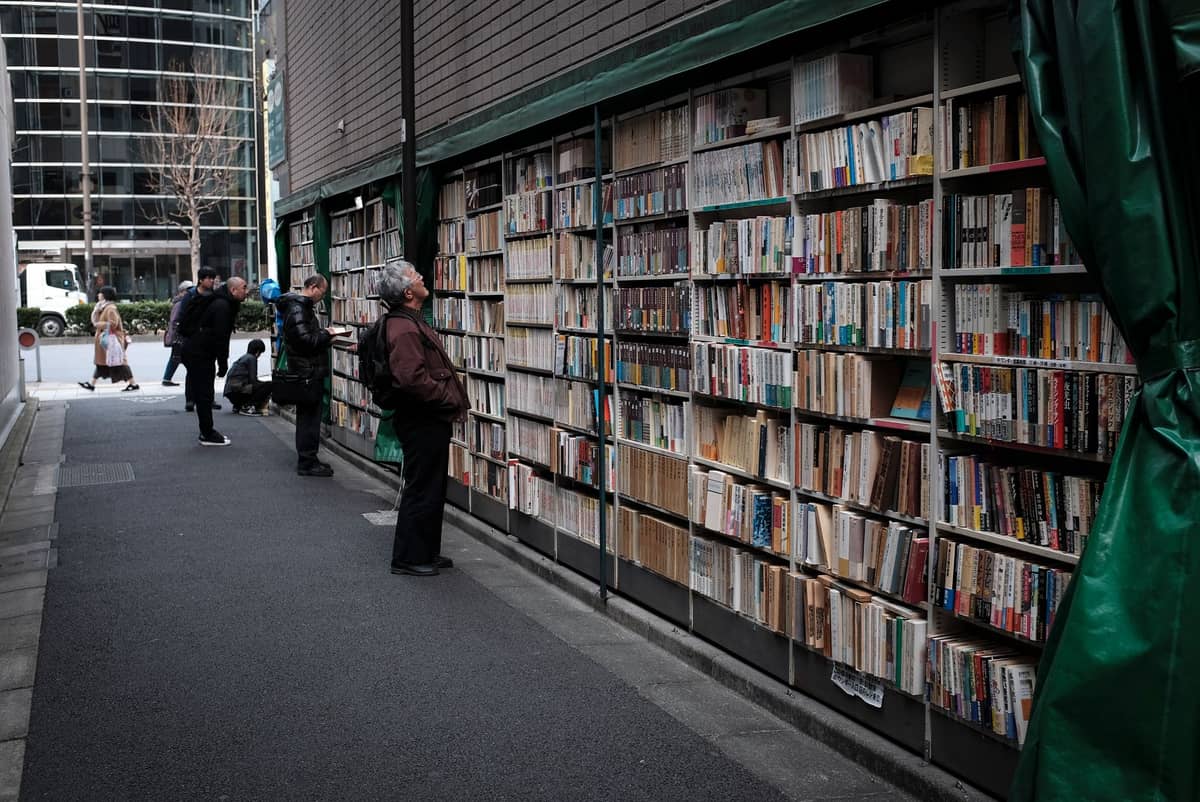
Kanda Jimbocho Used Bookshop Town (Japanese: 神田神保町古書店街) is a compact neighbourhood in Chiyoda ward where hundreds of secondhand and specialist bookstores line the main avenues of Yasukuni-dori and Hakusan-dori, plus the lanes threading between them. The density is staggering. Walk two blocks and you pass shops devoted entirely to art books, vintage maps, pre-war magazines, mountaineering literature, foreign-language paperbacks, manga first editions, and architectural prints. No other district in Tokyo, and arguably no other district in the world, concentrates this much printed material in this small an area.
The district is publicly accessible at all times — there are no gates, no tickets, no queues. The streets themselves are ordinary Tokyo sidewalks. What makes the experience is the sheer accumulation of shops, the outdoor book carts that spill onto the pavement, and the quiet particular to a neighbourhood full of people absorbed in reading. Even if you do not speak Japanese, you will find something: illustrated books, vintage photography collections, antique maps, and woodblock prints cross language barriers completely.
💡 Local tip
Arrive on a weekday morning if you want the streets to yourself. Many shops open from around 10:00–11:00 and the district is at its quietest before noon, especially Tuesday through Thursday.
How the Neighbourhood Came to Be
Jimbocho's identity as a book district is rooted in geography. Several major universities — including Meiji, Nihon, and Senshu — established campuses in and around the area in the late 19th and early 20th centuries. Student demand for affordable textbooks and reading material drew booksellers to the area, and the concentration gradually self-reinforced: more shops attracted more customers, more customers attracted more shops. By the interwar period, Jimbocho was already Tokyo's established centre for second-hand books and academic publishing.
The neighbourhood survived the 1923 Great Kanto Earthquake and the firebombing of 1945 better than many of Tokyo's older commercial districts, and the post-war recovery period saw the book trade expand further. Today the area still has functioning publishers, academic presses, and new-book retailers operating alongside the used-book shops, giving the streets a layered quality that purely vintage districts lack. Some of the older storefronts, with their wooden shelving visible through the glass, have been trading from the same location for several decades.
Tickets & tours
Hand-picked options from our booking partner. Prices are indicative; availability and final rates are confirmed when you complete your booking.
Guided Tour of Historical Asakusa District in Tokyo
From 131 €Instant confirmationFree cancellationTsukiji Fish Market Walking Food Tour
From 40 €Instant confirmationFree cancellationMt.Fuji,Owakudani, Hakone Cruise & Ropeway, Oshino Hakkai 1-Day Trip
From 54 €Instant confirmationFree cancellationTour to Mt. Fuji Area, Oshino Hakkai and Kawaguchi Lake from Tokyo
From 57 €Instant confirmationFree cancellation
The Walk: What You See and Where to Go
The most practical approach from Jimbocho Station (exit A6 or A7) places you directly on Yasukuni-dori, the main east-west spine of the district. Walk west and the bookshop fronts begin almost immediately, some with long wooden troughs of discounted paperbacks at street level and lit display windows showing more curated stock inside. The pavement is wide enough to browse comfortably without blocking pedestrian flow, which matters because on weekends the foot traffic can get dense near the most prominent shops.
The side streets south of Yasukuni-dori, particularly around the blocks between Yasukuni and Hakusan-dori, contain some of the more specialist shops: dealers in antique maps and ukiyo-e prints, military history collections, and stores focusing entirely on cinema or music ephemera. These lanes are quieter and the shopkeepers tend to be more willing to answer questions, even with limited shared language, if you show genuine interest in the stock.
The outdoor book carts deserve particular attention. On dry days, many shops wheel out additional stock onto the pavement at prices well below what is displayed inside. These carts are where you are most likely to find an unexpected bargain — an illustrated botany book from the 1960s, a full set of National Geographic from the 1970s, a collection of vintage travel posters. Prices on carts are usually fixed but occasionally negotiable for multiple purchases.
⚠️ What to skip
Outdoor book carts disappear on rainy days. If you are specifically hunting outdoor stock, check the forecast. Rain also makes some narrower shop interiors feel cramped, as browsers crowd inside.
The District by Time of Day
Mornings in Jimbocho have a subdued, workday atmosphere. Shop owners are unpacking stock, wiping down shelves, and arranging the pavement carts. The smell in the air at this hour is distinctly papery — old paper, a faint must from damp bindings, and occasionally the sharper scent of freshly brewed coffee from one of the neighbourhood's older coffee shops. The coffee house culture here is genuinely well-developed: Jimbocho has a cluster of old-style kissaten (traditional coffee shops) with tall wooden chairs and serious pour-over menus that open early and cater to the bookselling community as much as to tourists.
By early afternoon on weekends, the main stretch of Yasukuni-dori fills noticeably. Book collectors arrive in numbers, and you will see people carrying large fabric bags and methodically working their way along the street. The pace feels purposeful rather than leisurely. Lunchtime brings additional foot traffic from the surrounding office and university buildings, and the small curry restaurants and soba shops that cluster among the bookstores fill up quickly. Jimbocho has a genuine local curry culture — there are more curry specialists here than you would expect for the size of the neighbourhood, a quirk attributed to the large number of students from South Asian countries who studied at the nearby universities over the decades.
Late afternoon is when the light falls best for photography. The low sun hits the wooden shopfronts and the book spines in the outdoor carts at a useful angle. Many shops start tidying outdoor stock after 17:00 or 18:00, and some of the smaller specialist dealers close by early evening. If you want to browse seriously, aim to arrive by 14:00 at the latest.
The Kanda Used Book Festival
Every October, the district hosts the annual Kanda Used Book Festival (Aozora Kohon Ichiba), an open-air book market that extends beyond the permanent shops and fills the streets with additional stalls and pop-up sellers. It is one of the largest secondhand book events in Japan and draws collectors from across the country. If your visit coincides with October, it is worth timing your arrival to the festival days — the atmosphere is substantially different from the everyday district, and prices on certain categories of stock can be competitive.
Outside of October, the festival period aside, the district maintains a steady, year-round rhythm. There is no single best season: spring and autumn bring comfortable walking weather, but the district itself is largely indoors and functions perfectly well through summer heat or winter cold. Rain is the only condition that genuinely changes the experience, eliminating the outdoor cart browsing that is one of Jimbocho's most appealing features.
Practical Notes for Visitors
Getting here is straightforward. Jimbocho Station on three separate lines (Toei Mita, Toei Shinjuku, and Tokyo Metro Hanzomon) puts you a one-minute walk from the main book street. If you are coming from Akihabara or the Ueno area, JR Ochanomizu Station is about ten minutes on foot across the Kanda River. From the Imperial Palace and Chiyoda's government quarter, the walk is around fifteen minutes through quiet administrative streets.
Most shops accept cash; some of the larger or newer stores accept IC cards or credit cards, but do not count on it for the smaller specialist dealers. Bring yen if you plan to buy. Bags are useful: the neighbourhood has no shortage of things to purchase, and carrying a sturdy tote means you can accumulate stock across multiple shops without struggle.
Accessibility in the district is mixed. The pavements on Yasukuni-dori are wide and level, and Jimbocho Station has elevators at its exits. Inside individual bookstores, however, conditions vary considerably. Many shops have narrow aisles stacked floor-to-ceiling with books, steps at the entrance, or additional stock on upper floors reached only by steep internal stairs. If mobility is a consideration, the ground-floor street-level browsing and pavement carts are generally accessible, but some of the more specialist interiors are not.
For photography, the district works best in natural light. The shop interiors are typically dim and cluttered in a way that makes flash photography intrusive; the real photographic interest is in the pavement carts, the layered shop facades, and the occasional painted sign above an older storefront. If you are interested in the broader Chiyoda area, the Imperial Palace East Gardens are an easy walk east and make a natural second stop on the same afternoon.
ℹ️ Good to know
The official directory of shops in the district, including a searchable database by specialisation and language, is available in English at en.jimbou.info. Useful for planning if you are hunting a specific category of book.
Who Should Skip This
Visitors with no interest in books, print, or printed ephemera will find the district underwhelming. There are good coffee shops and a handful of curry restaurants, but the neighbourhood exists almost entirely to serve the book trade. It is not a sightseeing destination in the conventional sense — there are no major landmarks, no views, nothing that reads as a visual spectacle. If your Tokyo itinerary is focused on food markets, temples, or contemporary architecture, Jimbocho sits outside that logic. For those interests, the nearby Kanda Shrine and the Ginza district offer more conventionally varied experiences.
Travellers with very limited time in Tokyo should also think carefully. Jimbocho rewards patience and wandering — the best finds come from unplanned exploration rather than a targeted one-shop visit. If you have only a single full day in the city, there are higher-density experiences available elsewhere.
Insider Tips
- The outdoor pavement carts often have a dedicated section of 100-yen books at the far end of each display. These are almost always Japanese-language, but illustrated or photographic volumes at that price are worth picking through even without reading ability.
- Jimbocho's curry restaurants have a genuine local reputation and are not tourist facilities. Sawamura and a handful of other long-running lunch spots fill up by 12:15 on weekdays. Arrive at 11:45 or plan for a 13:30 visit after the initial rush.
- Several shops maintain running want-lists and will take contact details if you are looking for something specific. Even if your Japanese is limited, showing a photo or a title on your phone screen usually gets a response.
- The Hanzomon Line from Jimbocho connects directly to Shibuya with no transfers in around 13 minutes, making it easy to pair the district with an evening in the Shibuya or Daikanyama area on the same day.
- During the October book festival, bring more cash than you think you need and arrive early on the opening days. The best stock at the outdoor pop-up stalls moves quickly, particularly pre-war illustrated books and vintage map collections.
Who Is Jimbocho Book District For?
- Book collectors and readers hunting affordable secondhand stock across any genre or language
- Print and map collectors looking for antique woodblock prints, ukiyo-e, and vintage cartography
- Solo travellers who enjoy slow, unstructured neighbourhood exploration
- Architecture and urban texture walkers interested in older Tokyo commercial streetscapes
- Visitors combining Jimbocho with nearby Chiyoda sights such as the Imperial Palace gardens or Kanda Shrine
Nearby Attractions
Other things to see while in Imperial Palace & Chiyoda:
- Imperial Palace
The Imperial Palace (Kokyo) sits at the geographic and symbolic heart of Tokyo, occupying the former grounds of Edo Castle in Chiyoda. While the palace itself remains a working royal residence, the East Gardens are open to the public and free to enter, revealing stone castle ruins, manicured lawns, and centuries of Japanese history within walking distance of Tokyo Station.
- Imperial Palace East Gardens
The Imperial Palace East Gardens sit on the former grounds of Edo Castle, offering free access to historic stone ruins, manicured lawns, and seasonal gardens in the heart of Tokyo. Calm, spacious, and historically layered, they reward visitors who take time to look closely.
- National Museum of Modern Art, Tokyo (MOMAT)
Tucked beside the moat of the Imperial Palace in Kitanomaru Park, the National Museum of Modern Art, Tokyo traces Japanese art from the Meiji era to today across four floors of rotating and permanent displays. It draws far fewer crowds than Tokyo's blockbuster attractions, making it one of the most rewarding museum experiences in the city for anyone who gives it the time.
- Tokyo Station
Opened in 1914, Tokyo Station is the architectural and logistical heart of Japan's rail network. The restored red-brick Marunouchi facade frames one of the country's most recognizable buildings, while inside, a labyrinthine complex of platforms, restaurants, and specialty shops rewards those who treat it as a destination rather than just a transit point.