Tokyo Station: Japan's Most Iconic Railway Terminal
Opened in 1914, Tokyo Station is the architectural and logistical heart of Japan's rail network. The restored red-brick Marunouchi facade frames one of the country's most recognizable buildings, while inside, a labyrinthine complex of platforms, restaurants, and specialty shops rewards those who treat it as a destination rather than just a transit point.
Quick Facts
- Location
- 1-9-1 Marunouchi, Chiyoda-ku, Tokyo 100-0005
- Getting There
- JR lines (all platforms); Tokyo Metro Marunouchi Line (Tokyo Station). Direct Shinkansen access.
- Time Needed
- 30 minutes (transit only) to 2-3 hours (architectural exploration + dining)
- Cost
- Free to enter station concourse; train fares vary by route. No admission fee.
- Best for
- First-time visitors, architecture enthusiasts, Shinkansen travelers, food lovers
- Official website
- http://www.tokyostationcity.com/en
What Tokyo Station Actually Is
Tokyo Station (東京駅, Tōkyō-eki) is the central terminal of Japan's rail network, the primary gateway for Shinkansen bullet trains heading to Osaka, Kyoto, Hiroshima, and Hokkaido, and one of the most architecturally significant railway buildings in Asia. It sits at 1-9-1 Marunouchi in Chiyoda Ward, flanked on its western side by the corporate towers of Marunouchi and on its eastern side by Yaesu, a commercial district defined by underground malls and mid-range dining.
The station handles a staggering volume of daily passengers across JR East commuter lines, the Tokaido Shinkansen operated by JR Central, and several long-distance express services. The Tokyo Metro Marunouchi Line also connects directly via underground passage, making this one of the most connected transit nodes in the city. Yet despite that scale, the building itself never feels purely utilitarian — it rewards attention.
ℹ️ Good to know
There is no admission fee to enter Tokyo Station's public concourse areas. You only need a valid train ticket or IC card (such as Suica or Pasmo) to pass through the ticket gates onto the platforms.
The Architecture: A Restored Landmark Worth Stopping For
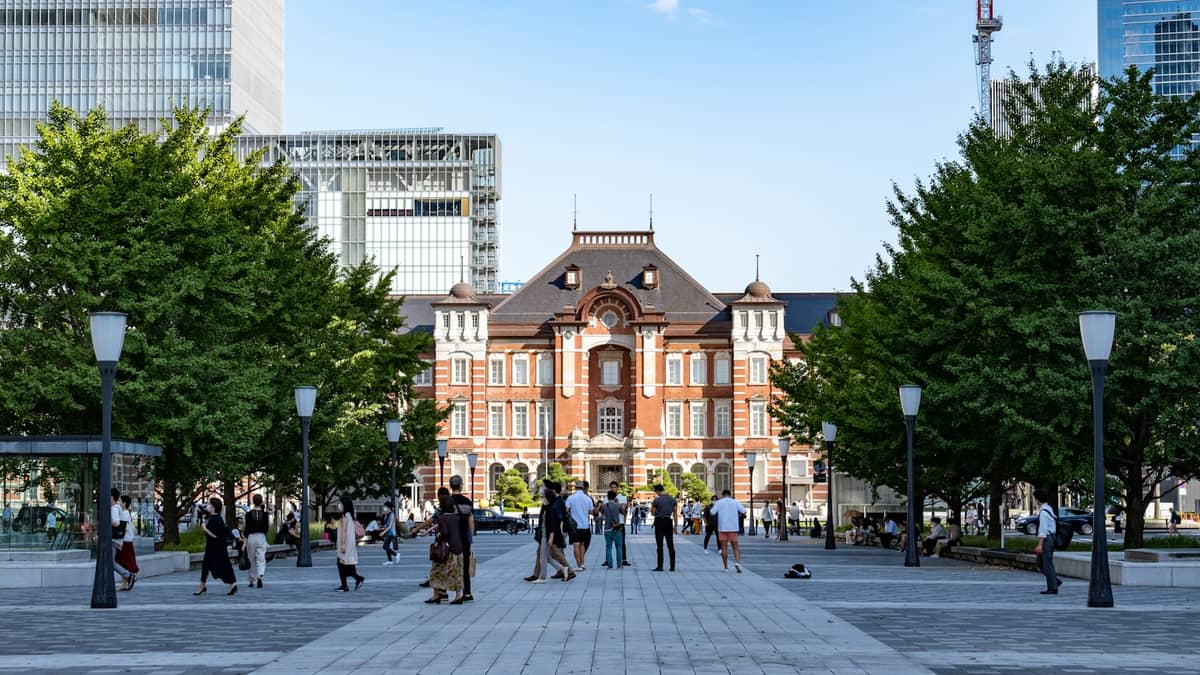
The Marunouchi building — the western facade of Tokyo Station — was completed on December 20, 1914, during the Taisho era. Its architect, Tatsuno Kingo, drew on Dutch Renaissance influences, producing a three-story red-brick structure with distinctive domed cupolas at each end. It was the largest station building in Japan at the time and remains one of the finest examples of Western-influenced Meiji-Taisho architecture in the country.
The building suffered significant damage in the air raids of 1945, losing its upper floors and the ornate domed rooftops. For decades, a simplified two-story version stood in their place. A meticulous restoration project, completed in 2012, rebuilt the original domes and reinstated the full three-story facade using period-appropriate methods and materials. The difference is visible in photographs taken before and after 2012, but today the building reads as genuinely historic rather than reconstructed.
The best view of the exterior is from the Marunouchi side, looking west from inside the station concourse toward the exit, or from the pedestrian plaza directly outside the Marunouchi Central Exit. Early morning — before 8am — is when the facade catches low light at its most photogenic. By midday, the plaza fills with commuters, tourists, and tour groups, and the angle becomes harder to frame cleanly. The South and North domes are also worth examining up close: the interior of each dome is decorated with relief sculptures of the zodiac and figures representing Japan's eight original regions, often overlooked by visitors rushing for trains.
💡 Local tip
Photography tip: For a clean shot of the full Marunouchi facade with the domed cupolas, stand at the far end of the pedestrian plaza on the Marunouchi side, roughly 80-100 meters from the building. A wide-angle lens or a standard smartphone works well here. Blue-hour shots (just after sunset) with the building lit from below are particularly striking.
Tickets & tours
Hand-picked options from our booking partner. Prices are indicative; availability and final rates are confirmed when you complete your booking.
Tour to Mt. Fuji Area, Oshino Hakkai and Kawaguchi Lake from Tokyo
From 57 €Instant confirmationFree cancellationNikko UNESCO Shrine and Nature View 1-Day Tour from Tokyo
From 78 €Instant confirmationFree cancellationYanaka: historical walking tour in Tokyo's old town
From 40 €Instant confirmationFree cancellationMeiji Shrine, Imperial Palace, Asakusa and Tokyo Skytree Entry
From 34 €Instant confirmationFree cancellation
Inside the Station: A City Within a Building
The interior of Tokyo Station is genuinely complex. There are multiple basement levels, a ground floor divided into the Marunouchi and Yaesu sides, and the elevated concourse areas above the platforms. First-time visitors frequently find it disorienting, particularly when navigating between JR lines and the Shinkansen gates. Signs are well-placed and bilingual throughout, but the sheer number of exits — over a dozen, named by direction and gate — can cause confusion.
The commercial operation within the station is substantial. Tokyo Station City — the official branding for the retail and dining complex within and directly attached to the station — includes Gransta (underground and concourse-level food shops) and the Daimaru department store in the Yaesu building. Kitte (the converted post office building directly adjacent on the Marunouchi side, worth a visit in its own right) is operated as a separate complex but is closely integrated into the station area. For Japanese food souvenirs and regional specialties — ekiben (train station bento boxes), wagashi (traditional sweets), and artisanal snacks from across Japan — the basement Gransta area is one of the best-stocked spots in the city. For a broader map of Tokyo's architecture and urban form, the Tokyo architecture guide provides useful context on how the Marunouchi district developed around the station.
The Shinkansen ticket gates are located on the central concourse level and require a separate Shinkansen ticket or reserved seat in addition to your IC card. If you are catching a bullet train and unfamiliar with the layout, allow at least 20 minutes of buffer time beyond your normal commuter instincts — the walk from, say, the Marunouchi Central Exit to the Tokaido Shinkansen platforms is longer than it appears on maps.
How the Station Changes Through the Day
Tokyo Station before 7am belongs to early commuters, overnight train arrivals, and a handful of tourists who have come specifically for the quieter atmosphere. The Marunouchi exterior plaza is nearly empty, and the domes glow faintly in the morning light. This is the best time to appreciate the building's proportions without navigating crowds. The coffee options are limited at this hour — a few kiosk-style cafes inside the gates — but functional.
Between 7:30am and 9:30am, the station handles the full force of Tokyo's morning commute. The concourses become dense and directional: people moving with practiced efficiency in defined flows. Tourists standing still to read signs or consult maps will find themselves working against the current. It is not unpleasant, but it is not the time to explore leisurely.
Midday is the most accessible window for a purposeful visit. Crowds thin between major commuter waves, shops are fully stocked, and the Gransta food area — which gets picked clean of popular items by early afternoon on weekends — still has reasonable selection. The Marunouchi exterior is busy with tour groups in peak season but manageable. By evening, around 5:30pm to 7pm, the outbound commuter rush returns, and the station fills again. After 9pm, the pace drops noticeably, and the interior takes on a different character: quieter, the food shops running down their inventory, but the architecture more visible without bodies filling every frame.
Getting There and Moving Through the Station
Tokyo Station is served by JR East's Yamanote Line, Chuo Line, Keihin-Tohoku Line, and multiple long-distance express services, in addition to the Tokaido Shinkansen (JR Central). The Tokyo Metro Marunouchi Line's Tokyo Station is connected via underground passage and is steps from the Marunouchi exits. If arriving from Narita Airport, the JR Narita Express (N'EX) terminates at Tokyo Station in approximately one hour. From Haneda Airport, the most straightforward route is the Tokyo Monorail to Hamamatsucho, then the Yamanote Line to Tokyo Station — typically around 30 minutes total. Full airport connection details are covered in the Tokyo airports guide.
Within the station, the most useful orientation landmark is the color-coded floor maps posted at every major junction. The Marunouchi side (west) and Yaesu side (east) have distinct exits, and crossing between them requires navigating either through the paid concourse (with a valid ticket) or via dedicated free passage corridors. If you are not catching a train and simply want to see the interior or visit the shops, use the free passage corridors marked on station maps — you do not need a ticket for this.
💡 Local tip
If you want to walk through the full station without buying a train ticket, use the designated 'free passage' corridors on the north and south ends of the building. These allow you to cross between the Marunouchi and Yaesu sides without passing through the ticket gates.
The Surrounding Area: Marunouchi and Kitte
Directly outside the Marunouchi South and Central exits, the broad pedestrian boulevard of Marunouchi leads toward the Imperial Palace and Imperial Palace East Gardens. The walk takes about 10-15 minutes and passes through one of Tokyo's most formally planned streetscapes — wide sidewalks, uniform building heights, seasonal tree plantings — which contrasts sharply with the denser commercial areas elsewhere in the city.
The Kitte building, directly adjacent to the Marunouchi South Exit, occupies the former Tokyo Central Post Office and is operated as an upscale shopping and dining complex. Its rooftop garden offers a free, undervisited view of the Tokyo Station Marunouchi facade from above — one of the few elevated vantage points onto the building's restored domes. It is a worthwhile five-minute detour. The broader Chiyoda neighborhood, including the commercial district around the station, is explored in more depth in the Imperial Palace and Chiyoda area guide.
Accessibility and Practical Details
Tokyo Station has extensive barrier-free infrastructure: elevators connect all major levels, ramps are available at key junctions, and tactile guidance strips run throughout the concourse. The Marunouchi exterior plaza is fully step-free. Wheelchair users and travelers with strollers will find the station navigable, though the volume of foot traffic during peak hours can make some corridors challenging. For specific platform-level accessibility queries, JR East's accessibility information page and the Tokyo Metro barrier-free search tool are the most current resources.
There is no dress code for the station or its commercial areas. Coin lockers are available throughout the complex in various sizes — useful for storing luggage before a day of sightseeing. They fill up quickly on weekends and during peak travel seasons (cherry blossom season in late March to early April, Golden Week in late April to early May, and the Obon period in mid-August), so arrive early if you plan to use them.
⚠️ What to skip
Coin lockers at Tokyo Station reach capacity by mid-morning on busy weekends and holidays. If you need to store luggage, arrive before 9am or use luggage forwarding services (takuhaibin) available at the station's service counters, which can send bags to hotels for a fee.
Insider Tips
- The interior of the North and South domes above the Marunouchi Central and South ticket gates contain detailed plasterwork relief sculptures — zodiac signs and regional figures — that almost nobody looks up to see. They are accessible from the non-ticketed area inside the station entrance, no platform ticket required.
- The rooftop garden of the adjacent Kitte building (free entry, accessible via elevator inside Kitte) gives a direct elevated view of the station's restored red-brick domes and is one of the most underused photography spots in central Tokyo.
- If you are purchasing Shinkansen tickets for the same day, the JR EAST Travel Service Center at the Marunouchi North Exit generally has shorter queues than the main ticket office. Staff speak English and can handle seat reservations, IC card top-ups, and JR Pass exchanges.
- The Gransta underground food hall's most popular regional ekiben (bento boxes) and limited-edition sweets sell out early — by noon on weekends. If you want specific items, shop before 11am.
- Late evening, around 9-10pm, the Marunouchi exterior plaza is dramatically lit and mostly empty. The facade looks its most impressive at this hour, and you can photograph it without navigating tour groups or commuters.
Who Is Tokyo Station For?
- First-time visitors to Tokyo who want to orient themselves at the city's geographic and transport center
- Architecture enthusiasts interested in Taisho-era Western-influenced design and Japan's 2012 restoration project
- Travelers catching Shinkansen bullet trains to Kyoto, Osaka, or other destinations — this is the primary departure point
- Food souvenir hunters looking for the widest selection of regional Japanese specialties under one roof
- Photographers wanting a landmark facade that reads unambiguously as 'Japan' without temple or shrine clichés
Nearby Attractions
Other things to see while in Imperial Palace & Chiyoda:
- Imperial Palace
The Imperial Palace (Kokyo) sits at the geographic and symbolic heart of Tokyo, occupying the former grounds of Edo Castle in Chiyoda. While the palace itself remains a working royal residence, the East Gardens are open to the public and free to enter, revealing stone castle ruins, manicured lawns, and centuries of Japanese history within walking distance of Tokyo Station.
- Imperial Palace East Gardens
The Imperial Palace East Gardens sit on the former grounds of Edo Castle, offering free access to historic stone ruins, manicured lawns, and seasonal gardens in the heart of Tokyo. Calm, spacious, and historically layered, they reward visitors who take time to look closely.
- Jimbocho Book District
Kanda Jimbocho Used Bookshop Town in Chiyoda is widely recognised as one of the largest concentrations of secondhand and specialist bookstores on earth. Entry is free, the streets are walkable year-round, and the neighbourhood rewards slow, unhurried browsing — whether you read Japanese or not.
- National Museum of Modern Art, Tokyo (MOMAT)
Tucked beside the moat of the Imperial Palace in Kitanomaru Park, the National Museum of Modern Art, Tokyo traces Japanese art from the Meiji era to today across four floors of rotating and permanent displays. It draws far fewer crowds than Tokyo's blockbuster attractions, making it one of the most rewarding museum experiences in the city for anyone who gives it the time.