Institute for Nature Study: Tokyo's Forgotten Forest
The Institute for Nature Study is one of the least-visited and most rewarding natural spaces in Tokyo. The Institute for Nature Study is one of the least-visited and most rewarding natural spaces in Tokyo. A forested reserve in Minato Ward, it offers something genuinely rare in this city: the sound of birdsong without traffic, paths through forest that feel nothing like a manicured park, and an admission fee of just ¥320. it offers something genuinely rare in this city: the sound of birdsong without traffic, paths through forest that feel nothing like a manicured park, and an admission fee of just ¥320.
Quick Facts
- Location
- 5-21-5 Shirokanedai, Minato-ku, Tokyo 108-0071
- Getting There
- Shirokanedai Station (Tokyo Metro Namboku Line / Toei Mita Line), 5-min walk
- Time Needed
- 1.5 to 2.5 hours
- Cost
- ¥320 (general/university students); free for high school students and younger; free for persons with disabilities and one caregiver
- Best for
- Nature lovers, photographers, quiet seekers, birdwatchers
- Official website
- ins.kahaku.go.jp/english
What Is the Institute for Nature Study?
The Institute for Nature Study (附属自然教育園) is a 20-hectare forested research area in Shirokanedai, Minato Ward, administratively attached to the National Museum of Nature and Science. It is not a public garden in the conventional sense. There are no manicured flower beds, no fountain displays, and no themed planting zones. What you get instead is a carefully preserved tract of secondary forest, wetlands, and meadow The Institute for Nature Study (附属自然教育園) is a forested research area in Shirokanedai, Minato Ward, administratively attached to the National Museum of Nature and Science. It is not a public garden in the conventional sense. There are no manicured flower beds, no fountain displays, and no themed planting zones. What you get instead is a carefully preserved tract of secondary forest, wetlands, and meadow that has been protected as a nature study area for decades.
The land itself has a longer history. The site served as an estate during the Edo period, later became military land, and was eventually transferred to national management. Because it avoided the large-scale urban development that reshaped most of central Tokyo in the 20th century, the forest has had decades to accumulate genuine ecological depth: layered canopies, moss-covered stones, seasonal wetlands, and a surprising diversity of bird species.
💡 Local tip
Visitor numbers are capped to protect the ecosystem. Arriving early on weekdays almost guarantees a quiet experience. On weekends in spring and autumn, a short wait at the gate is possible during peak hours.
What It Feels Like to Walk Here
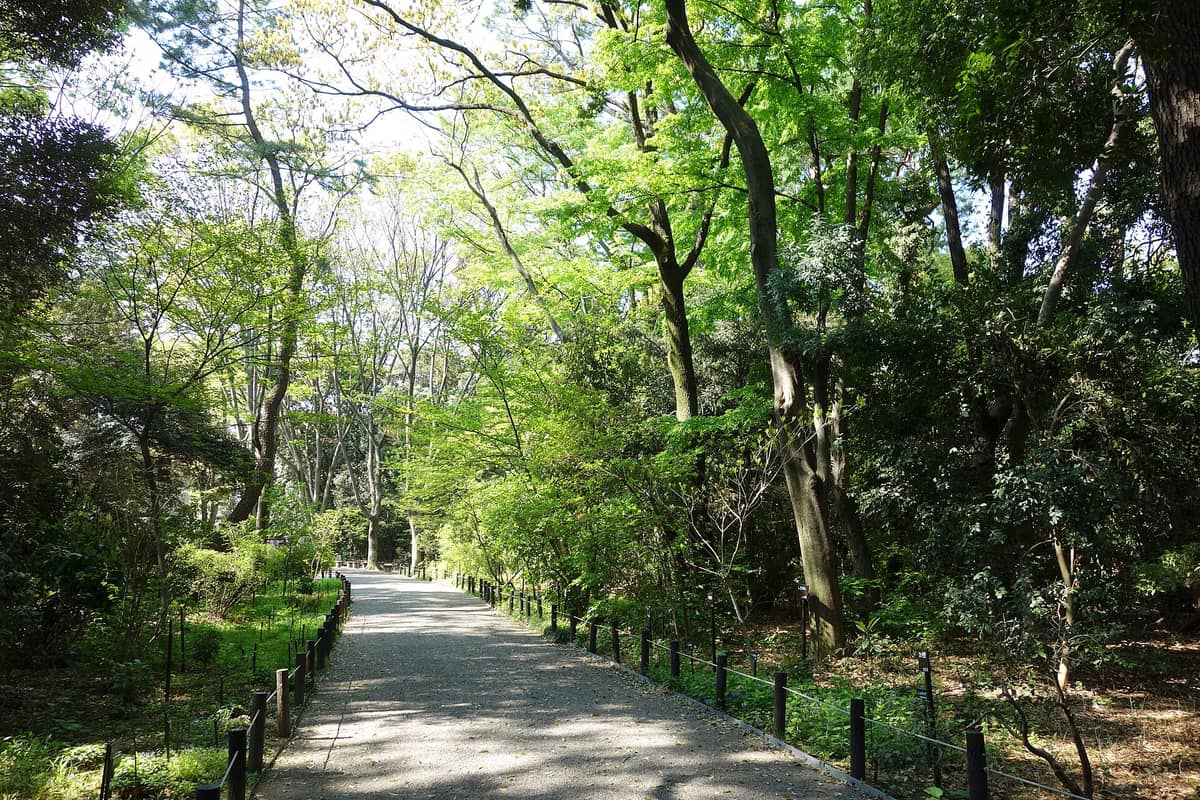
The transition from street to forest happens fast. You pay at a small booth, pass through a gate, and within a few dozen meters the noise of Shirokanedai drops away. The main paths are unpaved and slightly uneven in places. The canopy closes overhead quickly, and on overcast days the light takes on a flat, green quality that makes the whole site feel further from the city than it actually is.
In summer, the air inside the forest is noticeably cooler and considerably more humid than the surrounding streets, with the smell of damp earth and leaf litter. In winter, bare deciduous trees let in sharp morning light, and the calls of thrushes and other overwintering birds carry clearly through the understory. Spring brings a brief and genuine flush of wildflowers along the forest margins, while autumn turns the higher canopy copper and amber.
The paths are wide enough for two people side by side but not designed for strollers or wheelchairs in most sections. Shoes with some grip are a practical choice after rain. The route forms a rough loop around the perimeter with shorter interior paths branching off to ponds and wetland areas. There are benches placed at intervals, and most visitors slow to a deliberate pace almost immediately.
Tickets & tours
Hand-picked options from our booking partner. Prices are indicative; availability and final rates are confirmed when you complete your booking.
Nikko UNESCO Shrine and Nature View 1-Day Tour from Tokyo
From 78 €Instant confirmationFree cancellationTsukiji Fish Market Walking Food Tour
From 40 €Instant confirmationFree cancellationMt.Fuji,Owakudani, Hakone Cruise & Ropeway, Oshino Hakkai 1-Day Trip
From 54 €Instant confirmationFree cancellationTour to Mt. Fuji Area, Oshino Hakkai and Kawaguchi Lake from Tokyo
From 57 €Instant confirmationFree cancellation
Morning vs. Afternoon: How the Experience Shifts
Morning visits, especially on weekdays between opening at 9:00 AM and around 10:30 AM, are reliably quiet. Birdwatchers tend to arrive early and stand patiently near the pond edges. The light through the canopy is angled and soft. If you have any interest in photography, this window produces the most atmospheric conditions.
By mid-afternoon, particularly on weekends, the site sees more families and couples, though it never reaches the density of a place like Shinjuku Gyoen. The afternoon light tends to flatten inside the forest, and the bird activity quiets. Late afternoon near closing time has its own character: the light becomes golden in autumn and spring, and the last visitors trickle toward the exit. Last admission is at 4:00 PM, so arriving after 3:30 PM leaves limited time.
⚠️ What to skip
The Institute for Nature Study is closed on Mondays (or Tuesday if Monday is a public holiday), and also closes for a period around New Year. Check the official website before visiting, as irregular closures do occur.
Opening Hours, Admission, and Getting There
The site operates on a seasonal schedule. From September 1 through April 30, hours are 9:00 AM to 4:30 PM. From May 1 through August 31, the site stays open until 5:00 PM. In both cases, last entry is at 4:00 PM. Admission is ¥320 for general visitors and university students. High school students and younger enter free. Persons with disabilities and one accompanying caregiver are admitted free; identification may be required.
The nearest station is Shirokanedai Station on the Tokyo Metro Namboku Line and Toei Mita Line, about a five-minute walk from the entrance. This places it on a convenient axis with Meguro to the north and Azabu-Juban to the east. If you are combining it with other destinations, the Hamarikyu Gardens and Shinjuku Gyoen are accessible by subway, though they offer quite different characters.
Photography and Natural Features Worth Noticing
The ponds near the center of the reserve are among the most visually striking elements. Depending on the season, the surface is covered in aquatic vegetation or reflects bare winter branches in near-perfect stillness. The surrounding reeds and grasses provide structure in any season. A standard wide lens handles the open pond areas well; for the forest interior, the low light and close canopy favor a faster prime lens or patience with a tripod.
There are interpretive signs along the main paths, most with English translations, explaining the ecological history of specific areas. These are worth reading. They reframe what looks like natural wilderness into something more deliberate: a managed attempt to understand how urban green space can recover ecological function over time, which makes the site intellectually engaging beyond its aesthetic appeal.
If you have a broader interest in Tokyo's natural and scientific institutions, the National Museum of Nature and Science in Ueno is the parent institution and offers extensive indoor collections that complement a visit here well.
Context: Green Space in Central Tokyo
Tokyo has more parks than most visitors expect, but few that feel genuinely unmanicured. The Institute for Nature Study occupies a specific niche: it is ecologically serious rather than decoratively pleasant. If your interest is in traditional Japanese garden design, you would be better served by sites like the Koishikawa Korakuen Garden or Rikugien Garden. If what you want is a sprawling park with open lawns for picnics and crowds of Tokyoites, Yoyogi Park is the better option.
The Institute's value is specifically in what it withholds: pruning, engineering, commerce, and spectacle. For visitors who feel worn down by the deliberate intensity of Tokyo's urban environment, this is one of the few places in the city where the sensory demand genuinely drops away.
For more on how Tokyo's parks and gardens fit together as a system, the Tokyo gardens guide covers the range of options across different neighborhoods and styles.
Who Will Find This Worth Their Time, and Who Should Skip It
The Institute for Nature Study rewards visitors who are comfortable with slow, purposeful walking and who find ecological rather than architectural detail interesting. Birdwatchers, plant enthusiasts, photographers working with natural light, and anyone who simply needs a break from the pace of Tokyo will get genuine value here.
It is not well-suited to travelers with a tightly packed itinerary who want high visual returns in short time windows. There are no dramatic viewpoints, no famous singular attractions within the reserve, and no food or coffee inside the gates. Children under school age may find the lack of play structures limiting, though older children with an interest in nature often respond well to the freedom of the paths.
First-time visitors to Tokyo with limited days should weigh whether this fits their priorities. It is most valuable as a half-day addition to a neighborhood-level exploration of Shirokanedai or Meguro, rather than as a standalone destination requiring significant cross-city travel.
Insider Tips
- Bring your own water. There are no vendors inside the reserve, and vending machines are only at the entrance area.
- Visit on a Tuesday or Wednesday morning in the off-peak season (February or early October) for the closest thing to solitude you will find in central Tokyo.
- The pond area in the interior of the reserve is significantly better for birdwatching than the perimeter paths. Take the branching interior paths rather than staying on the main loop.
- Mosquitoes are present from late spring through early autumn, particularly near the wetland areas. Insect repellent is worth packing from May onward.
- The entrance gate and ticketing area have a small information counter where staff can point you to seasonal highlights: specific wildflower zones in spring, migratory bird sightings in winter. Worth asking even with limited Japanese, as some staff speak basic English.
Who Is Institute for Nature Study For?
- Birdwatchers and wildlife observers looking for urban habitat diversity
- Photographers seeking natural light and forest textures without crowds
- Travelers who need genuine quiet after days of intensive sightseeing
- Nature and ecology enthusiasts interested in urban ecological recovery
- Solo visitors or couples looking for a meditative, unhurried half-day
Nearby Attractions
Combine your visit with:
- Akasaka Palace (State Guest House)
The State Guest House, Akasaka Palace is Japan's principal diplomatic residence and one of the few Western-style palaces in Asia open to the public. Built in neo-baroque style for the Crown Prince in the early 20th century, it now receives heads of state and, on select days, ordinary visitors. The combination of ornate gilded interiors, formal French gardens, and a Japanese-style annex makes it one of the most architecturally unusual stops in Tokyo.
- Edo-Tokyo Open Air Architectural Museum
Spread across the grounds of Koganei Park, the Edo-Tokyo Open-Air Architectural Museum rescues and reassembles more than 30 historic structures spanning the Edo period through the early 20th century. From a dismantled farmhouse to a reconstruction of a Showa-era Tokyo streetscape, it is one of the most thoughtful and undervisited cultural sites in the metropolitan area.
- Enoshima
A small island off the Shonan coast of Kanagawa Prefecture, Enoshima packs a surprising amount into a short walk: a three-part Shinto shrine, ancient sea caves, a hilltop botanical garden, a lighthouse observation tower, and seafood stalls lining a stone-paved shopping street. It works as a half-day excursion or a full day if you combine it with nearby Kamakura.
- Gotokuji Temple
Gotokuji Temple in Setagaya is a working Soto Zen Buddhist temple that happens to be one of the claimed birthplaces of the maneki-neko, Japan's iconic beckoning cat. Hundreds of white ceramic cats line the shelves of a dedicated shrine, creating one of Tokyo's most quietly striking visual spectacles. Entry is free, crowds are manageable, and the surrounding grounds offer genuine calm.