Holmenkollen Ski Jump: Oslo's Iconic Arena Above the City
Holmenkollen Ski Jump rises 375 metres above Oslo on a forested hillside, combining one of the world's oldest ski jumping venues with a museum tracing 4,000 years of skiing history. The tower offers some of the most dramatic views in Norway's capital, looking out over the city, the Oslofjord, and the Nordmarka forest.
Quick Facts
- Location
- Kongeveien 5, 0787 Oslo (Holmenkollen district)
- Getting There
- T-bane Line 1 to Holmenkollen station, then a short uphill walk
- Time Needed
- 1.5 to 3 hours
- Cost
- Adults 200 NOK, children (6–17) 100 NOK, under-30s 150 NOK, family 2+2 500 NOK (2026 prices)
- Best for
- City views, ski history, architecture, families, winter sport fans
- Official website
- holmenkollen.com/en
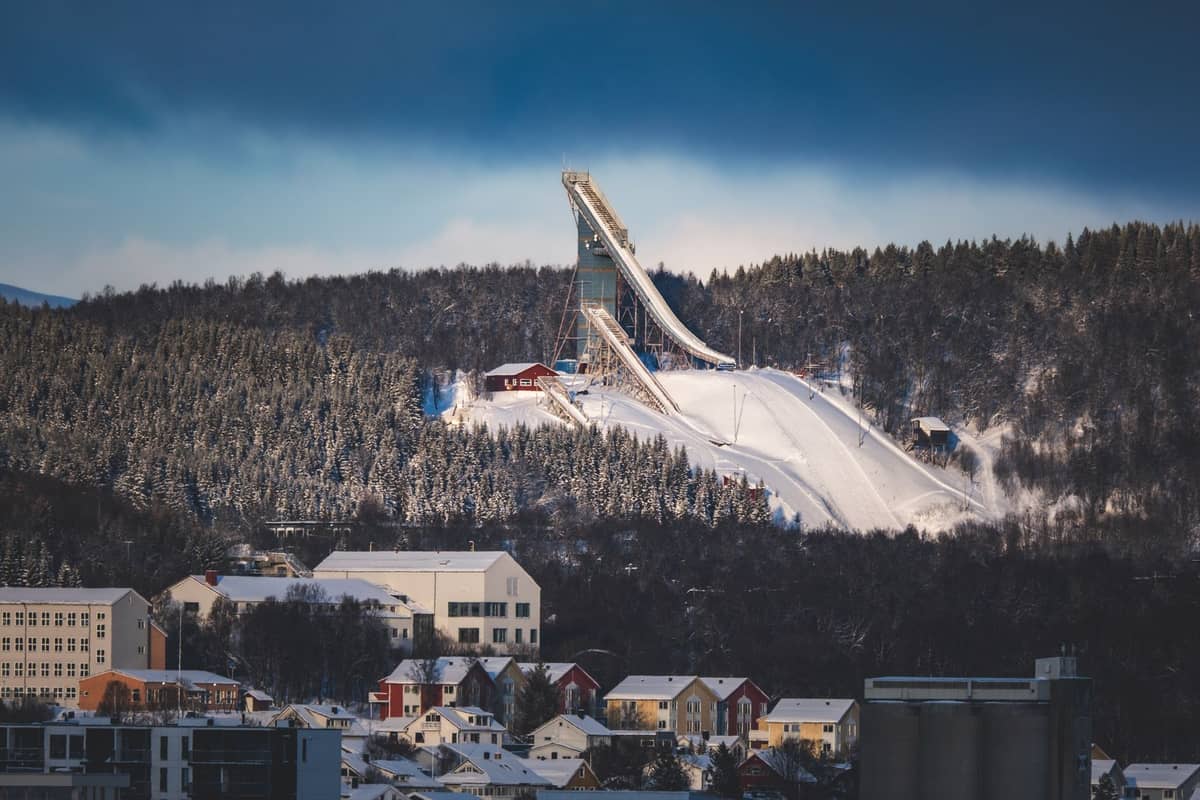
What Holmenkollen Actually Is
The Holmenkollen Ski Jump, known in Norwegian as Holmenkollbakken, is not just a sports venue. It is a national landmark that Norwegians treat with something close to reverence. Perched on the forested ridgeline northwest of Oslo city centre at roughly 375 metres above sea level, the jump tower is visible from large parts of the city on clear days. Its curved steel silhouette has become as recognisable as the Oslo Opera House or City Hall.
The arena has hosted ski jumping competitions almost every year since 1892, making it one of the oldest purpose-built ski jumping facilities in the world. The current structure was rebuilt and inaugurated for the FIS Nordic World Ski Championships 2011. It is not a preserved relic but a working international competition venue that doubles as a visitor attraction year-round, combining the Ski Museum in Holmenkollen (Skimuseet i Holmenkollen) with access to the jump tower and its viewing platform.
ℹ️ Good to know
Opening hours: January–April and October–December: 10:00–16:00 daily. May–September: 10:00–17:00 daily. Reduced hours (10:00–14:00) on 17 May, 24 December, and 31 December.
The Tower: Numbers That Put It in Perspective
The start house sits approximately 64 metres above ground level, and the tower structure contains around 1,000 tonnes of steel. To reach the top under your own power, you climb roughly 250 steps. The height difference between the takeoff edge and the K-point below is 59.1 metres, and the hill record stands at 144 metres. Standing at the platform and looking down at the landing slope, that number stops being abstract very quickly.
The viewing platform at the top of the jump is enclosed with glass and steel railings, which helps with wind but does little to reduce the psychological impact of the angle. First-time visitors often spend several minutes simply adjusting to the perspective before they think about taking photographs. The slope falls away steeply below, the city spreads across the valley, and on a clear day the Oslofjord glimmers in the distance. It is a genuinely striking view, not a manufactured one.
💡 Local tip
Photography tip: For the classic shot framing the jump tower against Oslo and the fjord, position yourself at the viewing terrace near the base of the inrun rather than at the very top. Morning light falls well on the tower's steel face. If you want the city backdrop from above, late afternoon gives warmer tones over the fjord.
For broader Oslo panoramas from other elevated vantage points, see the Oslo viewpoints guide, which covers Holmenkollen alongside Ekeberg and several lesser-known alternatives.
Tickets & tours
Live prices and dates from our booking partner. If you book, we may earn a commission at no extra cost to you.
Daypass at SNO ski resort in Oslo
From 45 €Instant confirmationFree cancellationHolmenkollen private walking tour
From 0 €Instant confirmationFree cancellationOslo Fjord sightseeing audio-guided electrical boat tour
From 35 €Instant confirmationFree cancellationFjord cruise with live jazz music
From 64 €Instant confirmationFree cancellation
The Ski Museum: More Depth Than You Expect
The ticket price covers both the tower and the Ski Museum, and the museum deserves more time than most visitors give it. The collection traces skiing as a human activity across approximately 4,000 years, from early hunting skis found in Norwegian bogs to the equipment used by polar explorers Roald Amundsen and Fridtjof Nansen. The polar exploration section is particularly well done, with original sledges, clothing, and navigational instruments that make the audacity of early 20th-century expeditions concrete.
The alpine and Nordic racing galleries cover the development of competitive skiing with enough specificity to hold the attention of non-specialists. Ski design changed faster than most people realise, and the physical progression from 19th-century wooden planks to modern carbon-fibre slalom skis is laid out clearly. Interactive simulators let you experience the sensation of a ski jump from the competitor's perspective, which is popular with children and genuinely disorienting for adults.
Holmenkollen sits within a wider context of Oslo's exceptional museum culture. If you are planning a multi-museum day, the Oslo museums guide covers how to prioritise your time across the city's major collections.
How the Experience Changes by Time of Day and Season
Winter is when Holmenkollen makes the most sense. Snow covers the landing slope, the surrounding forest is white, and the scale of the jump becomes obvious in a way that it does not in summer. If you visit during the Holmenkollen Ski Festival, typically held in March, the atmosphere shifts entirely: the stands fill with tens of thousands of spectators, the Norwegian flags appear in every direction, and the entire hillside becomes a national celebration. Arriving outside festival dates in winter gives you the structure almost to yourself, with a quiet quality that the summer months do not match.
In summer, the forested ridge path and the architecture are the draw. The tower looks cleanest against a blue sky, and the views extend further on clear days. School groups and international tourists are more numerous from June onward, with midday being the busiest window. Arriving when the museum opens at 10:00 gives you the first hour with noticeably fewer people. Late afternoon visits have a calmer quality, and if you take the T-bane back toward the city at dusk in summer, the light over Oslo from the train windows is worth the journey alone.
⚠️ What to skip
Weather note: The ridgeline at Holmenkollen is several degrees colder than central Oslo and exposed to wind year-round. In winter, temperatures at the top of the tower can feel extreme. Bring more layers than you think you need, regardless of season.
Getting There and Getting Around
T-bane Line 1 runs directly to Holmenkollen station from central Oslo, and the journey from Nationaltheatret takes roughly 20–25 minutes. From Holmenkollen station, the ski jump is visible immediately; follow the path uphill for about 10 minutes. The route is well-signed and the gradient is manageable, though it is a real uphill walk and not a flat stroll. The same Line 1 continues upward to Frognerseteren, which makes a logical extension if you want to combine the ski jump visit with a longer walk in the Nordmarka forest.
The Oslo Pass covers admission to the Ski Museum and jump tower as well as unlimited public transport, which makes economic sense if you are visiting multiple attractions in a day. Details on coverage and pricing are in the Oslo Pass guide.
If you plan to continue from Holmenkollen into the hills, the Oslo hiking guide covers the trail network that begins practically at the foot of the ski jump, with routes ranging from short forest walks to full-day hikes into Nordmarka.
Accessibility
The Ski Museum is wheelchair accessible and has a lift and accessible toilets. The jump tower is also accessible by wheelchair, but chair users can generally reach the lower viewing platform only, not the uppermost point. The uphill path from Holmenkollen T-bane station is paved but steep; wheelchair users arriving independently should plan for this gradient.
Clear Assessment: Is It Worth the Trip?
For most visitors to Oslo, yes. The combination of a genuinely impressive piece of engineering, a well-curated museum, and panoramic views makes this a destination that earns its place on a three-day itinerary. The views from the top of the jump are among the best available in Oslo without a hike, and the historical context provided by the museum adds substance to what might otherwise be just a tall structure.
That said, it is not a half-day destination for everyone. Visitors with no interest in ski sport and no head for heights may find the museum moderately interesting and the tower visit brief. If panoramic views are the primary goal, the Holmenkollen Line (T-bane 1) up to Frognerseteren or the ridgeline walk above the ski jump offer comparable or better scenery with more physical engagement. Visitors with limited mobility who cannot access the upper tower platform will miss the central visual experience, though the museum remains fully accessible.
If you are building a full itinerary around Holmenkollen, the 3-day Oslo itinerary positions it logically within a broader visit, pairing it with Frognerseteren and the Nordmarka edge.
Insider Tips
- The T-bane ride up to Holmenkollen is itself a small attraction: Line 1 climbs steeply through residential suburbs and then into open forest, offering views over the city as it ascends. Sit on the right-hand side heading uphill for the best angle.
- If you visit during the Holmenkollen Ski Festival in March, buy tickets weeks in advance. The stands hold up to 70,000 spectators and sell out for the major jumping events. On festival days, the T-bane runs at high frequency but gets very crowded.
- The café near the base of the jump serves decent coffee and a small food menu. It is a good place to warm up after the tower visit in winter, and the terrace faces south toward the city, which makes it a pleasant rest stop in summer.
- Combine the visit with Frognerseteren restaurant, five stops further up Line 1. The building is a fine example of National Romantic architecture, and the apple cake (eplekake) served there is locally famous. You can walk back down through the forest to Holmenkollen afterward.
- Weekday mornings in the off-season (October through April outside festival weekends) are the quietest times to visit. You may have the tower viewing platform almost entirely to yourself, which is a very different experience from a busy summer afternoon.
Who Is Holmenkollen Ski Jump For?
- Travelers interested in Norwegian national identity and winter sports culture
- Families with children aged 8 and older, particularly for the museum simulators and the tower climb
- Architecture and engineering enthusiasts drawn to the jump's distinctive steel structure
- Visitors combining a city panorama with a half-day in the Holmenkollen forest
- Winter visitors who want to see Oslo's ski culture in its natural setting, especially during the March festival
Nearby Attractions
Other things to see while in Holmenkollen & Nordmarka:
- Frognerseteren
Perched at the top of the Holmenkollen ridge, Frognerseteren is a landmark timber restaurant dating to 1891, combining traditional Norwegian dragon-style architecture with panoramic views over Oslo and the Oslofjord. It works equally well as a lunch destination, a post-hike reward, or a winter afternoon stop for hot apple cake.
- Korketrekkeren Toboggan Run
Korketrekkeren is an approximately 2.5 km public toboggan run in the Holmenkollen hills, dropping 255 metres from Frognerseteren to Midtstuen. Free to use and accessible by metro, it's one of Oslo's most genuinely fun winter experiences, for locals and visitors alike.
- Nordmarka Forest
Nordmarka Forest is a vast, freely accessible woodland stretching north from Oslo's city limits — offering hiking, cross-country skiing, and lakeside walks within 25 minutes of the city center. No entrance fee, no ticket booth, just forest. Here is how to make the most of it.
- Ski Museum (Skimuseet)
Tucked beneath the iconic Holmenkollen ski jump, the Ski Museum in Holmenkollen (Skimuseet i Holmenkollen) chronicles over 4,000 years of skiing history through equipment, art, and immersive exhibits. Combine it with the jump tower's panoramic platform for one of Oslo's most complete half-day experiences.
Planning a trip? Discover personalized activities with the Nomado app.