Highgate Cemetery: London's Most Atmospheric Victorian Burial Ground
Opened in 1839 as one of London's 'Magnificent Seven' cemeteries, Highgate Cemetery combines Gothic Victorian architecture, overgrown woodland, and the graves of some of history's most recognisable figures. The East Cemetery is open to independent visitors; the wilder West Cemetery requires a guided tour booked in advance.
Quick Facts
- Location
- Swain's Lane, Highgate, London N6 — adjacent to Waterlow Park
- Getting There
- Archway (Northern line), then approx. 15-minute walk; or C11 bus to Brookfield Park stop on Swain’s Lane
- Time Needed
- 1.5–2.5 hours for both sides; add 30 minutes if joining a guided West Cemetery tour
- Cost
- East Cemetery: paid entry; West Cemetery: guided tour ticket (book online). Check highgatecemetery.org for current prices
- Best for
- History lovers, architecture enthusiasts, photographers, and anyone who finds meaning in quiet, wooded places
- Official website
- highgatecemetery.org
What Highgate Cemetery Actually Is
Highgate Cemetery is not a tourist attraction that happens to have graves. It is an active, working cemetery managed by the Friends of Highgate Cemetery Trust, and the atmosphere reflects that. Visitors come to walk among around 170,000 people buried in around 53,000 graves, laid out across a hillside in North London that has been slowly reclaimed by ivy, foxes, and mature woodland over nearly two centuries.
The site is divided into two distinct halves by Swain's Lane. The East Cemetery, opened in 1860, is the more accessible of the two: visitors can enter independently with a paid ticket, walk at their own pace, and find the grave of Karl Marx without needing to book anything in advance. The original West Cemetery, which opened in 1839, is only accessible on a guided tour. It is older, denser, more overgrown, and widely considered the more dramatic of the two.
💡 Local tip
West Cemetery tours sell out, especially on weekends. Book your guided tour online at highgatecemetery.org well before your visit. East Cemetery tickets can usually be purchased on arrival, though at busy times advance booking online is recommended.
The West Cemetery: Gothic Architecture in the Undergrowth
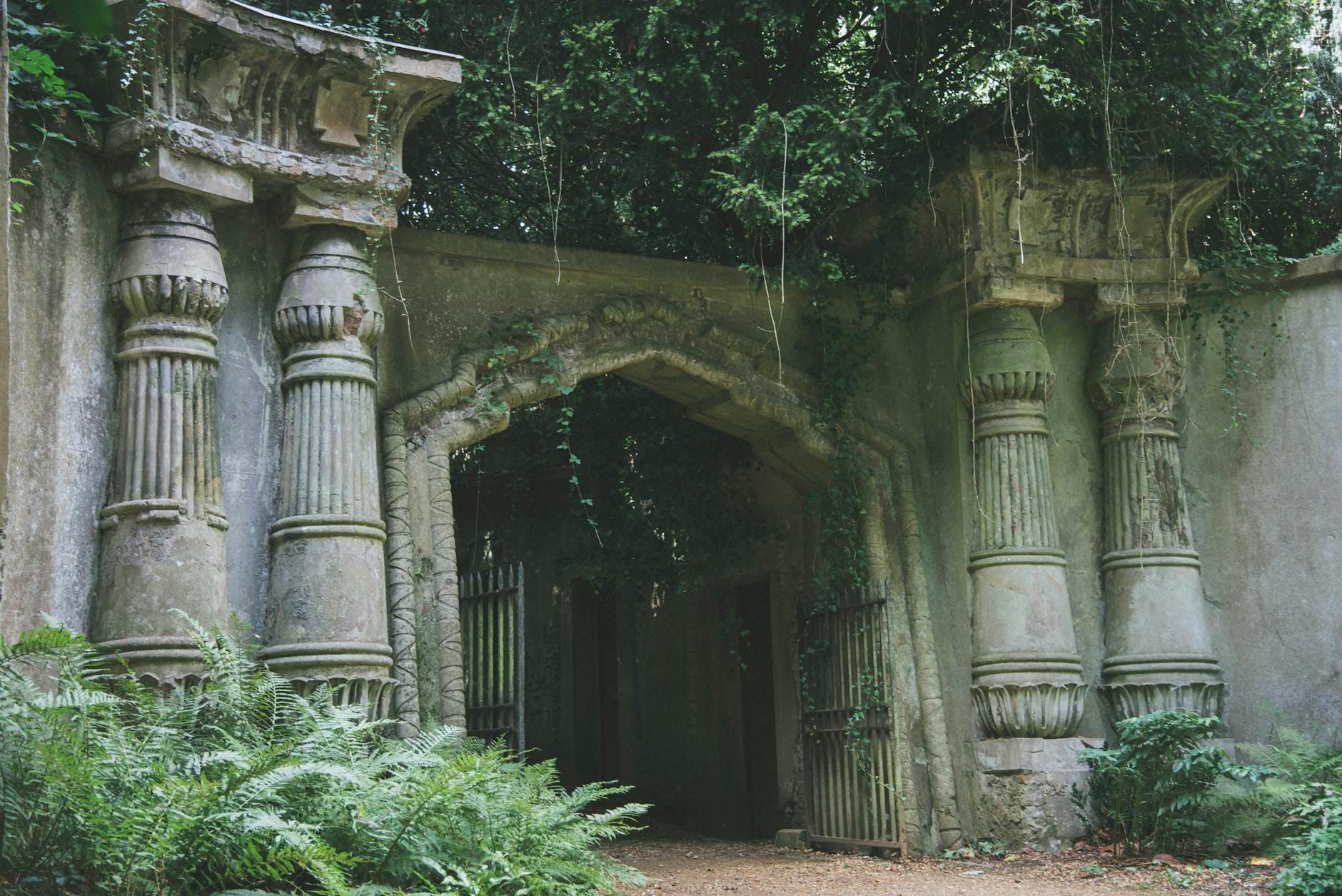
The West Cemetery is the part that most photographs fail to capture accurately. The images that circulate online tend to emphasise its most dramatic features: the Egyptian Avenue, with its lotus-column gate and row of vault doors carved into the hillside; the Circle of Lebanon, a circular path of catacombs surrounding an ancient cedar tree; the Terrace Catacombs, long brick-lined passages with iron vault doors set into the bank. These structures were designed to impress Victorian visitors with the permanence of stone and the dignity of death.
What photographs rarely convey is how much the vegetation has overtaken everything. Roots push through stonework. Ivy has pried open vault lids. Trees have grown through the roofs of mausoleums. The effect is not one of neglect, exactly, but of nature asserting itself over human ambition in slow motion. This tension between the designed grandeur of the 1839 layout and the decades of organic growth is what gives the West Cemetery its particular texture.
The guided tours, led by trained volunteers, typically last around 75 minutes and cover the major architectural features while weaving in stories of the people buried there. Tour group sizes are controlled, so the experience feels considered rather than crowded. The guides tend to be knowledgeable about both the architecture and the social history of Victorian attitudes toward death and memorial.
ℹ️ Good to know
Photography is permitted in the West Cemetery during tours, but tripods and flash are generally not allowed. Early morning light on weekday tours produces the clearest shots through the canopy.
Tickets & tours
Hand-picked options from our booking partner. Prices are indicative; availability and final rates are confirmed when you complete your booking.
Soho Instagram a self-guided walking tour to top photo spots
From 6 €Instant confirmationFree cancellationTootbus London by Night: Bus tour
From 32 €Instant confirmationFree cancellationIFS Cloud Cable Car Ride and Uber Boat Hop-on Hop-off 1 Day Ticket
From 38 €Instant confirmationFree cancellationThe Making of Harry Potter Guided Tour of London Warner Bros. Studio
From 201 €Instant confirmationFree cancellation
The East Cemetery: Karl Marx and a Long Walk Among the Graves
The East Cemetery is less architecturally dramatic than its counterpart across the lane, but it rewards slower visitors. The grounds are more open, the paths more navigable, and the graves span a wider period of time. The most visited spot is the Karl Marx memorial: a large bronze bust of Marx mounted on a tall stone plinth, inscribed with lines from the Communist Manifesto. It draws visitors from around the world, and at certain hours you will find people photographing it, leaving flowers, or simply standing quietly.
Other notable graves include those of novelist George Eliot, chemist Michael Faraday, and more recently, Douglas Adams, the author of The Hitchhiker's Guide to the Galaxy. Adams' grave tends to have pens left on it by visitors, a small and surprisingly moving tribute. The cemetery provides a map at the entrance that marks key graves, which is worth picking up before you begin.
The East Cemetery sits alongside Waterlow Park, a peaceful public green space that makes a natural addition to the visit. After leaving the cemetery, many visitors cut through the park before heading back toward Archway station. If you are spending the afternoon in this part of North London, Hampstead Heath is about a mile east and offers a very different but complementary experience of London's green landscape.
Historical Context: The Magnificent Seven and the Victorian Death Problem
Highgate Cemetery was created in response to a genuine urban crisis. By the 1830s, London's parish churchyards were full to the point of posing a public health hazard. The Burial Acts of the mid-nineteenth century eventually led to the closure of most inner-city burial grounds, but before that legislation came into force, a private initiative established seven large commercial cemeteries in a ring around the city. Highgate was the third of these, opened in 1839 by the London Cemetery Company on a 17-acre site with views over the city.
The designer Stephen Geary and landscape architect David Ramsey laid out the original grounds with deliberate drama: terraced catacombs, formal avenues, Egyptian Revival architecture that signalled permanence and antiquity. The location on a north London hillside, with mature trees and long sightlines, was chosen partly for its picturesque quality. Victorian families would visit on Sundays as a form of contemplative leisure, which seems strange now but was entirely conventional at the time.
The cemetery fell into serious decline during the twentieth century. The London Cemetery Company was effectively wound up around 1960, and Highgate suffered years of neglect, vandalism, and the kind of dense overgrowth that made sections inaccessible. The Friends of Highgate Cemetery Trust was formed in 1975 and has been responsible for its restoration and ongoing management ever since. The site is now Grade I listed on the Register of Historic Parks and Gardens, one of the highest designations available.
Visiting at Different Times: How the Experience Changes
Morning visits to the East Cemetery, particularly on weekdays, are quieter than afternoon slots. The light in autumn and winter falls through the tree canopy at a lower angle, which gives the stone monuments a sharper clarity. In summer, the trees are in full leaf and the atmosphere is greener and more enclosed, but the paths can feel warm and the Marx memorial is often surrounded by visitors from mid-morning onward.
The West Cemetery tours scheduled for the morning tend to have a different quality to afternoon tours. Sound carries differently when the cemetery is less visited, and the guides are not competing with noise from other groups. If the weather is dry and overcast rather than bright, the shadows within the catacombs and under the cedar tree in the Circle of Lebanon are particularly atmospheric. Rain is not necessarily a deterrent: the stone and ivy retain water in ways that intensify the colours, and a wet day in winter with a small tour group can feel quite extraordinary.
The cemetery is open daily from 10:00, with closing times that vary seasonally, typically between 16:00 and 17:00 for the East Cemetery and by scheduled tour times for the West Cemetery. Check the official website before visiting, especially in winter when closing time comes early.
Getting There and Practical Logistics
The simplest route from central London is the Northern line to Archway, followed by a roughly 15-minute walk north through the residential streets of Highgate. The walk itself is pleasant, passing Victorian terraces and rising steadily uphill. The C11 bus also stops at Brookfield Park, closer to the cemetery entrance on Swain's Lane.
From King's Cross St Pancras, the Northern line journey to Archway takes approximately 15–20 minutes. There is no dedicated nearby car park, and driving is not recommended given the narrow lanes in the area and limited street parking. Comfortable, waterproof walking shoes are strongly advised: the paths in both cemeteries are uneven, often sloping, and can be slippery when wet. The West Cemetery in particular has steep sections and narrow passages where unsuitable footwear becomes a real problem.
If you are building a wider itinerary around North London, the neighbourhood of Hampstead sits nearby and offers a concentration of independent cafes, the Freud Museum, and Kenwood House, making a full half-day or day very manageable without returning to central London.
⚠️ What to skip
Highgate Cemetery is an active burial ground. Funerals take place regularly, particularly on weekday mornings. If you see a service in progress, give it space and quiet. The cemetery's respectful atmosphere is part of what makes it worth visiting — please maintain it.
Who Should Consider Skipping It
Highgate Cemetery is a specific kind of experience, and it is worth being clear about its limitations. Visitors with significant mobility difficulties will find the West Cemetery inaccessible and parts of the East Cemetery challenging. The paths are not designed for wheelchairs, and the steep gradients in the older sections of the cemetery make them difficult even for visitors without mobility concerns.
Families with very young children may find the experience works better as part of a broader day that begins or ends in Waterlow Park next door, where there is open grass and a playground nearby. If your primary interest is London's historical architecture and you are pressed for time, Westminster Abbey and St Paul's Cathedral both offer grand funerary monuments and historical depth in a more accessible central location.
Visitors expecting a polished, well-signposted tourist site may also be surprised by how understated the experience is. There is no gift shop in the conventional sense, no audio guide, and very little interpretation beyond what the guides provide on the West Cemetery tour and the map available at the East Cemetery entrance. That restraint is by design and is precisely what distinguishes Highgate from more commercial attractions.
Insider Tips
- Book the West Cemetery guided tour for a weekday morning rather than a Saturday afternoon. Weekend tours fill quickly and the atmosphere is quieter mid-week, with fewer simultaneous groups.
- Pick up the grave map at the East Cemetery entrance before you start walking. Without it, finding specific graves like Douglas Adams or George Eliot involves a lot of backtracking on similar-looking paths.
- If you visit in late autumn, the leaf fall between October and November reveals architectural details that are obscured in summer. The stone angels and obelisks in the East Cemetery are particularly visible when the canopy has thinned.
- The cedar tree at the centre of the Circle of Lebanon in the West Cemetery is thought to predate the cemetery itself. It is the single most dramatic sight on the tour and worth pausing at for longer than most visitors do.
- Exit via Waterlow Park after your visit rather than retracing your steps. The park has good views over the city and a small cafe near the pond, which is a useful place to decompress after a couple of hours in the cemetery.
Who Is Highgate Cemetery For?
- History and architecture enthusiasts who want to see Victorian funerary design at its most ambitious
- Photographers looking for unusual light, texture, and subject matter away from central London crowds
- Literary and cultural pilgrims visiting the graves of Marx, George Eliot, Douglas Adams, and others
- Visitors who enjoy slow, contemplative walks in green, wooded spaces with genuine historical depth
- Travellers returning to London who have already covered the major central attractions and want something less familiar
Nearby Attractions
Other things to see while in Hampstead & Highgate:
- Freud Museum London
The Freud Museum London preserves the Hampstead house where Sigmund Freud spent the last year of his life after fleeing Nazi-occupied Vienna in 1938. His original consulting room, the iconic couch, and thousands of antiquities remain exactly as he left them, making this one of London's most quietly extraordinary house museums.
- Hampstead Heath
Hampstead Heath is a vast, ancient heathland rising above north London, offering panoramic skyline views, outdoor swimming ponds, old-growth woodland, and open grassland — all free to enter and roughly 30–45 minutes from central London. It is one of the few places in the city where you can lose yourself in landscape that feels uncurated and unhurried.
- Kenwood House
Kenwood House is a beautifully restored neo-classical villa sitting on the northern edge of Hampstead Heath, housing one of London's finest free art collections. From Rembrandt self-portraits to sweeping landscaped grounds, it rewards visitors looking for culture without crowds or cost.