Freud Museum London: Inside the Father of Psychoanalysis's Final Home
The Freud Museum London preserves the Hampstead house where Sigmund Freud spent the last year of his life after fleeing Nazi-occupied Vienna in 1938. His original consulting room, the iconic couch, and thousands of antiquities remain exactly as he left them, making this one of London's most quietly extraordinary house museums.
Quick Facts
- Location
- 20 Maresfield Gardens, Hampstead, London NW3 5SX
- Getting There
- Finchley Road (Metropolitan/Jubilee lines) – 3-min walk; Finchley Road & Frognal Overground – 6-min walk
- Time Needed
- 1.5 to 2.5 hours
- Cost
- Adults £14.90, concessions £12.90, ages 12–16 £9.00, under 12s free. Open Wed–Sun 10:30–17:00
- Best for
- History and psychology enthusiasts, architecture lovers, solo travellers, readers, quiet cultural afternoons
- Official website
- www.freud.org.uk
What the Freud Museum Actually Is
The Freud Museum London is a specialist house museum at 20 Maresfield Gardens, a redbrick Edwardian villa in the residential streets of Hampstead. It is not a conventional exhibition space. What it preserves is a domestic interior left almost entirely intact: the furniture, the books, the objects, and above all the atmosphere of the household that Sigmund Freud and his family created during his final year of life.
Freud arrived in London in June 1938, one of thousands of Jewish refugees who fled Austria after the Nazi Anschluss of March that year. He was 82 years old and already suffering from the oral cancer that would kill him 16 months later. Despite his condition, he had the energy and the means to ship almost his entire Vienna practice to London, including his couch, his desk, his library of over 2,000 books, and a collection of roughly 2,000 antiquities he had accumulated over decades. The result is a study that looks less like a museum recreation and more like a room someone stepped out of that morning.
After Freud died in September 1939, his daughter Anna, herself a pioneering child psychoanalyst, continued to live and work in the house until her own death in 1982. She bequeathed it to become a museum, which opened to the public in 1986. The ground floor reflects Sigmund's world; the first floor is dedicated to Anna's life and work, including her contributions to child psychology and her wartime nurseries for children in London.
💡 Local tip
The museum is closed on Mondays and Tuesdays. If your London trip falls mid-week, plan accordingly. Holiday hours also vary, so check the official website before visiting: freud.org.uk/visit
The Consulting Room: The Heart of the Visit
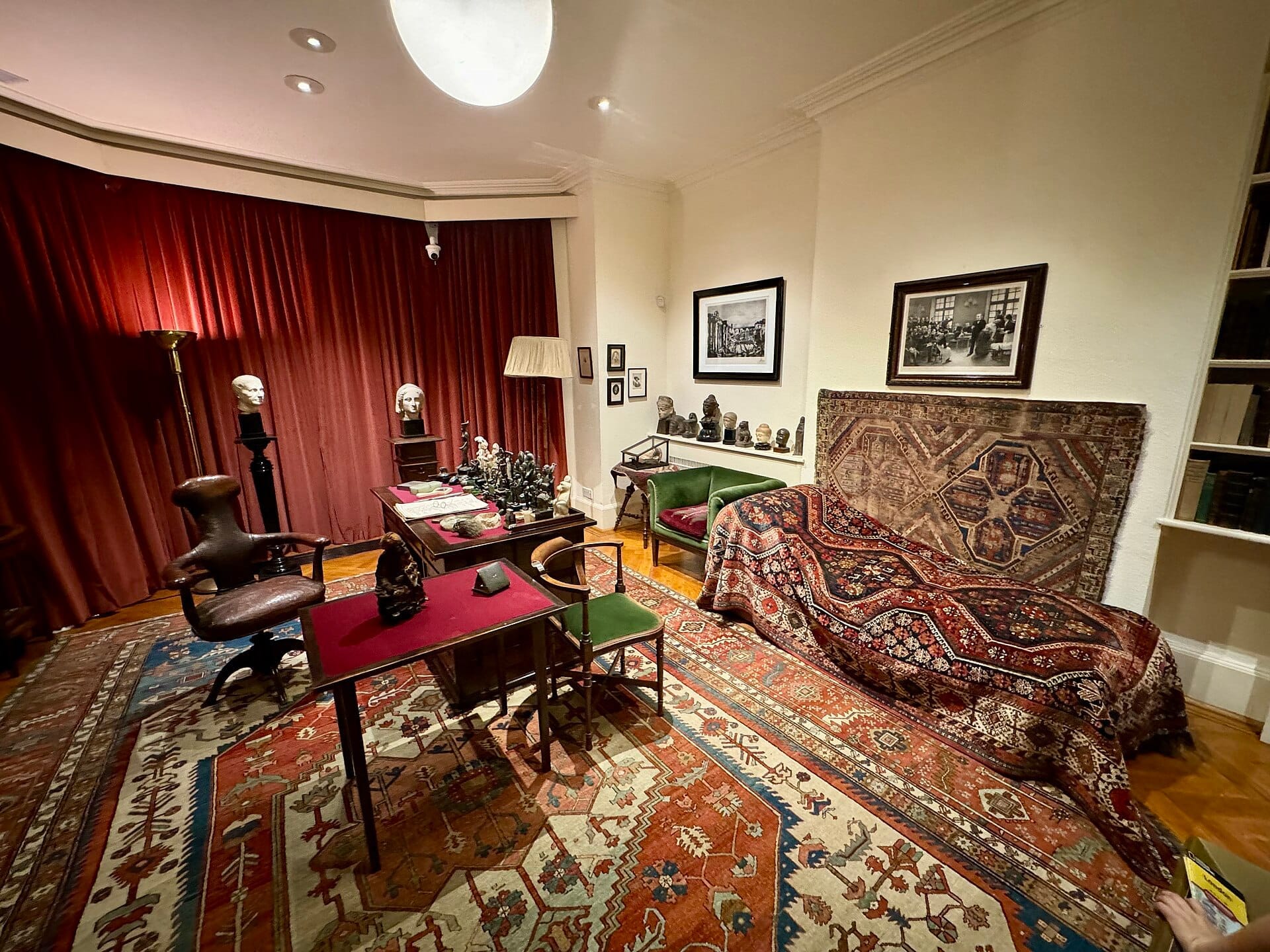
The centrepiece of the museum is Freud's study and consulting room on the ground floor, and it is arresting in a way that photographs do not fully capture. The room is dim, warm-toned, and dense. Every surface has something on it. The desk is covered in small figurines, Egyptian shabtis, Greek bronzes, Roman terracottas, Chinese jade objects. Freud worked surrounded by antiquity, and the collection reflects a lifelong obsession with archaeology as a metaphor for the excavation of the unconscious.
The couch occupies the far end of the room, covered in a Persian rug and bolstered cushions, positioned so that Freud, seated in his armchair at the head, would have been out of the direct line of sight of the patient lying on it. Standing next to it, the arrangement makes immediate, physical sense in a way that reading about it never quite does. The logic of the setup, the spatial relationship between analyst and patient, becomes obvious. It is the rare case where an object explains a theory better than any text.
The antiquities are not incidental decoration. Freud wrote extensively about archaeology and psychoanalysis as parallel disciplines, both concerned with uncovering buried layers of the past. The sheer number of objects in this one room, approximately 300 on the desk alone, communicates something about the scale of that obsession. Many items were gifts from patients and colleagues; others were acquired through dealers in Vienna, Athens, and Rome.
ℹ️ Good to know
Photography is permitted in the museum, but tripods and flash are not. The consulting room has limited natural light; phone cameras will struggle without steady hands. The exhibition handouts mention this but it is worth knowing in advance.
Tickets & tours
Hand-picked options from our booking partner. Prices are indicative; availability and final rates are confirmed when you complete your booking.
Soho Instagram a self-guided walking tour to top photo spots
From 6 €Instant confirmationFree cancellationTootbus London by Night: Bus tour
From 32 €Instant confirmationFree cancellationIFS Cloud Cable Car Ride and Uber Boat Hop-on Hop-off 1 Day Ticket
From 38 €Instant confirmationFree cancellationThe Making of Harry Potter Guided Tour of London Warner Bros. Studio
From 201 €Instant confirmationFree cancellation
Anna Freud's Floor and the Wider House
The first floor is quieter and receives fewer visitors than the ground floor consulting room, which means it often feels more contemplative. Anna Freud's work as a child psychoanalyst and her role in shaping developmental psychology are covered through documents, photographs, and personal objects. During the Second World War, she co-ran the Hampstead War Nurseries with Dorothy Burlingham, providing care for young children separated from their families, and her observations from that period informed influential writing on child development and trauma.
There is a care taken in how Anna's story is told here that resists reduction. She was not simply her father's assistant or secretary, a role she has sometimes been unfairly assigned in popular accounts. She was a significant intellectual figure in her own right, and the museum gives her the space to be read as one. Her bedroom and study have a plainer, more practical quality than her father's rooms downstairs, which itself says something.
Note that the first floor is not fully accessible to visitors with mobility difficulties. The museum offers exhibition handouts for those unable to climb the stairs, and disabled companion tickets are available free of charge. Contact the museum directly on +44 (0)20 7435 2002 if you have specific access requirements before your visit.
How the Visit Changes by Time of Day
The museum opens at 10:30, and arriving close to opening is worthwhile for a specific reason: the consulting room is small enough that even four or five other visitors changes its character significantly. In the first hour, you are more likely to have the room to yourself for at least a few minutes, which is when the quiet of it becomes most apparent. The house is silent in a way that larger museums are not, and that silence is part of the experience.
Weekend afternoons draw the largest numbers, particularly after 13:00. The museum never becomes overwhelmingly crowded in the way that major London institutions can, but the consulting room in particular has a fixed capacity feel to it, and a queue to stand near the couch can form on busy Saturdays. Midweek mornings, particularly Wednesday and Thursday, tend to be the calmest.
The garden, which is not always mentioned in standard guides, is accessible in warmer months and worth a few minutes. It is a proper domestic garden rather than a curated attraction, and the contrast between the quiet outside and the density of objects within the house underscores the strangeness of the place.
Getting There and the Surrounding Area
The museum sits in a residential street in Hampstead, one of north London's most intact Victorian and Edwardian neighbourhoods. The easiest approach by public transport is via Finchley Road station, served by the Metropolitan and Jubilee lines, which puts you roughly three minutes on foot from the front door. Finchley Road and Frognal Overground station is slightly further, around six minutes. Driving is not recommended: parking on Maresfield Gardens is restricted to residents Monday to Friday 9:00 to 18:30, though pay-and-display spaces are available at the south end of the street and on Nutley Terrace nearby. For more on navigating London's transport network, the getting around London guide covers Tube, Overground, and bus options in detail.
Hampstead village itself is ten to fifteen minutes on foot uphill from the museum. If you are combining the Freud Museum with a broader afternoon in north London, Hampstead Heath is a natural extension of the visit. The Heath's Parliament Hill has one of the better elevated views across the city, and the walk from the museum up through the village is pleasant if you have time.
Alternatively, Kenwood House on the northern edge of the Heath pairs well thematically as another significant house museum in the same part of London, though its focus is on Old Master paintings and Georgian architecture rather than intellectual history.
Is the Freud Museum Worth the Admission Price?
At £14.90 for adults, the Freud Museum is not cheap relative to London's many free institutions. Whether it is worth it depends on what you are bringing to the visit. If psychoanalysis, the history of ideas, or the period of European intellectual refugee culture in London mean something to you, then yes, unambiguously. The density of original material here, the fact that the objects on Freud's desk are the actual objects, not reproductions, not reconstructions, creates an encounter with intellectual history that is unusually direct.
If you are visiting primarily out of general curiosity or because it appears on a list, the experience may feel short for the price. The ground floor consulting room is the draw, and while it is exceptional, the entire visit can be completed in under 90 minutes. The museum has a reading room, a small shop, and occasional temporary exhibitions, but it does not have the depth of programming of larger institutions.
For visitors managing a tight budget across multiple London attractions, it is worth comparing the Freud Museum against the London Pass, which does not include the Freud Museum, or checking the free things to do in Londonguide if cost is a significant factor. The Freud Museum is one of the few smaller London house museums where paid admission reflects access to original primary material, but that caveat is worth understanding before you buy a ticket.
⚠️ What to skip
The museum is closed Monday and Tuesday. Under-12s enter free, but the experience is primarily text and object-based with limited interactivity for younger children. Families with primary school-age children may find the visit less engaging than anticipated.
Practical Details at a Glance
- Address: 20 Maresfield Gardens, London NW3 5SX
- Open Wednesday to Sunday, 10:30 to 17:00. Closed Monday and Tuesday.
- Adult admission £14.90 standard. Concessions £12.90. Ages 12–16: £9.00. Under 12s: free.
- Nearest Tube: Finchley Road (Metropolitan/Jubilee lines), approximately 3-minute walk.
- Nearest Overground: Finchley Road and Frognal, approximately 6-minute walk.
- Parking restricted on the street; pay-and-display available at south end of Maresfield Gardens and Nutley Terrace.
- Accessibility: First floor not fully accessible; handouts available; free disabled companion tickets available on request.
- Photography permitted without flash or tripods.
- No café on site; nearest options are along Finchley Road or up in Hampstead village.
Insider Tips
- Arrive at 10:30 when the museum opens. The consulting room is small, and having it to yourself for even ten minutes changes the experience entirely. It is one of the only rooms in London where you can stand next to an object that altered the course of Western thought.
- Pick up the free floor plan at the entrance and read the labels on the antiquities in the consulting room carefully. The selection of objects Freud chose to keep within arm's reach of his analytic work reveals his intellectual priorities more vividly than any biography.
- The temporary exhibition space on the ground floor changes regularly and often features contemporary artists responding to Freudian themes. It is easy to overlook in favour of the consulting room, but it frequently contains the most unexpected material in the building.
- The museum shop stocks a curated selection of psychoanalytic texts, art books, and unusual gifts. It is one of the better specialist bookshops in north London for its size, and worth browsing even if you are not buying.
- If you plan to visit Hampstead Heath the same day, wear comfortable walking shoes. The route from the museum up through Hampstead village involves a steep hill, but the streets themselves, Flask Walk in particular, are worth the climb.
Who Is Freud Museum London For?
- Readers and thinkers with an interest in the history of psychology or 20th-century intellectual history
- Architecture and interior design enthusiasts drawn to intact Edwardian domestic spaces
- Solo travellers who want a quiet, unhurried cultural experience away from major tourist crowds
- Visitors spending a full day in Hampstead, combining the museum with the Heath and the village
- Anyone interested in the refugee experience of European Jewish intellectuals in pre-war and wartime London
Nearby Attractions
Other things to see while in Hampstead & Highgate:
- Hampstead Heath
Hampstead Heath is a vast, ancient heathland rising above north London, offering panoramic skyline views, outdoor swimming ponds, old-growth woodland, and open grassland — all free to enter and roughly 30–45 minutes from central London. It is one of the few places in the city where you can lose yourself in landscape that feels uncurated and unhurried.
- Highgate Cemetery
Opened in 1839 as one of London's 'Magnificent Seven' cemeteries, Highgate Cemetery combines Gothic Victorian architecture, overgrown woodland, and the graves of some of history's most recognisable figures. The East Cemetery is open to independent visitors; the wilder West Cemetery requires a guided tour booked in advance.
- Kenwood House
Kenwood House is a beautifully restored neo-classical villa sitting on the northern edge of Hampstead Heath, housing one of London's finest free art collections. From Rembrandt self-portraits to sweeping landscaped grounds, it rewards visitors looking for culture without crowds or cost.