Higashi Hongan-ji Temple: Kyoto's Monumental Free Attraction Near the Station
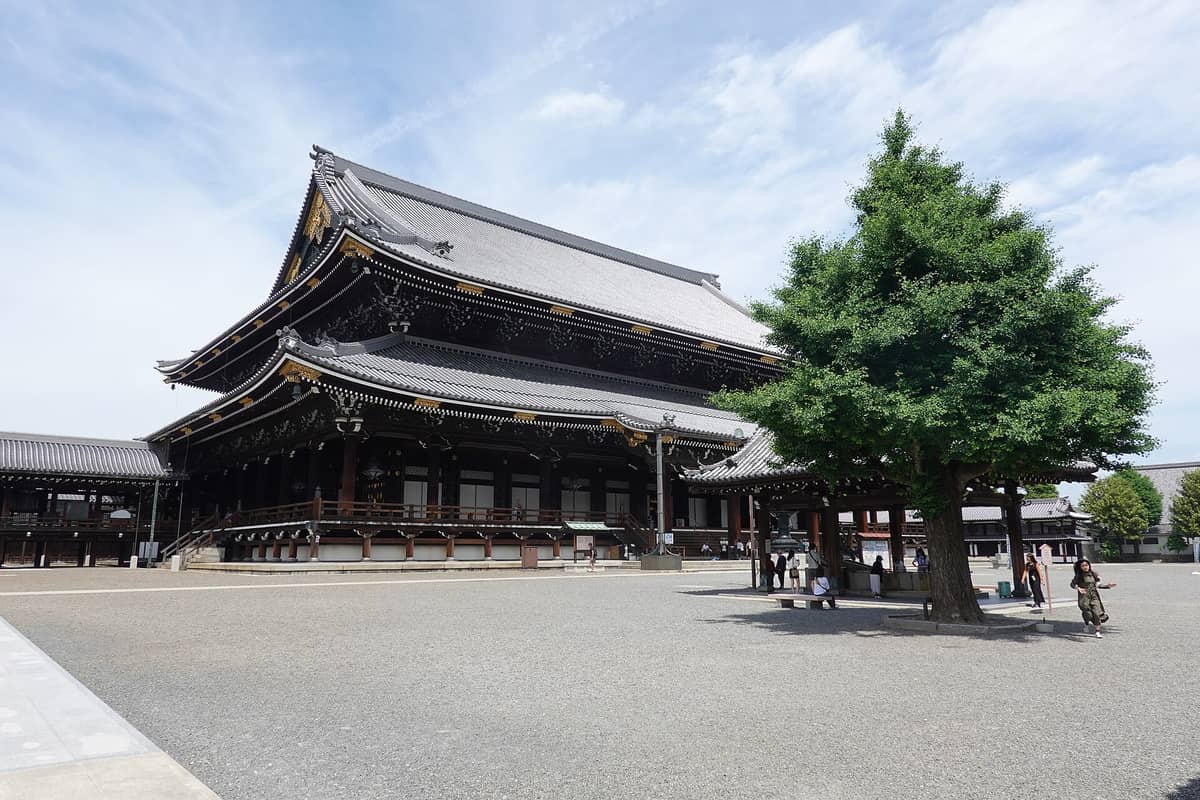
Higashi Hongan-ji is the head temple of the Shinshū Ōtani-ha Buddhist sect and home to the Miei-dō, the Founder's Hall widely recognized as one of the largest wooden structures on earth. Located a short walk from Kyoto Station, it costs nothing to enter and operates almost year-round, making it one of the most accessible major temples in the city.
Quick Facts
- Location
- Karasuma Shichi-jō, Shimogyō-ku, Kyoto — Kyoto Station Area
- Getting There
- 7 min walk from JR Kyoto Station along Karasuma-dori; city buses stop nearby
- Time Needed
- 45–90 minutes for the main grounds; add 30 min if visiting Shosei-en Garden
- Cost
- Main grounds: Free. Shosei-en Garden: cooperation donation requested (from 500 yen adults, from 250 yen students)
- Best for
- First-time Kyoto visitors, architecture enthusiasts, budget travelers, early morning walkers
- Official website
- english.higashihonganji.or.jp
What Higashi Hongan-ji Actually Is
Higashi Hongan-ji Temple — officially the Head Temple of the Shinshū Ōtani-ha sect of Jōdo Shinshū Buddhism — is not a quaint hillside shrine or a garden retreat. It is a compound of monumental scale, built to express the institutional weight of one of Japan's largest Buddhist denominations. The name translates roughly as 'Eastern Temple of the Original Vow,' distinguishing it from its twin, Nishi Hongan-ji, located a few blocks to the west.
The temple was established in 1602 when Shogun Tokugawa Ieyasu ordered the division of the Honganji, creating a separate eastern branch and reducing the political power of the unified institution. What emerged was not a modest offshoot but a full rival headquarters, rebuilt repeatedly after fires and eventually reaching its current form. The Miei-dō, or Founder's Hall, which enshrines an image of Shinran (the 13th-century founder of Jōdo Shinshū), is widely described as one of the largest wooden buildings in the world. That is not hyperbole for a travel brochure; the hall's dimensions are genuinely difficult to take in from ground level.
ℹ️ Good to know
Opening hours shift seasonally: March–October, 05:50–17:30. November–February, 06:20–16:30. The temple opens every day of the year with no regular closure days.
The Walk In: Arriving from Kyoto Station
The approach from Kyoto Station takes about seven to ten minutes on foot heading north along Karasuma-dori, one of the city's main north-south avenues. As you walk, Kyoto Tower recedes behind you and the temple's rooflines begin to appear above the surrounding low-rise blocks — first the curve of the Amida-dō roof, then the steeper pitch of the Miei-dō beyond it. The contrast between this workaday urban street and the scale of what emerges is part of the experience.
The main gate opens onto a wide gravel forecourt. There are no ticket booths, no wristbands, no queues. You simply enter. The ground underfoot shifts from pavement to raked gravel, and the ambient city noise drops noticeably once you pass through the outer gates. In the early morning — particularly before 8:00 — the compound is largely occupied by worshippers rather than tourists, and the contrast with the crowds at major paid-entry temples nearby is striking.
If you are arriving in Kyoto by shinkansen and want to ease into the city before heading to more visited sites, Higashi Hongan-ji makes an excellent first stop. For more on navigating Kyoto's transit network, seegetting around Kyoto.
Tickets & tours
Hand-picked options from our booking partner. Prices are indicative; availability and final rates are confirmed when you complete your booking.
Kyoto Coast, Amanohashidate and Ine Bay 1-Day Trip from Osaka or Kyoto
From 46 €Instant confirmationFree cancellationKyoto Sanzen-in, Arashiyama and Bamboo Grove Full Day Tour
From 47 €Instant confirmationFree cancellationKyoto Arashiyama insider walking tour
From 66 €Instant confirmationFree cancellationMatcha green tea tour in Kyoto's Uji Market
From 130 €Instant confirmationFree cancellation
Inside the Compound: Scale, Silence, and Detail
The Miei-dō (Founder's Hall)
The Miei-dō is the larger of the two main halls, and its size registers differently depending on where you stand. From the forecourt, you see a vast expanse of dark-tiled roof, the ridge far above street level. Walking closer, the wooden columns of the veranda are thick enough that two people cannot reach around them. The hall is open for worship and visitors may enter the interior, removing shoes at the entrance. Inside, the air carries incense — low and woody rather than sharp — and the floor is cool underside regardless of the season. The lacquered altar complex at the far end is elaborate, all gold leaf and carved wood, illuminated by hanging lanterns.
The structure has been rebuilt several times, most recently in the Meiji period (completed 1895) after fire damage.
The Amida-dō (Amida Hall)
The smaller but still imposing Amida-dō stands adjacent to the Miei-dō, housing an image of Amida Buddha. Architecturally it is similar in style — heavy tiled roof, deep eaves, subdued color palette dominated by weathered wood and dark lacquer — but its interior is slightly more intimate. Worshippers often move between the two halls as part of morning services, and if you visit around sunrise, you may hear sutra chanting from within while mist clings to the courtyard between the buildings.
How the Experience Changes by Time of Day
Early morning, before 8:00, is the most atmospheric time to visit. The light is low and directional, catching the bronze hardware on the gates and the texture of the wooden columns. Incense burns inside during morning services and the smell drifts across the forecourt. The gravel is freshly raked in sections, and the sound of ritual bells carries across the otherwise quiet compound. The temperature inside the halls is noticeably cool even in summer, which makes this a practical refuge during Kyoto's humid mornings.
Midday brings a different character. The compound fills with visitors cutting through on foot, school groups, and tourists who have combined this with a walk from the station. The buildings still impress at any hour, but the sense of active religious life fades. By contrast, late afternoon in autumn and winter, when the low sun catches the roof tiles at a raking angle and the crowds thin out after 16:00, is worth timing a visit around if your schedule allows.
💡 Local tip
Photography of the exterior is unrestricted on the grounds. Interior photography policies can vary and may not be well-signed; watch what other visitors do or ask staff if uncertain.
Shosei-en Garden: The Quieter Extension
About five minutes' walk east of the main compound lies Shosei-en, a traditional strolling garden associated with Higashi Hongan-ji. It is a separate enclosure with its own gate, shorter visiting hours, and a cooperation donation (from 500 yen for adults, from 250 yen for students under high school age). The garden centers on a large pond and is planted for seasonal interest, though it receives far fewer visitors than the temple proper and offers a genuinely different experience — contained, green, and quiet.
The garden's autumn foliage is underrated by comparison with famous spots like Eikan-do or Tofuku-ji, which means you can enjoy the red and orange reflections in the pond without shoulder-to-shoulder crowds. It is a reasonable 30-minute add-on if you have time, though not a destination in itself.
Visitors specifically chasing autumn color across the city can find a broader seasonal overview in the guide toKyoto in autumn.
Practical Details: Getting There, Accessibility, and What to Bring
The main temple grounds are flat, wide, and paved or gravel-surfaced throughout. The walk from Kyoto Station follows level pavements. If you require step-free access to specific interior halls or have particular mobility needs, confirm in advance by contacting the temple office directly (+81-75-371-9181).
There is no strict dress code enforced at the gate, but as an active place of worship, modest clothing is appropriate. The gravel courtyard can be uneven enough to make high heels impractical. In summer, the open forecourt offers little shade; a hat and water are sensible. In winter, the interior halls are unheated and significantly colder than outside, so layering matters.
The temple sits in the Kyoto Station area, making it easy to combine with other nearby sites or as a first or last stop on a longer day. It is also worth knowing thatNishi Hongan-ji, the western counterpart and a UNESCO World Heritage site, is walkable from here in under ten minutes.
Who This Is Not For
Higashi Hongan-ji is not a garden temple and it is not set in a scenic natural landscape. If your primary interest is moss, maple canopies, mountain paths, or scenic ponds, this is not the right stop. The compound is urban, open, and largely paved — impressive for its architecture and religious significance, less so for its natural surroundings.
Similarly, visitors looking for interactive cultural experiences — tea ceremony rooms, craft demonstrations, multilingual exhibits on Buddhism — will find limited programming here compared to some temples that have invested in visitor interpretation. The experience is largely self-guided and relies on your willingness to observe and absorb without narration. There is minimal English signage beyond basic orientation.
If you want a more curated temple experience with strong visitor infrastructure, considerKinkaku-ji or Kiyomizu-dera— both heavily visited but with more interpretive support. For a broader look at where Higashi Hongan-ji fits in Kyoto's temple landscape, thebest temples in Kyoto guide covers the full range.
Insider Tips
- The ke-zuna (hair ropes) used in the Meiji-era reconstruction are displayed in a covered case near the entrance between the two main halls. They are easy to walk past without noticing, but up close they are one of the most striking objects on the entire compound.
- The Miei-dō is technically open for interior visits, but the hall sometimes closes temporarily during religious ceremonies. If the doors are shut when you arrive, wait 10–15 minutes and check again before assuming it is fully closed for the day.
- Visiting on a weekday morning before a major holiday almost always means a noticeably emptier compound than on weekends, even though the temple is rarely overcrowded by Kyoto standards.
- The view north along Karasuma-dori with both main rooflines visible is one of the more underused photography angles near Kyoto Station. Position yourself at the edge of the forecourt rather than directly in front of either hall to get both buildings in frame with depth.
- Shosei-en Garden opens at 09:00, so you can visit the main temple at dawn, have breakfast nearby, and then enter the garden when it opens — a logical sequence that gets the most out of both sites with minimal backtracking.
Who Is Higashi Hongan-ji Temple For?
- First-time visitors to Kyoto who want an immediate sense of traditional scale and architecture within walking distance of their arriving train
- Budget-conscious travelers: the main grounds are free, making this one of Kyoto's most impressive no-cost experiences
- Architecture and religious history enthusiasts drawn to monumental wooden construction and living Buddhist practice
- Early risers and photographers who want atmospheric morning light and active worship rituals without paid-entry crowds
- Travelers with limited mobility, as the flat, wide grounds are among the most accessible of any major temple in Kyoto
Nearby Attractions
Other things to see while in Kyoto Station Area:
- Kyoto Aquarium
Tucked inside Umekoji Park, a short walk from Kyoto Station, Kyoto Aquarium is a fully indoor attraction built around regional aquatic life, dolphin performances, and one of Japan's most unusual residents: the giant salamander. It's a reliable rainy-day option and a strong choice for families, though adult travelers visiting solo may find the experience skews young.
- Kyoto Railway Museum
The Kyoto Railway Museum is one of Japan's largest and most comprehensive rail museums, housing 53 historic vehicles across a sprawling indoor-outdoor complex near Kyoto Station. From Meiji-era steam locomotives to original Shinkansen cars, it rewards curious visitors of any age with well-designed exhibits, working demonstrations, and one of the best rooftop views of the surrounding area.
- Kyoto Tower
Rising 131 meters directly above Kyoto Station, Nidec Kyoto Tower offers one of the city's most accessible panoramic viewpoints. The observation deck delivers a sweeping 360-degree view over the low-rise temple cityscape, and the entire visit takes under an hour, making it a practical add-on to any day in the area.
- Nishi Hongan-ji Temple
Nishi Hongan-ji is one of Kyoto's most architecturally significant Buddhist temples and a UNESCO World Heritage Site, located minutes from Kyoto Station. Entry is free, the scale is extraordinary, and crowds are a fraction of what you'll find at more famous temples across the city.