Kyoto Tower (Nidec Kyoto Tower): What to Expect at Kyoto's Tallest Structure
Rising 131 meters directly above Kyoto Station, Nidec Kyoto Tower offers one of the city's most accessible panoramic viewpoints. The observation deck delivers a sweeping 360-degree view over the low-rise temple cityscape, and the entire visit takes under an hour, making it a practical add-on to any day in the area.
Quick Facts
- Location
- 721-1 Higashishiokojicho, Karasuma-dori Shichijo-sagaru, Shimogyo-ku, Kyoto (directly across from Kyoto Station)
- Getting There
- JR Kyoto Station Karasuma Central Gate, approximately 2-minute walk
- Time Needed
- 30–60 minutes
- Cost
- ¥900 adults / ¥700 high school / ¥600 junior high and elementary / ¥200 infants under 6
- Best for
- City orientation, evening views, families with children, first-time Kyoto visitors
- Official website
- www.kyoto-tower.jp/en
What Kyoto Tower Actually Is
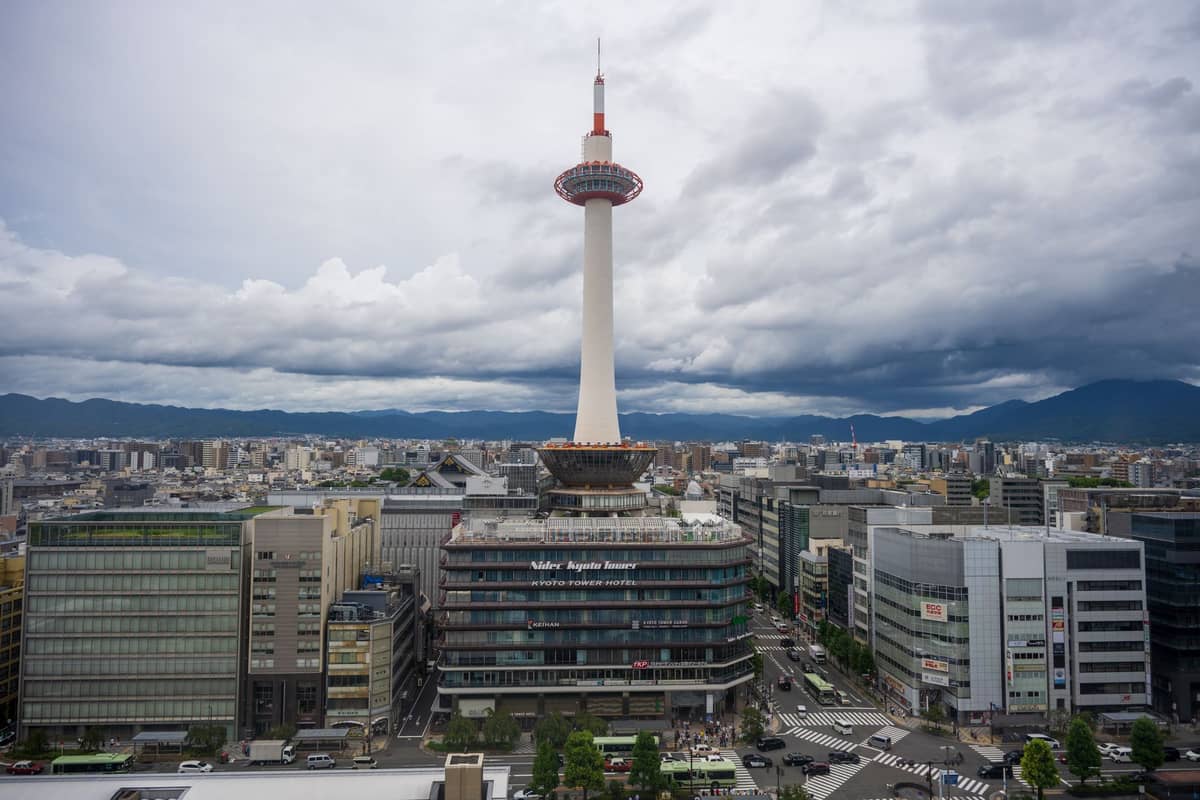
Nidec Kyoto Tower, formally known as Kyoto Tower or 京都タワー, is a 131-meter observation tower completed in December 1964, built on top of a low-rise hotel-and-retail base directly across from Kyoto Station's main entrance. It is the tallest structure in Kyoto. The design, which resembles a lighthouse candle, was intentionally secular and modern, which made it controversial at the time in a city defined by historic temples and low skylines. Today it remains the most conspicuous landmark in the station area, visible from several kilometers away and useful as a navigational anchor.
The tower is not a cultural monument in the way that Kiyomizu-dera or Fushimi Inari Taisha are. It doesn't tell Kyoto's story as a historic city. What it does offer is altitude: a clear, unobstructed platform from which to look out over a city that otherwise keeps its horizons low. Because Kyoto enforces strict building height limits to protect its historic character, the view from the top is genuinely wide and flat, a sea of terracotta tile rooftops broken only by forested hills and the occasional pagoda silhouette.
ℹ️ Good to know
Opening hours: 10:00–21:00 daily, with last admission at 20:30. Note that on August 16, hours are shortened to 10:00–18:30 (last entry 18:00). Verify current hours at kyoto-tower.jp/en before your visit, as schedules can change.
The View and What You Can See
The observation deck sits high enough to clear every surrounding building, giving a full 360-degree panorama. To the north, on clear days, you can trace the Higashiyama mountain ridge that edges the eastern side of the city, the same hills that shelter Kiyomizu-dera and the temple corridors of Higashiyama. Further north, the forested slopes of the Kitayama mountains roll into the distance. To the south, the urban grid fans out flat and dense toward Fushimi and Osaka.
Looking west, the low roofline of central Kyoto stretches toward Nijo Castle and the Nishijin textile district. The overall impression is how horizontal the city is compared to almost every other major Japanese urban center. There are no skyscraper clusters, no elevated expressway tangles close to the center. That restraint is intentional, and seeing it from above makes Kyoto's planning philosophy legible in a way that walking the streets does not. If you're using the tower as orientation before exploring neighborhoods likeHigashiyama or Gion, the bird's-eye view helps you understand how those areas relate to each other geographically.
The deck has telescopes available for close-up looks at specific landmarks. On hazy days, which are common in summer, the mountain ridges blur out and the view loses some of its depth. In winter, cold air sharpens visibility dramatically, and on dry, clear winter days, distant landmarks like the pagoda at To-ji Temple are crisp and well-defined. Autumn afternoons, especially in late November, offer the best combination of clarity and golden light.
Tickets & tours
Hand-picked options from our booking partner. Prices are indicative; availability and final rates are confirmed when you complete your booking.
Kyoto Coast, Amanohashidate and Ine Bay 1-Day Trip from Osaka or Kyoto
From 46 €Instant confirmationFree cancellationKyoto Sanzen-in, Arashiyama and Bamboo Grove Full Day Tour
From 47 €Instant confirmationFree cancellationKyoto Arashiyama insider walking tour
From 66 €Instant confirmationFree cancellationMatcha green tea tour in Kyoto's Uji Market
From 130 €Instant confirmationFree cancellation
How the Experience Changes by Time of Day
Morning visits (10:00–11:00, as soon as the tower opens) are generally the least crowded. The light comes from the east at this hour, which means the Higashiyama hills are partially backlit and the western side of the city is brightly lit. It's a good time to appreciate the urban grid clearly, and you'll have the viewing windows mostly to yourself on weekdays.
Midday on weekends, particularly during spring cherry blossom season and autumn foliage season, is the peak crowd window. The deck isn't enormous, and with tour groups cycling through, the atmosphere can feel rushed. Weekday afternoons are significantly more relaxed.
Evening is the most photogenic time. Kyoto's low roofscape catches the sunset light differently than a high-rise skyline would: the terracotta tiles shift through amber and pink, and temple roofs catch the last rays with surprising warmth. After dark, the city lights spread evenly in all directions without dramatic towers to anchor the view, which makes the nighttime panorama feel quieter and more contemplative than a typical urban night view. The illuminated To-ji pagoda to the southwest is a reliable focal point after dark.
💡 Local tip
For the clearest views, visit in winter on a dry, sunny day. For the best light, aim for the hour before sunset. Evening visits (after 18:00) tend to draw smaller crowds than the midday window, even on weekends.
Getting There and Practical Logistics
The tower's single greatest advantage is its location. The entrance is approximately a 2-minute walk from JR Kyoto Station's Central Exit, making it the most accessible elevated viewpoint in the city. You don't need to plan any additional transit, and it fits naturally into the beginning or end of a Kyoto day. Visitors arriving from Kansai International Airport on the JR Haruka limited express train will step out of Kyoto Station and see the tower directly in front of them.
For anyone spending time in the Kyoto Station area, the tower pairs well with a visit to the nearbyNishi Hongan-ji or Higashi Hongan-ji, both of which are within walking distance and free to enter.
The building that the tower sits on contains shops and restaurants on the lower floors, including a food hall with Kyoto-style snacks and bento boxes. It's worth noting that the queues for the elevator to the observation deck can extend into the lobby during peak season; weekday afternoons outside of March–May and October–November rarely see meaningful waits.
Accessibility: the observation deck is wheelchair accessible via ramps and a stair lift. The main elevator from the ground level is spacious enough for wheelchairs. This makes Nidec Kyoto Tower one of the more accessible viewpoints in the city, compared to hillside alternatives that involve uneven stone paths or stairs.
Photography Notes
The observation deck has large glass windows rather than an open-air platform. Shooting through glass introduces reflections, particularly in bright conditions. To minimize this, press your lens directly against the glass and cup your hand around it to block ambient light. A polarizing filter helps, but pressing close to the glass is the simplest fix and works well enough for smartphone cameras.
Wide-angle lenses capture the full panoramic sweep, but the most interesting Kyoto-specific shots often come from isolating the contrast between the modern station plaza below and the traditional rooftops beyond it. The To-ji pagoda to the southwest, the Higashiyama ridgeline to the east, and the tile-roofed blocks of central Kyoto offer more distinctive images than the generic city-grid shots that most visitors default to.
⚠️ What to skip
Shooting through glass at night: interior lighting on the deck reflects on the windows and washes out the view. Turn off your phone's flash entirely and keep the lens pressed directly against the glass for cleaner night shots.
An Honest Assessment: Is It Worth It?
Kyoto Tower is not the most dramatic observation deck in Japan, and it's nowhere near the most culturally significant stop in Kyoto. The ¥900 admission is reasonable for what you get: a clear, spacious view platform with a genuine panorama over a city that genuinely looks unusual from above. The experience is clean, efficient, and quick, which makes it a good choice for travelers who want context before diving into the city's historic neighborhoods.
For visitors with limited time who have to choose between the tower and a second temple, the temple will nearly always deliver more. But for first-time visitors to Kyoto who want a geographic overview, or for families with children who enjoy the thrill of height, the tower earns its entry fee. It's also one of the very few elevated viewpoints where you can see Kyoto's temple-dense skyline without being embedded in it. The view fromDaimonji-yamais free and arguably more rewarding, but it requires a 45-minute uphill hike. The tower trades the effort for convenience.
Those who find observation decks in general underwhelming, or who have already visited similar platforms in Tokyo or Osaka, are unlikely to feel this one adds much. Seasoned Japan travelers on repeat visits to Kyoto will probably skip it without regret. But if it's your first time in the city and you arrive at Kyoto Station on a clear afternoon, going up for 30 minutes before your hotel check-in is a low-risk, high-payoff decision.
For more context on planning your first days, the Kyoto first-timer guidecovers how to orient yourself across the city's different neighborhoods and prioritize your time.
Insider Tips
- Visit on a weekday morning when the tower opens at 10:00 for minimal crowds and clean eastward light over the Higashiyama hills.
- The lobby-level basement of the tower building connects directly to Kyoto Station's underground shopping concourse, which means you can descend the tower and be at your train platform within five minutes in bad weather without going outside.
- If skies are hazy (common in summer), check visibility before paying: look from street level and see if you can clearly make out the Higashiyama ridge. If the hills look washed out from 131 meters below, the view from the top will be similarly flat.
- The tower's exterior is illuminated at night in different colors for seasonal events and national observances. Viewing it from the Kyoto Station rooftop terrace (free access) or from Karasuma Street gives a better sense of the tower's iconic silhouette than looking out from inside it.
- Combine the tower visit with the Nishi Hongan-ji or Higashi Hongan-ji temples nearby, both of which are free to enter and within a 10-minute walk. This turns a quick 30-minute tower stop into a half-day loop around the station neighborhood.
Who Is Kyoto Tower For?
- First-time visitors to Kyoto wanting a geographic overview of the city before exploring
- Families with younger children who enjoy observation decks and need a quick, easy activity near the station
- Photographers looking for a wide panorama of Kyoto's low, temple-studded roofscape at golden hour or after dark
- Travelers with a layover or late afternoon arrival who want to fill an hour near Kyoto Station
- Wheelchair users or visitors with limited mobility who want an elevated city view without stairs or uneven terrain
Nearby Attractions
Other things to see while in Kyoto Station Area:
- Higashi Hongan-ji Temple
Higashi Hongan-ji is the head temple of the Shinshū Ōtani-ha Buddhist sect and home to the Miei-dō, the Founder's Hall widely recognized as one of the largest wooden structures on earth. Located a short walk from Kyoto Station, it costs nothing to enter and operates almost year-round, making it one of the most accessible major temples in the city.
- Kyoto Aquarium
Tucked inside Umekoji Park, a short walk from Kyoto Station, Kyoto Aquarium is a fully indoor attraction built around regional aquatic life, dolphin performances, and one of Japan's most unusual residents: the giant salamander. It's a reliable rainy-day option and a strong choice for families, though adult travelers visiting solo may find the experience skews young.
- Kyoto Railway Museum
The Kyoto Railway Museum is one of Japan's largest and most comprehensive rail museums, housing 53 historic vehicles across a sprawling indoor-outdoor complex near Kyoto Station. From Meiji-era steam locomotives to original Shinkansen cars, it rewards curious visitors of any age with well-designed exhibits, working demonstrations, and one of the best rooftop views of the surrounding area.
- Nishi Hongan-ji Temple
Nishi Hongan-ji is one of Kyoto's most architecturally significant Buddhist temples and a UNESCO World Heritage Site, located minutes from Kyoto Station. Entry is free, the scale is extraordinary, and crowds are a fraction of what you'll find at more famous temples across the city.