Nishi Hongan-ji Temple: Kyoto's Grand Buddhist Headquarters Worth Every Minute
Nishi Hongan-ji is one of Kyoto's most architecturally significant Buddhist temples and a UNESCO World Heritage Site, located minutes from Kyoto Station. Entry is free, the scale is extraordinary, and crowds are a fraction of what you'll find at more famous temples across the city.
Quick Facts
- Location
- Horikawa-dori, Shimogyo-ku, Kyoto (Kyoto Station Area)
- Getting There
- Kyoto Station (10–15 min walk west) or city bus to Nishi Hongan-ji-mae stop
- Time Needed
- 45–90 minutes
- Cost
- Free admission to grounds
- Best for
- Architecture, Buddhist culture, photography, and visitors seeking calm near Kyoto Station
- Official website
- www.hongwanji.kyoto/en
What Is Nishi Hongan-ji?
Nishi Hongan-ji Temple, formally known as Hongwanji (西本願寺), is the head temple of the Jodo Shinshu Hongwanji-shu school of Buddhism, one of the largest Buddhist denominations in Japan. It sits in the Shimogyo ward of Kyoto, less than a kilometer northwest of Kyoto Station, and has been designated a UNESCO World Heritage Site as part of the "Historic Monuments of Ancient Kyoto" group.
Unlike many of Kyoto's celebrated temples, Nishi Hongan-ji is not primarily a tourist monument. It is a working religious headquarters with resident priests, daily rituals, and pilgrim worshippers who travel from across Japan. That distinction shapes everything about the experience: the atmosphere is more devotional than performative, and the architecture is preserved with serious institutional care rather than staged for visitors.
💡 Local tip
Admission is free and no reservation is required for the main grounds. Arrive within the first hour of opening to catch morning chanting echoing from the Founder's Hall, the most atmospheric time of day.
The Architecture: Why This Temple Stands Apart
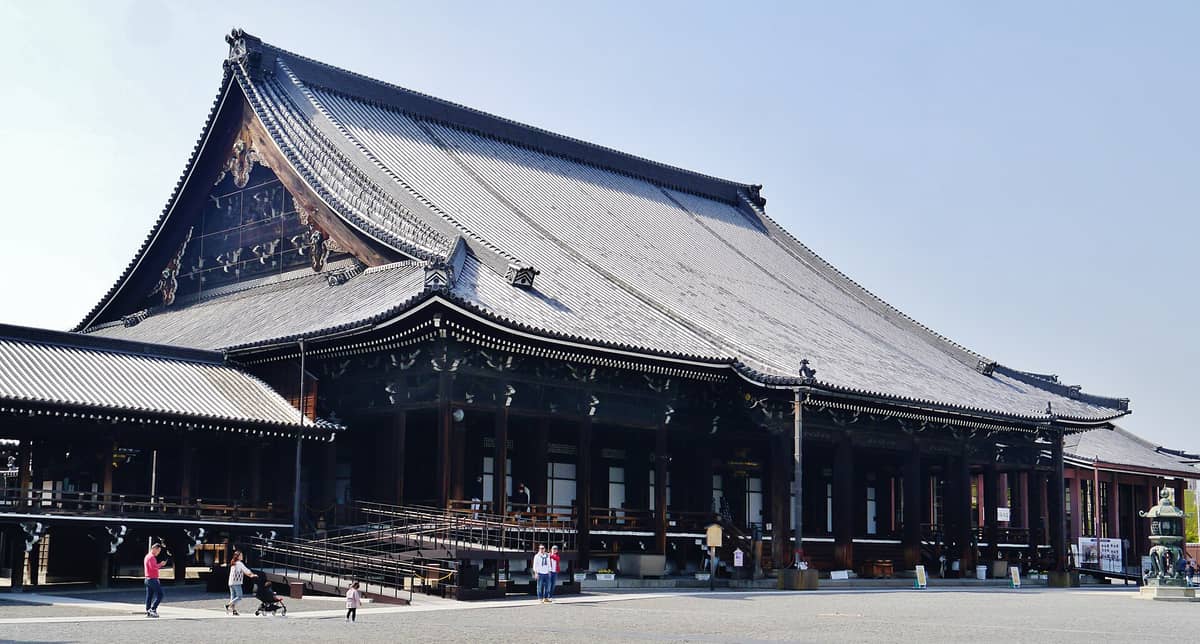
The two principal structures on the grounds are the Goei-do (Founder's Hall) and the Amida-do (Amida Hall). The Goei-do is one of the largest wooden structures in Japan, a claim that stops being abstract once you are standing in front of it. The roof lines sweep outward with a controlled drama that took centuries of temple carpentry tradition to refine. The proportions are deliberately human-scale at the entrance, then overwhelm you as you approach the main doors.
The Karamon gate, a designated National Treasure, is a small but intricately carved structure whose nickname translates loosely as "the gate you could stare at all day and forget to leave." Its woodwork features cranes, peonies, and Chinese lions worked into every surface, achieving density without chaos. Natural light in the morning makes the carvings read most clearly, as the low-angle sun catches the relief without washing it out.
Two celebrated Noh theater stages are also on the grounds, brought from Fushimi Castle in the early 17th century. Access to interior spaces is sometimes restricted or requires advance arrangement through the temple office; the official website provides current access guidelines. Do not assume all areas are open on any given visit.
Tickets & tours
Hand-picked options from our booking partner. Prices are indicative; availability and final rates are confirmed when you complete your booking.
Nishiki Market breakfast walking food tour
From 32 €Instant confirmationFree cancellationFood tour in Kyoto Nishiki Market
From 130 €Instant confirmationFree cancellationKyoto Walking Tour and Shopping at Nishiki Market
From 76 €Instant confirmationFree cancellationKyoto Coast, Amanohashidate and Ine Bay 1-Day Trip from Osaka or Kyoto
From 46 €Instant confirmationFree cancellation
How the Temple Feels at Different Times of Day
Early morning, roughly between 6:00 and 8:00, is categorically the best time to visit. The grounds carry the smell of incense from morning rituals, the flagstones are cool underfoot, and the Goei-do occasionally fills with the low resonance of sutra chanting audible from outside. Pigeons scatter across the wide gravel courtyard. The few visitors present at this hour tend to be pilgrims or locals, not tour groups.
By 10:00, school groups and organized tours begin to arrive, but the grounds are large enough that congestion rarely becomes uncomfortable. Midday in summer is genuinely hot: the open courtyard between the two main halls offers almost no shade, and temperatures regularly exceed 32°C in July and August. Bring water, or buy some from the vending machines just outside the grounds before entering.
Late afternoon light, particularly in autumn, turns the curved rooflines golden and softens the stone courtyard. The crowd thins after 15:00 on most days. Closing time varies by season: 17:00 from January through February and again in November and December, 17:30 in March, April, September, and October, and 18:00 from May through August. Arriving 90 minutes before closing gives adequate time without rushing.
Historical and Cultural Context
Jodo Shinshu, the school of Buddhism centered here, was founded by the monk Shinran in the 13th century and teaches that salvation is accessible to all people through faith rather than monastic practice alone. This democratic theology gave the school an enormous popular following and considerable political influence over the centuries.
The split between Nishi (West) Hongan-ji and Higashi (East) Hongan-ji, located roughly 15 minutes walk to the northeast, dates to the early Edo period when the ruling Tokugawa shogunate deliberately divided the powerful temple to reduce its institutional influence. The two temples now operate independently, each maintaining its own administrative structure and distinct character. Higashi Hongan-ji is also free to enter and worth comparing architecturally, though its main halls are managed differently.
Nishi Hongan-ji's current buildings date largely from the late 16th and early 17th centuries, incorporating structures moved from Fushimi Castle after Toyotomi Hideyoshi's death. The Karamon gate and the Noh stages are key examples of this transfer, making the temple an indirect archive of Momoyama-period castle culture as well as Buddhist architecture.
Getting There and Getting Around the Grounds
The temple is a straightforward walk from Kyoto Station: exit via the central or Karasuma exit, head north along Horikawa-dori or take a city bus to the Nishi Hongan-ji-mae stop. The walk takes about 12–15 minutes at a comfortable pace and passes through an ordinary residential and commercial neighborhood, not a scenic approach. Those carrying heavy luggage should take the bus.
Once inside the main gate, the layout is relatively straightforward. The Goei-do and Amida-do face each other across the main courtyard. The Karamon gate is set to the south of the complex, reachable by walking around the main buildings. Signage in English is available but sparse in some sections; picking up a free map from the reception area near the main entrance is worth the 30 seconds it takes.
ℹ️ Good to know
Shoes must be removed before entering the main halls when interior access is available. Wear footwear that is easy to slip on and off. The interiors have wooden floors that can be cold in winter, so a second layer of socks is practical from November through February.
Photography Notes and Practical Details
The courtyard is open to photography. Interior photography rules vary by area and can change seasonally; follow posted signs and err on the side of asking before pointing a camera inside a hall. The Goei-do's facade photographs best from the southeast corner of the courtyard in morning light, where the depth of the roof overhangs reads clearly against the sky.
The scale of the Goei-do makes wide-angle lenses more useful than telephoto for architectural shots. The Karamon is small enough to capture with a standard lens but requires patience to frame without other visitors in frame, as its position near a secondary gate means foot traffic is concentrated.
For context on how this temple fits into a broader itinerary, see theguide to Kyoto's best temples and consider pairing it with a visit to To-ji Temple, a 20-minute walk south, which has a striking five-story pagoda and a weekend flea market on its grounds.
Who Should and Should Not Prioritize This Temple
Nishi Hongan-ji rewards visitors with an interest in architectural history, Buddhist culture, or simply scale. The two main halls are genuinely impressive in a way that is hard to convey in photographs, and the free admission removes any pressure to justify the visit. First-time visitors to Kyoto on a tight schedule should consider whether this fits before automatically assuming it belongs on the itinerary.
If your interest is primarily in scenic garden landscapes or forested hillside settings, other temples will serve you better.Ryoan-ji offers the most famous dry garden in Japan, while Kiyomizu-deradelivers the hillside views and wooden stage architecture that appear in nearly every Kyoto travel image. Nishi Hongan-ji's setting is urban and flat, with no garden views to speak of.
Visitors with limited mobility will find the main courtyard and exterior areas largely accessible on flat ground, though the interior halls involve steps and the removal of footwear. Confirm current access details directly with the temple before visiting, as the official sources reviewed do not specify wheelchair provisions.
⚠️ What to skip
Some interior spaces and subsidiary buildings are not open to the public without advance arrangement through the temple office, and access conditions can change seasonally. Do not plan a visit around seeing specific interior areas without confirming in advance via the official website.
Insider Tips
- The morning sutra chanting services in the Goei-do are open to observers and typically begin around 6:00–7:00. Standing quietly near the entrance of the hall offers one of the most genuinely atmospheric experiences available at any Kyoto temple, and it costs nothing.
- The temple grounds are popular with local residents for a quiet morning walk. Arriving before 8:00 on a weekday places you alongside a completely different crowd than the midday tourist flow.
- Nishi Hongan-ji and Higashi Hongan-ji together form a natural pairing that most visitors skip in favor of the more photographed northern or eastern temples. Visiting both in a single morning, starting at Nishi and walking northeast to Higashi, takes roughly two to three hours total and provides an unusually direct comparison of Jodo Shinshu temple architecture.
- The ginkgo trees on the grounds turn vivid yellow in mid-to-late November. This is less well-known than autumn foliage spots in the northern or eastern parts of the city, which means the grounds remain relatively calm even during peak autumn color season.
- The Karamon gate is sometimes partially obscured by scaffolding during conservation work. Check the official website for current restoration status if you are visiting specifically to see this structure.
Who Is Nishi Hongan-ji Temple For?
- Architecture and history enthusiasts who want to understand the scale of Japan's major Buddhist institutions
- Budget travelers: one of Kyoto's most significant UNESCO-listed sites with no admission charge
- Early risers who want a genuinely atmospheric morning experience without crowds
- Visitors staying near Kyoto Station who want a culturally substantial attraction within easy walking distance
- Travelers pairing this with Higashi Hongan-ji for a focused half-day on Jodo Shinshu Buddhist heritage
Nearby Attractions
Other things to see while in Kyoto Station Area:
- Higashi Hongan-ji Temple
Higashi Hongan-ji is the head temple of the Shinshū Ōtani-ha Buddhist sect and home to the Miei-dō, the Founder's Hall widely recognized as one of the largest wooden structures on earth. Located a short walk from Kyoto Station, it costs nothing to enter and operates almost year-round, making it one of the most accessible major temples in the city.
- Kyoto Aquarium
Tucked inside Umekoji Park, a short walk from Kyoto Station, Kyoto Aquarium is a fully indoor attraction built around regional aquatic life, dolphin performances, and one of Japan's most unusual residents: the giant salamander. It's a reliable rainy-day option and a strong choice for families, though adult travelers visiting solo may find the experience skews young.
- Kyoto Railway Museum
The Kyoto Railway Museum is one of Japan's largest and most comprehensive rail museums, housing 53 historic vehicles across a sprawling indoor-outdoor complex near Kyoto Station. From Meiji-era steam locomotives to original Shinkansen cars, it rewards curious visitors of any age with well-designed exhibits, working demonstrations, and one of the best rooftop views of the surrounding area.
- Kyoto Tower
Rising 131 meters directly above Kyoto Station, Nidec Kyoto Tower offers one of the city's most accessible panoramic viewpoints. The observation deck delivers a sweeping 360-degree view over the low-rise temple cityscape, and the entire visit takes under an hour, making it a practical add-on to any day in the area.