Kyoto Railway Museum: Steam Engines, Shinkansen, and Japan's Railway Story
The Kyoto Railway Museum is one of Japan's largest and most comprehensive rail museums, housing 53 historic vehicles across a sprawling indoor-outdoor complex near Kyoto Station. From Meiji-era steam locomotives to original Shinkansen cars, it rewards curious visitors of any age with well-designed exhibits, working demonstrations, and one of the best rooftop views of the surrounding area.
Quick Facts
- Location
- Kankijicho, Shimogyo-ku, Kyoto — near Umekoji-Kyotonishi Station
- Getting There
- 20-min walk from JR Kyoto Station; or take JR Sagano Line one stop to Umekoji-Kyotonishi Station
- Time Needed
- 2 to 4 hours for a thorough visit
- Cost
- Adults ¥1,500 / University & High School ¥1,300 / Junior High & Elementary ¥500 / Ages 3+ ¥200
- Best for
- Families with children, rail enthusiasts, rainy-day sightseeing, tech and history lovers
- Official website
- www.kyotorailwaymuseum.jp/en
What the Kyoto Railway Museum Actually Is
The Kyoto Railway Museum opened on April 29, 2016, on the grounds of the former Umekoji Steam Locomotive Museum, absorbing and vastly expanding what had been a beloved but compact heritage facility. The result is one of Japan's largest railway museums by any measure: roughly 53 vehicles on display, spanning the full arc of Japanese rail history from nineteenth-century steam traction through early diesel and electric locomotives to the bullet trains that reshaped travel across the country.
The museum occupies a large footprint in Shimogyo-ku, the ward that also contains Kyoto Station, and it sits within easy walking distance of the station's west exit. What you encounter inside is not a dusty archive of old machinery. The layout is considered and educational, with displays calibrated for both young children and adults who want technical depth. English signage is consistent throughout, which is not a given at every Japanese museum.
ℹ️ Good to know
Opening hours are 10:00–17:00 (last admission 16:30). The museum is closed on Wednesdays (unless Wednesday falls on a public holiday or during spring/summer school vacations) and during year-end/New Year holidays (Dec 30–Jan 1). Always check the official site before visiting, as hours can vary seasonally.
The Exhibits: What You Will See Room by Room
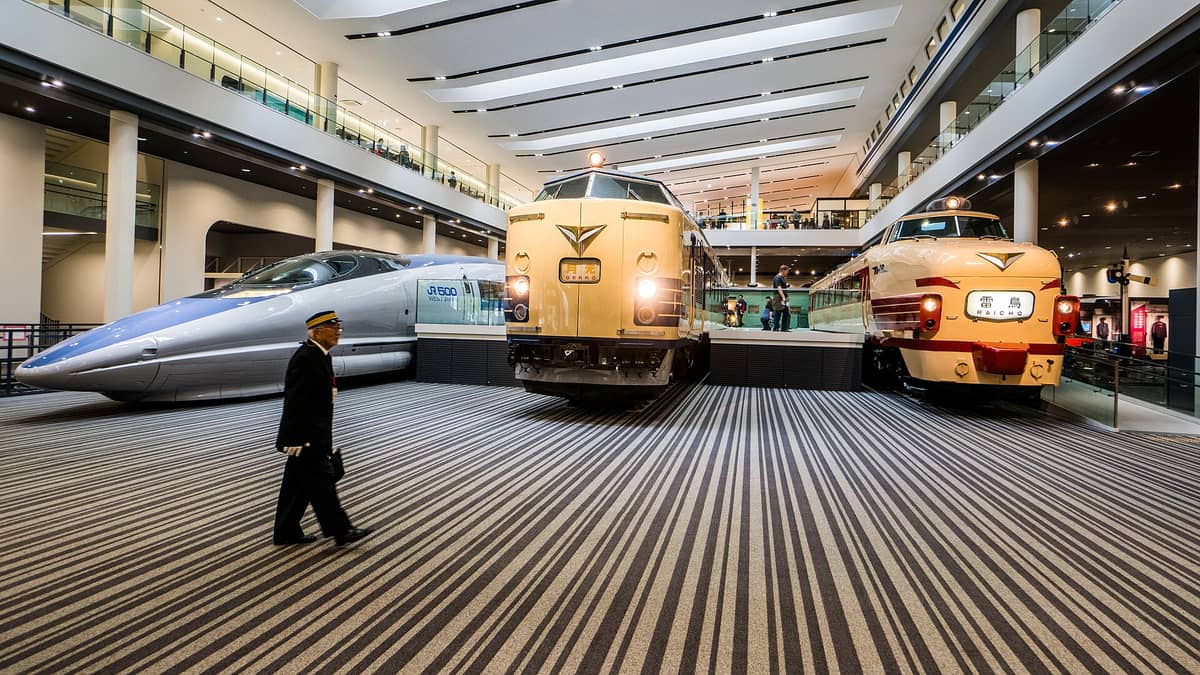
The visit begins in a voluminous entrance hall where full-size vehicles are arranged on original track sections. The spatial scale here is genuinely surprising. A 0 Series Shinkansen car — the iconic white bullet train that entered service in 1964 for the Tokyo Olympics — sits alongside steam locomotives from the Meiji and Taisho eras, their black boilers polished to a reflective shine. The contrast between these eras of engineering is made vivid by simply standing in the room.
Visitors can board several of the preserved carriages. The interiors of some older passenger cars have been restored to period specification: the green plush upholstery, the overhead luggage nets, the small etched-glass windows that separated compartments. Stepping inside and sitting down gives a sense of what a long-distance journey across Japan felt like before the Shinkansen era compressed travel times to a fraction of what they once were.
The Shinkansen section is particularly strong. Beyond the 0 Series exterior, the museum offers a walk-through diorama and simulation experience that contextualizes how the bullet train network was conceived, engineered, and expanded across Japan. For visitors less familiar with rail history, these interpretive elements do real work.
Upper floors feature interactive simulators where visitors can take the controls of a virtual train cab, managing acceleration and braking along a simulated route. These are timed experiences and require a separate reservation or token purchase at the venue. They sell out by mid-morning on weekends and school holiday periods, so it is worth stopping at the booking point immediately upon entry if this is a priority.
Tickets & tours
Hand-picked options from our booking partner. Prices are indicative; availability and final rates are confirmed when you complete your booking.
Kyoto Coast, Amanohashidate and Ine Bay 1-Day Trip from Osaka or Kyoto
From 46 €Instant confirmationFree cancellationKyoto Sanzen-in, Arashiyama and Bamboo Grove Full Day Tour
From 47 €Instant confirmationFree cancellationKyoto Arashiyama insider walking tour
From 66 €Instant confirmationFree cancellationMatcha green tea tour in Kyoto's Uji Market
From 130 €Instant confirmationFree cancellation
The Roundhouse and Outdoor Steam Yard
The most atmospheric section of the museum is the retained historic roundhouse from the original Umekoji site. A roundhouse is a functional architectural form: locomotives were driven onto a central turntable, rotated to align with one of the radiating stall tracks, and pulled in for servicing or storage. The Umekoji roundhouse dates to 1914 and is a designated Important Cultural Property. Walking through it, you feel the weight of its industrial heritage in a way that the modern exhibition halls, however well-designed, cannot quite replicate.
On selected days the museum operates steam locomotive rides along a short track within the outdoor precinct. Tickets for the steam ride are purchased separately inside the museum and are among the most popular activities, particularly for children. The ride is short, a few minutes at most, but the experience of boarding a working steam locomotive, hearing the hiss of pressure and the clank of coupling rods, is tactile in a way that no exhibit panel can provide. Check the official schedule for operating days and times, as rides are not available every day.
💡 Local tip
For the steam ride, purchase your ticket immediately after entering the museum. Slots fill quickly, especially on weekends, Japanese school holidays, and during Golden Week (late April to early May). If the steam ride is a priority for your visit, arrive at opening time.
Rooftop Terrace and Views
The museum's rooftop terrace is an underused asset that many visitors skip. From here you have a clear sightline over the active JR freight and passenger lines running parallel to the museum site, and on clear days the mountain ridges encircling Kyoto's basin are visible to the north and east. In the late afternoon, when the low sun picks out the geometry of the tracks below, it is genuinely photogenic. Rail enthusiasts with telephoto lenses come specifically for this vantage point.
The terrace also offers a calmer space away from the ground-floor crowds. If you are visiting with children who need a break from structured exhibits, this open-air space gives them room to move without disrupting anything. There are benches and the sight lines in all directions tend to hold young attention naturally.
Timing Your Visit: Crowds, Light, and Practical Realities
Weekday mornings, particularly Tuesday, Thursday, and Friday outside Japanese school holiday periods, are the quietest times to visit. Arriving at opening (10:00) on a weekday means you can move through the main exhibition hall before coach groups arrive, typically around 10:30 to 11:00. By early afternoon the ground floor is noticeably fuller, though the upper galleries and roundhouse remain relatively calm throughout the day.
The museum draws a local as much as a tourist audience, which affects the atmosphere positively. You will hear a mix of Japanese school groups, families with young children, and older rail enthusiasts who treat the collection with obvious personal investment. The atmosphere is engaged rather than perfunctory.
Because the museum is almost entirely indoors, it is one of the more sensible choices during Kyoto's rainy season (June and early July) or on oppressively hot August days. The entrance hall is air-conditioned, and the scale of the space means it does not feel crowded even when attendance is reasonably high. This is worth factoring into your itinerary planning, particularly if you are visiting during summer.
If you are building a wider itinerary for the area, the Kyoto Station areahas more to offer than many visitors realize, and combining this museum with a visit toNishi Hongan-ji— a UNESCO World Heritage temple less than 15 minutes on foot — makes for a well-balanced half-day in the neighborhood.
Getting There and Practical Logistics
From JR Kyoto Station, the museum is reachable on foot in about 20 minutes by heading northwest from the station's central or west exits. The walk is flat and uncomplicated, passing through an ordinary urban streetscape without particular interest. Alternatively, the JR Sagano Line (also called the JR嵯峨野線) runs one stop from Kyoto Station to Umekoji-Kyotonishi Station, which opened in 2019 partly to serve this museum. From the station exit, the museum entrance is visible within a few minutes' walk.
City buses also serve the area; the stop nearest the museum is commonly listed as Umekoji-Kyotonishi-Station-mae or equivalent, though bus stop names and route numbers change periodically. Confirm current bus options via the Kyoto City Bus route map or the museum's official access page before relying on this option.
Barrier-free access is well-considered throughout the museum. Elevators connect all floors, ramps supplement stairs at key transitions, wheelchairs are available for loan, and multipurpose restrooms are positioned at multiple points. The main historic roundhouse has some areas where flooring is original and uneven, which the museum notes in its accessibility guidance.
The museum is an easy addition to a broader day around the station area. For visitors trying to structure their time efficiently, theKyoto 3-day itineraryincludes practical notes on sequencing the station district with other central attractions.
Who Should Manage Their Expectations
If your primary interest in Kyoto is temples, gardens, and traditional culture, the Railway Museum sits outside that frame entirely. It is an excellent museum by any standard, but it will not resonate with every visitor, and there is no shame in prioritizing your limited days differently. Those with a single day or two in Kyoto are probably better served by the city's extraordinary concentration of historic architecture and natural scenery.
For context on how to balance the museum against Kyoto's wider offerings, thecomplete guide to things to do in Kyotois a useful reference for prioritizing across very different types of experiences.
Similarly, visitors who travel for sensory immersion in Japan's traditional aesthetic will find the museum's industrial setting a significant departure. That contrast can be refreshing, but it should be understood going in. The gift shop, which stocks a range of rail-themed goods including detailed miniature models, operator merchandise, and Kyoto Railway Museum-branded items, is genuinely well-stocked and a potential time and money trap for enthusiasts.
Photography Notes
The main exhibition hall presents some real photographic challenges. The space is large and artificially lit, with mixed color temperature lighting from spotlights and overhead panels. A wide-angle lens is useful for capturing whole vehicles; a standard prime works well for detail shots of cab interiors, wheel bogies, and signage. The roundhouse, with its radiating geometry and overhead skylights, rewards patience. Early in the day, before crowds fill the space, there are clean sight lines between vehicles that disappear once visitors arrive in numbers.
The rooftop terrace is best in late afternoon when the sun is low enough to cast directional light across the track geometry below. On clear days between October and February, the mountain backdrop to the north is sharp and blue-tinted, giving context to the urban railway landscape in the foreground.
If you are planning a photography-focused trip to Kyoto more broadly, theguide to the best views in Kyoto covers locations and timing across the city.
Insider Tips
- Purchase the train simulator token immediately upon entry on weekends or school holidays. Tickets are sold in person at the venue and can run out quickly on busy days, so early arrival is best.
- The museum restaurant and cafe on the lower level serves bento boxes with railway-themed packaging that work well as a takeout lunch on the rooftop terrace, especially on mild days in spring or autumn.
- The roundhouse is the oldest surviving structure on the site, built in 1914, and carries designation as an Important Cultural Property. Most visitors walk through it quickly. Slow down and look at the track junction geometry on the floor and the corbelling of the brick walls — the engineering is elegant in a way the exhibit panels do not fully explain.
- If you are visiting with children who are not natural rail enthusiasts, the working steam ride is the experience most likely to produce genuine excitement regardless of prior interest. Plan your day backward from its schedule rather than treating it as an optional add-on.
- A JR commuter day pass may make the one-stop train from Kyoto Station to Umekoji-Kyotonishi Station economical if you are already using it for other journeys that day. Check pass coverage before purchasing separately.
Who Is Kyoto Railway Museum For?
- Families with children aged 4 and above who respond well to hands-on and scale experiences
- Rail enthusiasts and engineering-minded travelers with a specific interest in Japanese transport history
- Visitors caught in Kyoto's rainy season or summer heat looking for a quality full-morning indoor alternative
- Photographers interested in industrial heritage, architectural geometry, and working rail infrastructure
- First-time visitors to Japan who want context for the rail network they are traveling through
Nearby Attractions
Other things to see while in Kyoto Station Area:
- Higashi Hongan-ji Temple
Higashi Hongan-ji is the head temple of the Shinshū Ōtani-ha Buddhist sect and home to the Miei-dō, the Founder's Hall widely recognized as one of the largest wooden structures on earth. Located a short walk from Kyoto Station, it costs nothing to enter and operates almost year-round, making it one of the most accessible major temples in the city.
- Kyoto Aquarium
Tucked inside Umekoji Park, a short walk from Kyoto Station, Kyoto Aquarium is a fully indoor attraction built around regional aquatic life, dolphin performances, and one of Japan's most unusual residents: the giant salamander. It's a reliable rainy-day option and a strong choice for families, though adult travelers visiting solo may find the experience skews young.
- Kyoto Tower
Rising 131 meters directly above Kyoto Station, Nidec Kyoto Tower offers one of the city's most accessible panoramic viewpoints. The observation deck delivers a sweeping 360-degree view over the low-rise temple cityscape, and the entire visit takes under an hour, making it a practical add-on to any day in the area.
- Nishi Hongan-ji Temple
Nishi Hongan-ji is one of Kyoto's most architecturally significant Buddhist temples and a UNESCO World Heritage Site, located minutes from Kyoto Station. Entry is free, the scale is extraordinary, and crowds are a fraction of what you'll find at more famous temples across the city.