Heunginjimun Gate: Seoul's Great East Gate and a designated Treasure
Heunginjimun Gate, commonly called Dongdaemun Gate, is one of the last surviving city gates of old Seoul's fortress wall. Built during the Joseon Dynasty and designated a Treasure, it stands freely accessible around the clock at the heart of the Dongdaemun district, surrounded by one of the city's most chaotic and energetic intersections.
Quick Facts
- Location
- 288 Jong-ro, Jongno-gu, Seoul 03119 (Dongdaemun district)
- Getting There
- Dongdaemun Station, Lines 1 & 4, Exit 9 (74 m from exit)
- Time Needed
- 20–40 minutes to walk around and photograph; combine with nearby sites for a longer visit
- Cost
- Free, no ticket required. Open 24 hours, 7 days a week.
- Best for
- History lovers, architecture photography, Joseon-era context, late-night wanderers
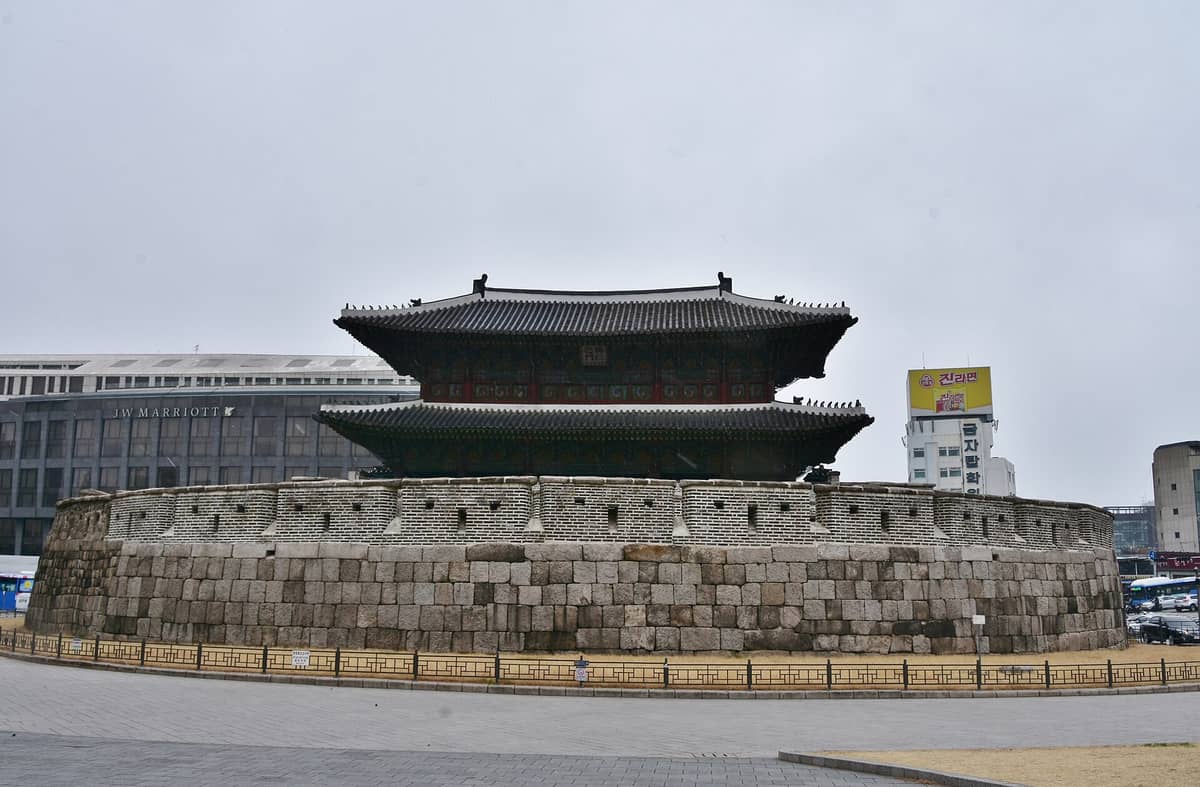
What Heunginjimun Actually Is
Heunginjimun Gate, officially known in Korean as 흥인지문 and widely referred to as Dongdaemun (the Great East Gate), is one of the eight original city gates built to guard the walls of the Joseon Dynasty capital. Constructed in 1398 under King Taejo and designated a Treasure, the structure that stands today is the rebuilt gate preserved from later Joseon-period restoration. That distinction matters little when you're standing in front of it: the tiered wooden pavilion rising above a massive stone archway is genuinely striking, and its designation as a Treasure reflects both its historical weight and its architectural rarity.
Unlike most of Seoul's designated treasures, Heunginjimun sits on a traffic island at one of the city's most relentless intersections. It is not tucked behind palace walls or approached along a leafy path. It occupies an urban setting that can feel jarring at first: buses, taxis, and motorcycles circle it continuously, and the surrounding blocks are packed with fabric wholesalers, street food carts, and 24-hour fashion markets. That contrast between the 600-year-old gate and the restless commerce around it is, in its own way, a defining Seoul experience.
ℹ️ Good to know
The gate is open 24 hours with no admission fee. You can walk around the perimeter at any hour. Access to the interior upper structure is not open to the public.
The Architecture Up Close
The gate follows the double-roofed wooden pavilion style typical of Joseon-era fortress architecture. The lower section is a curved stone base pierced by a single arched passageway, originally used as the main entrance through Seoul's city wall. The upper wooden structure features bracketed eaves, painted green and red beams, and the layered roof silhouette that defines the period's aesthetic. What makes Heunginjimun architecturally unusual among Seoul's surviving gates is the curved half-moon outer wall (ongseong) that partially wraps around its front, added for defensive purposes, which no other gate in the original wall system retains in any comparable form.
Standing close to the stone base, you can see the weathered texture of the granite blocks, which carry more than a century of surface age even in the 1869 reconstruction. The wooden elements above have been restored and repainted in more recent decades, and the color contrast between the worn stone and fresh paintwork is noticeable. This is a maintained monument, not a ruin, and it looks like one.
If you want to understand Heunginjimun in the context of the full Hanyangdoseong fortress system, it helps to have visited other surviving sections first. The Hanyangdoseong Seoul City Wall traces the ancient perimeter across several districts and provides the geographic and historical frame that makes this single gate much more legible.
Tickets & tours
Hand-picked options from our booking partner. Prices are indicative; availability and final rates are confirmed when you complete your booking.
DMZ and Lake Majang Suspension Bridge Tour from Seoul
From 57 €Instant confirmationFree cancellationHalf Day DMZ Tour from Seoul, 3rd Tunnel, Observatory and More
From 47 €Instant confirmationFree cancellationSeoul zombie city exploration game and private tour
From 10 €Instant confirmationFree cancellationLuggage Storage in Seoul
From 7 €Instant confirmationFree cancellation
How the Experience Changes by Time of Day
Early morning, from around 6:00 to 8:30 a.m., is the best time to photograph Heunginjimun without crowds obscuring the gate or vehicles dominating the foreground. The surrounding streets are quieter, the light is softer, and you can walk the full perimeter of the small park around the gate without being pressed for space. A few vendors begin setting up nearby, and the occasional commuter passes through, but the gate has a calm authority at this hour that disappears once traffic builds.
Midday and afternoon bring steady foot traffic from tourists and local workers, combined with constant vehicle movement on the surrounding roads. The gate itself is always there to look at, but the experience of standing near it becomes noisier and more compressed. Afternoon light from the west creates reasonable conditions for photography of the eastern-facing structure, though direct sunlight can flatten the stone textures.
Night is when Heunginjimun becomes visually dramatic in a different way. The gate is illuminated after dark, and the light on the painted wooden eaves and stone archway against the night sky makes for some of the most memorable photographs you'll take of it. The surrounding Dongdaemun district operates largely as a nocturnal economy, with the nearby fashion markets running until the early hours. Visiting the gate after 9:00 p.m. and pairing it with an hour in the markets is a completely reasonable evening plan.
💡 Local tip
For photography: arrive before 8:00 a.m. for a clear foreground, or after 9:00 p.m. for night illumination shots. A wide-angle lens or phone with a wide setting helps capture the full gate given the limited space on the traffic island.
Historical Context: Why a Designated Treasure
When the Joseon Dynasty established Seoul (then called Hanyang) as its capital in 1394, one of the first large construction projects was a perimeter wall encircling the city, with four major gates and four smaller gates marking its cardinal and intercardinal points. Heunginjimun served as the Great East Gate, the eastern entry point into the capital for travelers arriving from the east. Its name translates roughly as 'Gate of Rising Benevolence,' part of the Confucian moral vocabulary embedded into the names of the four major gates.
The original 1398 structure was repaired multiple times over the centuries before the current rebuilt form was completed during the Joseon period. Despite being a later reconstruction rather than the original gate, it earned the designation of a designated Treasure. Despite being a 19th-century reconstruction rather than the original Joseon gate, it earned the designation of a designated Treasure, a status that reflects its position as the most historically significant surviving example of the original capital gate system. Most of the original wall and its other gates were demolished or severely damaged during the Japanese colonial period and the rapid urbanization of the 20th century.
Visitors interested in the broader palace and fortress heritage of the Joseon period will find that Heunginjimun makes a natural companion to the major palaces nearby. Gyeongbokgung Palace and Changdeokgung Palace sit within a few kilometers to the northwest, and together they form the core of Joseon-era Seoul that has survived into the present.
Getting There and Getting Around
Heunginjimun is exceptionally easy to reach. Exit 9 of Dongdaemun Station (served by Subway Lines 1 and 4) places you approximately 74 meters from the gate, a walk of under two minutes. The station is a major interchange on two of Seoul's busiest lines, making the gate accessible from virtually anywhere in the city without a transfer or long journey. There is no parking infrastructure designed for the gate itself, and driving to this intersection is not recommended given the congestion.
The gate sits at the boundary between Jongno-gu and the Dongdaemun shopping district, and the surrounding blocks reward exploration on foot. The immediate area includes several street food stalls operating from late afternoon onwards, and the wholesale fabric and fashion markets that made Dongdaemun internationally known begin roughly two to three blocks away. Plan your visit to the gate as part of a wider loop rather than a standalone trip.
For a fuller understanding of the Dongdaemun area's mix of heritage and contemporary energy, the Dongdaemun Design Plaza is a 10-minute walk south and offers a sharp architectural contrast: Zaha Hadid's aluminum-clad cultural complex directly next to where the old city wall once stood.
Practical Notes and Honest Assessment
Heunginjimun is not a destination that requires a long time commitment. You cannot enter the upper gate structure, which means the experience is entirely exterior: walking around the base, reading the signage, photographing the architecture, and absorbing the setting. For visitors whose schedule allows only a few days in Seoul, this gate is best appreciated as part of a larger Dongdaemun area visit rather than a standalone trip from a distant neighborhood.
Weather has a noticeable effect on the experience. Seoul summers (June through August) are humid and often hazy, which softens distant views and makes extended outdoor standing uncomfortable in the middle of the day. Spring (April to May) and autumn (September to October) offer the most comfortable conditions for walking the perimeter and spending time in the surrounding streets. Winter visits are entirely feasible given the gate is open at all hours, and snow or frost on the stone base can make for striking photography, though wind in this open intersection can be sharp.
Accessibility information for the gate's immediate surroundings is not detailed in official tourism sources. The perimeter path around the traffic island involves crossing busy roads via pedestrian crossings, and the paving around the gate itself is uneven stone in some sections. Visitors with mobility constraints should approach with that in mind.
Travelers who arrive expecting an immersive historical environment, similar to the experience inside Gyeongbokgung Palace or along quieter sections of the city wall, may find the traffic-island setting underwhelming. The gate is genuinely significant and worth seeing, but it demands a degree of urban patience. That said, it is free, always open, and two minutes from a major subway station, which means there is almost no cost to including it in a wider day in this part of the city.
If you are planning a day that connects Seoul's major historical landmarks, the guide to Seoul's palaces and historic gates covers how to sequence these sites efficiently across a full day.
Insider Tips
- Arrive before 8:00 a.m. on a weekday to photograph the gate with minimal traffic in frame. Weekend mornings can also be relatively quiet before 9:00 a.m.
- The curved ongseong outer defensive wall is a unique architectural feature not found at any other surviving Joseon gate. Walk the full perimeter to see how it wraps around the front of the structure.
- Night illumination makes the gate photogenic in a completely different way from daylight. If you're in the Dongdaemun area for the evening markets, circle back to the gate after dark before heading home.
- The official signage around the gate is available in Korean, English, Chinese, and Japanese, and covers the key historical facts clearly. Read it before heading to the markets to give the rest of your visit some context.
- Combine the gate with Gwangjang Market, a 10-minute walk northwest, for a single afternoon that spans six centuries of Seoul commerce in one continuous walk.
Who Is Heunginjimun Gate (Dongdaemun Gate) For?
- History and heritage travelers who want to tick off a designated Treasure and understand the Joseon capital's original urban plan
- Architecture and photography enthusiasts interested in late Joseon wooden pavilion construction and the unique ongseong defensive wall
- Night owls already visiting the Dongdaemun fashion markets who want to add a meaningful cultural reference point to their evening
- First-time visitors to Seoul building a compact historical circuit through the old city center
- Budget travelers: the gate is completely free and requires no advance booking or timed entry
Nearby Attractions
Other things to see while in Dongdaemun:
- Dongdaemun Design Plaza (DDP)
Dongdaemun Design Plaza, known as DDP, is one of Seoul's most striking structures: a vast, curvaceous building designed by the late architect Zaha Hadid, sitting where an old baseball stadium once stood. Free to enter the grounds and many public areas, with separate hours and fees for individual exhibitions, it serves as a cultural campus for design exhibitions, fashion weeks, and public events, and is just as compelling to explore from the outside as it is within.
- Dongmyo Flea Market
Dongmyo Flea Market (동묘벼룩시장) is unlike anything else in Seoul. Spread across open lots and narrow alleys near Jongno-gu, it draws antique hunters, vintage fashion seekers, and elderly Koreans haggling over old tools and military surplus. Entry is free, the atmosphere is raw, and the finds are genuinely unpredictable.
- Gyeongdong Market
Gyeongdong Market (경동시장) is one of Seoul's most important traditional herbal medicine and dried goods markets, rooted in post-Korean War history. Sprawling across Jegi-dong in Dongdaemun-gu, it offers an unfiltered look at how Koreans source medicinal herbs, dried seafood, grains, and roots — a world away from the polished surfaces of the city's shopping malls.
- Naksan Park
Naksan Park sits on a wooded hill in Jongno-gu, where a preserved stretch of Seoul's 600-year-old city wall traces the ridgeline above Ihwa-dong. Free to enter and open around the clock, it rewards visitors with panoramic views over the city, a quieter pace than downtown, and a genuinely different side of Seoul after dark.