Gyeongdong Market: Seoul's Traditional Herbal Market in a Modern City
Gyeongdong Market (경동시장) is one of Seoul's most important traditional herbal medicine and dried goods markets, rooted in post-Korean War history. Sprawling across Jegi-dong in Dongdaemun-gu, it offers an unfiltered look at how Koreans source medicinal herbs, dried seafood, grains, and roots — a world away from the polished surfaces of the city's shopping malls.
Quick Facts
- Location
- 3 Gosanja-ro 36-gil, Dongdaemun-gu, Seoul
- Getting There
- Seoul Subway Line 1, Jegi-dong Station, Exit 2 (approx. 381 m walk)
- Time Needed
- 1.5 to 2.5 hours
- Cost
- Free entry; budget extra for purchases
- Best for
- Food culture explorers, traditional medicine enthusiasts, photographers
- Official website
- english.visitseoul.net/shopping/kyungdong-market/ENP3rjtd6
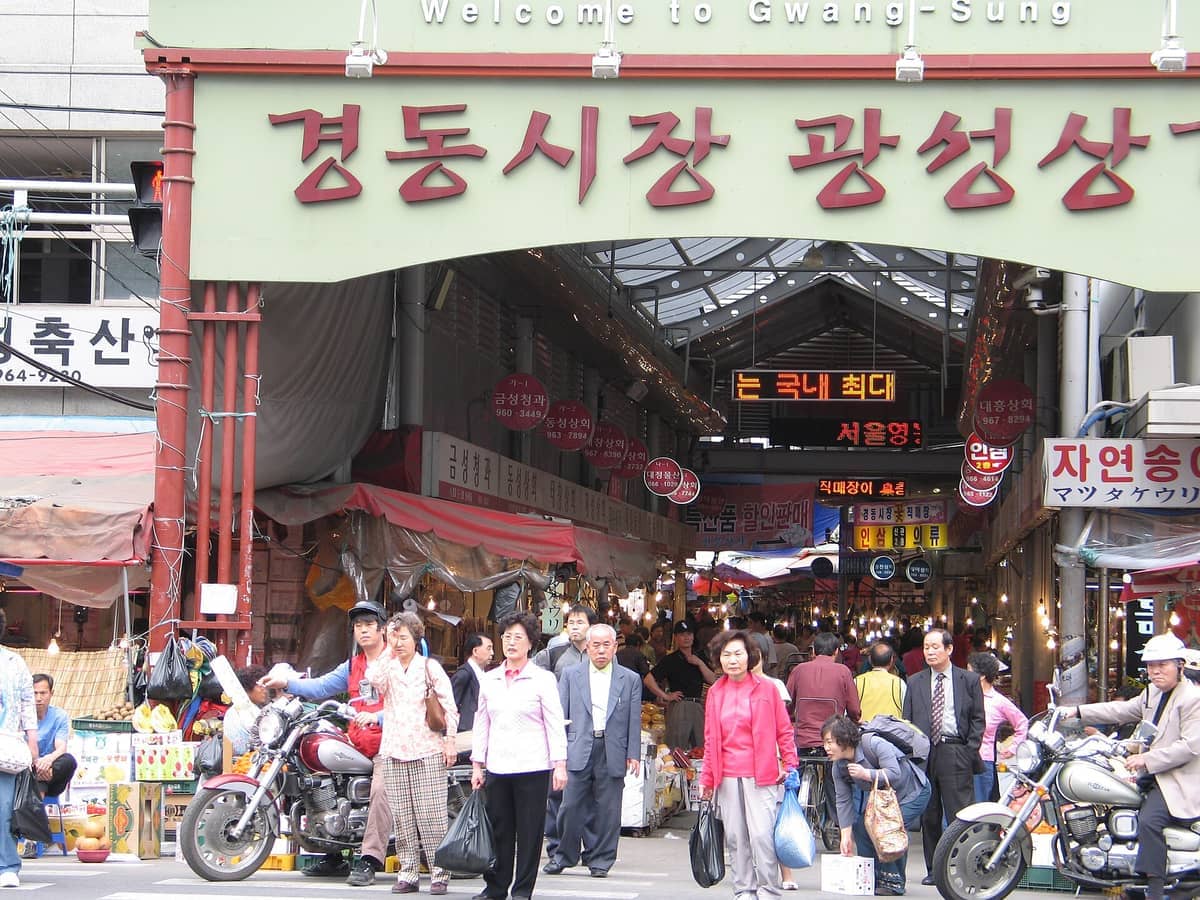
What Gyeongdong Market Actually Is
Gyeongdong Market is not a market in the way most tourists expect. There are no street food Instagram setups, no English signage translating every product, and no vendors calibrated for tourist traffic. What you get instead is one of South Korea's largest hubs for traditional herbal medicine (hanbang), dried goods, grains, and agricultural produce — a place where herbalists, restaurateurs, and everyday Seoulites come to stock up on ingredients that have been central to Korean wellness culture for centuries.
The market occupies a dense cluster of alleys and covered corridors in Jegi-dong, within Dongdaemun-gu. Its stalls overflow with dried mushrooms the size of a hand, roots that look prehistoric, entire walls of bark and compressed plant matter, and sacks of grains piled nearly to the ceiling. The smell hits before the visual does: earthy, sharp, faintly medicinal, with occasional sweetness from dried fruits and grains. It is not an unpleasant smell, but it is emphatic.
💡 Local tip
Arrive between 09:30 and 11:00 on a weekday for the most active trading atmosphere. By early afternoon some vendors begin winding down, and Sunday hours are significantly reduced with many stalls closed.
A Market Born From Necessity: The Post-War Origins
Gyeongdong Market's origins trace to the years following the Korean War (1950–1953), when the country was rebuilding. Farmers and traders began gathering near the old Seongdong Station to sell produce and goods — informally at first, then with increasing permanence as demand grew. The market consolidated around what is now Jegi-dong, and over subsequent decades it evolved into the specialized hub it is today, with herbal medicine merchants becoming its most distinctive identity.
Traditional Korean medicine (hanbang, 한방) has deep roots in Korean culture, drawing from centuries of East Asian pharmacological tradition. Practitioners prescribe treatments built around combinations of dried roots, bark, seeds, flowers, and animal products. Gyeongdong became — and remains — one of the main sources in Seoul for these ingredients. Walking through it, you are walking through a living supply chain for a medical system with a long premodern history.
The market's location near Jegi-dong Station also places it close to several traditional Korean medical clinics and small hanbang pharmacies that have operated in the surrounding streets for decades. If you are exploring the broader area, the Dongdaemun neighborhood has other points of interest worth combining into a half-day itinerary.
Tickets & tours
Hand-picked options from our booking partner. Prices are indicative; availability and final rates are confirmed when you complete your booking.
DMZ and Lake Majang Suspension Bridge Tour from Seoul
From 57 €Instant confirmationFree cancellationHalf Day DMZ Tour from Seoul, 3rd Tunnel, Observatory and More
From 47 €Instant confirmationFree cancellationSeoul zombie city exploration game and private tour
From 10 €Instant confirmationFree cancellationLuggage Storage in Seoul
From 7 €Instant confirmationFree cancellation
What You Will See, Smell, and Hear
The covered inner corridors are where the herbal medicine trade concentrates. Stalls are crammed with labeled jars, open sacks, and hanging bundles — dried astragalus root (hwanggi), angelica root (danggwi), ginseng in multiple grades and forms, dried jujube (daechu), goji berries, and dozens of items that resist easy translation. Many vendors will grind or prepare herbs to order using loud electric grinders, so the soundscape inside is part mechanical hum, part animated negotiation between Korean-speaking regulars.
The outer sections of the market shift toward dried seafood, fermented goods, grains, and fresh produce. Stacks of dried anchovies (myeolchi), seaweed varieties, and dried shiitake occupy one zone; sacks of rice, barley, black beans, and mixed grains dominate another. The transition between zones is gradual, marked more by smell than by any clear signage.
Vendors here are primarily focused on trade, not tourism. Most will not approach you, and if you browse without intent to buy, that is entirely acceptable. However, if you point at something with genuine curiosity, many vendors will attempt to explain through gesture or by showing product labels, even without shared language. Bring a translation app: it goes a long way.
How the Market Changes Through the Day
Early morning, from opening at 08:30 until around 10:30, is when wholesale activity peaks. is when wholesale activity peaks. Restaurant buyers and herbal medicine practitioners arrive with lists and negotiate prices in bulk. The energy is purposeful and fast, and the narrow corridors move with people who know exactly where they are going. This is the best time to observe the market functioning on its own terms, without adjustment for casual visitors.
By mid-morning to midday the pace settles into steady retail traffic. This is the most accessible window for a first-time visitor: vendors are less rushed, and there is more room to stop and look without obstructing the flow. Afternoon light filters differently into the covered sections, and some of the outer stalls begin packing up around 15:00–16:00, particularly toward the end of the week.
⚠️ What to skip
Sunday visits are possible but often quieter. On Sundays and public holidays, only some stores are open. A weekday visit, ideally Tuesday through Friday, gives you the full market experience.
Practical Walkthrough: How to Navigate the Market
Gyeongdong Market does not have a single entrance or a mapped circuit. The main approach from Jegi-dong Station Exit 2 leads you toward the market within a few minutes. From there, the covered herbal medicine halls are found by following the concentration of dried-goods stalls and the increasingly medicinal aroma inward. There is no admission gate, no ticket counter, and no formal orientation point.
The market is compact enough that you will naturally circle back to familiar corridors if you explore without a fixed plan, which is actually a reasonable approach. Allow 90 minutes at a minimum if you want to move through all the main sections without rushing. Allow two hours or more if you intend to buy or want to watch vendors process herbs to order.
If you want to pair this with another traditional market experience, Gwangjang Market is accessible from the same subway line and offers an entirely different atmosphere, centered on fabric, vintage clothing, and street food. The Seoul markets guide covers the full range of options across the city.
💡 Local tip
Cash is strongly preferred at most stalls. While some larger vendors may accept card, small stalls almost exclusively deal in Korean won. Bring small bills — exact change is appreciated for smaller purchases.
Photography, Accessibility, and What to Bring
Gyeongdong Market is visually rich. The textures of dried roots, the color gradients in jars of seeds and berries, and the worn wooden surfaces of long-used stalls reward close-up photography. Vendors generally tolerate camera phones without objection, though pointing a camera directly at someone's face without acknowledgment is considered rude anywhere in Korea. A quick nod and a smile usually resolves any ambiguity.
Natural light is limited inside the covered sections, so if image quality matters to you, aim for a bright midday visit when some outdoor light reaches the corridors. The outer produce stalls are better lit and are good for wide-angle shots that capture the market's scale.
On accessibility: the official tourism listing does not specify step-free routes, elevator access, or other mobility-related infrastructure details. Visitors with significant mobility limitations should verify current conditions directly with the market or local tourist information before planning a visit. Practical footwear with good grip is advisable for everyone.
Seoul's traditional market scene is part of a much broader cultural experience. If you are building a longer itinerary around this side of the city, the things to do in Seoul guide can help you connect the market to nearby points of interest.
Who Might Not Enjoy This Market
Gyeongdong Market will not suit every visitor. Travelers seeking a curated cultural performance, clearly explained exhibits, or a comfortable tourist infrastructure will find the experience disorienting rather than rewarding. The market exists primarily for its local clientele, and it does not soften itself for outsiders. If your interest in Korean culture runs shallow, or if unfamiliar smells bother you intensely, this is probably not the best use of your time in Seoul.
It is also not a place to eat your way through Seoul. Unlike Gwangjang or Namdaemun, Gyeongdong is not structured around prepared food vendors. There are some small eateries in and around the market, but food is not the draw here.
Insider Tips
- If you want to buy ginseng, this is one of the best places in Seoul to do so. Ask the vendor to show you the grade classification: Korean red ginseng (hongsam) is graded by quality and form, and prices vary accordingly.
- A handful of small traditional Korean medicine clinics operate in the streets immediately surrounding the market. If you have a specific health question, check opening hours and consultation availability in advance.
- The covered herbal medicine halls are at their atmospheric best on cool, dry days. On hot humid summer days, the enclosed spaces become stifling and the intensity of the aromas increases substantially. Late spring and autumn visits are noticeably more comfortable.
- Look for the vendors who grind herbs to order using stone or electric grinders. Watching a full dried root reduced to a fine powder over a few minutes is one of the more genuinely interesting processes you can observe anywhere in Seoul's traditional markets.
- The area around Jegi-dong Station also has traditional Korean medicinal food restaurants (hanbang sikdang) that serve dishes built around tonic ingredients.
Who Is Gyeongdong Market For?
- Food culture travelers who want to understand what Korean cuisine and wellness is built on
- Photographers looking for texture, color, and genuinely unposed scenes
- Anyone curious about traditional East Asian medicine in a real commercial context
- Travelers who have already covered Seoul's headline attractions and want something less mediated
- Shoppers looking to buy quality dried goods, grains, and herbal ingredients at fair prices
Nearby Attractions
Other things to see while in Dongdaemun:
- Dongdaemun Design Plaza (DDP)
Dongdaemun Design Plaza, known as DDP, is one of Seoul's most striking structures: a vast, curvaceous building designed by the late architect Zaha Hadid, sitting where an old baseball stadium once stood. Free to enter the grounds and many public areas, with separate hours and fees for individual exhibitions, it serves as a cultural campus for design exhibitions, fashion weeks, and public events, and is just as compelling to explore from the outside as it is within.
- Dongmyo Flea Market
Dongmyo Flea Market (동묘벼룩시장) is unlike anything else in Seoul. Spread across open lots and narrow alleys near Jongno-gu, it draws antique hunters, vintage fashion seekers, and elderly Koreans haggling over old tools and military surplus. Entry is free, the atmosphere is raw, and the finds are genuinely unpredictable.
- Heunginjimun Gate (Dongdaemun Gate)
Heunginjimun Gate, commonly called Dongdaemun Gate, is one of the last surviving city gates of old Seoul's fortress wall. Built during the Joseon Dynasty and designated a Treasure, it stands freely accessible around the clock at the heart of the Dongdaemun district, surrounded by one of the city's most chaotic and energetic intersections.
- Naksan Park
Naksan Park sits on a wooded hill in Jongno-gu, where a preserved stretch of Seoul's 600-year-old city wall traces the ridgeline above Ihwa-dong. Free to enter and open around the clock, it rewards visitors with panoramic views over the city, a quieter pace than downtown, and a genuinely different side of Seoul after dark.