Dongdaemun Design Plaza (DDP): Seoul's Architectural Landmark
Dongdaemun Design Plaza, known as DDP, is one of Seoul's most striking structures: a vast, curvaceous building designed by the late architect Zaha Hadid, sitting where an old baseball stadium once stood. Free to enter the grounds and many public areas, with separate hours and fees for individual exhibitions, it serves as a cultural campus for design exhibitions, fashion weeks, and public events, and is just as compelling to explore from the outside as it is within.
Quick Facts
- Location
- 281, Eulji-ro, Jung-gu, Seoul (Dongdaemun area)
- Getting There
- Dongdaemun History & Culture Park Station (Lines 2, 4, 5), Exit 1
- Time Needed
- 1.5 to 3 hours depending on exhibitions
- Cost
- Free to enter grounds and building; individual exhibitions may charge separate fees
- Best for
- Architecture lovers, design enthusiasts, night photography, casual wanderers
- Official website
- www.ddp.or.kr
What DDP Actually Is
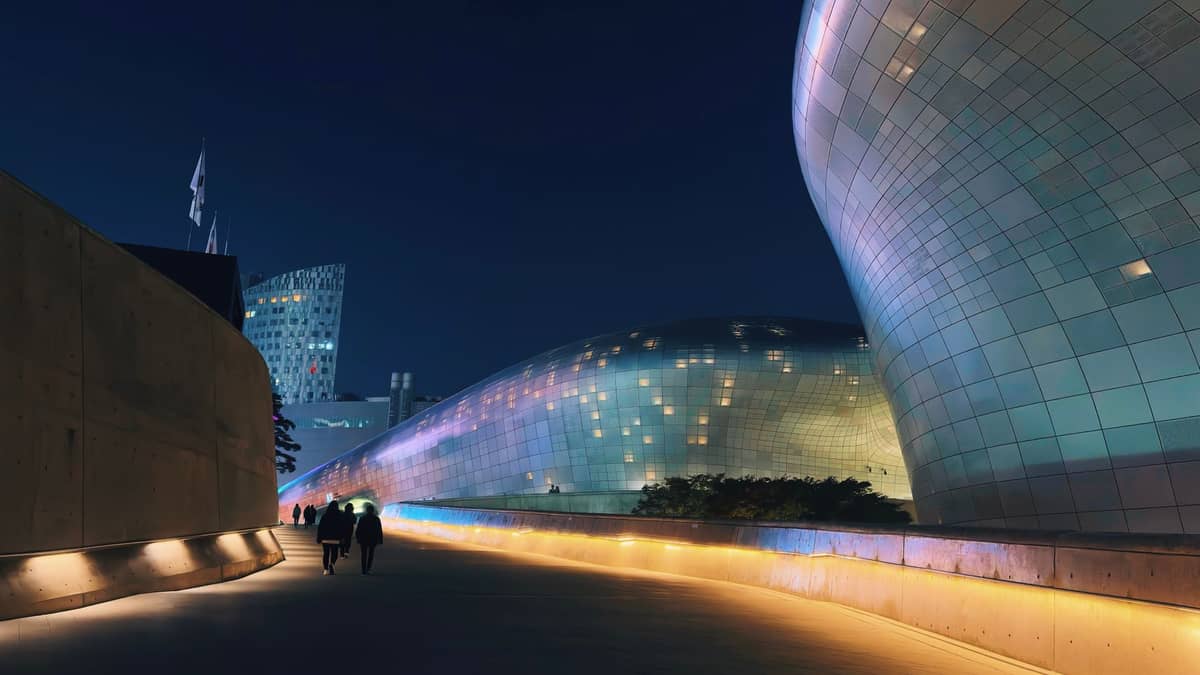
Dongdaemun Design Plaza opened on March 21, 2014, and it still surprises people who see it for the first time. The building does not look like it belongs to a city grid. It curves and folds across roughly 86,000 square meters of floor space, Dongdaemun Design Plaza opened on March 21, 2014, and it still surprises people who see it for the first time. The building does not look like it belongs to a city grid. It curves and folds across roughly 86,000 square meters of floor space. Zaha Hadid Architects, working with Samoo Architects and Engineers, designed it as a "three-dimensional urban landscape" rather than a conventional building, and that description holds up on the ground.
Seoul City Hall commissioned the project in the mid-2000s, with the explicit goal of establishing Seoul as a global design capital. What makes the site especially layered is what preceded the building: excavation work uncovered significant remnants of Joseon-era structures and a section of the old Seoul city wall, all of which now sit in the adjacent open-air archaeological zone called Dongdaemun History and Culture Park, effectively part of the same campus.
ℹ️ Good to know
Opening hours vary by facility, and the General Information Desk operates on official DDP hours; check the official DDP website before visiting if you have a specific venue in mind.
The Architecture: What to Look At and Where to Stand
Approaching from Exit 1 of Dongdaemun History and Culture Park Station, the full scale of DDP registers gradually. The building does not announce itself with a grand entrance. Instead, it rises organically from sloping grass-covered terraces, merging ground and structure in a way that makes the boundary between landscape and building genuinely ambiguous. Walk around the perimeter before going inside. The exterior rewards slow movement: surfaces shift from matte to reflective depending on light conditions, and the curves create entirely different silhouettes from different angles.
The northeast facade, facing the old market streets of Dongdaemun, offers the most dramatic view at night. LED lighting transforms the aluminum skin into something closer to a lantern than a wall. Photographers gravitate toward this side after dark, particularly when the building hosts large exhibitions and the entire surface carries projected imagery. Arrive around sunset to catch both the daylight geometry and the transition into illuminated mode within a single visit.
The Rose Garden on the exterior terrace level is easy to miss on a first visit. It sits on a raised green mound with a direct sightline back toward the building's main curves, making it one of the better spots to photograph the structure without getting too close. The terrace is accessible by foot path and requires no ticket.
Tickets & tours
Hand-picked options from our booking partner. Prices are indicative; availability and final rates are confirmed when you complete your booking.
DMZ and Lake Majang Suspension Bridge Tour from Seoul
From 57 €Instant confirmationFree cancellationHalf Day DMZ Tour from Seoul, 3rd Tunnel, Observatory and More
From 47 €Instant confirmationFree cancellationSeoul zombie city exploration game and private tour
From 10 €Instant confirmationFree cancellationLuggage Storage in Seoul
From 7 €Instant confirmationFree cancellation
Inside the Building: Venues and What They Hold
DDP operates as a campus of separate but connected spaces rather than a single museum. The main zones include the Museum, the Art Hall, the Design Lab, and the Design Market. On any given day, these spaces may hold a technology exhibition, a fashion showcase, a product design retrospective, or a large-scale commercial pop-up. The programming rotates constantly, which means the interior experience changes significantly depending on when you visit.
The internal corridors are unusually interesting even when nothing is on. Hallways curve without obvious endpoints, ceiling heights shift dramatically between sections, and ramp systems replace conventional stairwells in many parts of the building. For anyone interested in spatial design or parametric architecture, walking the building without a specific destination is a worthwhile exercise.
The Design Market on the lower ground level carries Korean design products, stationery, homeware, and accessories, most of them produced by independent or small-batch designers. It is one of the better places in Seoul to buy design-conscious souvenirs that are not widely available elsewhere in the city. Prices are higher than mass-market souvenirs but proportionate to the quality.
💡 Local tip
Check the DDP website's exhibition calendar before your visit. The difference between arriving during a blockbuster exhibition and on a quiet week is significant. During Seoul Fashion Week, held twice yearly, the entire campus becomes a different place, dense with industry visitors and street photographers.
The Archaeological Layer: History Beneath the Building
Before DDP, this site was occupied by Dongdaemun Stadium, a historic sports venue that was demolished in 2008. Beneath it, excavation revealed Joseon-era ruins including portions of Igansumun, a historic water gate, along with artifacts and segments of Seoul's ancient city wall. These finds complicated and enriched the development: the archaeological zone was preserved and is now visible from the open-air park adjacent to the main building.
The Dongdaemun area has long been associated with wholesale fabric and fashion markets, and that identity still surrounds DDP. Walk five minutes in any direction and you are in the dense retail corridors of Doota Mall or the late-night wholesale alleys that supply clothing vendors across Korea. DDP does not replace this character but sits alongside it, which creates an odd and interesting contrast: a globally recognized piece of parametric architecture surrounded by market stalls selling polyester by the bolt. For more on the history and urban fabric of the area, the Heunginjimun Gate stands just minutes away and provides a direct visual connection to the old city wall system that once defined this part of Seoul.
Time of Day and When to Visit
DDP works well at different times of day for different reasons. Mornings between 10:00 and noon are the quietest, with few visitors and good light on the east-facing surfaces. This is the best window if you want photographs without other people in frame or if you want to walk the corridors without crowds.
Afternoons bring more foot traffic, especially on weekends and during holidays. If a popular exhibition is running, queues for the ticketed zones can develop by early afternoon. The grounds themselves remain open and free throughout.
Evening, particularly after 18:00, is when the building looks most dramatic. The illuminated exterior draws a steady stream of visitors, including large numbers of people who are not specifically interested in the exhibitions but come to photograph or simply experience the scale of the lit structure. On warm nights, people sit on the grass terraces well into the evening. The surrounding Dongdaemun market district, which runs through the night, means this part of the city never fully empties after dark.
⚠️ What to skip
During Seoul Fashion Week (typically March and October), DDP becomes significantly more crowded and some spaces may be restricted for industry events. If your interest is the exhibitions or the architecture rather than the fashion scene, plan accordingly.
Getting There and Getting Around
The most direct access is via Seoul's subway network. Take Lines 2, 4, or 5 to Dongdaemun History and Culture Park Station and use Exit 1, which deposits you directly at the DDP grounds. The walk from exit to building entrance takes under two minutes. Most visitors coming from central districts like Myeongdong or Insadong will find the journey under 15 minutes by subway.
The surrounding streets are straightforward to navigate on foot. The park connects directly to the historic gate and the archaeological zone without requiring re-entry or transit. Wear shoes comfortable for varied surfaces: the exterior terraces include stone, grass, and the aluminum-paneled paths that wrap around the building, which can be slippery when wet.
Accessibility provisions include stroller rental at the General Information Desk, with free rental available for children from 6 months to under 36 months (ID required). Much of the building is ramp-accessible by design, though the curved geometry means some sections are more easily navigated than others. Visitors with specific accessibility requirements should check current details with the venue directly.
Who This Attraction Is and Is Not For
DDP rewards visitors with genuine interest in architecture, design, or contemporary culture. It is the kind of place where knowing a little about Zaha Hadid's design philosophy, or having any interest in how buildings are made, meaningfully deepens the experience. It also pairs naturally with the surrounding area: combine it with a walk along the Cheonggyecheon Stream, which runs nearby, or with an evening visit to the Dongdaemun market streets that stay open until the early hours.
Visitors expecting a traditional Korean cultural experience will find very little of that within DDP itself, though the adjacent archaeological zone and the Heunginjimun Gate add historical context nearby. The building is aggressively contemporary in form and content.
Families with young children can walk the grounds freely, and the open terraces give children space to move. The interior exhibitions vary: some are entirely suitable for children, others are dense design or art presentations that require sustained attention. The free stroller rental is a practical advantage for families visiting the complex.
Travelers building a broader Seoul itinerary can fit DDP into a half-day that also covers the Dongdaemun neighborhood and the stream. For fuller itinerary structures, the 3-day Seoul itinerary and the guide to the best views in Seoul both include useful context for placing DDP within a broader visit.
Insider Tips
- The rooftop terrace access points are not prominently signed. Look for ramp access on the exterior of the building rather than expecting a lift-to-roof option. The terrace-level views back toward the building's main curves are worth the extra walking.
- During weekday mornings, the Design Market is nearly empty. This is the best time to browse without pressure from crowds, and staff are more available to explain the products and the designers behind them.
- The building hosts free outdoor film screenings and public design events at irregular intervals, particularly in spring and autumn. Check the DDP events calendar on the official website before your visit rather than relying on generic travel listings.
- The night photography window between 19:00 and 21:00 gives you the lit exterior against a darkened sky, but the most interesting shots come from incorporating the surrounding market street neon, which creates a visual contrast between DDP's smooth surfaces and the chaotic retail landscape behind it.
- If you are visiting during a paid exhibition, student discounts and group rates are commonly available. Bring ID if you are a student, and check the specific exhibition page on the DDP website rather than assuming a single ticket price applies.
Who Is Dongdaemun Design Plaza (DDP) For?
- Architecture and design enthusiasts who want to experience a major work of parametric architecture up close
- Night owls and photographers seeking dramatic illuminated exteriors in a city context
- Travelers combining culture and shopping, given DDP's proximity to the Dongdaemun market district
- Families looking for a free, open-access space with interesting sensory environments
- Fashion and creative industry visitors, particularly during Seoul Fashion Week
Nearby Attractions
Other things to see while in Dongdaemun:
- Dongmyo Flea Market
Dongmyo Flea Market (동묘벼룩시장) is unlike anything else in Seoul. Spread across open lots and narrow alleys near Jongno-gu, it draws antique hunters, vintage fashion seekers, and elderly Koreans haggling over old tools and military surplus. Entry is free, the atmosphere is raw, and the finds are genuinely unpredictable.
- Gyeongdong Market
Gyeongdong Market (경동시장) is one of Seoul's most important traditional herbal medicine and dried goods markets, rooted in post-Korean War history. Sprawling across Jegi-dong in Dongdaemun-gu, it offers an unfiltered look at how Koreans source medicinal herbs, dried seafood, grains, and roots — a world away from the polished surfaces of the city's shopping malls.
- Heunginjimun Gate (Dongdaemun Gate)
Heunginjimun Gate, commonly called Dongdaemun Gate, is one of the last surviving city gates of old Seoul's fortress wall. Built during the Joseon Dynasty and designated a Treasure, it stands freely accessible around the clock at the heart of the Dongdaemun district, surrounded by one of the city's most chaotic and energetic intersections.
- Naksan Park
Naksan Park sits on a wooded hill in Jongno-gu, where a preserved stretch of Seoul's 600-year-old city wall traces the ridgeline above Ihwa-dong. Free to enter and open around the clock, it rewards visitors with panoramic views over the city, a quieter pace than downtown, and a genuinely different side of Seoul after dark.