Dongmyo Flea Market: Seoul's Grittiest, Most Authentic Secondhand Bazaar
Dongmyo Flea Market (동묘벼룩시장) is unlike anything else in Seoul. Spread across open lots and narrow alleys near Jongno-gu, it draws antique hunters, vintage fashion seekers, and elderly Koreans haggling over old tools and military surplus. Entry is free, the atmosphere is raw, and the finds are genuinely unpredictable.
Quick Facts
- Location
- 243 Nangye-ro, Jongno-gu, Seoul 03116
- Getting There
- Seoul Subway Lines 1 or 6 – Dongmyo Station, Exit 3 (approx. 4-minute walk)
- Time Needed
- 1.5 to 3 hours depending on how deeply you browse
- Cost
- Free entry; purchases negotiable
- Best for
- Vintage clothing, antiques, retro curiosities, and local street food
- Official website
- english.seoul.go.kr/dongmyo-flea-market
What Dongmyo Flea Market Actually Is
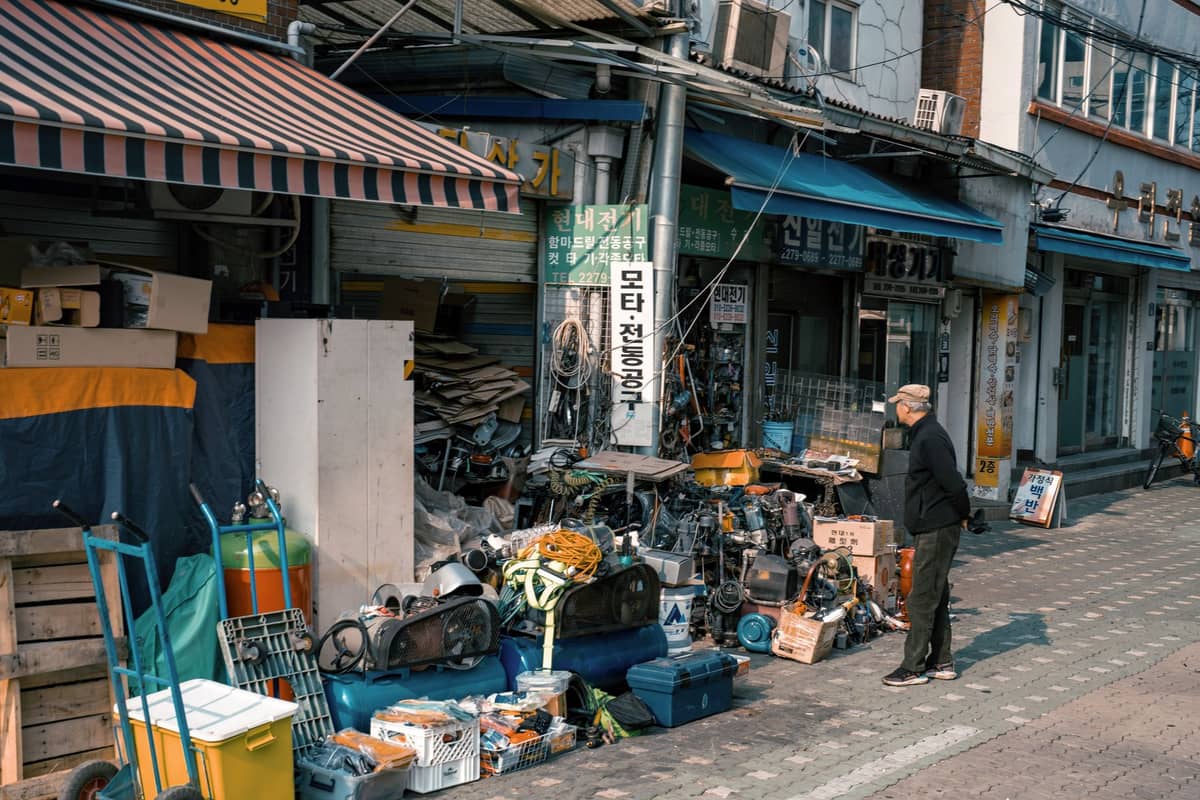
Dongmyo Flea Market (동묘벼룩시장) is Seoul's most unapologetically secondhand marketplace. Forget the curated vintage boutiques in Hongdae or the styled antique shops of Insadong. This is a working flea market where elderly vendors arrive early, spread plastic sheets across the pavement, and stack decades of accumulated goods into improbable towers: military canteens next to 1990s cassette players, hand-embroidered silk beside stacks of yellowed paperbacks, old Korean coins in cracked plastic trays.
The market operates year-round, Monday through Saturday from 10:00 to 17:00, and Sunday from 11:00 to 17:00. Admission is free. The address is 243 Nangye-ro, Jongno-gu, and it sits just a four-minute walk from Dongmyo Station (Lines 1 and 6), Exit 3.
💡 Local tip
Arrive before noon on a weekday for the fullest spread of goods and fewer crowds. Sunday afternoons see the largest turnout and also the fastest-moving inventory.
How the Market Is Laid Out
The market doesn't have a formal entrance or a map. From Exit 3, you'll follow the noise and the spread of tarpaulins down Nangye-ro, and the market unfolds sideways from there into adjacent lots and side alleys. There are roughly three zones, though their boundaries shift depending on the day and weather.
The outer street stalls along the main road sell the most accessible goods: vintage clothing, shoes, bags, and belts piled in bins. This is the most photogenic stretch and where younger visitors and foreign tourists tend to linger. Prices here are slightly higher because vendors know the audience.
Push further in, past the street food carts, and the character of the market shifts. Goods become more eclectic and frankly harder to categorize: analog measuring instruments, old construction tools, hand-painted wooden signs, stacks of military-issue gear with Korean army markings. The vendors here are largely older men who have been selling at Dongmyo for years. They are not performing nostalgia. This is their livelihood.
A third, more covered indoor section runs along the eastern edge of the main market area. This stretch tends to have more fragile or weather-sensitive items: ceramics, small electronics, books, and framed prints. It stays cooler in summer and is the section to duck into when it rains.
Tickets & tours
Hand-picked options from our booking partner. Prices are indicative; availability and final rates are confirmed when you complete your booking.
DMZ and Lake Majang Suspension Bridge Tour from Seoul
From 57 €Instant confirmationFree cancellationHalf Day DMZ Tour from Seoul, 3rd Tunnel, Observatory and More
From 47 €Instant confirmationFree cancellationSeoul zombie city exploration game and private tour
From 10 €Instant confirmationFree cancellationLuggage Storage in Seoul
From 7 €Instant confirmationFree cancellation
What You'll Find (and What You Won't)
The range of goods at Dongmyo is genuinely broad. Vintage Korean military jackets, often in good condition, are among the most consistently available finds and have become popular with younger shoppers. Denim from the 1980s and 1990s appears regularly. You can find leather goods, wristwatches in varying states of repair, and sunglasses in shapes that cycle back into fashion without anyone here caring about trends.
Antique and curiosity items are part of the market's character: old celadon-style ceramics (authenticity varies widely), wooden Korean furniture hardware, handwritten letters, vintage photographs. None of this is guaranteed to be authentic or valuable. Buyers should approach with curiosity, not expectation.
What you will not find here: designer labels (or convincing fakes of them), mainstream tourist souvenirs, or the kind of organized boutique experience you find in dedicated vintage markets in European cities. This market is genuinely random. That unpredictability is its appeal, and also its limitation.
⚠️ What to skip
Haggling is expected but should be done respectfully. Many vendors are elderly and set prices based on real knowledge of their goods. Aggressive bargaining is frowned upon. A polite counter-offer in basic Korean numbers, or a quiet gesture, usually works better than insistence.
How the Atmosphere Changes Through the Day
Early mornings before 10:00 are when vendors set up. If you arrive right at opening around 10:00 on a weekday, you'll see the market at maximum density. Everything is laid out, the light is good, and the crowd is composed almost entirely of local Korean shoppers. This is the most authentic window into how the market actually functions.
By midday, street food carts are running fully. The smell of tteokbokki (spicy rice cakes) and soondae (blood sausage) mixes with the faintly musty smell of old fabric and metal. The afternoon light flattens the outdoor displays a little, but the indoor and covered sections become easier to linger in. Foot traffic peaks between noon and 2:00 on weekends.
After 3:30, vendors begin packing up selectively, particularly those with goods spread on plastic sheets on the ground. If you're hoping for late-afternoon browsing, you may find a noticeably reduced selection. The market does not run into the evening, which separates it sharply from the nearby Dongdaemun fashion district that operates through the night.
Context: Why This Market Exists Here
Dongmyo Flea Market sits directly adjacent to Donggwanwangmyo (동관왕묘), a Joseon-era shrine dedicated to the Chinese general Guan Yu, built in the late 16th century after the Imjin War. The shrine is a designated Treasure and sits largely unnoticed by most market visitors, which is part of what makes this corner of Seoul unusual. The juxtaposition is distinctly Korean: ancient ceremonial architecture surrounded by piles of old cassette tapes. The shrine is worth a brief detour if you're in the area. For more of Seoul's historic sites, see our guide to palaces and heritage sites in Seoul.
The flea market itself is widely cited as having developed from the 1980s onward, growing around the informal secondhand trade that took root near this transit junction. It predates Seoul's current obsession with curated vintage culture by decades. The clientele reflects this: the majority of regular buyers at Dongmyo are older Korean locals, not tourists, which is a reliable indicator that this market functions on real supply and demand rather than atmosphere alone.
The surrounding Dongdaemun area is best known for its fashion wholesale markets and the futuristic Dongdaemun Design Plaza, but Dongmyo occupies an older, quieter corner of the district. The contrast between the two is pronounced and worth experiencing in a single visit.
Practical Walkthrough: Getting There and Moving Around
Take Seoul Subway Line 1 or Line 6 to Dongmyo Station and use Exit 3. The walk to the market takes about four minutes along Nangye-ro. The route is straightforward and flat. No significant hills or stairs are involved on the street-level approach, though uneven ground is common once you are inside the market itself due to the informal layout of goods spread directly on pavements and lots.
Accessibility for wheelchair users or those with limited mobility is not detailed in official sources. The station itself has elevator access, but the market's interior, with its unpaved sections, goods on the ground, and narrow lanes between vendors, presents real navigational challenges. Visitors with mobility considerations should plan accordingly.
Wear comfortable shoes with closed toes. The ground is irregular and, on damp days, muddy in some sections. If you are visiting in summer (June through August), Seoul's heat and humidity hit hard in open outdoor markets with little shade. Bring water. Winter visits (December through February) require warm layers as there is minimal shelter from wind. For seasonal planning, the best time to visit Seoul guide covers this in detail.
Cash is strongly advisable. Many vendors do not accept card payments. Korean won in small denominations (1,000 and 5,000 won notes) makes transactions smoother. There are convenience stores and ATMs near Dongmyo Station before you reach the market.
Eating Around the Market
The street food options around Dongmyo are genuinely good and priced for local shoppers rather than tourists. Look for soondae gukbap (blood sausage soup with rice), which is a neighborhood staple in this part of Jongno-gu. Several pojangmacha (outdoor food tents) serve makgeolli (rice wine) alongside light snacks. If you want a more comprehensive market food experience, Gwangjang Market is a short distance away and has one of Seoul's best-known indoor food halls.
For a broader look at what to eat in and around Seoul's traditional market areas, the Seoul street food guide covers the most reliable options by neighborhood.
Photography at Dongmyo
Dongmyo is visually rich. The combination of elderly vendors, layered textures of old goods, and the shrine's traditional roofline in the background creates a density of imagery that rewards patient photography. Morning light on weekdays is best for color and contrast. The covered indoor section is poorly lit and benefits from a camera or phone with strong low-light performance.
Ask before photographing individual vendors or customers. Some vendors are comfortable with it; others are not. A simple nod of the camera with eye contact usually communicates the question clearly enough across a language gap. Pointing a camera directly at goods without engaging the vendor first is considered rude.
ℹ️ Good to know
The Donggwanwangmyo shrine adjacent to the market is free to enter and rarely crowded. Its tiled roofline and stone courtyard provide a striking contrast to the market sprawl outside. Allow 15–20 minutes to walk through.
Insider Tips
- The best vintage military jackets and denim tend to disappear before noon on weekdays. If you're seriously shopping rather than browsing, go on a Tuesday or Wednesday morning when competition from other buyers is lowest.
- Prices on the outer street stalls are quoted slightly higher than in the interior lots. The same category of item, say a leather belt or vintage bag, will often be cheaper from a vendor whose goods are spread on a sheet in the inner section rather than hanging from a rack facing the main road.
- A few words of Korean numbers go a long way. Knowing how to say the numbers 5,000 through 30,000 in Korean, and being able to gesture and smile, will open more negotiation than any translation app.
- The shrine (Donggwanwangmyo) directly next to the market is a designated Treasure that almost no one visits during market hours. Slip in for 15 minutes before or after your browse. It costs nothing and is usually silent.
- If you are visiting in winter, the covered indoor corridor along the east side of the market stays warmer and has better lighting than the outdoor sections. This is also where the more delicate items (ceramics, books, prints) tend to be concentrated.
Who Is Dongmyo Flea Market For?
- Vintage clothing hunters looking for affordable, non-curated finds from Korean secondhand stock
- Antique and curiosity collectors willing to sift without guarantees
- Photographers interested in candid, documentary-style street scenes
- Travelers who want to see how older Seoulites shop, not just how tourists are expected to
- Budget travelers: free entry, low prices, and good street food within walking distance
Nearby Attractions
Other things to see while in Dongdaemun:
- Dongdaemun Design Plaza (DDP)
Dongdaemun Design Plaza, known as DDP, is one of Seoul's most striking structures: a vast, curvaceous building designed by the late architect Zaha Hadid, sitting where an old baseball stadium once stood. Free to enter the grounds and many public areas, with separate hours and fees for individual exhibitions, it serves as a cultural campus for design exhibitions, fashion weeks, and public events, and is just as compelling to explore from the outside as it is within.
- Gyeongdong Market
Gyeongdong Market (경동시장) is one of Seoul's most important traditional herbal medicine and dried goods markets, rooted in post-Korean War history. Sprawling across Jegi-dong in Dongdaemun-gu, it offers an unfiltered look at how Koreans source medicinal herbs, dried seafood, grains, and roots — a world away from the polished surfaces of the city's shopping malls.
- Heunginjimun Gate (Dongdaemun Gate)
Heunginjimun Gate, commonly called Dongdaemun Gate, is one of the last surviving city gates of old Seoul's fortress wall. Built during the Joseon Dynasty and designated a Treasure, it stands freely accessible around the clock at the heart of the Dongdaemun district, surrounded by one of the city's most chaotic and energetic intersections.
- Naksan Park
Naksan Park sits on a wooded hill in Jongno-gu, where a preserved stretch of Seoul's 600-year-old city wall traces the ridgeline above Ihwa-dong. Free to enter and open around the clock, it rewards visitors with panoramic views over the city, a quieter pace than downtown, and a genuinely different side of Seoul after dark.