Naksan Park: Seoul's City Wall Hilltop with Views Worth the Climb
Naksan Park sits on a wooded hill in Jongno-gu, where a preserved stretch of Seoul's 600-year-old city wall traces the ridgeline above Ihwa-dong. Free to enter and open around the clock, it rewards visitors with panoramic views over the city, a quieter pace than downtown, and a genuinely different side of Seoul after dark.
Quick Facts
- Location
- 41 Naksan-gil, Jongno-gu, Seoul (near Daehangno / Dongdaemun area)
- Getting There
- Hyehwa Station (Line 4), Exit 2 — uphill walk to the park
- Time Needed
- 1–2 hours for a full loop; 45 minutes for the viewpoint only
- Cost
- Free admission; open 24 hours daily
- Best for
- Sunset views, city wall walks, couples, and evening strolls
- Official website
- english.seoul.go.kr/naksan-park-3
What Naksan Park Actually Is
Naksan Park is a public hilltop park in Jongno-gu, Seoul, built along the ridge of Naksan Mountain, one of the four inner mountains that historically enclosed the old capital. At roughly 125 metres above sea level, Naksan is one of Seoul's four guardian mountains, but its position directly northeast of the city centre makes it a surprisingly useful perch for looking back over the rooftops of Ihwa-dong, across Dongdaemun, and toward the Han River on clear days., but its position directly northeast of the city centre makes it a surprisingly useful perch for looking back over the rooftops of Ihwa-dong, across Dongdaemun, and toward the Han River on clear days.
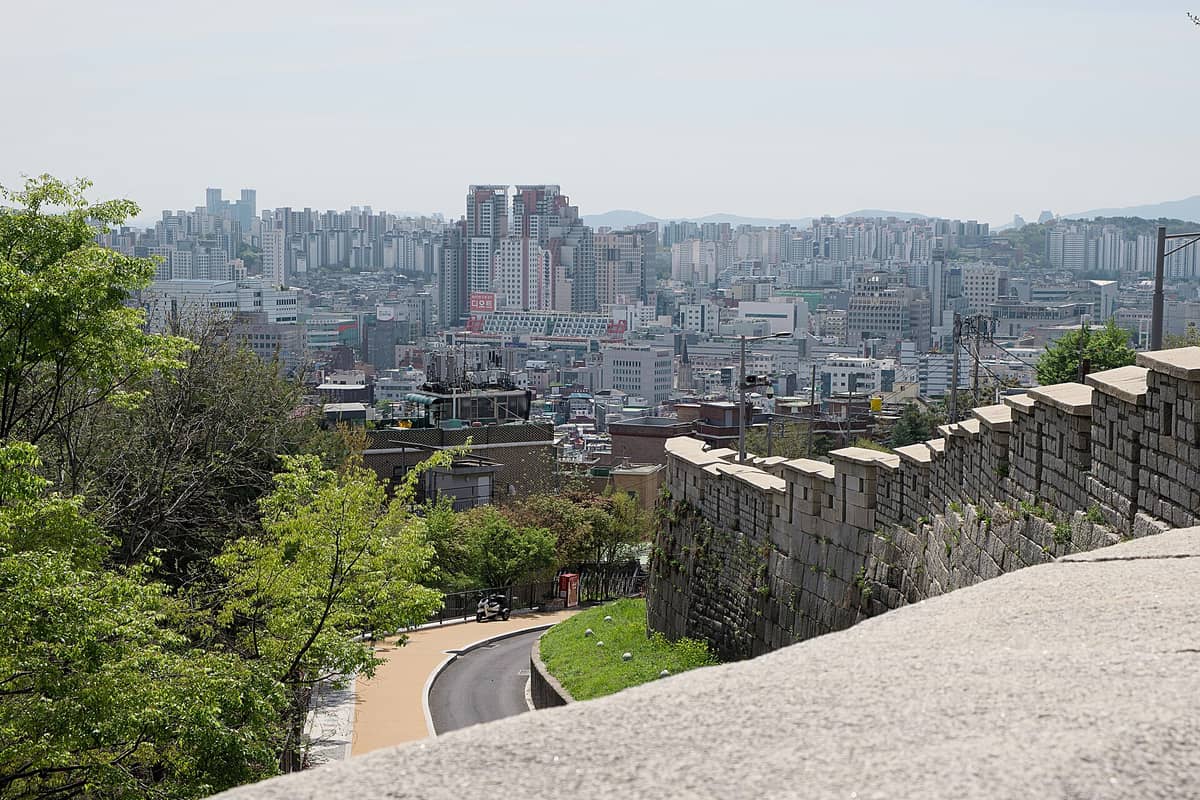
The park was established in 2002. Today it preserves a restored section of Hanyangdoseong, the Seoul City Wall originally built in 1396 under King Taejo to demarcate and defend the Joseon capital. Walking beside that wall — the cut granite and rough fieldstone alternating in a patchwork that reveals successive restoration eras — gives the park a historical weight that a simple green space would not.
💡 Local tip
The park is free and open 24 hours. The Naksan Exhibition Hall within the park has separate hours (9:00–17:00) if you want context on the city wall's history. Confirm current hours at the gate, as they can shift seasonally.
The Walk Up: What to Expect on Arrival
From Hyehwa Station Exit 2, the route to the park climbs steadily through the Ihwa-dong neighbourhood for about 10–15 minutes. The alley is steep in places and lined with low-rise homes, small cafes, and the occasional street mural. It is not a polished tourist corridor; it is a working residential neighbourhood on a hillside, and that texture is part of the appeal. Wear flat, closed shoes with grip. Heels are genuinely impractical here, and the stone-paved alleys can be slippery after rain.
As you gain elevation, the city noise drops. By the time you reach the park entrance and the first stretch of city wall, you can hear birds rather than traffic. The transition is noticeable and one of the reasons locals treat this as a decompression walk rather than a tourist attraction in the conventional sense.
Naksan Park sits at the northern edge of the Dongdaemun area, but its atmosphere has almost nothing in common with the commerce and neon of Dongdaemun Design Plaza a kilometre downhill. It also connects, via the city wall trail, to the broader Hanyangdoseong Seoul City Wall route — a longer hike that links several peaks around the old city if you want to extend the day.
Tickets & tours
Hand-picked options from our booking partner. Prices are indicative; availability and final rates are confirmed when you complete your booking.
DMZ and Lake Majang Suspension Bridge Tour from Seoul
From 57 €Instant confirmationFree cancellationHalf Day DMZ Tour from Seoul, 3rd Tunnel, Observatory and More
From 47 €Instant confirmationFree cancellationSeoul zombie city exploration game and private tour
From 10 €Instant confirmationFree cancellationLuggage Storage in Seoul
From 7 €Instant confirmationFree cancellation
The View: What You Actually See from the Top
The main viewpoint faces southwest and west, which means the sight lines open toward central Seoul, with Namsan and Seoul Tower visible on clear days. In autumn and spring, the air is clean enough to resolve individual buildings in Gangnam across the river. In summer humidity, haze often softens the far skyline to silhouettes, which is still atmospheric, just less crisp.
Directly below the ridge, the Ihwa-dong rooftops step down the hillside in the compact, irregular pattern of a neighbourhood that preexists zoning. Old low-rise homes, small studio apartments, and rooftop water tanks create a foreground that feels genuinely different from the planned urban geometry you see from most other Seoul viewpoints. It is the kind of view that rewards a slow look rather than a quick photograph.
If skyline views are a priority for your Seoul trip, Naksan pairs well with the observation deck at Namsan Seoul Tower for a contrasting perspective — one panoramic and commercial, the other free, unmediated, and embedded in a neighbourhood. For a ranked look at Seoul's best observation points, the best views in Seoul guide covers the full range.
How the Park Changes Through the Day
Morning visits, roughly 7:00–9:00, attract local residents doing exercise walks along the wall path. The light is soft and comes from behind you if you are facing west, which is not ideal for photography but makes the surrounding greenery look sharp and well-lit. It is the quietest time of day, and the park has a neighbourhood park quality: people stretching, older residents sitting on benches, the smell of damp earth and pine.
Midday is the least interesting window. The overhead light flattens the view, the benches fill with lunch-break visitors from nearby university areas, and Hyehwa Station's proximity to Daehangno — Seoul's theatre district — means student and arts-crowd foot traffic increases. It is not unpleasant, but there is no particular reason to choose noon over other times.
Sunset is when Naksan Park earns its reputation. Arrive 30–40 minutes before the sun drops behind Bugaksan to the northwest, claim a spot along the western-facing wall, and wait. The city lights begin to populate the grid below while the sky shifts through orange and blue above the ridgeline. On weekends this section of wall fills with couples and photographers, and the atmosphere is genuinely warm without being crowded in an uncomfortable way.
After dark, the city wall is lit from below, casting the stonework in amber light against the night sky. The surrounding neighbourhood has low ambient light, so the contrast between the lit wall and the dark hillside is stark and photographically useful. The park is open 24 hours, and evening walkers are common enough that solo visitors should feel comfortable, though the unlit sections of path away from the wall are darker than you might expect.
ℹ️ Good to know
Sunset timing varies significantly across seasons. In late autumn and winter, sunset can arrive as early as 17:30. In summer it is closer to 19:45. Check the specific date before planning an evening visit.
The City Wall Stretch: Historical Context
The section of Hanyangdoseong visible in Naksan Park is one of the more instructive along the entire 18.6-kilometre circuit. The stonework shows layers from different periods of restoration, giving the park a tactile history lesson that most museum displays cannot match. Standing at the wall and reading these layers is a more tactile history lesson than most museum displays.
Naksan, translated roughly as 'camel mountain', was historically one of the four inner mountains of Seoul, and the 2002 park establishment reversed some of that, replanting trees and restoring wall sections that had been dismantled or buried. The 2002 park establishment reversed some of that, replanting trees and restoring wall sections that had been dismantled or buried.
For a deeper understanding of the full wall's history and how to walk the complete circuit, the hiking in Seoul guide covers the Hanyangdoseong trail in detail alongside other mountain walks around the city.
Practical Details and Getting There
Naksan Park is reached most directly from Hyehwa Station on Seoul Metro Line 4, Exit 2. From the exit, follow the road uphill through Ihwa-dong, using the signage for Naksan Park or the Hanyangdoseong trail markers. Google Maps navigation is reliable here, and the route is well-signed in Korean and English for most of the climb.
There is no vehicle access to the hilltop park area. Taxis can drop you at the base of the Ihwa-dong neighbourhood, cutting a few minutes off the walk, but you will still climb the last section on foot. The incline is consistent rather than steep, comparable to a long escalator in effort, but for visitors with limited mobility or knee problems, the gradient on the return descent can be uncomfortable. There are no elevators or ramps to the main viewpoint.
The T-money transit card, The T-money transit card, available at many subway stations and convenience stores, covers bus and metro fares across Seoul and is the most convenient option for getting around the city. The T-money system also works on city buses if you prefer to approach from a different direction., covers bus and metro fares across Seoul and is the most convenient option for getting around the city. The T-money system also works on city buses if you prefer to approach from a different direction.
If you are combining Naksan Park with a broader Dongdaemun-area day, it works well as an opening or closing segment. The Dongdaemun Design Plaza is roughly 1.5 kilometres downhill to the south, and Heunginjimun Gate — the great eastern gate of the old city wall — is a short walk from DDP and completes a logical historical circuit from the wall section at Naksan.
Who Should Skip This, and When to Reconsider
Naksan Park is not for visitors who want spectacle or structured sightseeing. There are no entrance gates, no ticketed exhibits to work through, no restaurants inside the park, and no guides on duty. It is a public hillside park with a view. If your Seoul itinerary is short and you need to prioritise, a major palace or the Namsan tower observation deck will give you more layered content per hour.
In heavy summer rain or winter ice, the stone paths and alleys leading up are genuinely hazardous. The park does not close in bad weather, but visiting during or immediately after significant rainfall adds real risk to the uphill walk. Winter visits are possible and the lit wall against snow can be striking, but ice on the sloped alleys of Ihwa-dong demands traction footwear.
⚠️ What to skip
Avoid Naksan Park in heavy rain or immediately after: the stone alleys through Ihwa-dong become slippery, and parts of the wall path can be muddy. Winter ice on the approach streets is also a genuine hazard without appropriate footwear.
Insider Tips
- The best photography angle on the city wall is from the lower terrace looking uphill toward the wall crenellations with the Seoul skyline behind. This requires walking a little past the main viewpoint and turning back — most visitors stop at the first bench and miss it.
- The Ihwa Mural Village, which lines the alleys below the park in Ihwa-dong, is busiest on weekend afternoons. If you want the neighbourhood quiet, arrive on a weekday morning when the murals are there but the crowds are not.
- There is a small convenience store at the base of the Ihwa-dong alley near Hyehwa Station. Stock up on water and snacks before climbing — there are no vendors inside the park.
- For the best sunset position, walk north along the wall from the main viewpoint until you find a gap in the treeline facing southwest. The unobstructed angle from this spot is better than the main terrace but requires about five extra minutes of walking.
- The Naksan Exhibition Hall near the park entrance covers the history of the city wall with maps and artefacts. It is small, free, and often empty — worth ten minutes if you arrive before 17:00.
Who Is Naksan Park For?
- Couples looking for a quiet, free sunset spot away from tourist crowds
- History and architecture enthusiasts interested in the Joseon-era city wall up close
- Photographers who want a neighbourhood-scale cityscape rather than a skyscraper panorama
- Travellers combining a half-day in the Dongdaemun and Jongno areas
- Morning walkers and runners who want a green, elevated route before the city wakes up
Nearby Attractions
Other things to see while in Dongdaemun:
- Dongdaemun Design Plaza (DDP)
Dongdaemun Design Plaza, known as DDP, is one of Seoul's most striking structures: a vast, curvaceous building designed by the late architect Zaha Hadid, sitting where an old baseball stadium once stood. Free to enter the grounds and many public areas, with separate hours and fees for individual exhibitions, it serves as a cultural campus for design exhibitions, fashion weeks, and public events, and is just as compelling to explore from the outside as it is within.
- Dongmyo Flea Market
Dongmyo Flea Market (동묘벼룩시장) is unlike anything else in Seoul. Spread across open lots and narrow alleys near Jongno-gu, it draws antique hunters, vintage fashion seekers, and elderly Koreans haggling over old tools and military surplus. Entry is free, the atmosphere is raw, and the finds are genuinely unpredictable.
- Gyeongdong Market
Gyeongdong Market (경동시장) is one of Seoul's most important traditional herbal medicine and dried goods markets, rooted in post-Korean War history. Sprawling across Jegi-dong in Dongdaemun-gu, it offers an unfiltered look at how Koreans source medicinal herbs, dried seafood, grains, and roots — a world away from the polished surfaces of the city's shopping malls.
- Heunginjimun Gate (Dongdaemun Gate)
Heunginjimun Gate, commonly called Dongdaemun Gate, is one of the last surviving city gates of old Seoul's fortress wall. Built during the Joseon Dynasty and designated a Treasure, it stands freely accessible around the clock at the heart of the Dongdaemun district, surrounded by one of the city's most chaotic and energetic intersections.