Calouste Gulbenkian Museum: Lisbon's Most Remarkable Art Collection
The Calouste Gulbenkian Museum houses one of the world's most coherent private art collections, spanning ancient Egypt to early 20th-century Europe across more than 6,000 objects. Set within a beautifully landscaped 7.5-hectare garden, the museum is closed for renovation until July 2026. Plan ahead and this will be one of Lisbon's most rewarding cultural experiences.
Quick Facts
- Location
- Avenida Berna 45A, 1067-001 Lisboa — northern edge of Parque Eduardo VII
- Getting There
- Metro: São Sebastião (Blue/Yellow lines) or Praça de Espanha (Blue Line) — 5-minute walk
- Time Needed
- 2.5 to 4 hours for the museum; add 1 hour if visiting the gardens
- Cost
- Check gulbenkian.pt for current pricing — free on Sundays (verify before visiting)
- Best for
- Art lovers, history enthusiasts, and anyone wanting depth over spectacle
- Official website
- gulbenkian.pt/en/museum/
⚠️ What to skip
The Calouste Gulbenkian Museum is closed for renovation until July 2026. Confirm the reopening date on the official website before including it in your itinerary.
What Makes This Museum Worth the Journey
The Calouste Gulbenkian Museum is not a national collection assembled by committee. It is the intensely personal accumulation of a single man: Calouste Sarkis Gulbenkian, an Armenian-British oil magnate who spent decades acquiring objects not for investment or prestige, but because he genuinely could not stop. That distinction matters. Where many museums feel encyclopedic, the Gulbenkian feels curated with a personality behind every case.
The collection spans more than 5,000 years of human art-making across over 6,000 objects: ancient Egyptian faience, Mesopotamian cylinder seals, Islamic manuscripts with illuminations so precise they make modern printing look coarse, Flemish portraits, French furniture, Lalique jewelry, and Impressionist paintings. Yet the galleries never feel overcrowded. This is a museum that trusts its objects to speak without shouting.
For context, the Gulbenkian consistently ranks among Europe's top art museums, yet remains far less crowded than comparable institutions in Paris or London. If you are building a Lisbon itinerary around culture, this belongs at the top alongside the National Tile Museum and Jerónimos Monastery.
The Collection: A Room-by-Room Orientation
The museum is organized roughly chronologically and geographically, beginning with ancient civilizations and moving through Islamic and Oriental art before transitioning into European works. The layout rewards a slow, sequential approach rather than darting between highlights.
The ancient Egypt section contains objects of unusual intimacy: amulets, small bronze figures, and scarabs that sit at eye level in low cases. There is no grand pharaonic stonework here; instead, you find the everyday and the devotional objects of a civilization that Gulbenkian found deeply compelling. From there, Greek and Roman coins and medals lead into the Islamic art galleries, which are among the finest in any European institution.
The Islamic manuscripts, Persian rugs, and mosque lamps in this section deserve real time. The illuminated pages in particular, some from 13th and 14th-century Persia, use lapis lazuli and gold leaf in combinations that photography cannot replicate. The gallery lighting is calibrated carefully, kept low to preserve the pigments, which means your eyes take a moment to adjust before the detail resolves.
The European galleries cover Old Masters, 18th-century French decorative arts, and 19th-century paintings including works by Turner, Manet, Monet, and Degas. Gulbenkian had a documented affection for Rembrandt, and the two portraits in the collection are displayed with enough wall space around them to be properly absorbed. The final rooms pivot to René Lalique's jewelry and glasswork, which Gulbenkian commissioned directly during his lifetime, making this the largest Lalique collection in the world.
Tickets & tours
Live prices and dates from our booking partner. If you book, we may earn a commission at no extra cost to you.
Belem and Modern Lisbon bus hop-on hop-off combined tickets
From 28 €Instant confirmationFree cancellationSt. George Castle E-ticket and Audio Tour
From 28 €Instant confirmationLisbon Story Centre entrance tickets
From 7 €Instant confirmationFree cancellationYellow boat river tour
From 24 €Instant confirmationFree cancellation
The Architecture and Gardens
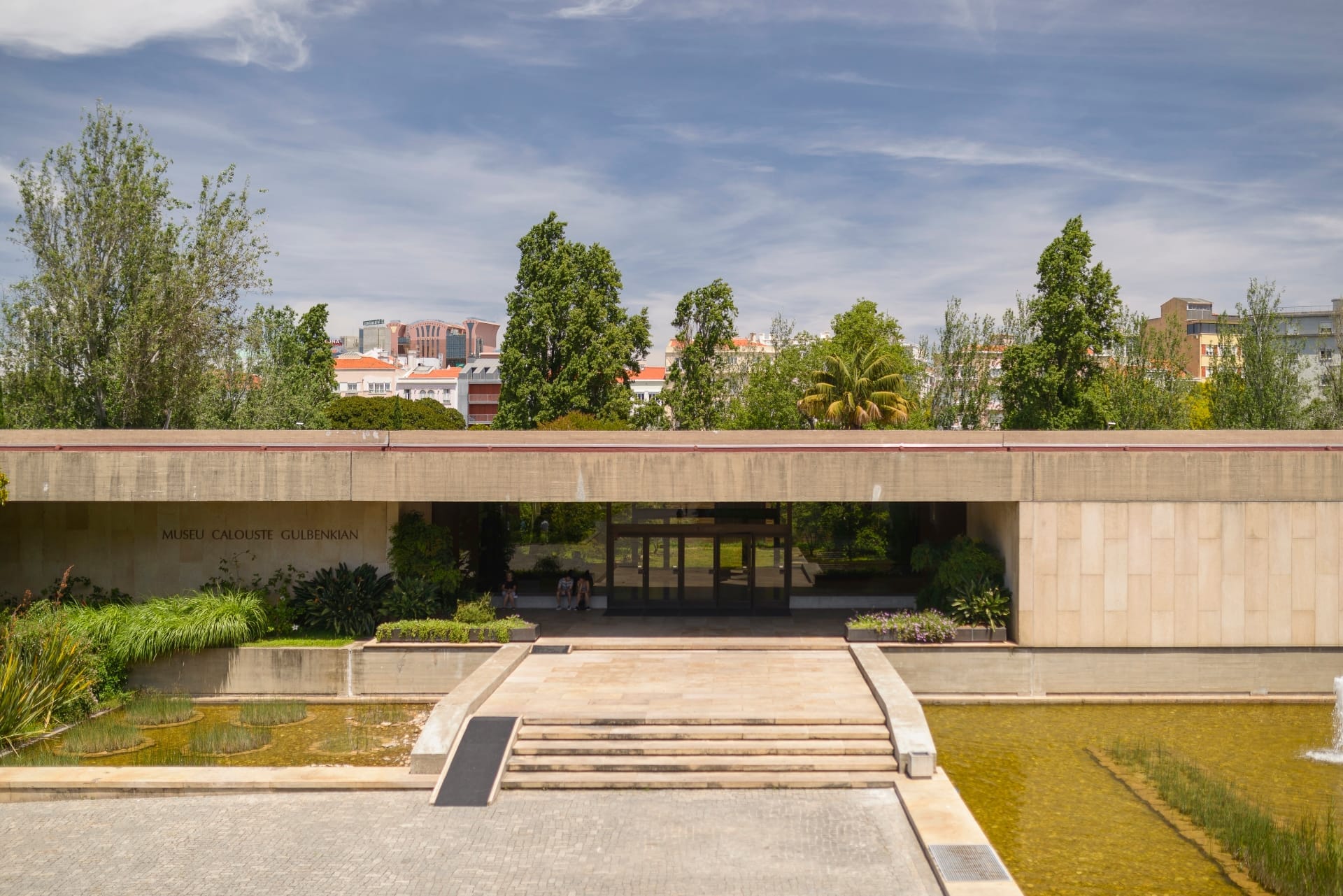
The museum building itself, completed in 1969 and designed by architects Ruy Jervis d'Athouguia, Pedro Cid, and Alberto Pessoa, is a thoughtful piece of mid-century modernism. The exterior is concrete and granite, deliberately low-profile, so that the structure settles into its landscape rather than competing with it. From outside, the building reads almost as understated. Inside, the interplay between gallery spaces and the views out to the gardens creates a rhythm that many larger institutions fail to achieve.
The surrounding park, 7.5 hectares designed in the 1960s by landscape architect Gonçalo Ribeiro Teles and António Barreto, functions as a genuine destination in its own right. Mature trees, a pond with ducks and terrapins, lawns that fill with office workers and students at lunchtime, and winding paths that feel genuinely peaceful despite sitting within a major European capital. On a spring morning, the gardens catch the light in a way that makes the short walk from the metro feel like a decompression chamber between the city and the art.
If you are combining the museum with nearby attractions, Parque Eduardo VII is a 10-minute walk south, and the surrounding São Sebastião neighborhood has several good lunch options between the two.
When to Visit and How the Experience Changes by Time of Day
Morning visits, particularly on weekdays, offer the museum at its most tranquil. The galleries are quiet enough that you can stand in front of a Turner seascape or an Islamic rug for several uninterrupted minutes, which is genuinely rare in European museum culture. The natural light in the building shifts through the morning as the sun moves around the exterior gardens, changing the ambient mood of certain rooms noticeably.
Afternoons bring more visitors, particularly school groups and organized tours. The audio is manageable but the energy is different. Sunday afternoons tend to be the busiest, partly because admission has historically been free on Sunday mornings (verify current policy on the official website before visiting). If free admission is available, arrive at opening time on a Sunday to get the quiet morning with the financial benefit.
💡 Local tip
The gardens are lovely in late afternoon when the light is lower and the crowds from the museum thin out. Combine a morning in the galleries with a slow walk through the park before heading elsewhere in the city.
Weather affects the garden component significantly more than the museum itself, which is climate-controlled throughout. On rainy days, the indoor experience is unchanged, but the visual connection between gallery windows and the park is muted. Lisbon's rainy season runs October through April, so if gardens matter to you, aim for May through September.
Getting There and Practical Logistics
The museum sits in the northern residential part of Lisbon, well outside the historic core. It is not walkable from Alfama or Baixa without significant effort, and that distance keeps casual foot traffic low, which benefits the experience considerably.
The most convenient access is via the Lisbon Metro. Both São Sebastião station (Blue and Yellow lines) and Praça de Espanha station (Blue Line) are within a 5-minute walk of the main entrance. If you are already using Lisbon's public transport network, a single Viva Viagem card covers all metro journeys and eliminates the need to buy individual tickets.
Uber and Bolt both operate reliably in this area. From Baixa-Chiado, expect a 10-15 minute journey depending on traffic. Parking is available nearby but Lisbon city traffic, particularly mid-morning and late afternoon, makes driving less predictable than public transit.
The museum has a free cloakroom, free Wi-Fi, a museum shop, and three cafeteria spaces. The main café, looking out toward the garden, is genuinely pleasant for a mid-visit break. Tickets are available online and at the ticket office on site. Online booking is advisable during high season to avoid queuing.
ℹ️ Good to know
Accessibility: The building is single-level and designed with multiple openings to the exterior. For specific accessibility accommodations, contact the museum directly at museu@gulbenkian.pt or +351 217 823 000 before your visit.
Photography Inside the Museum
Personal photography without flash is permitted throughout most of the permanent collection. The challenge is that many of the most extraordinary objects, particularly the Islamic manuscripts and the Lalique pieces, are displayed in low-light conditions that require patience and a steady hand. A smartphone with a good low-light sensor will produce more usable results than a DSLR with a large lens in these tight gallery spaces.
The gardens provide better photography conditions for natural light shots and architectural framing. If you are building a Lisbon photography itinerary, the museum exterior and garden pond area offer a different aesthetic from the more frequently photographed spots in the city.
Who Will Love This and Who Should Look Elsewhere
The Gulbenkian rewards visitors who approach it with curiosity and at least modest familiarity with art history. Children under ten may find the experience long, though the garden offers a genuine release valve. Travelers primarily interested in Lisbon's Moorish history, fado culture, or coastal scenery will find other parts of the city more immediately engaging.
If you have limited time in Lisbon and are choosing between major attractions, consider that the Gulbenkian requires at least half a day to do it justice. It does not combine as naturally with Alfama or Belém as those two neighborhoods combine with each other. But if your itinerary has room, it is the kind of place that tends to be the unexpected highlight of a Lisbon trip for visitors who were not expecting to spend three hours absorbed in art. See our guide to the best museums in Lisbon to compare options before you decide.
Insider Tips
- The Lalique gallery at the end of the European collection is easy to rush through because it comes after a lot of painting. Slow down here. The jewelry cases contain pieces made to Gulbenkian's personal commission, and the detail in the enamelwork is extraordinary up close.
- The museum shop stocks genuinely good reproductions and design objects inspired by the collection. It is one of the better museum shops in Portugal and worth browsing even if you are not a heavy souvenir buyer.
- If you visit on a Sunday when free admission is offered, arrive at opening time. By 11am the lobby fills noticeably. The first hour of a free-admission Sunday morning is as quiet as a regular weekday.
- Pack a picnic and use the garden after the museum. The lawns near the pond are a legitimate Lisbon lunch spot used by locals who work in the surrounding neighborhood, not just tourists.
- The Modern Collection, housed in a separate building on the same campus and covering 20th-century Portuguese and international art, has its own distinct program and is worth checking separately on the official website for exhibitions running alongside your visit.
Who Is Gulbenkian Museum For?
- Art and history enthusiasts who want depth over a checklist approach
- Couples looking for a slower, more contemplative half-day experience
- Repeat visitors to Lisbon who have already covered the major historic sites
- Travelers visiting in summer who want a cool, uncrowded interior during peak heat
- Anyone interested in Islamic art, as the Gulbenkian's Islamic collection is among Europe's finest and least-visited
Nearby Attractions
Combine your visit with:
- Aqueduto das Águas Livres
Standing 65 metres above the Alcântara Valley on 35 soaring Gothic arches, the Aqueduto das Águas Livres is one of the most extraordinary feats of 18th-century engineering in Europe. Free to admire from street level and easy to combine with other west-Lisbon sights, it rewards visitors who look up from the city's quieter edges.
- Cabo da Roca
Cabo da Roca is the westernmost point of mainland Europe, a wind-scoured cape rising 165 metres above the Atlantic Ocean in the Sintra-Cascais Natural Park. It combines raw coastal scenery, genuine historical weight, and easy access from both Lisbon and Sintra into one of Portugal's most geographically significant stops.
- Cascais
Forty minutes west of Lisbon by train, Cascais trades the capital's urban intensity for whitewashed streets, Atlantic beaches, and a marina ringed by seafood restaurants. Once the summer retreat of Portuguese kings, it remains one of the most complete day trips available from Lisbon.
- Costa da Caparica Beaches
Costa da Caparica stretches 30 kilometres down the Atlantic coast, just 30 minutes from central Lisbon. Free to access year-round, it ranges from family-friendly Blue Flag beaches near the town centre to quieter surf breaks and nudist sections further south, backed by fossil-rich cliffs protected as a nature reserve.
Planning a trip? Discover personalized activities with the Nomado app.