Parque Eduardo VII: Lisbon's Grand Hilltop Park
Stretching 25 hectares above Marquês de Pombal Square, Parque Eduardo VII is Lisbon's most formally designed public park. Free to enter and open daily, it rewards visitors with a panoramic view over the city's central boulevard, a pair of tropical greenhouses, and enough shade and lawn to slow the pace of a busy itinerary.
Quick Facts
- Location
- Avenida Sidónio Pais, north of Marquês de Pombal Square, Lisbon
- Getting There
- Metro: Parque (Blue Line); Buses: 203, 713, 726, 742, 746
- Time Needed
- 45 minutes to 2 hours depending on greenhouse visit
- Cost
- Free (park); greenhouse admission applies
- Best for
- Views, morning walks, families, photography
- Official website
- www.golisbon.com/sight-seeing/edward-park.html
What Parque Eduardo VII Actually Is
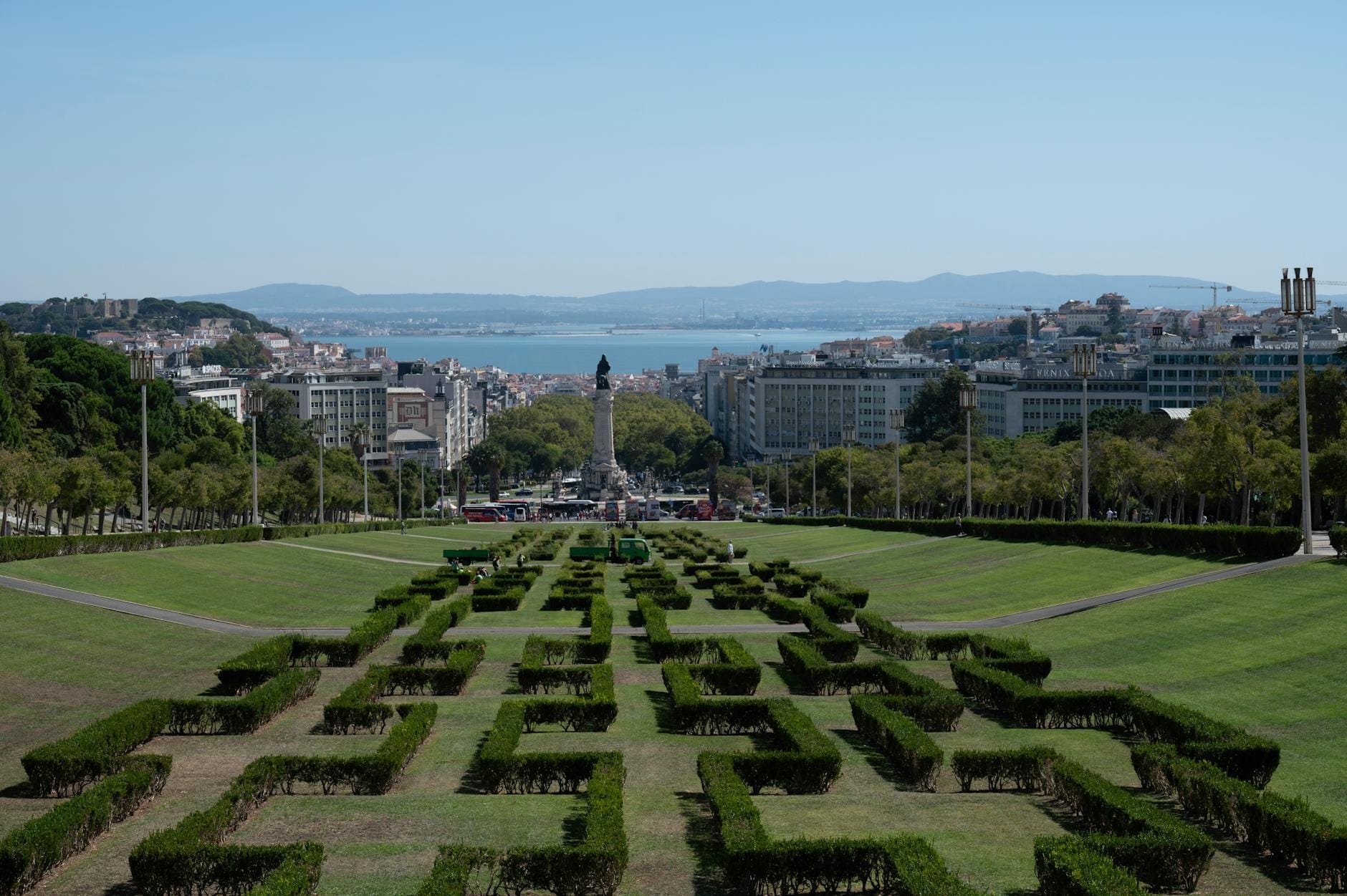
Parque Eduardo VII is a 25-hectare formal park that climbs the hillside directly north of Marquês de Pombal Square, at the top of Lisbon's grand central avenue. It is the largest park in the city centre, named in 1903 to mark a state visit by King Edward VII of Britain. Before that, it was called Parque da Liberdade. The park was substantially redesigned in 1945 by Portuguese architect Francisco Keil do Amaral, who gave it the symmetrical, sloping layout still visible today: a wide clipped boxwood parterre running up the central axis, flanked by paths, lawns, and wooded edges.
It is not a park that surprises you with secret corners. The design is monumental and deliberate: two long hedgerow borders in a geometric pattern frame the central carpet of manicured greenery, and the whole structure funnels your gaze upward toward the belvedere at the summit. What makes the visit worthwhile is precisely that endpoint — and the two greenhouses that flank the upper section of the park.
💡 Local tip
Enter from the bottom (Marquês de Pombal side) and walk uphill. The view improves with every step and you get the full panoramic payoff at the top rather than starting with it.
The View from the Top
The belvedere at the park's northern summit is the main event. From this elevated point, the entire length of Avenida da Liberdade stretches south below you in a straight line, flanked by trees and traffic lanes, dissolving into the tighter grid of Baixa and, on clear days, the Tagus River glinting at the far end. The scale of the view is genuinely impressive: you can see roughly four kilometres of city from a single fixed point.
On hazy summer mornings, the lower city loses definition and the river becomes more suggestion than fact. In autumn and winter, when Atlantic light sharpens the air, the view extends clearly to the hills of Alfama and the castle silhouette beyond. Sunset from this terrace turns the avenue into a corridor of orange light. If you are compiling a list of places to photograph Lisbon from above, this belongs on it alongside the traditional miradouros.
For a comparison of all the city's elevated viewpoints, the best viewpoints in Lisbon guide covers the full range — from informal hilltop terraces to purpose-built platforms.
Tickets & tours
Live prices and dates from our booking partner. If you book, we may earn a commission at no extra cost to you.
Belem and Modern Lisbon bus hop-on hop-off combined tickets
From 28 €Instant confirmationFree cancellationSt. George Castle E-ticket and Audio Tour
From 28 €Instant confirmationLisbon Story Centre entrance tickets
From 7 €Instant confirmationFree cancellationYellow boat river tour
From 24 €Instant confirmationFree cancellation
The Greenhouses: Estufa Fria and Estufa Quente
On the western edge of the upper park sit two greenhouses that are worth your attention even if you are not ordinarily interested in plants. The Estufa Fria (Cool Greenhouse) is the more unusual of the two: a large covered structure with a slatted wooden roof that filters light without retaining heat, creating a year-round microclimate for ferns, palms, and subtropical species. Inside, paths wind past ponds, stone bridges, and a dense canopy that makes the space feel more like a ravine than a greenhouse. The scale is larger than most visitors expect.
Adjacent to it, the Estufa Quente (Hot Greenhouse) and Estufa Doce house warm-climate species including cacti, succulents, and flowering tropicals. These are glass-enclosed and properly warm, which makes them a genuine refuge on a cold or rainy winter day. The combined complex is one of the more underappreciated horticultural sites in the city, and entry fees are modest.
ℹ️ Good to know
The greenhouses (Estufa Fria, Estufa Quente, Estufa Doce) have separate admission fees and their own opening hours, which may differ from the open park. Check the Câmara Municipal de Lisboa website or the on-site signage before planning a visit around them.
How the Park Changes Through the Day
Early mornings, particularly on weekdays, the park belongs to Lisbon residents: joggers on the perimeter paths, dog walkers across the lawns, the occasional retiree on a bench with a newspaper. The light at this hour is soft and low, catching the formal hedgerows at an angle that makes the geometry of the parterre read cleanly. If you want the view from the top with no one in it, arrive before 9am.
By mid-morning the tour groups begin filtering in from the nearby metro station, and the upper belvedere collects its first clusters of visitors with cameras. Midday in summer is the least comfortable time: the central parterre is almost entirely exposed, and the stone surfaces of the upper terrace radiate heat. If you are visiting in July or August, the shaded wooded edges of the park are a better option for sitting, and the greenhouses become an air-conditioned alternative.
Late afternoon light is the best for photography of the avenue view. The sun drops toward the west and the long shadows of the trees along Avenida da Liberdade create strong graphic lines in the composition. The park fills again after work hours with a local crowd, and the atmosphere shifts from tourist attraction to neighbourhood green space.
Getting There and Getting Around the Park
The easiest approach is Metro Parque on the Yellow Line, which deposits you directly at the lower entrance on the park's southern edge. From there, the walk to the belvedere is entirely uphill — not steep, but sustained. Allow ten to fifteen minutes at a comfortable pace. Buses 203, 713, 726, 742, and 746 also stop nearby.
The park is a natural endpoint or starting point if you are walking the length of Avenida da Liberdade. Starting from Rossio Square at the bottom and walking north through Baixa-Chiado and up the avenue to the park takes around 25 to 30 minutes at a tourist pace and covers a representative cross-section of the city centre.
The park's central axis is paved and manageable for pushchairs and wheelchairs, though the incline is real. The perimeter paths vary in surface quality. The greenhouses have their own entrance structures; check these directly for step-free access details.
💡 Local tip
Wear shoes with grip. The decorative tile inlays near the upper terrace can be slippery when wet, and Lisbon's autumn mornings bring enough moisture to make smooth soles a problem.
Historical and Urban Context
The park's location at the top of Avenida da Liberdade is not incidental. The avenue itself was constructed in the 1880s as Lisbon's answer to Paris's Champs-Élysées, and the park serves as its formal terminus, anchoring the northern end with a green mass that closes the perspective. The renaming in 1903 after King Edward VII cemented the boulevard's aspirations toward European grandeur, even if the comparison with Paris always required some goodwill.
Keil do Amaral's 1945 redesign introduced the current boxwood parterre patterns, which are maintained today by the city's parks department. The manicured hedgerows in the central strip are trimmed into low geometric shapes that are visually striking from the elevated paths but somewhat abstract at ground level. This is a park designed to be read from above as much as walked through.
If you want to connect the park to a broader understanding of Lisbon's central districts, the Lisbon walking tours guide covers routes that link this area with the historic core.
Honest Assessment: Who This Is For and Who Might Skip It
Parque Eduardo VII is not one of Lisbon's most emotionally resonant places. It does not have the character of Alfama's backstreets or the intimacy of the smaller gardens around Estrela. What it does have is scale, a genuinely excellent panoramic view, and the practical value of free open green space in the middle of a city that is increasingly crowded.
Travellers on a tight two-day itinerary may find that the view, while good, is not so dramatically different from other accessible viewpoints that it justifies a dedicated trip. If you are already walking the avenue or staying in the Marquês de Pombal area, the park is an easy addition and worth your time. If you are coming specifically for a viewpoint experience, the miradouros in Alfama or Graça tend to offer more atmosphere alongside the panorama.
Families with children will find the open lawns and the greenhouse's unusual enclosed environment genuinely engaging. The park also works well as a starting point if you plan to continue to Gulbenkian Museum, which is a short walk to the northwest and represents one of the city's best indoor cultural experiences.
Insider Tips
- The best photographic position for the avenue view is not from the very top of the central axis, but from the slightly raised stone balustrade about ten metres back from the edge. This gives you framing from the hedgerows and clears any railing from the foreground.
- If you visit in late spring, the rose garden on the park's western edge is in full colour and almost always quiet, even when the main parterre is busy.
- The café near the upper section of the park is a practical rest stop but unremarkable. For a better coffee, walk back down to the streets around Marquês de Pombal Square, where there are several local pastelarias with outdoor seating.
- Estufa Fria in particular is significantly cooler than the open park on hot summer days. If you are visiting in July or August and need a break from the heat, the slatted-roof greenhouse interior is one of the more unusual places in the city to cool down.
- The park hosts occasional outdoor events and concerts, particularly in summer. Check the Câmara Municipal de Lisboa events calendar if you are visiting between June and September, as the upper terrace sometimes hosts evening performances.
Who Is Parque Eduardo VII For?
- Travellers who want a panoramic city view without climbing steep cobbled streets
- Families needing open lawn space and an interactive greenhouse to break up a sightseeing day
- Photographers working the golden hour above Avenida da Liberdade
- Early-morning walkers looking for a quiet green circuit before the city wakes up
- Anyone combining a visit with the nearby Gulbenkian Museum
Nearby Attractions
Other things to see while in Baixa & Chiado:
- A Ginjinha
Open since 1840 and still run by the same family, A Ginjinha is the counter-sized bar that started Lisbon's love affair with ginjinha. There's no seating, no menu, and no fanfare — just a shot glass, a sour cherry, and nearly two centuries of tradition.
- Arco da Rua Augusta
The Arco da Rua Augusta anchors the northern edge of Praça do Comércio with neoclassical grandeur, commemorating Lisbon's post-earthquake rebirth. Climb to the rooftop terrace for an unbroken view across the Tagus River and the Baixa grid below. Small in scale, big in context.
- Carmo Convent
The Convento da Ordem do Carmo is Lisbon's most visually arresting survivor of the 1755 earthquake. Its roofless Gothic nave, open to the sky for nearly 270 years, now shelters an archaeological museum with Peruvian mummies and pre-historic artifacts. It is equal parts ruin, museum, and meditation on disaster.
- Elevador de Santa Justa
The Elevador de Santa Justa is a 45-metre Neo-Gothic iron structure that has been hauling passengers between the flat streets of Baixa and the hilltop Largo do Carmo since 1902. It's one of Lisbon's most recognisable landmarks, but knowing when to go and what you're actually paying for makes all the difference between a queue and a genuine experience.
Planning a trip? Discover personalized activities with the Nomado app.