Giardini Pubblici Indro Montanelli: Milan's Oldest Public Park
Dating to 1784, the Giardini Pubblici Indro Montanelli are Milan's first public park, covering 160,000 square metres near Porta Venezia. Free to enter and open daily from early morning, they offer shaded paths, a small lake, and access to three museums, all a short walk from the city centre.
Quick Facts
- Location
- Porta Venezia, between Corso Venezia, Bastioni di Porta Venezia, Via Palestro and Via Daniele Manin
- Getting There
- M1 Palestro or Porta Venezia (Red Line); trams 1, 2, 9, 33
- Time Needed
- 45 minutes to 2 hours depending on museums
- Cost
- Free entry to the park; museums inside charge separately
- Best for
- Morning walks, families with children, picnics, museum visits
What the Giardini Pubblici Actually Are
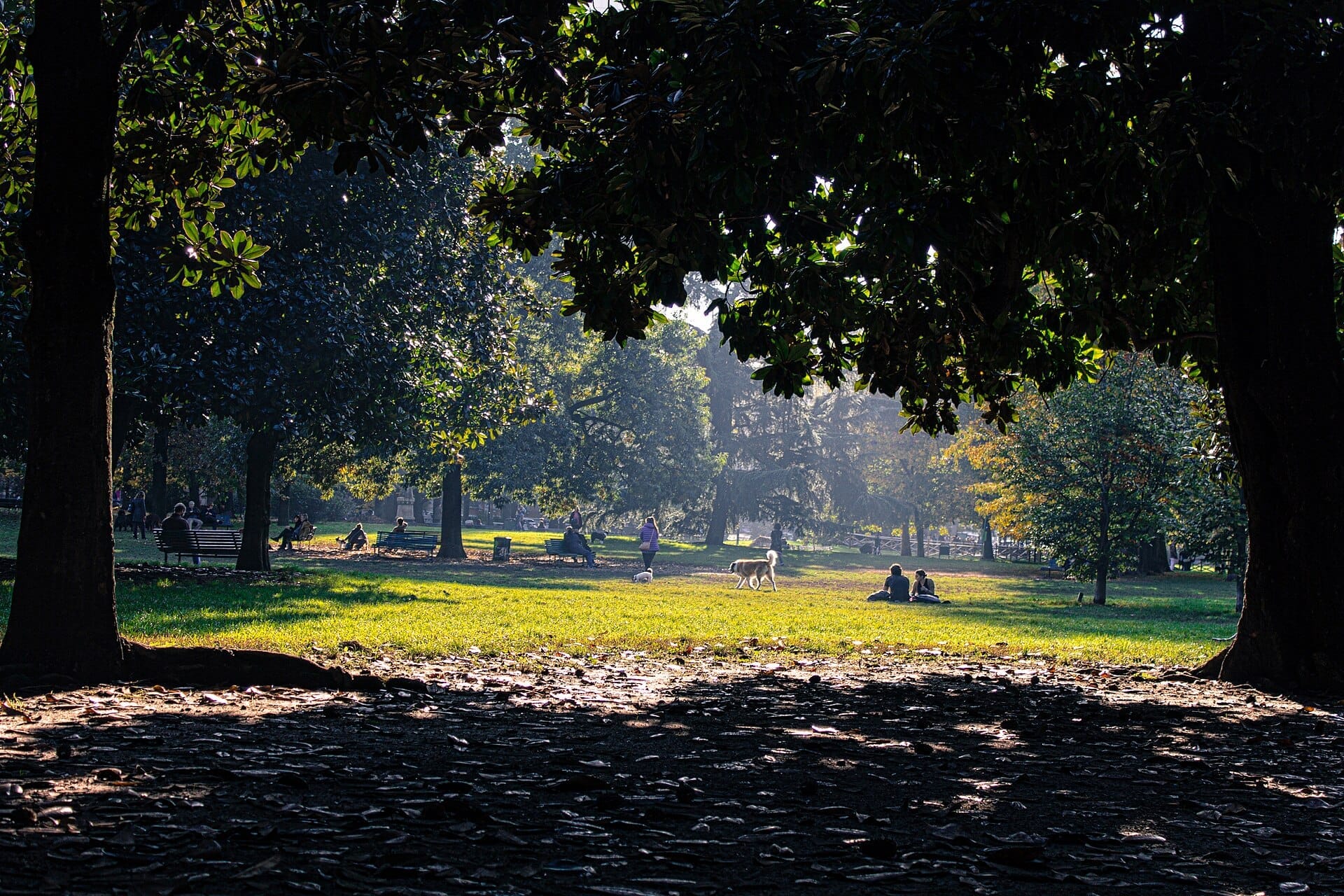
The Giardini Pubblici Indro Montanelli are Milan's oldest surviving public park, opened in 1784 under Habsburg rule as a deliberate act of civic planning. Architect Giuseppe Piermarini, the same man responsible for Teatro alla Scala, designed the grounds between 1782 and 1786 in the English landscape style that was fashionable across enlightened European courts at the time. The result is a 160,000-square-metre rectangle of controlled informality: winding gravel paths, a small artificial lake, gentle sculpted hillocks, and a narrow stream that crosses the interior.
The park was renamed in 2002 after Indro Montanelli, the Milanese journalist and founder of Il Giornale, whose statue now stands near the Via Palestro entrance. Before that, locals simply called it the Giardini Pubblici. Many still do. The name change was not without controversy, but the gardens themselves remained unchanged: a dense green block inserted into one of Milan's most architecturally coherent residential neighbourhoods.
ℹ️ Good to know
Entry is free and the park opens daily at 06:30. Closing time changes seasonally: 21:00 from October to April, 22:00 in May, and 23:30 from June to September.
How the Park Changes Through the Day
Early mornings belong to local residents. By 07:00, joggers are already working the outer perimeter path, older men play chess at the stone tables near the central lawn, and dog walkers navigate the gravel tracks before the heat builds. The light at this hour filters through the canopy of mature plane trees and chestnuts in long horizontal bands, and the air carries the faint scent of cut grass mixed with damp gravel. It is the quietest and most genuinely local the park ever feels.
By mid-morning on weekdays the tempo shifts. School groups arrive for the Museo Civico di Storia Naturale and the Planetario Ulrico Hoepli, both of which front the park on Via Palestro. The central paths become noticeably busier, particularly around the lake where children feed ducks and watch the small resident terrapins surface near the reeds. Benches fill up with people eating lunch between 12:30 and 14:00.
Weekend afternoons in spring and autumn are the peak visitor period. Families spread blankets on the lawns near the playground area, and the paths around the lake require some patience to navigate. If crowds are a concern, a weekday morning visit between April and June offers the best balance of good weather, green foliage, and manageable numbers. Summer weekends can feel crowded and the lack of shade on the central lawns becomes uncomfortable by early afternoon. Bring water.
Tickets & tours
Hand-picked options from our booking partner. Prices are indicative; availability and final rates are confirmed when you complete your booking.
Duomo Cathedral private tour with a local guide
From 105 €Instant confirmationFree cancellationSforza Castle entry and self-guided tour
From 15 €Instant confirmationFree cancellationSkip-the-line Duomo tour in Milan
From 40 €Instant confirmationFree cancellationNavigli Canals of Milan private walking tour with a local guide
From 40 €Instant confirmationFree cancellation
The Landscape and What to Look For
The park is not flat. Piermarini introduced a series of small artificial hills and a modest stream to give variety to what would otherwise be an entirely level site. The hills are subtle but enough to break sightlines, which is part of the English garden logic: the landscape should reveal itself gradually rather than all at once. The central lake, fed by the stream, anchors the design and provides the park's most photogenic corner, particularly from the small bridge on its northern side in early morning light.
The tree canopy is old and dense in places. Plane trees dominate along the main alleys, but there are also linden trees, magnolias, and a number of cedars that have grown large enough to provide shade over entire stretches of path. In late spring the magnolias near the Via Palestro entrance flower before the leaves fully open, producing a brief moment of colour against the neoclassical facade of the Natural History Museum behind them.
There is a children's playground toward the Bastioni di Porta Venezia edge, and a small carousel that operates on weekends and public holidays during the warmer months. The park also contains several sculptures and busts, including the Montanelli statue, though none are individually labelled with interpretive panels, so casual visitors will walk past most without context.
💡 Local tip
For photography, the lake and its bridge work best in the hour after opening when the light is low and foot traffic is minimal. The reflection of the surrounding trees in still water disappears once the wind picks up by mid-morning.
The Museums Inside and Alongside the Park
Three significant cultural institutions occupy or border the Giardini Pubblici, and they are worth factoring into any visit.
The Museo Civico di Storia Naturale sits on Via Palestro with a Lombardo-Gothic facade that makes it immediately recognisable. It holds extensive natural history collections including palaeontology, mineralogy, and zoology sections, and is one of the largest natural history museums in Italy. Admission is charged separately. The Museo di Storia Naturale di Milano is particularly suited to visits with children, and the combination of the museum and the outdoor space makes for a full half-day programme.
The Planetario Ulrico Hoepli, located inside the park near the Via Palestro side, is one of Europe's older operational planetariums, inaugurated in 1930. It runs projection shows on rotating schedules; check directly with the venue for current programming and ticket prices before your visit as these change seasonally.
On the Via Palestro side, the Galleria d'Arte Moderna (GAM) occupies the Villa Reale, a neoclassical palazzo built in 1790. The gallery holds 19th and early 20th century Italian and European art and is frequently overlooked in favour of larger Milanese institutions. Its courtyard garden alone is worth a pause. If your interest runs to contemporary art, the Museo del Novecento in Piazza del Duomo covers the 20th century with greater depth.
Getting There and Navigating the Area
The park sits in the Porta Venezia neighbourhood, one of Milan's most architecturally layered districts. The two closest metro stations are Palestro and Porta Venezia, both on the M1 red line. From either, the park is a one to two minute walk. Trams 1, 2, 9, 29, 30, and 33 also serve the surrounding streets if you are connecting from other parts of the city.
The main entrances are on Bastioni di Porta Venezia to the north, Via Daniele Manin to the west, Via Palestro to the south, and Corso Venezia to the east. The Via Palestro entrance is the most used and drops you directly opposite the Natural History Museum facade. The Bastioni di Porta Venezia entrance is wider and more useful if you are arriving with a stroller or bicycle.
Internal paths are primarily compacted gravel, not paved. Wheelchairs and strollers can manage the main arteries, but the sections near the artificial hills and around the lake perimeter become uneven and can be difficult after rain. Flat-soled shoes are more comfortable than sandals or heels for extended walking.
⚠️ What to skip
The gravel paths can be slippery after rain and become heavily tracked in winter. Avoid the area around the stream after prolonged wet weather as the ground stays soft for some time.
The Neighbourhood Context
The Giardini Pubblici did not appear in isolation. The entire Porta Venezia district developed significantly in the 19th century as a residential extension of the city, and the park was its green anchor. The streets immediately surrounding the gardens, particularly along Corso Venezia and Via Palestro, contain some of Milan's finest Liberty-style (Art Nouveau) architecture from the early 1900s. Casa Galimberti on Via Malpighi, a short walk from the park's north-west corner, is among the best preserved examples.
If you are building a half-day around this area, the gardens connect naturally to a walk south along Via Palestro toward Gallerie d'Italia on Piazza della Scala, or north into the Liberty architecture of the Porta Venezia streets. For a different kind of green space on the same visit, Orto Botanico di Brera is accessible by metro and offers a completely different, more intimate atmosphere.
The park is not the right choice for visitors specifically hunting Milan's design or fashion credentials. It is an everyday public space that happens to have significant historical depth. Visitors expecting the manicured drama of a formal Italian garden will find the English landscape style more understated than they anticipated. That is precisely what makes it feel distinctly Milanese rather than tourist-facing.
Insider Tips
- The benches facing the lake on its northern side get full afternoon shade from the plane trees, making them the coolest seats in the park during summer. Arrive before 11:00 to claim one on hot days.
- The Planetario Ulrico Hoepli runs Italian-language shows as standard. Check their current schedule for any English-language or multilingual sessions before building your visit around it.
- The park's perimeter along Corso Venezia offers some of the best views of the Liberty-era residential facades that line the street. Walking this edge after sunset in summer, when the trees are lit from the street lamps, is a different experience entirely from the daytime version.
- If you visit on a Sunday morning, the area around the children's carousel is significantly quieter before 10:00. After that, it becomes the most crowded corner of the park for the rest of the day.
- The Via Daniele Manin entrance on the western side is the least used and deposits you near the older, denser tree section of the park where noise from the surrounding streets drops noticeably.
Who Is Giardini Pubblici Indro Montanelli For?
- Families with young children combining outdoor space with a Natural History Museum visit
- Travellers who want a quiet morning walk away from the main tourist circuit
- Architecture and urban history enthusiasts interested in 18th-century landscape design and the surrounding Liberty district
- Photographers looking for reflective water and canopy light in an urban setting
- Anyone based in or around Porta Venezia needing a reliable green space for a midday break
Nearby Attractions
Other things to see while in Porta Venezia:
- Casa Galimberti & Liberty Architecture
Built between 1903 and 1905 by architect Giovanni Battista Bossi, Casa Galimberti is the most ornate surviving example of Italian Liberty style in Milan. Its façade, covered in roughly 170 square metres of fire-painted ceramic panels, wrought iron, and floral cement reliefs, can be viewed from the street for free at any hour. This guide explains what to look for, when to visit, and how it fits into the wider Porta Venezia neighbourhood.
- Museo di Storia Naturale di Milano
Built between 1888 and 1907 in a neo-Gothic palace inside Milan's oldest public gardens, the Museo civico di storia naturale di Milano holds one of Italy's largest natural history collections. Across 23 halls and roughly 5,500 square metres, it covers mineralogy, palaeontology, zoology, and more — and preserves almost three million specimens across its collections.