Casa Galimberti: Milan's Most Spectacular Liberty Façade
Built between 1903 and 1905 by architect Giovanni Battista Bossi, Casa Galimberti is the most ornate surviving example of Italian Liberty style in Milan. Its façade, covered in roughly 170 square metres of fire-painted ceramic panels, wrought iron, and floral cement reliefs, can be viewed from the street for free at any hour. This guide explains what to look for, when to visit, and how it fits into the wider Porta Venezia neighbourhood.
Quick Facts
- Location
- Via Marcello Malpighi 3, Porta Venezia, Milan 20129
- Getting There
- Metro M1 (Red Line) to Porta Venezia, then a short walk; Palestro on M1 is an alternative at similar distance
- Time Needed
- 15–30 minutes for the façade; 1–2 hours if walking the full Liberty circuit
- Cost
- Free — exterior viewing from the public pavement; no interior access
- Best for
- Architecture enthusiasts, photographers, design history walkers
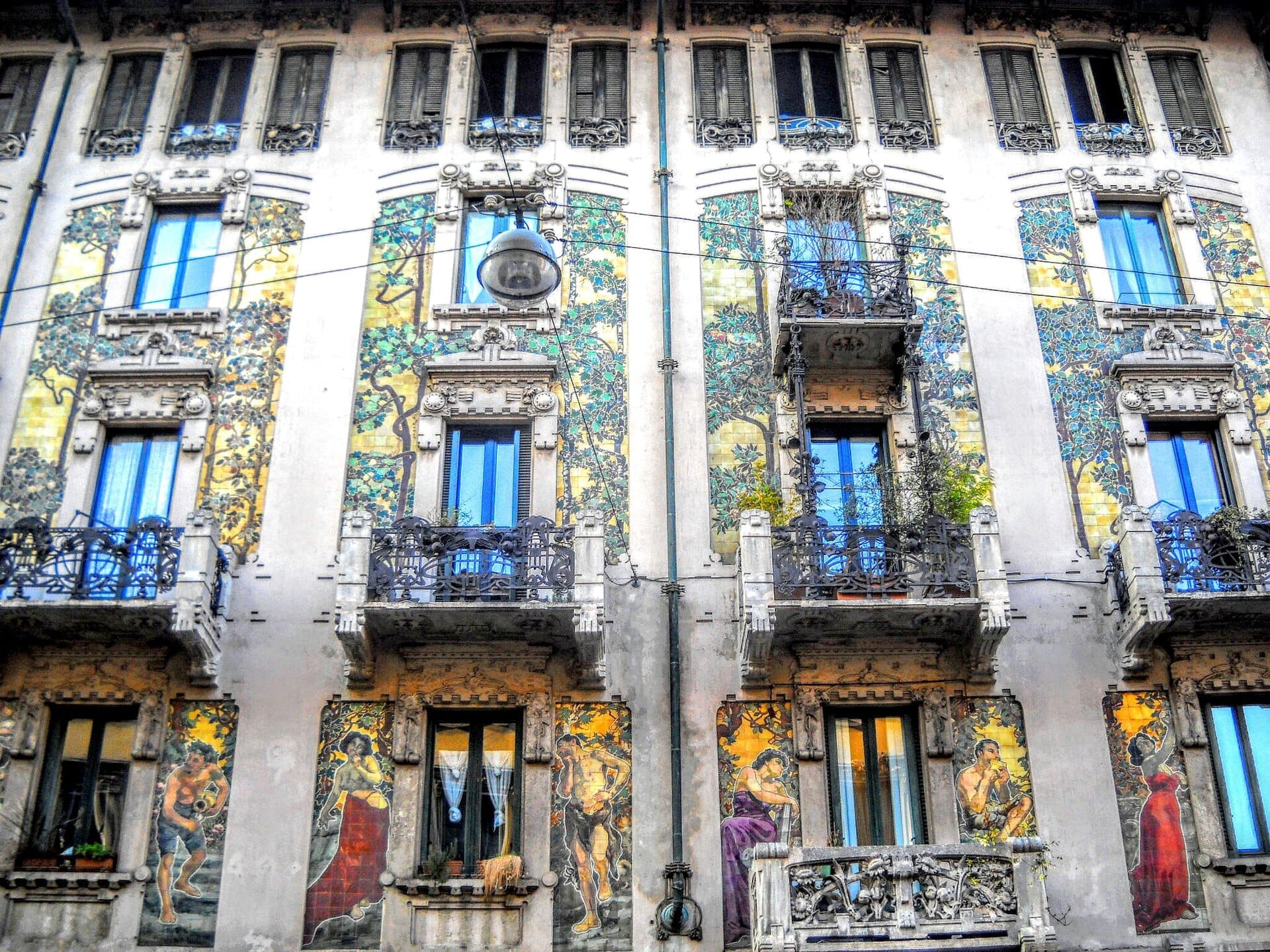
What Casa Galimberti Actually Is
Casa Galimberti is a residential palazzo on Via Marcello Malpighi, completed in 1905 to designs by architect Giovanni Battista Bossi and commissioned by the Galimberti brothers. It is not a museum, gallery, or public building. The interiors are private apartments, and there is no regular visitor access. What draws people here is entirely the exterior: a façade that covers approximately 170 square metres in fire-painted ceramic tiles, wrought iron balcony railings, and sculpted cement reliefs of flowers, female figures, and organic forms that climb every surface from ground-floor pilasters to the cornice line.
The Italian state placed the building under fine arts protection in 1965, recognising it as a work of significant cultural heritage. That designation matters practically: it means the façade cannot be altered or obscured, so what you see today is close to what Bossi intended when the building was new and Milan's Liberty movement was at its confident peak.
ℹ️ Good to know
The building is privately occupied. Entering the courtyard or lobby without permission from residents is not appropriate. Everything worth seeing is visible from the pavement on Via Malpighi.
The Architecture: What to Look For
Italian Liberty, the local interpretation of Art Nouveau, reached its height in Milan between roughly 1900 and 1915, driven by the city's rapid industrial expansion and a newly wealthy bourgeoisie eager to distinguish their buildings from Neoclassical convention. Bossi's design for Casa Galimberti is one of the most complete surviving examples of the style in the city: unlike some Liberty buildings where ornament is concentrated at the entrance or cornice, here decoration is essentially continuous across all four residential floors above the commercial ground level.
The ceramics are the first thing that registers. Bossi used fire-painted tiles to produce panels of stylised flowers, writhing plant stems, and female heads with flowing hair, rendered in ochres, deep greens, and cream whites that have aged with surprising consistency. At close range, the individual tiles are small and precisely painted; from the pavement across the street, they read as coherent pictorial panels framed by the building's structural grid. The wrought iron on the balconies continues the botanical vocabulary, with curling forms that echo the ceramic motifs rather than sitting in contrast to them. Cement reliefs fill the spaces between balcony brackets and window surrounds, adding low-relief texture that catches morning light differently from afternoon shadows.
The ground floor retains its original proportions and commercial function, with larger openings that anchor the decorative mass above. Bossi structured the upper floors so that each pair of windows is framed within a taller decorative unit, giving the façade a rhythm that prevents it reading as chaotic despite the density of ornament. Stand back to the opposite pavement on Via Malpighi near the corner where Casa Galimberti stands and the compositional logic becomes clear: the building is busy but not disordered.
Tickets & tours
Hand-picked options from our booking partner. Prices are indicative; availability and final rates are confirmed when you complete your booking.
Casa Milan: Mondo Milan Museum tickets
From 17 €Instant confirmationDuomo Cathedral private tour with a local guide
From 105 €Instant confirmationFree cancellationSforza Castle entry and self-guided tour
From 15 €Instant confirmationFree cancellationSkip-the-line Duomo tour in Milan
From 40 €Instant confirmationFree cancellation
How the Experience Changes by Time of Day
Morning light, especially on clear days between April and October, hits the façade from the east and brings out the warmth in the ochre and cream ceramic glazes. The tile surfaces have a slight sheen that activates in direct sunlight; shadows from balcony ironwork fall across the ceramic panels and create a secondary layer of pattern. If you are coming specifically to photograph the building, arrival before 10:00 in spring and summer gives you better light and noticeably fewer pedestrians. Via Malpighi is a residential street with modest foot traffic at most hours, but morning school runs and delivery vehicles do briefly congest the pavement.
By midday in summer the street is in partial shade and the colours flatten somewhat. Afternoon visits in autumn, when lower sun angles send warm light across the surface for longer into the evening, can be equally rewarding photographically. The building is illuminated at night by standard street lighting rather than dedicated architectural lighting, so nocturnal visits produce atmospheric but less detail-legible images.
💡 Local tip
Photography tip: The full width of the façade fits comfortably in a 24mm equivalent frame from the opposite pavement. For detail shots of individual ceramic panels, you will need to cross to the building's side of the street and use a standard or short telephoto lens.
Casa Galimberti in Context: The Porta Venezia Liberty Circuit
Casa Galimberti is most rewarding when visited as part of a longer walk through Porta Venezia, the district that contains the highest concentration of Liberty-era buildings in Milan. The neighbourhood developed rapidly after 1880 as the city expanded beyond its historic core, and the newly prosperous middle classes commissioned residential buildings that would announce their status. Several significant examples stand within a few minutes' walk of Via Malpighi.
Casa Guazzoni on Via Malpighi itself, designed by Giovanni Battista Bossi (often listed together with Casa Galimberti in tourism sources), offers another point of comparison on the same street. Corso Buenos Aires, a few blocks away, and the streets radiating from Piazza Oberdan contain further examples of the Liberty style at various levels of preservation. This is not a curated museum circuit with signage; you are reading the neighbourhood's building fabric directly, which is either its appeal or its limitation depending on what you want from a morning.
The Giardini Pubblici Indro Montanelli are a five-minute walk from Via Malpighi, making it natural to combine the architecture walk with time in the park. The Museo di Storia Naturale di Milano and the Villa Reale face the park's western edge, adding further layers to a half-day in the area.
Getting There and Practical Logistics
The simplest approach is Metro Line M1 (Red Line) to Porta Venezia station, then a walk of roughly five to eight minutes south along Corso Buenos Aires and left onto Via Malpighi. Palestro station, one stop west on M1, is approximately the same walking distance and may be preferable if you are combining the visit with the gardens or museums around Piazza Cavour. Tram and bus routes serving Corso Buenos Aires and Viale Piave provide alternative surface connections from the centre.
There is no entrance, no queue, and no ticket. You arrive, look at the building, and leave. Via Malpighi has pavement on both sides and is narrow enough that you are never far from the façade. The street has no dedicated viewing area or interpretive panels, so prior reading, which you are doing now, is the only way to understand what you are seeing.
💡 Local tip
The pavement directly in front of the building can be obstructed by parked motorcycles and bicycles. Cross to the opposite side of Via Malpighi for the clearest unobstructed view of the full façade.
Accessibility: the surrounding streets are level urban pavements with standard kerb drops at crossings, typical of central Milan. There are no steps required to view the exterior. In wet weather the pavement can be slippery near the building's base where ceramic ornament meets the ground. No toilets, cafés, or visitor facilities exist at or adjacent to the building itself; the nearest amenities are on Corso Buenos Aires.
Is It Worth the Detour?
Casa Galimberti is not a destination that works for everyone. It is a façade on a quiet residential street. You cannot enter, there is nothing to purchase, and the experience lasts fifteen minutes unless you are specifically interested in architectural ornament or urban history. Visitors who arrive expecting a museum experience, a guided narrative, or an interior will be disappointed.
For those with a genuine interest in Milan's architectural history, it is one of the most complete and accessible examples of the Liberty style anywhere in Italy, and the fact that it costs nothing and requires no booking makes it easy to include. The building rewards attention: the more time you spend looking, the more detail resolves. Ceramic panels that read as abstract from a distance reveal specific botanical species up close. The ironwork has visible hand-forging marks. The cement reliefs show the tooling of individual craftspeople working over a century ago.
If you are following a focused Liberty itinerary or have an hour free in Porta Venezia before a lunch reservation on Corso Buenos Aires, Casa Galimberti fits naturally. If you are on a short city break prioritising the Duomo, the Last Supper, or major museums, it is worth knowing about but not worth reorganising your schedule to reach.
Who Should Skip This
Travellers focused exclusively on interior cultural experiences, families with children looking for interactive programming, and visitors on tight itineraries who have not yet seen Milan's primary landmarks will find other places more rewarding per hour spent. The building is also less engaging in poor weather: rain flattens the ceramic colours and makes standing on the pavement to look upward uncomfortable. If your trip coincides with extended rain, prioritise covered attractions and return to the Liberty buildings on a clearer day.
Insider Tips
- The façade faces roughly southwest, meaning late afternoon light in spring and autumn grazes across the ceramic surfaces and brings out their texture most dramatically. If you can choose your timing, 16:00–17:30 between March and October is often the most visually rewarding window.
- Via Malpighi is short enough that you can walk its full length in two minutes. Do this before stopping to photograph: it lets you identify the best vantage points and note where vehicles are parked before you set up.
- Combine the visit with a walk along Corso Buenos Aires toward Piazza Oberdan. The stretch contains several other Liberty-era buildings at street level that most visitors miss entirely because they are looking into shop windows rather than upward.
- If you want architectural context without an organised tour, the Milan Archives website (milanarchives.wordpress.com) has detailed written analysis of Casa Galimberti's construction and ceramic programme that you can read before visiting; there is no equivalent information available on a plaque or panel at the site.
- The Giardini Pubblici Indro Montanelli, five minutes on foot, are a practical place to sit and review photographs or notes after visiting. In spring the park's tree canopy is a strong visual contrast to the dense ornament of the Liberty buildings.
Who Is Casa Galimberti & Liberty Architecture For?
- Architecture and design enthusiasts drawn to Art Nouveau and Italian Liberty style
- Photographers seeking ornate façades with strong ceramic colour and ironwork detail
- Walkers building a self-guided Liberty district itinerary through Porta Venezia
- Travellers with limited time who want a high-quality, zero-cost cultural stop
- Art historians and students researching early twentieth-century Italian urban architecture
Nearby Attractions
Other things to see while in Porta Venezia:
- Giardini Pubblici Indro Montanelli
Dating to 1784, the Giardini Pubblici Indro Montanelli are Milan's first public park, covering 160,000 square metres near Porta Venezia. Free to enter and open daily from early morning, they offer shaded paths, a small lake, and access to three museums, all a short walk from the city centre.
- Museo di Storia Naturale di Milano
Built between 1888 and 1907 in a neo-Gothic palace inside Milan's oldest public gardens, the Museo civico di storia naturale di Milano holds one of Italy's largest natural history collections. Across 23 halls and roughly 5,500 square metres, it covers mineralogy, palaeontology, zoology, and more — and preserves almost three million specimens across its collections.