Geological Museum of China: Dinosaurs, Crystals, and Deep Time in Xicheng
The Geological Museum of China is one of the country’s oldest national geology museums, founded in 1916. Tucked inside a hutong in Xicheng District, it houses spectacular mineral specimens, dinosaur fossils, and ancient rocks that tell the story of Earth across billions of years — all for an admission price that makes it one of Beijing's most underrated museum stops.
Quick Facts
- Location
- No. 15 Yangrou Hutong, Xisi, Xicheng District, Beijing
- Getting There
- Line 4, Xisi Station; buses 3, 13, 22, 38, 42, 88, 105, 409 to Xisi Lukoubei
- Time Needed
- 1.5 to 2.5 hours
- Cost
- ¥15 adults; free or discounted admission varies by eligibility, including qualifying students, seniors, children, disabled visitors, and military personnel
- Best for
- Science lovers, families with children, fossil enthusiasts, budget travelers
- Official website
- http://www.gmc.org.cn
Why the Geological Museum of China Deserves Your Attention
The Geological Museum of China (中国地质博物馆) is not the kind of place most first-time visitors to Beijing seek out. That is precisely what makes it worth your time. While tour groups queue at the Forbidden City and photo-takers crowd Tiananmen Square, a short walk from Xisi subway station leads you into one of Asia's most significant earth-science collections — founded in 1916, long before most of Beijing's headline attractions were opened to the public.
The museum holds over 200,000 specimens in its permanent collection, ranging from 4-billion-year-old Archean rock samples to the bones of dinosaurs that roamed what is now Chinese territory. At ¥15 for a standard adult ticket, it offers extraordinary value. The visitor demographic tells the story: school groups with clipboards on weekday mornings, geology students photographing mineral specimens, and families with young children who make a beeline for the dinosaur hall. If your travel companions include curious kids or anyone with even a passing interest in natural history, this museum moves easily into a morning itinerary.
💡 Local tip
Last entry is at 16:00, and the museum closes at 16:30. Plan your visit with enough time to see the galleries you want without feeling rushed. The museum is closed on Mondays, except during national statutory holidays.
What You Actually See Inside
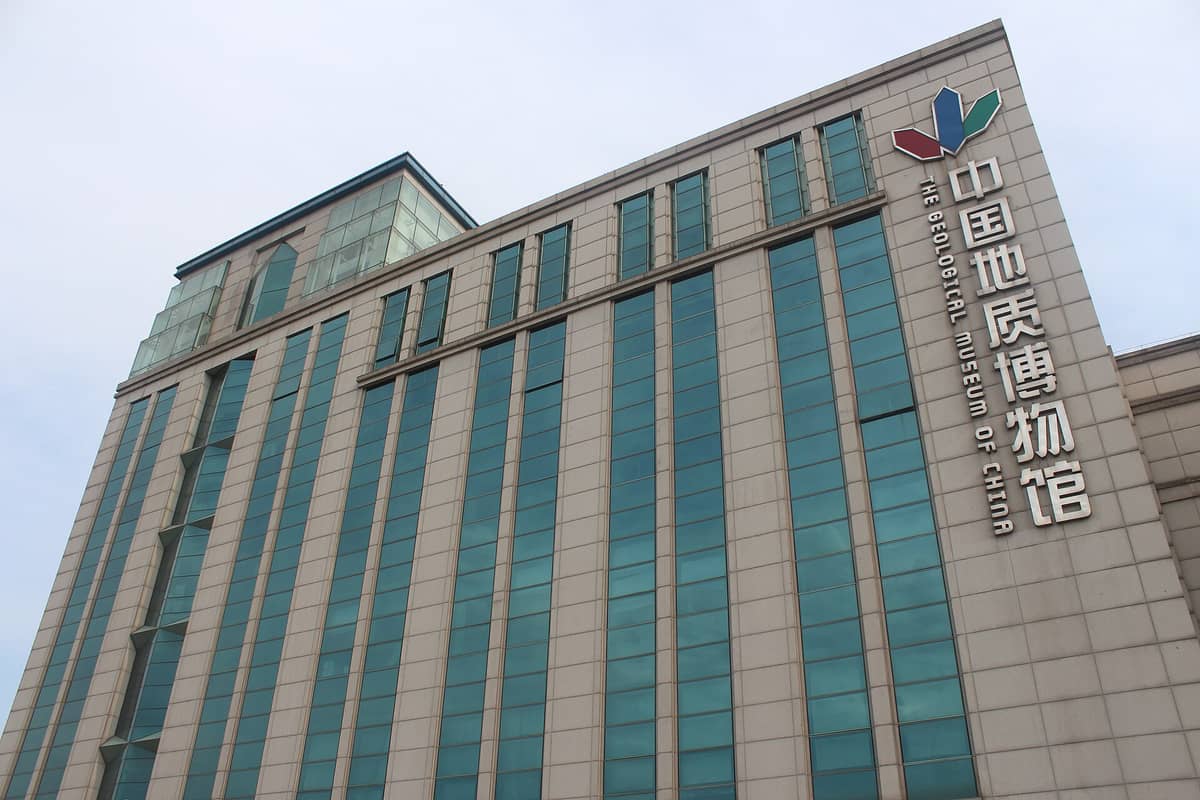
The building is a mid-20th-century institutional structure with large exhibition halls spread across multiple floors. It is not a sleek, internationally renovated museum space, and the display design in some sections is functional rather than immersive. That said, the specimens on show are genuinely impressive on their own terms.
The ground floor mineral hall is the visual centrepiece. Cases and open platforms display crystals of extraordinary scale: amethyst geodes as tall as a person, tourmaline clusters in deep greens and pinks, and fluorite specimens that seem to glow under the hall lighting. The star of the room, frequently cited by visitors, is a massive smoky quartz crystal cluster that weighs several hundred kilograms. The textures here are tactile even when you cannot touch them — the faceted geometry of calcite formations, the silky lustre of selenite, the raw mass of malachite nodules.
The dinosaur and paleontology halls occupy a central position in the exhibition. Skeletal mounts include large sauropod specimens, and the fossil displays cover everything from ancient marine invertebrates to Mesozoic flora. For visitors who have already seen the paleontology holdings at the National Museum, these galleries feel more specialized and quieter, which makes them easier to appreciate at your own pace.
Upper floors address China's geological resources: ore deposits, petroleum geology, and the structural makeup of the Chinese landmass. This section draws a more specialist audience — students and professionals rather than general visitors — but the physical samples and cross-section models are genuinely instructive even without deep prior knowledge. Label text is in Chinese, with some English translation, though coverage varies by gallery.
Tickets & tours
Hand-picked options from our booking partner. Prices are indicative; availability and final rates are confirmed when you complete your booking.
Early start guided tour to the Great Wall at Mutianyu
From 355 €Instant confirmationFree cancellationIndependent tour to Jinshanling Great Wall with digital guidebook
From 237 €Instant confirmationFree cancellationOriginal section of Great Wall at Jinshanling full day tour
From 361 €Instant confirmationFree cancellationJuyongguan Great Wall and in-depth tour of Ming Tombs
From 331 €Instant confirmationFree cancellation
How Crowds and Light Change the Experience
Weekday mornings between 09:00 and 11:30 are the quietest window. The mineral hall in particular benefits from low foot traffic: you can stand directly in front of the largest specimens without navigating around groups, and the overhead lighting catches crystal faces at angles that photographs can rarely replicate. By 13:00 on weekends, the ground floor fills with families and the ambient noise level rises considerably.
Natural light plays a limited role inside the building, but the entrance courtyard and the approach through Yangrou Hutong have their own rhythm. In spring and autumn, the hutong itself is pleasant to walk — narrow enough to feel removed from the main Xisi intersection traffic, with the low-rise residential buildings giving a sense of the older fabric of Xicheng that survives around larger institutions.
ℹ️ Good to know
The museum's label text is primarily in Chinese. Some galleries offer English translations, but not all. If reading exhibit text is important to you, consider downloading a translation app before your visit or preparing a few geological terms in advance.
Historical and Scientific Context
The Geological Museum of China was established in 1916, making it one of the earliest geological museums in modern Chinese history. It has functioned both as a public education institution and as a repository for geological specimens collected over more than a century.
This history gives the collection unusual depth. Many of the specimens on display were collected from Chinese geological expeditions in the early and mid-20th century — including finds from regions like the Tibetan Plateau, Inner Mongolia, and the carbonate formations of southern China. For anyone following up a visit with a trip to a site with geological significance, such as the Peking Man Site at Zhoukoudian, the museum provides useful scientific framing for what you'll encounter in the field.
The museum is administered under China's Ministry of Natural Resources and functions as a national research institution alongside its public exhibition role. This dual function means the collection is maintained to a research standard, which shows in the labelling precision for mineral specimens even when the broader exhibition design lags behind more commercially oriented museums.
Getting There and Practical Logistics
The museum sits in Xicheng District, one of Beijing's two historic central districts. The address is No. 15 Yangrou Hutong, Xisi. The most straightforward option is Xicheng District's own Line 4 at Xisi Station, a short walk from the hutong entrance. Bus routes 3, 13, 22, 38, 42, 88, 105, and 409 stop at Xisi Lukoubei.
The hutong approach means the museum is not immediately visible from the main road. Walk south from the Xisi intersection and look for signage directing you into the alley. The museum entrance is set back from the street and is modest by major-institution standards — a detail worth knowing so you do not walk past it.
Opening hours are Tuesday through Sunday, 09:00 to 16:30, with the last admission at 16:00. The museum closes on Mondays except during statutory holidays. Verify closure dates around Golden Week and other public holidays before visiting.
⚠️ What to skip
Accessibility details for wheelchair users, step-free routes, and lift availability are not comprehensively listed in the museum's current official information. If accessibility is a requirement, contact the museum directly or check the official site at www.gmc.org.cn before visiting.
Photography and What to Bring
The mineral hall is the best photography subject in the building. The large crystal specimens are lit from above and from below in several cases, which creates useful contrast on faceted surfaces. A phone camera with a portrait or macro mode handles close-up crystal details reasonably well. For the dinosaur skeletons, wider focal lengths work better given the hall dimensions. Flash is typically prohibited in museum settings, so adjust your exposure settings before entering.
If you plan a wider photography day in Beijing, the Beijing photography guide covers lighting conditions and restrictions at major sites across the city, which can help you plan your route efficiently.
There is no cloakroom or locker facility prominently listed. Bring only what you need for a two-hour visit. A bottle of water is advisable, particularly in summer when air conditioning in older institutional buildings can be uneven. There is no significant food offering on site, so plan your meal timing around the visit.
Is This Attraction Worth Your Time?
Honestly assessed: the Geological Museum of China is excellent for science-curious visitors, families with children aged six and above, and anyone who appreciates natural history at a serious level. The mineral collection alone justifies the ¥15 admission and a 90-minute visit. The dinosaur halls hold up well against comparable displays in larger cities.
Visitors primarily interested in Chinese history, imperial architecture, or cultural heritage may find this museum less engaging than alternatives in the same district. If that is your focus, the nearby Capital Museum covers Beijing's urban and cultural history in a larger, more recently renovated space. Travelers on a tight itinerary who cannot accommodate both should decide based on whether earth sciences or human history is the more compelling subject.
The museum pairs well with a morning or afternoon in the surrounding Xicheng neighborhood. After your visit, the Shichahai lakes area is reachable by a 20-minute walk northward, or you can explore the quieter hutong lanes between Xisi and Fuchengmen at a relaxed pace. If you are planning a broader itinerary, the best museums in Beijing guide can help you sequence this stop alongside other major collections.
Insider Tips
- The smoky quartz cluster in the mineral hall is the single most photographed object in the museum. Visit on a Tuesday or Wednesday morning to photograph it without other visitors in frame.
- Admission concessions vary by eligibility; bring valid identification if you are claiming a discount or exemption.
- The hutong approach along Yangrou Hutong is genuinely worth slowing down for. The residential lane gives you a micro-dose of Xicheng's older urban texture before you enter the institutional building.
- Some of the geological resource galleries on the upper floors have English-language printed booklets available at or near the entrance to each section. Ask staff if you do not see them displayed.
- If you are visiting with children, spend extra time in the ground-floor mineral hall before moving upstairs. The large crystal specimens hold attention far longer than the educational resource displays on higher floors, and starting with the most visually dramatic material keeps younger visitors engaged.
Who Is Geological Museum of China For?
- Families with school-age children who respond well to fossils and oversized crystals
- Budget travelers wanting a substantive museum experience for ¥15
- Natural history and earth science enthusiasts at any level
- Visitors pairing a Xicheng half-day with the hutong neighborhood experience
- Travelers building an itinerary around Beijing's less-visited national-level institutions
Nearby Attractions
Other things to see while in Xicheng District:
- Beihai Park
Beihai Park is one of Beijing's oldest and best-preserved imperial gardens, covering roughly 69 hectares with more than half the area given over to a large lake. Dating back over a thousand years, it offers a rare mix of imperial architecture, Buddhist monuments, and open green space within walking distance of the Forbidden City.
- Beijing Planetarium
Beijing Planetarium (北京天文馆) is located in Xicheng District near Beijing Zoo. It runs dome theater shows, 3D and 4D screenings, and permanent science exhibitions across two buildings. Here's what a visit actually looks like.
- Beijing Zoo
Beijing Zoo is one of China's oldest and largest zoological parks, covering over 80 hectares in Xicheng District. Home to the city's most accessible giant panda viewing experience, it draws millions of visitors each year. This guide covers what to expect, when to go, and how to make the most of your time there.
- Capital Museum
The Capital Museum (首都博物馆) in Xicheng District is Beijing's premier civic museum, tracing the city's history across three millennia. Admission is free, the permanent galleries are genuinely impressive, and it rarely gets as crowded as the Forbidden City — making it one of the smartest stops in central Beijing.