Gamla Stan and Stortorget: Inside Stockholm's Medieval Old Town
Gamla Stan is the historic island at the heart of Stockholm, where the city was founded in the 13th century. Its central square, Stortorget, is the oldest in Stockholm and carries a weighty past. The entire district is free to explore and open at all hours, making it one of the most rewarding walks in Scandinavia.
Quick Facts
- Location
- Stadsholmen island, central Stockholm (Gamla Stan neighborhood)
- Getting There
- Metro: Gamla stan station (Green & Red lines), then 5-10 min walk to Stortorget. Buses 2, 57, 76 and SL ferries to Slussen.
- Time Needed
- 2-4 hours for a thorough walk; longer if you stop at museums or restaurants
- Cost
- Free to enter — Gamla Stan and Stortorget are public spaces open 24/7
- Best for
- History lovers, photographers, first-time Stockholm visitors
- Official website
- www.visitstockholm.com/areas/gamla-stan
What Gamla Stan Actually Is
Gamla Stan, officially occupying the island of Stadsholmen along with the smaller islets of Riddarholmen, Helgeandsholmen, and Strömsborg, is the original core of Stockholm. The city grew here in the 13th century, squeezed between Lake Mälaren to the west and the Baltic inlet of Saltsjön to the east. The name translates simply as 'Old Town,' and it earns that plainness: this is not a reconstructed heritage zone or a themed quarter, but a continuously inhabited urban district where people have lived, worked, and died for roughly 800 years.
The street layout has changed remarkably little since the medieval period. Alleyways called 'gränder' cut between the main lanes at angles that reflect medieval property lines, not any modern planning logic. Walking off Västerlånggatan into a passage barely wide enough for two people to pass sideways is not a scenic detour — it is the actual street plan of a 13th-century Scandinavian trading town. That authenticity is what separates Gamla Stan from most European old towns that have been partly rebuilt or heavily restored.
Gamla Stan sits at the geographic and historical center of Stockholm, connecting the northern districts of Norrmalm with the southern island of Södermalm. For a broader orientation to the city before or after your visit, the one-day Stockholm itinerary places Gamla Stan in useful sequence with other central landmarks.
Stortorget: Stockholm's Oldest Square
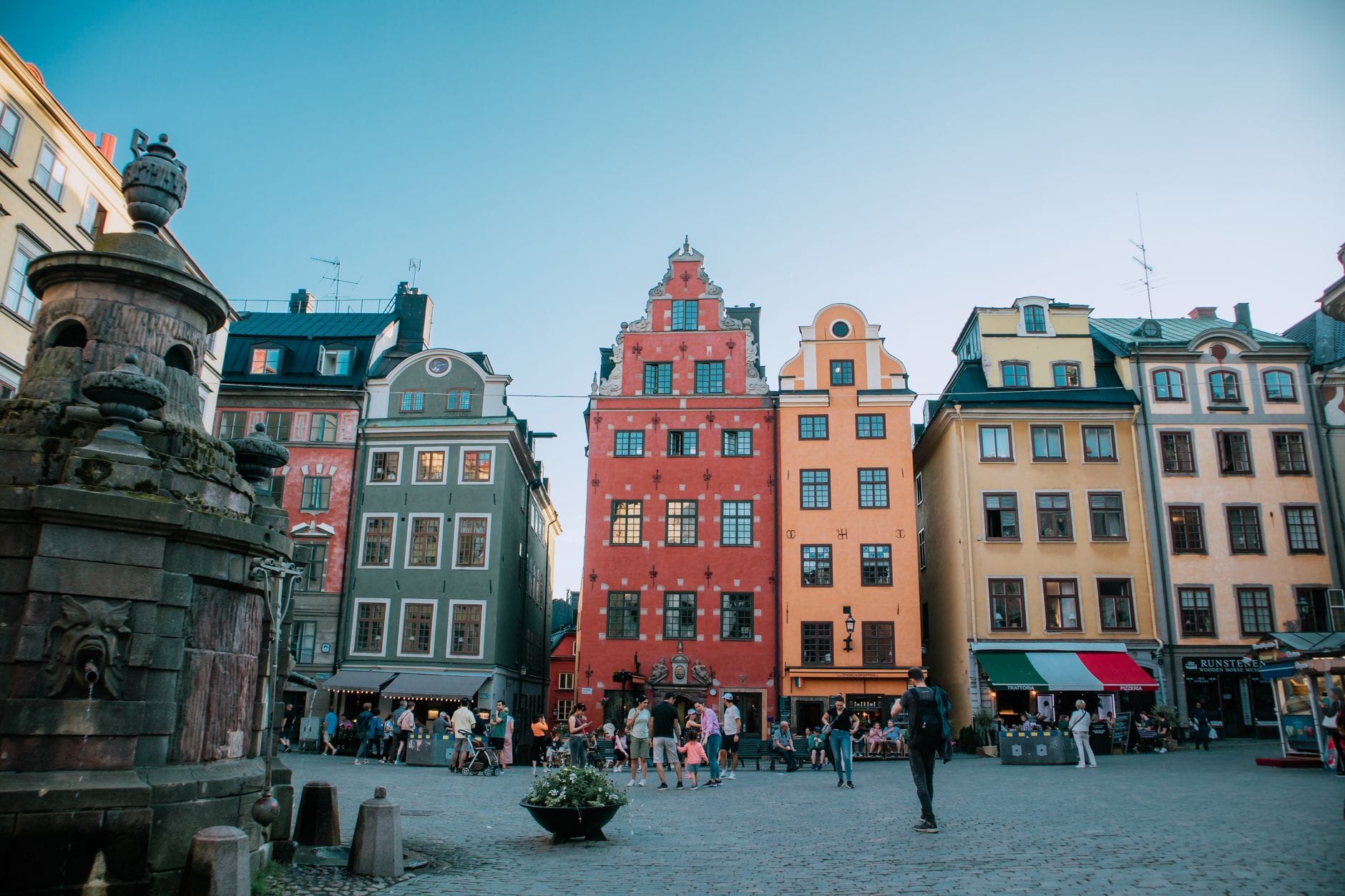
Stortorget, meaning 'the Great Square,' is the focal point of any walk through Gamla Stan. It dates to the mid-13th century, making it Stockholm's oldest public square. The buildings ringing it are painted in deep ochre, copper red, and faded yellow, their facades a mix of medieval foundations and later Baroque remodeling. The square is compact, perhaps 60 meters across at its widest, and enclosed enough that you hear conversations from the far side clearly.
The well at the center of the square is a 19th-century reconstruction of the original, and the buildings that surround it include the Nobel Museum, housed in the former Stock Exchange (Börsen), which dates to the 18th century. The physical atmosphere of Stortorget is unlike the grand plazas of southern Europe — there are no fountains, no wide promenades, and the proportions are intimate rather than monumental. Pigeons occupy it year-round, and in winter a Christmas market sets up stalls that fill the square with the smell of glögg and roasted almonds from late November through late December.
ℹ️ Good to know
Stortorget was the site of the Stockholm Bloodbath in November 1520, when Danish King Christian II ordered the execution of approximately 90 Swedish nobles, clergy, and citizens. The event shocked European courts and directly triggered the uprising that led to Swedish independence in 1523. Standing in the square, the scale of that event relative to the physical space makes it feel immediately concrete.
The Nobel Museum on the north side of Stortorget is the logical indoor extension of a walk through the square. It charges admission and requires separate planning, but even if you skip the interior, the building's facade and the square it anchors are worth extended time.
Tickets & tours
Live prices and dates from our booking partner. If you book, we may earn a commission at no extra cost to you.
Stockholm Old Town private walking tour
From 31 €Instant confirmationFree cancellationStockholm city tour with private driver and Vasa Museum
From 172 €Instant confirmationFree cancellationSwedish royal castle public tour
From 264 €Instant confirmationFree cancellationStockholm City Daytime Kayak Tour
From 83 €Instant confirmationFree cancellation
How the District Feels at Different Times of Day
Early morning is categorically the best time to walk Gamla Stan's narrower streets. Before 9am on weekdays, and before 10am even on summer weekends, the main thoroughfare of Västerlånggatan is largely empty. The cobblestones are damp from overnight cleaning, the light comes in low and angled from the east, and the sounds are mostly pigeons and distant tram bells. The scale of the alleyways becomes apparent when there are no crowds to distract from the architecture.
By mid-morning in July or August, Gamla Stan is among the most crowded places in Stockholm. Tour groups occupy Stortorget, souvenir shops on Västerlånggatan prop open their doors, and the narrower lanes become slow-moving single files. This is not necessarily unpleasant, but it does change the character of the place significantly. If your goal is photography or a sense of how the streets actually work spatially, late afternoon in shoulder season (May, September) or winter is far more rewarding.
At dusk, particularly in winter when darkness falls by 3:30pm, Gamla Stan takes on a different quality. The street lamps are old-style lanterns, the stone buildings absorb and reflect warm orange light, and the tourist crowds have thinned considerably. This is the most atmospheric hour to walk the main square and the smaller lanes off Österlånggatan. Restaurants fill up during this window, so if you want to eat in the neighborhood, book ahead or arrive by 6pm.
💡 Local tip
Winter or late autumn visits reward early arrivals. By 8am, the square is almost entirely yours. By 11am, tour groups from cruise ships docked at Stadsgårdshamnen have arrived in full. The difference in experience is significant.
Walking the Streets: A Practical Route
Coming from Gamla stan metro station, most visitors emerge on the northern side of the island and walk south along Stora Nygatan or Västerlanggatan. Västerlånggatan is the wider, more commercial street and gets crowded. Österlånggatan, running parallel on the eastern side of the island, is quieter, with fewer souvenir shops and more independent restaurants and design stores. Both eventually lead to Stortorget, which sits roughly in the center of the island.
The lanes between these two main streets are where Gamla Stan becomes genuinely interesting. Prästgatan is the most intact medieval street on the island and runs almost the full length of the district north to south. Mårten Trotzigs Gränd, branching off from Västerlånggatan near the southern end, is widely regarded as the narrowest street in Stockholm at roughly 90 centimeters wide at its tightest point. It connects to Järntorget, a smaller square at the southern tip of the island that sees far fewer visitors than Stortorget.
From Gamla Stan you can cross west onto Riddarholmen, a quieter islet dominated by Riddarholmen Church, the burial place of Swedish monarchs. It's a five-minute walk and offers views back toward Stadsholmen as well as across the water toward Kungsholmen and Stockholm City Hall. Most visitors skip Riddarholmen entirely, which is a genuine oversight.
The Stockholm Royal Palace sits at the northern tip of Gamla Stan and is technically a separate attraction with its own admission structure and hours. It's covered in detail on the Stockholm Royal Palace page. Budget additional time if you plan to go inside.
Accessibility and Practical Logistics
Gamla Stan presents genuine accessibility challenges. The cobblestones throughout the district are uneven and can be slippery when wet or icy. Most of the narrower lanes have no smooth path alternative. Stortorget itself has a roughly level surface with some unevenness, and the main streets are manageable for most mobility aids but not ideal. Visitors using wheelchairs or with significant mobility limitations should plan routes carefully and may find the main streets navigable while the side lanes are not.
In winter, ice is a serious consideration. The cobblestones become treacherous after freezing rain or snow, and the tourist infrastructure for winter maintenance is less consistent than in major pedestrian zones elsewhere in central Stockholm. Shoes with grip are genuinely important from November through March.
⚠️ What to skip
Pickpocketing occurs in Gamla Stan, particularly around Stortorget during peak summer months when crowds are dense. Keep bags closed and front-facing in busy areas. This is not a uniquely dangerous neighborhood, but it is the most tourist-dense part of Stockholm and attracts the attention that comes with that.
Gamla Stan and Stortorget are free, public, and open 24 hours. There is no ticket, no gate, and no defined entrance. You can walk through at any hour. The nearest public toilets are at Gamla stan metro station and at various cafes throughout the district (most require a small purchase).
What Gamla Stan Is Not
Gamla Stan's main commercial street, Västerlånggatan, is lined with souvenir shops selling Viking helmets, ABBA merchandise, and Dala horse figurines. This stretch is genuinely crowded in summer and can feel more like a shopping mall corridor than a medieval street. Travelers seeking a quiet, contemplative old-town experience during July or August are likely to be disappointed on this particular road. The atmosphere improves significantly one block east or west.
Restaurants in Gamla Stan carry a significant tourist premium. A lunch that costs 150-180 SEK in Södermalm might run 200-250 SEK or more in the same category here. Quality varies widely. The area rewards exploration for its architecture and history, but is not the neighborhood Stockholm residents typically recommend for food value. If budget is a concern, eat elsewhere and return for an evening walk.
Visitors on a tight budget will find detailed guidance in the free things to do in Stockholm guide, which covers Gamla Stan alongside other no-cost options across the city.
Photography and the Square in Different Seasons
Stortorget is one of the most photographed places in Sweden. The classic angle is from the south end of the square looking north toward the Nobel Museum, with the row of colored facades framing the shot. This photograph is taken by thousands of people daily in summer. For something less standard, the eastern side of the square looking southwest in late afternoon light, or the view up Källargränd from Stortorget's southeastern corner, produce more unusual results.
The Christmas market in Stortorget, running from late November to late December, transforms the square with wooden stalls, string lights, and a tree at the center. This is one of the more authentic-feeling Christmas markets in Stockholm, partly because the physical backdrop of the square gives it genuine context. It draws large crowds on weekends but is calmer on weekday mornings. For more options during the holiday season, the broader guide to Stockholm Christmas markets covers several locations.
If your interest in Stockholm's architecture extends beyond Gamla Stan, the Stockholm metro art offers a very different but equally compelling example of how the city treats public space as a visual experience.
Insider Tips
- Walk Prästgatan from north to south rather than Västerlånggatan. It's the more complete medieval street and rarely appears in guidebooks despite being the spine of the island's historic fabric.
- Cross over to Riddarholmen via the small bridge at the western end of Gamla Stan. The church there is one of the oldest buildings in Stockholm and the view back across the water to the Old Town is better than anything you'll find within the district itself.
- The square is at its most photogenic in winter, not summer. Snow on the colored facades and lantern light at 4pm produces images that look nothing like the standard summer postcards.
- Järntorget, the smaller square at the southern end of the island, has cheaper cafes and fewer tourists than anywhere near Stortorget. It's a useful place to stop and reset mid-walk.
- If you arrive via Slussen rather than the metro station, enter the island from the south through Järntorget and walk north toward Stortorget. You encounter the quieter end first and arrive at the main square having already oriented yourself in the street plan.
Who Is Gamla Stan: Stortorget & the Medieval Streets For?
- First-time visitors to Stockholm who want to understand the city's origins in one walk
- History-focused travelers with an interest in medieval Scandinavian urban structure or the political history of the Stockholm Bloodbath
- Photographers working in early morning or low winter light
- Visitors combining Gamla Stan with the Royal Palace, Nobel Museum, or Riddarholmen Church in a single half-day
- Travelers visiting in winter who want a Christmas market with genuine architectural context
Nearby Attractions
Other things to see while in Gamla Stan:
- German Church (Tyska Kyrkan)
Tucked into the medieval street grid of Gamla Stan, Tyska Kyrkan (the German Church, officially Saint Gertrude's Church) is one of Stockholm's most architecturally striking religious buildings. Built between 1638 and 1642 for the city's German-speaking merchant community, it rises 96 metres above the Old Town rooftops and rewards visitors who seek it out with elaborate Baroque interiors elaborate Baroque interiors in a quieter corner of Gamla Stan.
- Nobel Museum
Housed in Gamla Stan's 18th-century Stock Exchange Building, the Nobel Prize Museum brings over a century of human achievement to life through exhibits on laureates, Alfred Nobel's life, and the prize itself. It is thoughtful, compact, and genuinely moving for curious visitors.
- Riddarholmen Church
Riddarholmskyrkan is one of Stockholm's oldest preserved churches and the burial place of many Swedish monarchs from the medieval era through the 20th century. Standing on its own small island just west of Gamla Stan, it is one of the most historically significant buildings in Sweden.
- Stockholm Royal Palace
The Royal Palace of Stockholm is one of the largest working royal palaces in the world, a colossal Baroque structure sitting at the heart of Gamla Stan. With over 600 rooms spread across multiple museums and state apartments, it rewards visitors who know what to prioritize and when to show up.
Planning a trip? Discover personalized activities with the Nomado app.